
A practical volume comparison without invented factory pricing.
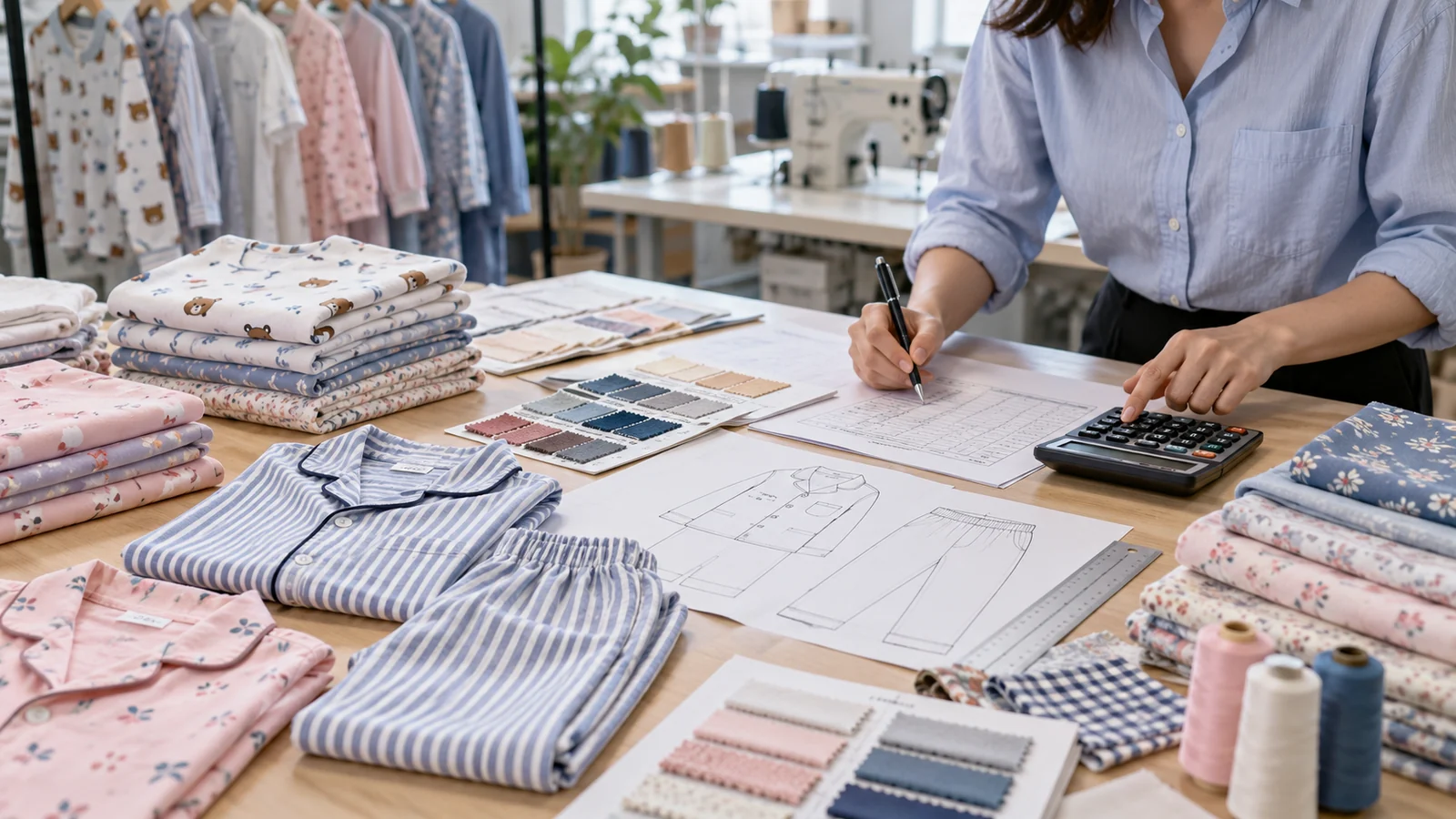
Kids pajamas manufacturing cost changes with order volume, fabric consumption, print setup, garment construction, testing and packaging.
A factory quote for 500 children’s pajama sets cannot be scaled to 3,000 sets simply by multiplying it by six. Material utilization, print setup, cutting batches, fixed development work, labels and compliance costs behave differently across volumes. This guide explains how to create a useful quantity-based quote comparison without inventing a universal factory price.
On this page
- 1. Define a fixed comparison specification
- 2. Understand the components of a kids pajamas manufacturing cost quote
- 3. Why 500 sets can cost disproportionately more
- 4. Why 1,000 sets may be a useful middle ground
- 5. Why 3,000 sets are not always the smartest order
- 6. Sample calculation: fixed cost allocation only
- 7. Add landed costs in a second worksheet
- 8. Ask for three quote formats
- 9. Protect quality when negotiating price
- Build a sensitivity model before choosing the order size
- Distinguish a discount from a specification change
- Quote-request worksheet: what to ask the factory to fill in
- Frequently asked questions
1. Define a fixed comparison specification
Before asking for volume discounts, freeze the garment type, intended use, sizes, knit type, fabric weight, fiber percentages, print, trims, labels, packaging and destination market. Otherwise a low-price option may use thinner material, fewer sizes or less inspection. Your baseline should include an approved sample or a complete tech pack.
Example comparison brief: two-piece long-sleeve knit pajama set, one approved print, specified size breakdown, defined seam/elastic/neck treatment, individual packaging and carton standard. This is not a published Nuohua quote; the supplier must confirm feasibility for your order.
2. Understand the components of a kids pajamas manufacturing cost quote
| Cost component | Usually scales with quantity? | Buyer question |
|---|---|---|
| Main fabric | Largely variable | Does fabric consumption include cutting waste and all sizes? |
| Sewing/CMT | Variable; may improve with line efficiency | Are quality checkpoints constant? |
| Print setup | Often has a fixed component | Does each colorway require a separate setup or fabric minimum? |
| Labels and packaging | Variable plus order/setup minimums | What happens to unused custom labels? |
| Sampling/development | Mainly fixed for an approved design | Which revisions are included? |
| Product testing/certification | Depends on regulations, groups and change scope | Who pays, who owns reports, what must be retested? |
| Inspection and freight | Variable/stepwise | Which Incoterm and shipping mode are included? |
3. Why 500 sets can cost disproportionately more
At 500 sets, you may divide a fabric print setup, sample development and packaging minimum over fewer garments. The total order can also fall below the mill’s minimum for a new fabric or custom color. Some suppliers can offer a 500-set program using available material, but not the same specification as a larger custom-mill order. Ask them to identify substitutions instead of presenting them as equivalent.
4. Why 1,000 sets may be a useful middle ground
At 1,000 sets, development charges are distributed over more units while inventory exposure remains lower than at 3,000. However, this only works if the per-print and size allocations align with production minimums. For example, 1,000 total sets split over five colors equals 200 per color; that could be less efficient than two colors at 500 each. The correct negotiating unit may be fabric color or print, not the headline total quantity.
5. Why 3,000 sets are not always the smartest order
Higher-volume runs can create better material pricing and production efficiency, but they tie up more working capital and increase the impact of an incorrectly chosen print or size curve. A low unit cost is not a savings if unsold sets need deep markdowns or long-term storage. Compare expected demand, sell-through timing, reorder capability and channel fees before committing.
6. Sample calculation: fixed cost allocation only
To illustrate the mechanism, assume a hypothetical fixed development and artwork expense of $900 shared across a single approved design. This number is not a real quoted Nuohua fee and excludes materials, sewing, testing, packaging and freight.
| Order quantity | Hypothetical fixed expense | Fixed expense per set |
|---|---|---|
| 500 sets | $900 | $1.80 |
| 1,000 sets | $900 | $0.90 |
| 3,000 sets | $900 | $0.30 |
The visible decrease is real arithmetic but not a prediction of finished garment unit prices. The factory may face stepwise fabric minimums, several print setups or revised compliance scope that change the total. Use this simple illustration only to ask better questions.
7. Add landed costs in a second worksheet
A purchase-order quote and a landed-cost model are different documents. Beyond the ex-factory/FOB cost, include relevant freight, insurance, customs brokerage, duty and other applicable import charges, domestic delivery, inspection costs and realistic defective-goods allowance. Model tariffs using the exact current classification and shipment details; do not paste a generic tariff percentage into every SKU.
A useful comparison sheet records factory price per set, fixed charges, cash payment schedule, landed cost per sellable set, months of forecast sales covered, expected margin, and inventory at risk. That makes it possible to prefer 1,000 sets even when 3,000 carry a lower unit quote.
8. Ask for three quote formats
Request the supplier to return one matrix where all columns use the same garment and quality scope:
| Quote field | 500 sets | 1,000 sets | 3,000 sets |
|---|---|---|---|
| Feasible MOQ per style/color | Supplier to fill | Supplier to fill | Supplier to fill |
| Fabric and print assumptions | Supplier to fill | Supplier to fill | Supplier to fill |
| Unit price + currency | Supplier to fill | Supplier to fill | Supplier to fill |
| One-time charges | Supplier to fill | Supplier to fill | Supplier to fill |
| Sampling and test responsibilities | Supplier to fill | Supplier to fill | Supplier to fill |
| Estimated ready-to-ship date | Supplier to fill | Supplier to fill | Supplier to fill |
| Incoterm / named place | Supplier to fill | Supplier to fill | Supplier to fill |
Also request a reorder price for the same approved materials, because second-order economics may differ substantially from launch economics.
9. Protect quality when negotiating price
Good cost engineering can remove unnecessary packaging steps, consolidate fabrics or rationalize colorways. Poor cost cutting quietly substitutes lower-grade fabric, removes inspections or changes grading. Any cost-down proposal should be written as a separate alternative with explicit differences and an approval/retesting gate.
For the total startup budget including marketing and sampling, read Nuohua’s existing private-label pajama line cost guide. The present article is designed as a factory quantity comparison worksheet, not a duplicate startup-budget estimate.
Build a sensitivity model before choosing the order size
Ask how the purchase decision changes if 20% of your forecast sizes sell more slowly than planned, if a particular print must be reordered in a separate fabric run, or if freight costs move before shipment. Each scenario affects cash needs and unit economics. You do not need a sophisticated financial model: a workbook containing quantity, total variable costs, one-time costs, sell-through and storage assumptions is often enough to expose a weak decision.
A useful comparison might test 500 sets against 1,000 using the same expected demand. If the 1,000-set program reduces factory price but doubles inventory carrying costs and markdown risk, it may be worse commercially. Conversely, a popular, predictable basic could justify a larger order if lead times would otherwise cause repeated stockouts.
Distinguish a discount from a specification change
When the factory offers a lower price, ask which factor changed. A real volume discount can result from cutting efficiency or material purchasing; a lower price can also come from reducing fabric weight, changing a print process, substituting an elastic or removing packaging steps. Require a revision log for every alternative quotation. Keep the original spec as the baseline.
This allows you to decide whether the change preserves the product promise and legal compliance pathway. A manufacturing cost reduction that increases returns, damages retail reputation or triggers retesting is unlikely to create sustainable value.
Quote-request worksheet: what to ask the factory to fill in
For each quantity and each style/color combination, request a table listing estimated fabric usage, print minimum, material lead time, unit CMT, packing, label setup, development/test charges, production milestones, currency, payment stages, Incoterm and quote validity. Have the supplier distinguish confirmed values from assumptions. Keep freight and taxes in a separate broker-validated worksheet so that the factory comparison does not become contaminated by inconsistent import-rate guesses.
Review the results with merchandising, finance and technical QA. Each team sees a different failure mode: poor size sell-through, unavailable working capital or specifications that cannot be safely changed. The best quantity is the one that balances all three.
Frequently asked questions
Is 500 sets always a feasible OEM MOQ?
No. Feasibility varies by fabric, style, color/print, trims and factory capacity. Some selected stock-material projects may support smaller runs; new-material minimums can be higher.
Does 3,000 sets guarantee a lower landed cost?
No. Unit factory cost may decline while warehousing, inventory financing, defects or slow sales increase total economic risk.
Can I use advertised web prices as my factory quote?
Not without confirming the SKU, quantity, trade term, fabric, packaging, pricing validity and inclusions.
What is the best first step in negotiating price?
Freeze your specification and ask for a transparent comparison with all assumptions disclosed. Without a stable spec, quotations are not comparable.
Content is intended for wholesale sourcing and educational use. Product specifications, quotations, certifications, labeling and import obligations must be confirmed for the actual style, market and shipment. References to regulatory guidance were checked October 2026.
Ready to discuss your kids sleepwear collection?
Share designs or reference images, target market, fabric, style/color quantities, size range and required delivery date. Nuohua can review OEM/ODM feasibility and provide a specification-based quotation.