
Make print artwork ready for repeatable factory production.
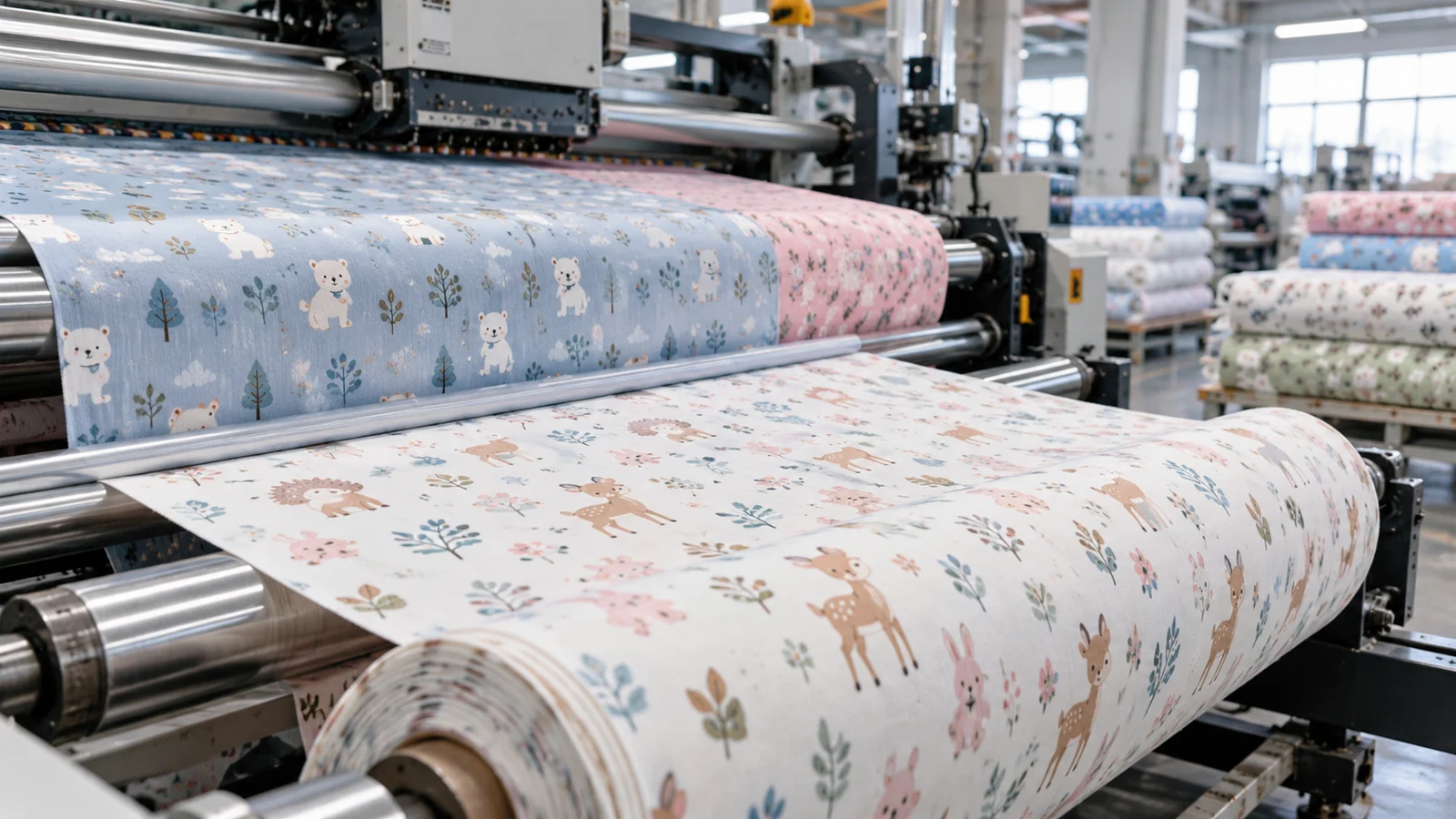
Custom printed kids pajamas depend on factory-ready artwork, the correct printing method, accurate color approvals and consistent repeat production.
A memorable children’s pajama print can drive a brand’s identity, but printing is also where many first production orders lose time and money. The right production route depends on repeat size, fabric composition, minimum print run, color consistency, durability and how the artwork aligns with sewn garments.
On this page
- 1. Start with the artwork use case
- 2. Compare printing methods without assuming one is always best
- 3. Build the custom printed kids pajamas specification
- 4. Test the artwork on real fabric
- 5. Make color consistency measurable
- 6. Understand why custom prints change MOQ
- 7. Review print changes for compliance effects
- 8. Control the approval trail
- Artwork handoff checklist for a custom pajama factory
- Example: solving an all-over print placement problem
- Set measurable bulk color and print acceptance criteria
- Frequently asked questions
1. Start with the artwork use case
All-over prints are built from a repeating tile across the fabric roll. Placement prints put a specific motif on a garment panel. Engineered prints require careful alignment of artwork with pattern pieces. Each has different equipment, wastage and quality risks.
For baby and children’s pajamas, consider how the motif looks on both a small toddler size and a larger child size. A giant print may become unrecognizable after cutting small pattern pieces. A tiny repeated motif may look busy on wide adult matching-family styles.
2. Compare printing methods without assuming one is always best
| Method | Typical role | Questions to ask |
|---|---|---|
| Digital fabric printing | Flexible artwork and detailed all-over designs | Fabric compatibility, wash/abrasion tests, color consistency, print minimums |
| Screen or rotary printing | Repeat designs at suitable scale | Setup costs, color count, mill minimum, repeat alignment |
| Heat-transfer methods | Selected fabrics and graphics | Hand feel, breathability, wash durability, end-use suitability |
| Placement print | Logo/graphic on defined panel | Registration, size-specific position, ink/trim safety review |
Actual availability depends on the fabric, printer and supplier. Do not assume a print method suitable for adult polyester activewear is automatically appropriate for close-to-skin children’s pajamas.
3. Build the custom printed kids pajamas specification
Send the original editable file, final repeat tile dimensions, color references, intended fabric, target product sizes, layout direction and placement rules. State who owns the design and verify rights to characters, logos and third-party patterns. When possible provide an approved physical color standard, since on-screen RGB colors are not production references.
Avoid sending only a compressed screenshot. A supplier may be able to redraw it, but this creates avoidable uncertainty over line weights, pattern scaling and copyright.
4. Test the artwork on real fabric
A strike-off is a sample of the print produced on the intended fabric or an equivalent substrate. Review color, edge sharpness, saturation, show-through, hand feel and print repeat. Then wash it using the planned care method and evaluate change. Digital files approved on a monitor do not substitute for a physical strike-off.
Request a small cut-and-sewn prototype when the print has strong directional lines, stripes or prominent motifs. This helps identify seam mismatches and asymmetric placements before large production commitments.
5. Make color consistency measurable
Different fabrics absorb dyes and inks differently; batch-to-batch shading may also vary. Ask for the supplier’s color standard, tolerance approach, light source and process for handling off-shade fabric. A “close enough” discussion is not an objective release criterion. Record the approved print lot and compare the final bulk roll or garment against the reference sample.
When using a branded printed collection, decide whether minor shade variation between batches is acceptable and communicate the policy to merchandising. Don’t silently mix visually incompatible print lots in one delivery.
6. Understand why custom prints change MOQ
A sewing factory may accept a low garment quantity while its printing partner or fabric mill requires a larger meterage per design or colorway. Quantity can also depend on fabric width and the number of color separations or setup steps. Ask for MOQ per print and fabric, not only per pajama set.
If a full custom print is impractical for a small first launch, alternatives include selecting a verified available print, adding a modest brand label to a proven body, or consolidating several garment silhouettes into one approved fabric. Confirm rights and exact applicability of the stock print.
7. Review print changes for compliance effects
For US children’s sleepwear, changing printed fabric or certain trims can affect the evidence supporting the product’s regulatory route. Under some defined conditions colors or print patterns can be grouped for testing, but this is not automatic and must follow the exact rule and supporting evidence. Work with the appropriate laboratory before assuming that every new seasonal print is covered by last year’s report.
A print’s material and processing may also influence pilling, shrinkage or surface feel. Review these alongside safety and label requirements.
8. Control the approval trail
A reliable sample approval package contains the following: versioned artwork; print repeat and orientation; approved color reference; fabric composition/GSM; strike-off sign-off; wash-test record; garment sample with print placement; bulk roll color-check evidence; and final carton/SKU mapping. If an error occurs, these records help identify whether it arose in artwork, printing, cutting or sewing.
Artwork handoff checklist for a custom pajama factory
Before the first strike-off, prepare a shared approval folder containing the following: the original vector artwork or high-resolution repeat tile; authorized color codes; repeat dimensions in centimeters or inches; orientation and motif scale; a printed reference where available; fabric code and weight; garment silhouettes and sizes; allowed print placement tolerance; and a unique version identifier. Include written confirmation of artwork ownership and any licensing permissions.
Ask the print supplier which file format and color profile its equipment requires. A file that appears correct in a design program may change when separated or interpreted by production software. Document the agreed proof process rather than allowing an informal color approval through a messaging app photo.
Example: solving an all-over print placement problem
Imagine a children’s pajama print with large animals placed on a straight repeat. The animals appear centered on the designer’s size-6 reference but are cut off at the neckline on the smallest toddler pattern pieces. Rather than moving every individual motif by hand after production, the team can adjust the repeat scale, move the repeat origin, or choose a smaller motif. Test the revised artwork on a garment cut in representative end sizes. This is a production problem, not a simple Photoshop correction.
Set measurable bulk color and print acceptance criteria
Agree on a light source or viewing method, acceptable shade variation, registration tolerance, edge clarity and defect categories. Define whether small print shifts are acceptable in non-critical areas, and whether prominent front-center motifs require tighter placement. The spec should also describe how rejected fabric will be segregated and whether the supplier may reprint without written approval. Do not approve a replacement print lot purely because it is within the same broad color family.
For repeat orders, retain both a signed digital artwork version and a physical approved swatch. This allows another production team or season to reconstruct the original finish without guesswork.
Frequently asked questions
Can you print any drawing onto kids pajamas?
Not automatically. Artwork rights, print-file resolution, fabric compatibility, safety evaluation and production feasibility must be checked.
Is digital printing always suitable for low MOQ?
It can reduce some setup barriers, but a fabric mill or finishing partner may still impose minimum meterage. Request a program-specific quote.
What is a strike-off?
A physical trial print used to evaluate the artwork and color on an intended fabric before bulk production.
Can a new colorway use the same compliance test reports?
Only where permitted under the applicable rules and properly supported. Have the lab review the exact changes and grouping criteria.
Content is intended for wholesale sourcing and educational use. Product specifications, quotations, certifications, labeling and import obligations must be confirmed for the actual style, market and shipment. References to regulatory guidance were checked October 2026.
Ready to discuss your kids sleepwear collection?
Share designs or reference images, target market, fabric, style/color quantities, size range and required delivery date. Nuohua can review OEM/ODM feasibility and provide a specification-based quotation.