
EN 14682 Drawstring Requirements for Children’s Clothing
Quick answer: EN 14682 addresses the safety of cords and drawstrings on children’s clothing. For brands and factories supplying the European market, it is a product-design risk control, not simply a label to print after sewing. Designers should review cord position, intended age group, free ends, attachments and possible entrapment before approving a sample. The exact requirements depend on the applicable edition and garment/age category; do not substitute a blog diagram for the full purchased standard.
The European Commission published the reference to EN 14682:2014, Safety of children’s clothing — Cords and drawstrings on children’s clothing — Specifications, in Commission Implementing Decision (EU) 2015/1345. Before using this page as a regulatory checklist, confirm the currently applicable edition and legal context with a qualified EU product-safety specialist.
Reference: European Commission decision on EN 14682
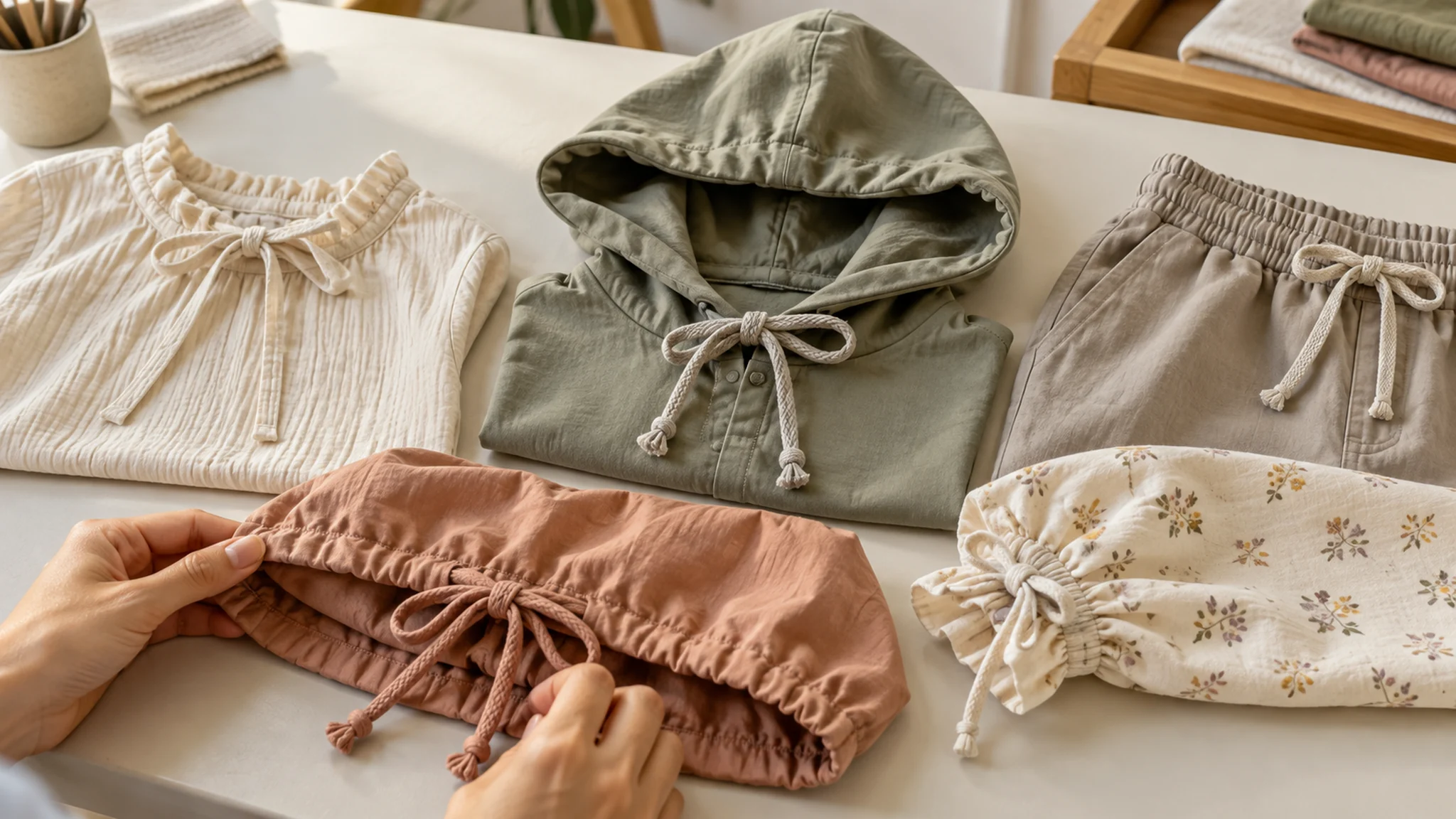
1. Why cords are treated as a design risk
A cord can become trapped on playground equipment, transportation structures or other objects; a loop or unsecured free end may create an injury risk during normal child movement. Risk depends on the child’s age, the position of the cord, whether it is functional or decorative, and the garment’s construction. A seemingly small style detail can affect how a product is assessed.
Think in terms of hazard pathways: Where could the free end catch? What force could be transferred to the child’s neck or torso? Could a toggle move toward an opening? Does the garment change shape under tension?
2. Identify every cord-related feature in a tech pack
“Drawstring” is not the only item requiring attention. Review decorative cords, ties, functional adjustment cords, loops, elastic cord features and connected hardware according to the definitions in the applicable standard.
| Garment zone | Example feature | Questions to record |
|---|---|---|
| Hood/neck | Adjustment cord or decorative tie | Is this feature permitted for the age/product category? |
| Shoulder/chest | Decorative tie, connected loop | Can it snag or form a hazardous loop? |
| Waist | Functional drawstring | What is the extension, fastening and attachment? |
| Lower hem | Adjustment cord with toggle | Could a free end catch during movement? |
| Back | Tie or decorative cord | Could it be pulled or caught from behind? |
| Cuffs/ankle | Elastic or cord adjustment | Does the construction create a snagging risk? |
This is a risk-location checklist, not a table of statutory or standard-specific pass/fail lengths. Those must be obtained from the correct edition and competent reviewer.
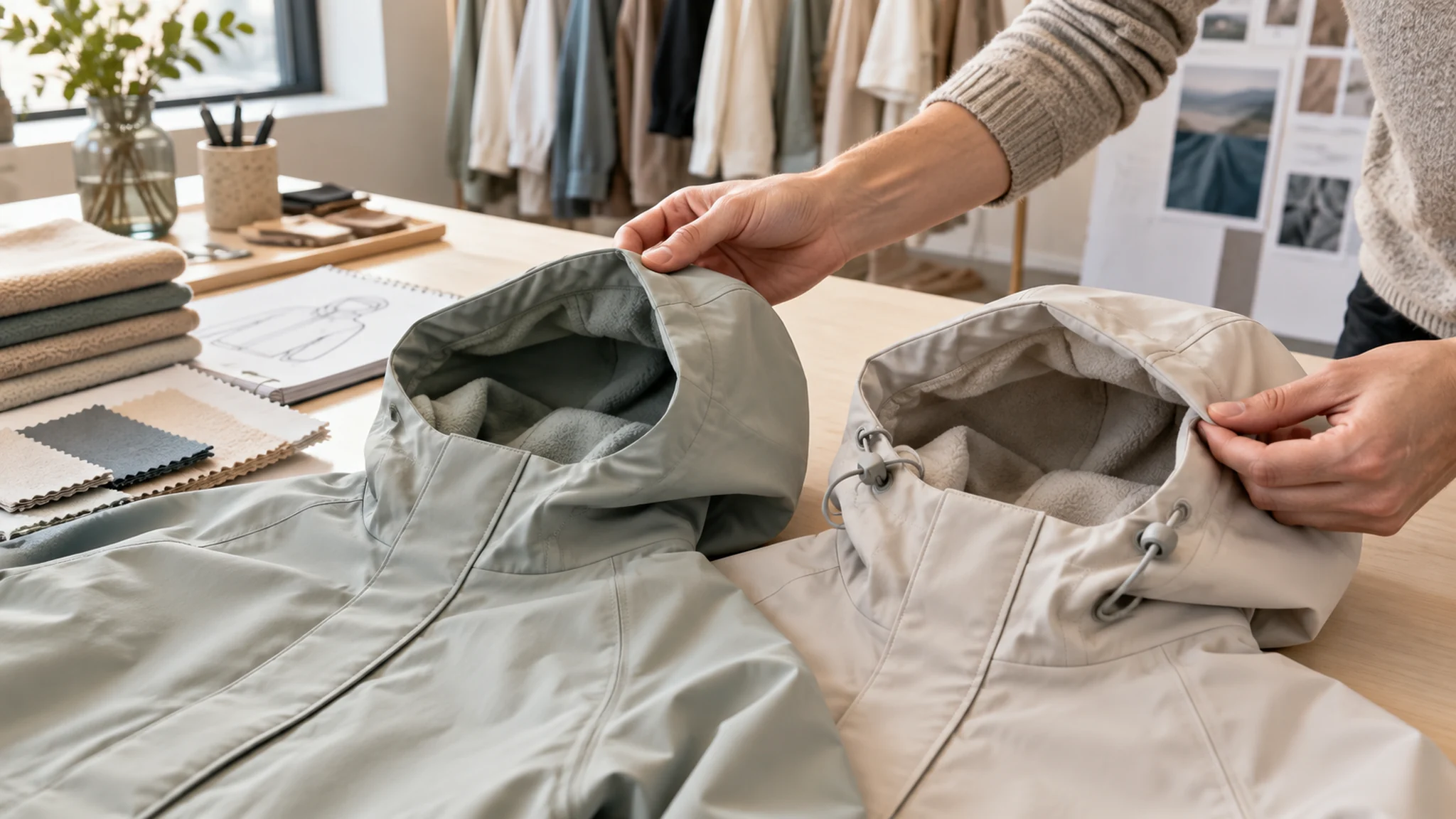
3. Different age groups can have different constraints
Children’s clothing standards commonly distinguish groups by age/height and the location of the feature. The buyer must map every intended size to the correct standard category. If a single design is sold across a wide size range, the factory may need different construction by size group or a universally safer design selected after review.
Do not label a style “3–14 years” in the tech pack and assume one placement rule applies across the range. Ask the reviewer to record age group, the exact applicable clause and why the approved construction is acceptable.
4. Apply design-out principles before testing
The first control should be to remove or redesign unnecessary hazards where possible. Decorative elements that do not serve a function can often be eliminated; functional adjustment might be achieved with a different construction. Selecting a safer design at sketch stage is generally less disruptive than cutting off cords from finished garments.
A good sample-room conversation asks:
- Why does this cord exist? Is the function essential?
- What is the child’s age and activity context?
- Can the adjustment be achieved without exposed cord ends or loops?
- Is the proposed solution comfortable and manufacturable?
- Which standard clause and documented sample confirm acceptance?
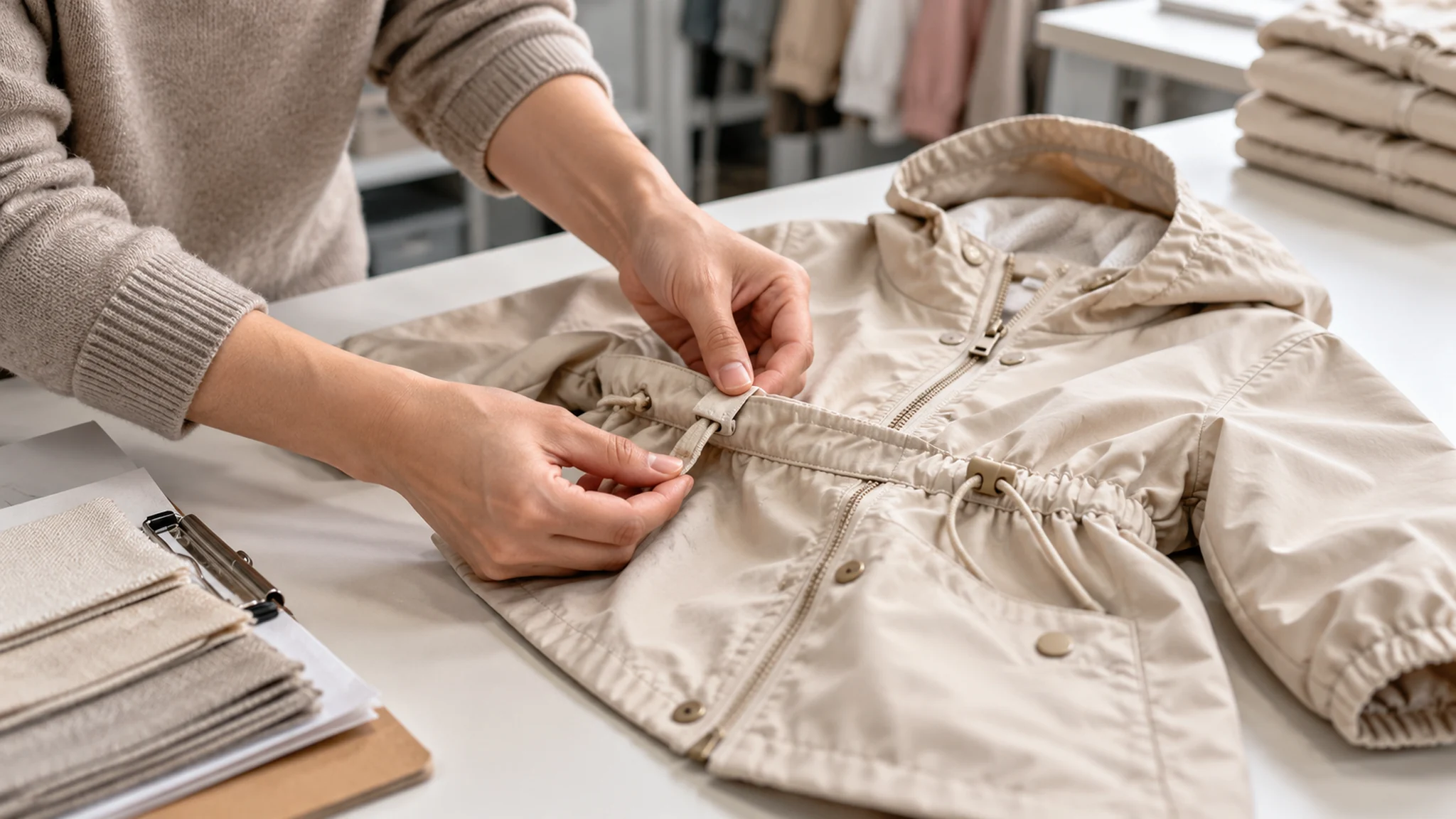
5. A design review workflow from sketch to bulk
Sketch review: A designer flags all ties/cords, including decorative ones. Pattern review: The technical team verifies construction and placement. Sample review: Inspect actual components and movements of the cords on a finished garment. Pre-production release: Retain the agreed reference and any clause-based assessment. Bulk QC: Confirm that production matches approved length, attachment and hardware specifications using the applicable test/inspection methods.
A pass comment should be linked to a sample number and a named reviewer. If a supplier changes cord material, locking mechanism or design after approval, reopen the review.
6. Sample and factory inspection form
| Field | Example entry format | Who completes it |
|---|---|---|
| Style code | KJ-____ | Brand / factory |
| Target markets | EU member states | Brand / importer |
| Age group and sizes | ____ | Brand technical team |
| Feature zone | Hood / waist / hem / other | Technical designer |
| Applicable standard + edition | Confirmed edition and clauses | Qualified reviewer |
| Reference sample | Sample ID, revision, date | QA |
| Measurements and findings | Values and notes per approved protocol | Inspector |
| Decision | Accept / revise / block | Authorized approver |
Template: templates/eu-cord-design-review.csv.
7. EN 14682 and the GPSR are not interchangeable
EN 14682 addresses a particular type of clothing hazard. The EU General Product Safety Regulation creates broader general product-safety duties, including risk assessment, traceability and actions relating to unsafe products. A garment can avoid risky drawstrings and still fail a chemical requirement, have inadequate traceability or present another hazard.
Nor should a supplier claim “EU certified” merely because a design was reviewed against a standard. Describe the precise requirement, product, assessment date, test/evidence and responsible party instead.
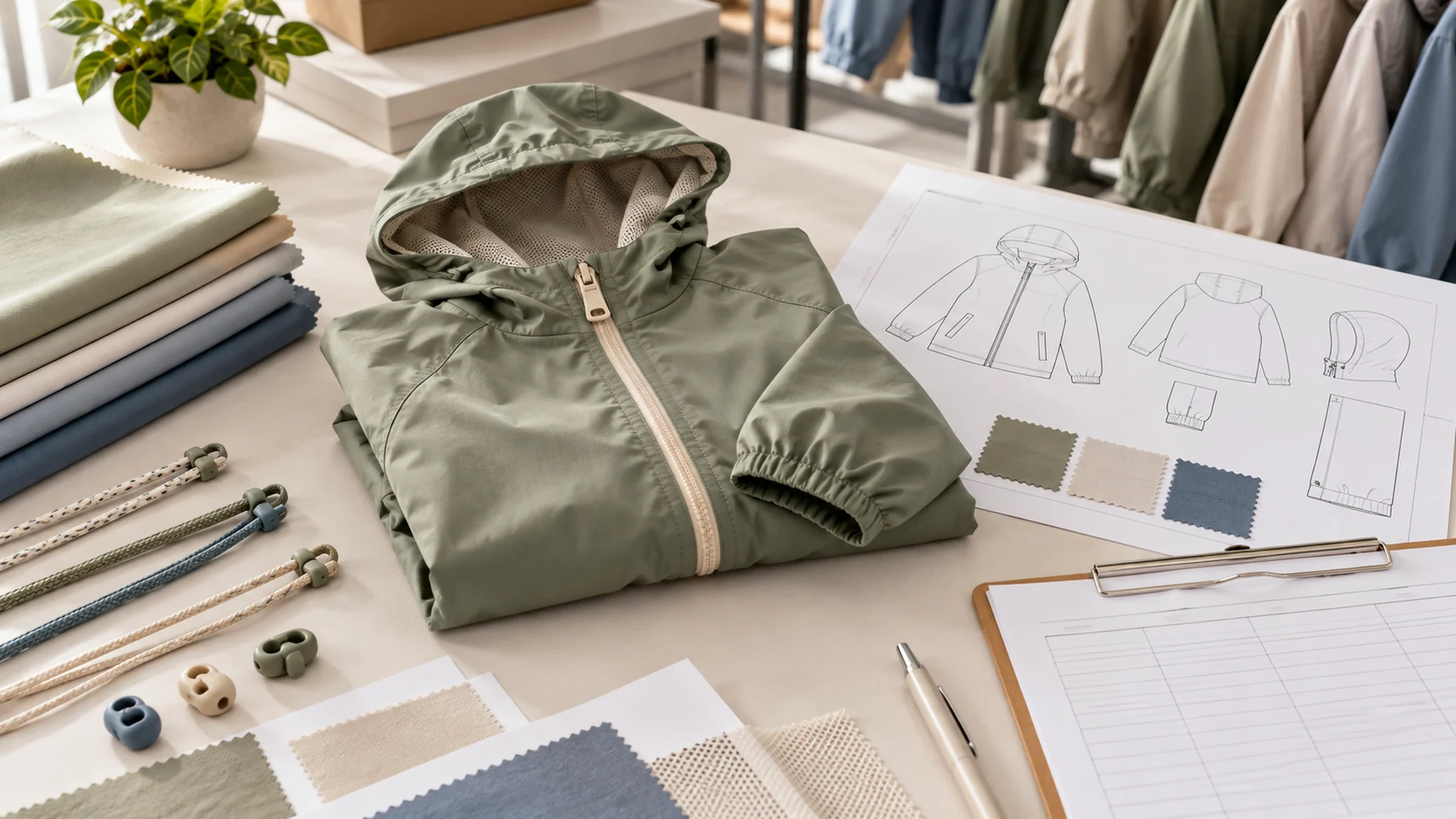
8. Prevent a hidden change during bulk production
A good control sheet records cord material, supplier, finishing, cut length, attachment method, stop features and acceptable tolerances consistent with the standard. Keep the approved physical sample accessible at the line and at final QC. Use recorded lot checks instead of assuming operators will notice a cord extension that changed during cutting.
When a design is sold to multiple markets, develop the technical safety file by destination rather than making an unsupported universal claim.
9. Questions to ask the children’s clothing manufacturer
- Which garment zones were screened for ties, cords and loops?
- What age groups and edition of EN 14682 were used for the review?
- What exact clauses apply to the disputed feature?
- Can you show the approved construction and objective inspection record?
- How will substitutions be controlled during production?
- Who signs off if the design is changed after sample approval?
- Are there other mechanical, chemical, labeling or traceability requirements for this product?
A professional factory should be able to discuss design controls without claiming that one standard covers all product safety obligations.
10. Product-specific review scenarios
Hooded sweatshirt: A designer adds a decorative functional-looking cord at the neck. The technical reviewer should identify the intended age group, examine the construction, consult the currently applicable standard and recommend a safer compliant redesign if needed. The reviewer should not approve the cord merely because an adult hoodie uses a similar component.
Elasticated-waist shorts: A seller wants a visible adjustable tie at the waist. The reviewer needs to check the specific style and age group, the way the tie functions, any exposed ends and the applicable restrictions. The decision is not made solely by quoting one memorized cord length from an unrelated design.
Rain jacket with hem adjuster: A toggle may alter both free-end geometry and how the cord can be caught. A visual review of the finished sample should be paired with clause-based measurement where relevant. Substituting the toggle after approval requires a new design assessment.
Girls’ dress with decorative bows: The team should distinguish sewn decorative details from cords/loops covered by the specific rule and investigate any separate attachment hazard. Not every ribbon has the same technical classification; an image generator is not a reliable arbiter of this distinction.
11. Effective communication with an EU brand buyer
Send a brief decision note for each feature: sample reference, intended age group, zone, current standard edition, relevant clauses, observed measurement or construction, outcome and authorized reviewer. If the decision depends on a full normative document, cite the clause rather than reproducing the purchased standard or asserting an unsupported number.
The supplier’s quotation and sample timeline should reserve time for a safety review before cutting. If the customer chooses to redesign a nonessential tie, issue revised drawings and sample photographs to avoid a production line following the old version. The approval should reach patternmaking, purchasing and QC, not remain in one email thread.
12. Safer image and diagram use in buyer education
Photography may illustrate the location of a hood, waist or hem feature, but should not be used to claim that a particular construction passes EN 14682. Any technical pass/fail infographic containing maximum lengths or prohibited arrangements must be drawn and checked against the authenticated current text by a qualified expert. For web content, use neutral close-up photos of inspection activity and attach a separate validated engineering diagram only after review.
FAQs
Does EN 14682 apply only to hooded garments?
No. Cord- and drawstring-related considerations can arise in other clothing zones, depending on the product and age group.
Is every waist drawstring prohibited?
Do not make that generalization. Determine the relevant garment, age and design clause in the applicable standard before deciding what is permitted.
Can a factory fix a cord safety problem by cutting it shorter?
Not always. Attachment, free-end features, loops, hardware and placement can matter. The modification must be reassessed as a complete design.
Does CE marking prove a children’s dress satisfies EN 14682?
Ordinary children’s clothing should not automatically carry CE marking. Whether CE marking is required depends on the applicable EU harmonized legislation and product type; do not attach CE marks as a generic assurance.
Do I need to keep sample review records?
Documented review and traceability support conformity control, investigation and corrective actions. Retention requirements depend on the applicable rules and responsible party.
Related reading: GPSR for Children’s Clothing · Kids Sleepwear OEM Services · Contact Manufacturing Team
Talk to a Kidswear Manufacturing Specialist
Send your product type, reference images or tech pack, fabric composition, size range, intended market, quantity by style and color, and target delivery date. Request an OEM/ODM feasibility review and quotation. MOQ, sampling, testing responsibilities and delivery milestones are confirmed against your actual specification.