Private Label Baby Clothing: MOQ, Samples, Labels and Cost
On this page
- What “Private Label Baby Clothing” Actually Means
- Choose the Right First Product
- MOQ: Separate the Five Different Minimums
- Labels: Build the System Before Printing
- Packaging: Design for Retail and Production
- Samples: What You Actually Need to Approve
- Cost: What Changes the Unit Price
- Ready Stock vs Custom Private Label
- Compliance Still Applies to Private Label
- Verify Organic and Material Claims
- Quality Control for Private Label
- How to Brief a Factory
- FAQ
- Build the SKU and Barcode System Before Packing
- Separate One-Time Development Cost From Repeat Cost
- Plan Colorways Around Fabric Reality
- Private Label Does Not Mean Generic
- Build Replenishment Into the Agreement
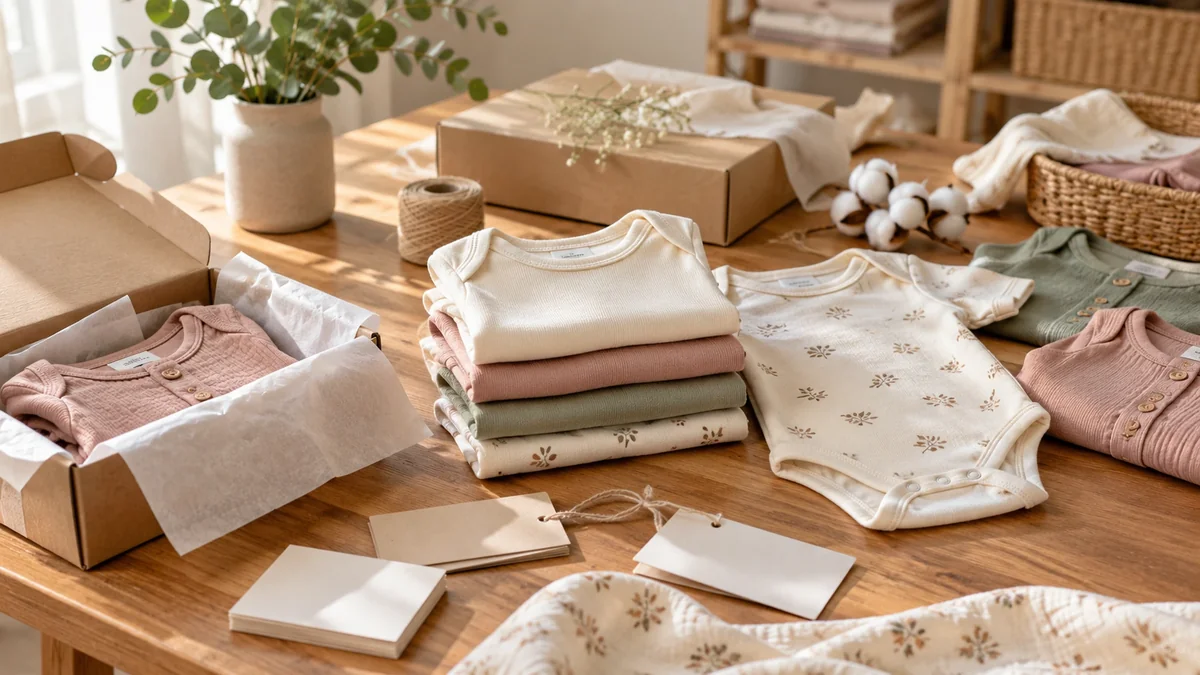
Private label baby clothing usually starts with an existing or lightly modified product base, then adds your brand identity through labels, packaging, colors, prints or selected construction changes. It can be faster and lower risk than full OEM, but the actual MOQ depends on what you customize. A stock garment with a new label is not the same production route as a custom-dyed, custom-printed baby collection. Brands should separate product MOQ from label, packaging and fabric minimums before comparing suppliers.
1. What “Private Label Baby Clothing” Actually Means
Private label is often used as a catch-all term, but there are several levels:
Level 1: Ready product + your packaging
Use an in-stock style with limited branding changes. Fastest route for validation.
Level 2: Existing style + your label + selected customization
Use an existing pattern but change color, print, label or packaging.
Level 3: ODM-based collection
Start from a factory base pattern and modify fit, fabric and styling.
Level 4: Full OEM
Build from your own tech pack or sample. This is no longer “simple private label” in production terms even if the product carries your private brand.
Understanding the level prevents surprise when the MOQ changes.
2. Choose the Right First Product
Babywear products differ in development risk.
Lower-complexity starting points often include:
- basic T-shirts;
- bodysuits;
- simple rompers;
- elastic-waist pants;
- two-piece knit sets.
Higher-complexity styles may include:
- footed sleepers;
- two-way zipper constructions;
- heavy embellishment;
- complicated all-over prints;
- multiple fabric panels;
- highly custom trims.
For a first private-label launch, a simple product that fits well is usually more valuable than a complex product with many failure points.
3. MOQ: Separate the Five Different Minimums
A private-label project can contain several MOQs at once:
- garment MOQ;
- fabric/dye MOQ;
- print MOQ;
- trim/label MOQ;
- packaging MOQ.
This is why “What is your MOQ?” is not enough.
At Nuohua, selected ready-stock baby products can start from 2 pcs in available styles/colors/sizes. Selected custom baby apparel may start from 150–300 pcs per color, while full OEM/ODM quantities are confirmed after fabric, GSM, size range, artwork, construction and other requirements are reviewed.
Example
A factory may accept 200 garments, while a woven-label supplier requires 1,000 labels. That does not mean you must order 1,000 garments. The unused labels may be held for future production if the commercial arrangement allows it.
4. Labels: Build the System Before Printing
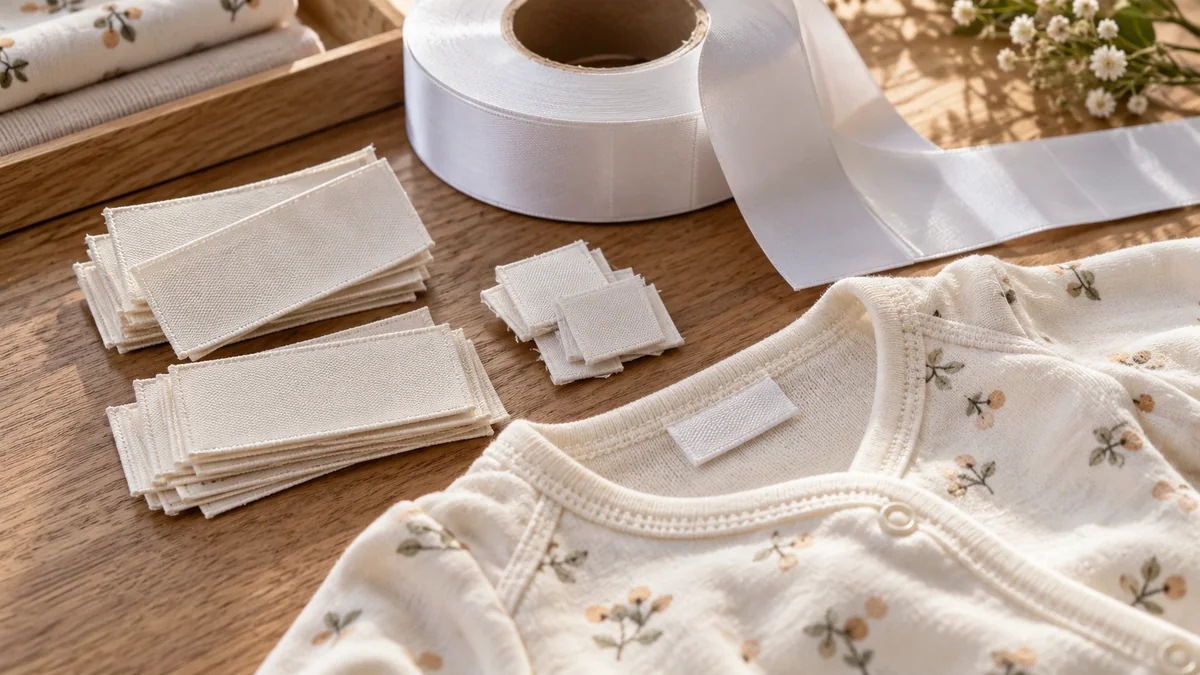
A baby brand may require:
- main brand label;
- size label;
- fiber/care label;
- country-of-origin information;
- printed neck label;
- hangtag;
- barcode sticker;
- packaging label.
Do not treat these as decoration only. Some label content is legally required depending on the market.
Make a label specification sheet
For each label define:
- dimensions;
- material;
- fold type;
- color;
- artwork file;
- placement;
- attachment method;
- exact approved wording;
- tolerance.
A woven label that is too stiff can be uncomfortable on babywear. A printed label may be better in some skin-contact areas.
5. Packaging: Design for Retail and Production
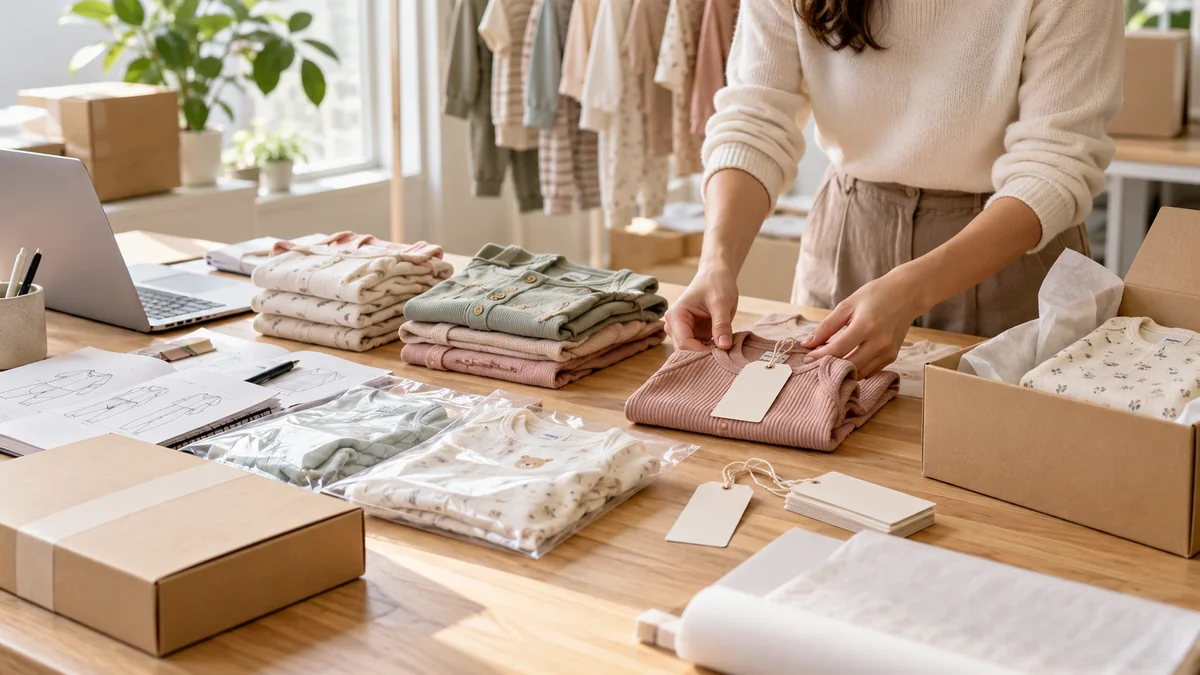
Packaging needs to protect the garment, fit your sales channel and remain efficient to pack.
Options include:
- standard polybag;
- branded polybag;
- recyclable bag where suitable;
- paper belly band;
- retail box;
- gift box;
- hanger pack;
- ecommerce mail-ready set.
Ask whether packaging will be applied at the garment factory or a separate packing location. Confirm carton quantities and dimensions before freight booking.
6. Samples: What You Actually Need to Approve
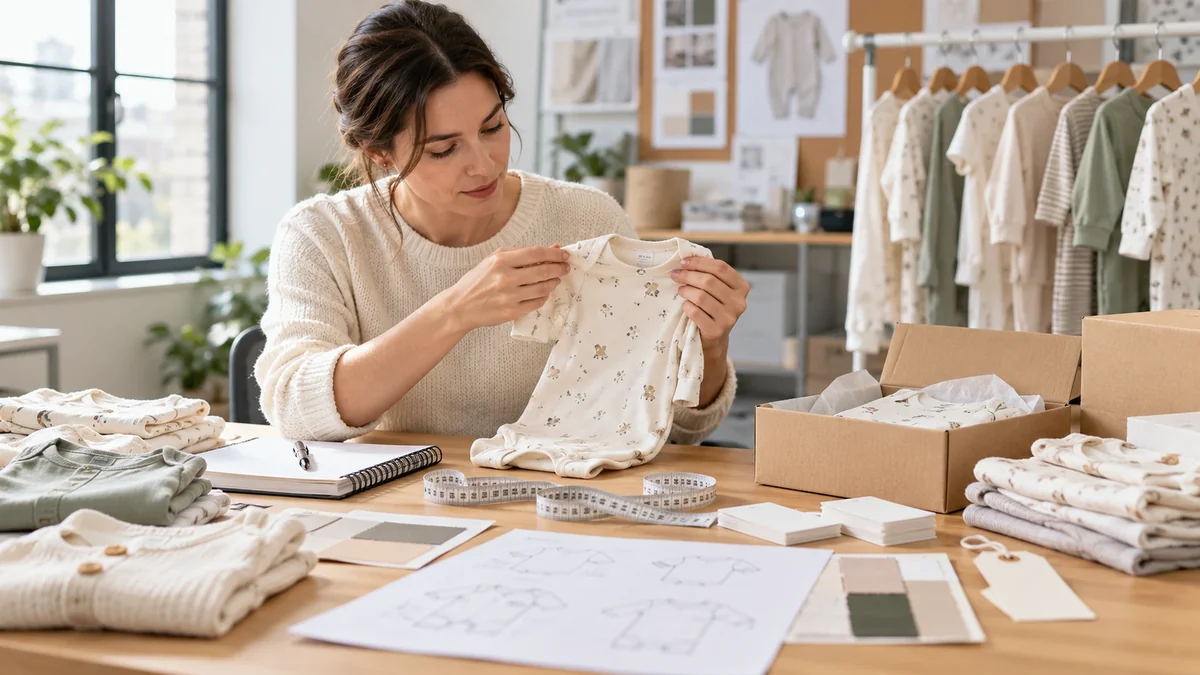
For a simple existing private-label product, you may only need a production-representative sample and branded-trim approval. For a modified or custom product, plan for fit and PP approval.
Check:
- fabric;
- measurements;
- color;
- seam construction;
- neckline/closure function;
- label placement;
- print/embroidery;
- wash performance;
- packaging appearance.
Approve the product before approving large quantities of packaging.
7. Cost: What Changes the Unit Price
Private-label baby clothing price is affected by:
- fabric composition and GSM;
- garment construction;
- order quantity;
- number of colors;
- print method;
- embroidery;
- trims;
- labels;
- packaging;
- testing;
- inspection;
- freight.
A simple in-stock bodysuit with a label change should not be benchmarked against a custom-dyed organic cotton romper with bespoke snaps and gift packaging.
8. Ready Stock vs Custom Private Label
| Factor | Ready stock/private label | Selected custom/full OEM |
|---|---|---|
| Development time | Lower | Higher |
| MOQ | Lowest on selected styles | Depends on spec |
| Fit control | Limited | High |
| Fabric control | Limited to available options | Customizable |
| Color control | Stock shades | Custom color possible |
| Print control | Existing/limited | Custom artwork possible |
| Best for | Testing and fast launch | Distinctive brand product |
The best route depends on what customers are paying your brand for.
9. Compliance Still Applies to Private Label
Putting your logo on an existing garment does not remove compliance responsibility.
For U.S. children’s products subject to applicable CPSC rules, third-party testing and certification requirements may apply. Importers of most regulated products subject to certification have also been subject to certificate eFiling requirements since July 8, 2026.
The party placing the product on the market should confirm what applies to the final product, not assume that “the factory has a certificate” covers every future style and material.
10. Verify Organic and Material Claims
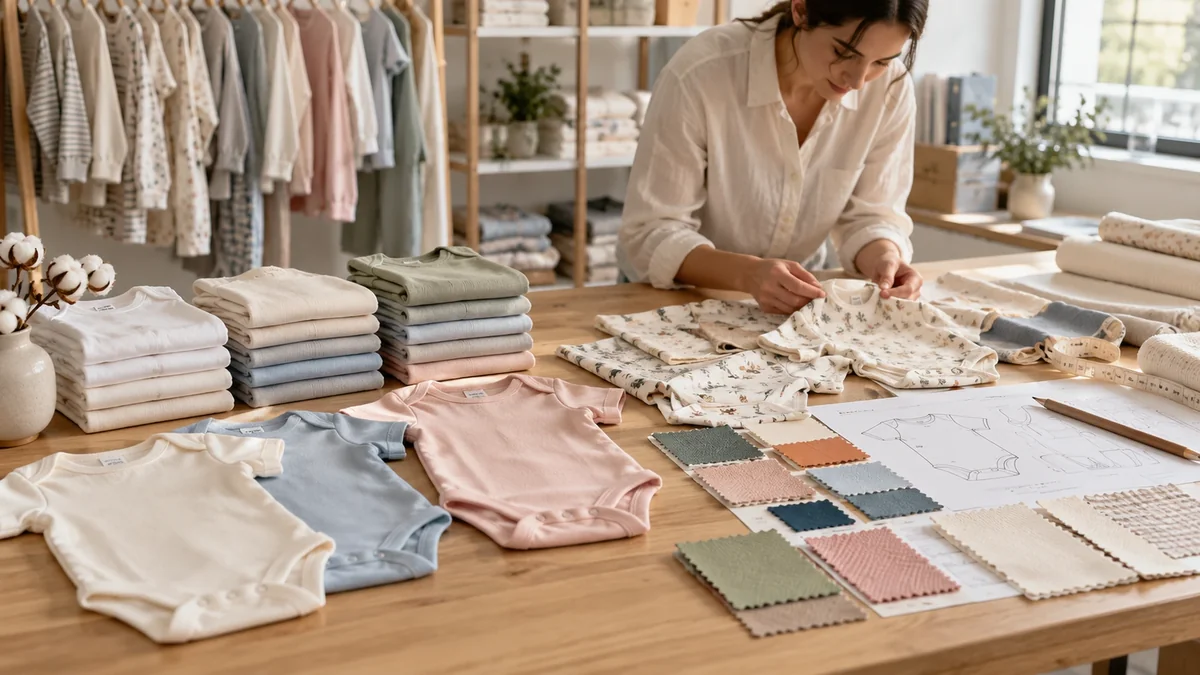
If you market organic cotton, verify what documentation supports the claim. If you market viscose made from bamboo, use accurate fiber terminology. If a supplier mentions OEKO-TEX, GOTS or another certification, confirm holder, scope, validity and whether the specific material/product is covered.
A private-label brand is still responsible for the claims printed on its own website and packaging.
11. Quality Control for Private Label
Even when the base style already exists, your order needs a written standard.
Confirm:
- approved garment sample;
- measurement tolerance;
- shade standard;
- label placement;
- packaging sequence;
- barcode/size accuracy;
- carton assortment;
- final inspection level.
Private-label errors often happen in branding rather than sewing: wrong size stickers, swapped labels, mixed barcodes or incorrect packaging copy.
12. How to Brief a Factory
Send:
- desired style or link/reference;
- size range;
- order quantity;
- destination market;
- preferred fabric;
- branding files;
- label requirements;
- packaging requirements;
- target launch date.
Then ask the factory to separate one-time setup costs from repeat-order costs.
FAQ
What is private label baby clothing?
It is baby apparel produced by a manufacturer and sold under your brand. The product may be existing, modified or fully custom depending on the program.
Is private label cheaper than full OEM?
Usually it can reduce development cost and time because you start from an existing base, but heavy customization can make it similar to OEM in practice.
Can I add my own labels to ready-stock baby clothes?
Often yes on selected styles, but the minimum for label production and relabeling can differ from the garment minimum.
What should I order first?
For validation, start with products closest to your intended long-term brand position. Testing random cheap products can give misleading market data.
13. Build the SKU and Barcode System Before Packing
Private-label orders often become complicated at the packaging stage because every size/color needs the correct sticker, barcode or retail label.
Before bulk packing, prepare a SKU matrix that connects:
- style number;
- color;
- size;
- SKU;
- barcode if used;
- packaging type;
- carton assortment.
Ask the factory to use the same matrix for packing and final inspection.
14. Separate One-Time Development Cost From Repeat Cost
Your first order may include:
- label mold/setup;
- print screen/setup;
- packaging dieline;
- pattern adjustment;
- artwork preparation;
- sample charges.
These should not automatically be treated as recurring unit cost. Knowing the one-time portion helps you understand the economics of the second order.
15. Plan Colorways Around Fabric Reality
Every additional color can create:
- dye-lot minimums;
- shade approval work;
- extra sampling;
- smaller quantity per SKU;
- more inventory risk.
A startup may get a stronger launch from three well-chosen colors than eight colors with shallow inventory.
16. Private Label Does Not Mean Generic
You can create differentiation without rebuilding the garment from zero. Consider controlled changes such as:
- exclusive color palette;
- custom print;
- custom label language;
- coordinated packaging;
- a specific size range;
- bundled sets;
- matching products across one fabric base.
The goal is to spend customization budget where customers can perceive it.
17. Build Replenishment Into the Agreement
Ask:
- Will the same base fabric remain available?
- Are labels stored for reorders?
- Is the approved color recorded?
- How long are patterns/files retained?
- Can small replenishment use remaining stock fabric?
- What changes if the original fabric is discontinued?
A private-label product is valuable when it can be replenished consistently, not only when the first order looks good.
Build a Private-Label Route That Can Scale
Send Nuohua the baby product type, size range, quantity and branding requirements. We can separate what can use an existing base from what requires custom development, so the MOQ and cost are clear before labels are ordered.
Or explore our kidswear manufacturing capabilities.
Nuohua Garment is a kidswear OEM/ODM manufacturer producing children’s underwear, sleepwear, baby apparel and custom kidswear for brands, retailers and wholesalers, with an 8,000 m² production base in Guangdong, China. Guidance here reflects our production experience; confirm current regulations and requirements for your market and product before ordering.