
Quick Answer
Garment AQL inspection is a statistically valid sampling method, defined by ISO 2859-1 and ANSI/ASQ Z1.4, that lets a buyer accept or reject a production lot based on a small random sample rather than inspecting 100% of the goods. For most kids’ underwear programs, buyers specify AQL 2.5 for Major defects and AQL 4.0 for Minor defects, with 0% acceptance for Critical defects (broken needles, sharp parts, flammability failures). A documented 8-stage QC workflow — from fabric inspection through pre-shipment — combined with a calibrated needle detector, is what holds the final defect rate under 0.3% at a responsible factory.
What Is AQL in Garment Manufacturing?
AQL stands for Acceptance Quality Limit. It is the worst quality level that is still considered acceptable for a production lot, expressed as a percentage of defective items in a sample. AQL is not the percentage of defects in the whole lot; it is the threshold that defines the boundary between “acceptable” and “rejectable” when a random sample is drawn from the lot.
The method was originally developed for military supply chains and is now the global standard for garment quality control. It is codified in two parallel documents that say the same thing in two languages:
- ISO 2859-1 — the international standard, used across Europe, Asia, and most of the world.
- ANSI/ASQ Z1.4 — the U.S. national standard, used in North America.
Both standards use the same sampling tables, the same inspection levels, and the same Ac (Accept) / Re (Reject) numbers. For a buyer, the practical implication is simple: a sample is drawn, defects are counted, and a pass/fail decision is made using a two-line lookup. There is no negotiation, no judgment call — either the sample is under the Accept number or it has crossed the Reject number.
Why this matters for kids’ underwear: Children’s garments have a near-zero tolerance for Critical defects (broken needles, sharp metal, flammability failures, choking-hazard trims). AQL gives the buyer a way to enforce that zero tolerance through a written, reproducible procedure rather than a handshake. Combined with 100% needle detection and GB 31701 Class A certification, an AQL-based system is the backbone of any credible children’s wear QC program.
Why Clothing Brands Use AQL for Kids’ Underwear
A buyer has three options when sourcing from a factory:
- Inspect 100% of the goods. Slow, expensive, almost impossible above 10,000 pieces per lot, and famously unreliable — humans miss roughly 1–3% of defects even when focused.
- Trust the factory’s word. Cheap and fast, but gives the buyer no recourse when a shipment arrives damaged.
- Use AQL random inspection. Statistically valid, affordable, written, and defensible. The buyer pays for a small sample (typically <5% of the lot) and gets a clear pass/fail signal that holds up in a dispute.
For kids’ underwear specifically, AQL is the most efficient way to manage three risk categories at once:
- Safety — needle detection plus AQL 0% on Critical defects catches broken needles and sharp parts before they reach a child.
- Fit and comfort — size measurement checks at AQL 2.5 catch elastic over-stretch, twisted waistbands, and off-grain panels.
- Brand presentation — AQL 4.0 on Minor defects keeps the visible imperfection rate (loose thread, slight shade variance, minor pilling) low enough that a child’s parent never notices.
In short, AQL is the language that lets a buyer and a factory agree on quality in writing.
The Three Defect Classes: Critical, Major, Minor
Every defect observed during inspection is sorted into one of three classes before the lot is evaluated against the AQL table. This classification — not the AQL number itself — is what determines whether a defect counts against the lot.
| Class | Definition | Typical AQL | Examples (kids’ underwear) |
|---|---|---|---|
| Critical | Defects that endanger the user, fail mandatory regulation, or render the product unsellable. | 0% (zero acceptance) | Broken needle (caught by detector), sharp metal, choking-hazard trim, flammability failure, illegal fiber (e.g. AZO dye over limit). |
| Major | Defects that reduce usability, sellability, or noticeably affect comfort and appearance. | 2.5 (most common) | Broken stitch, missing elastic, hole >3 mm, visible stain, off-size by >1.0 cm, twisted waistband, mislabel. |
| Minor | Defects that do not affect usability or sellability but fall below the brand’s finish standard. | 4.0 (most common) | Loose thread (untrimmed), slight shade variance within A-class tolerance, minor pilling, light surface mark visible only on close inspection. |
The buyer and factory agree on this defect list in the tech pack before production starts. A well-written defect list names every defect class the buyer cares about and gives a worked example of each. It is the single most important document in a kids’ underwear QC program — more important than the AQL number, because it is what the inspector actually counts in the sample.
Critical defects always = 0% acceptance. No matter what AQL level you negotiate for Major and Minor, a single Critical defect in the sample rejects the lot. This is non-negotiable for children’s wear under most national regulations (including the U.S. CPSIA, the EU GPSR, and China’s GB 31701 Class A). The needle detector exists to enforce this zero on the most common Critical failure mode.
AQL Sampling Standards: ISO 2859-1 and ANSI/ASQ Z1.4
Two standards govern AQL sampling for garments. They are interchangeable for practical purposes — a sample drawn under one is valid under the other.
ISO 2859-1 (International)
Published by the International Organization for Standardization, ISO 2859-1 is titled Sampling procedures for inspection by attributes — Single sampling plans by AQL. It defines:
- Inspection Levels: General Level I, II, III (II is the default) and Special Levels S-1, S-2, S-3, S-4 for destructive or expensive tests.
- Lot size — sample size relationship.
- Accept / Reject numbers for each AQL level (1.0, 1.5, 2.5, 4.0, 6.5, etc.).
- Single, double, and multiple sampling schemes.
ANSI/ASQ Z1.4 (U.S. National)
Published by the American Society for Quality, ANSI/ASQ Z1.4 is the U.S. adoption of the same system. The Ac/Re numbers are identical to ISO 2859-1. North American buyers will often reference Z1.4 in their tech pack; Asian and European factories will quote ISO 2859-1. Both are correct.
Which Inspection Level to Choose?
General Level II is the default and covers most garment orders. General Level I loosens the sample size (useful for low-risk repeats); General Level III tightens it (useful for first orders or new factories). Special Levels S-1 through S-4 are for destructive tests where the test piece is consumed (tensile strength, colorfastness to washing) — they are not used for visual AQL inspection.
The Complete AQL Sampling Table
Below is the full Normal Inspection, Single Sampling table for General Level II from ISO 2859-1 / ANSI Z1.4, with the Ac (Accept) and Re (Reject) numbers for the AQL levels most often used in kids’ underwear programs: 1.0, 1.5, 2.5, and 4.0.
| Lot Size (pieces) | Sample Size | AQL 1.0 | AQL 1.5 | AQL 2.5 | AQL 4.0 | ||||
|---|---|---|---|---|---|---|---|---|---|
| Ac | Re | Ac | Re | Ac | Re | Ac | Re | ||
| 2–8 | 2 | 0 | 1 | 0 | 1 | 0 | 1 | 0 | 1 |
| 9–15 | 3 | 0 | 1 | 0 | 1 | 0 | 1 | 0 | 1 |
| 16–25 | 5 | 0 | 1 | 0 | 1 | 0 | 1 | 1 | 2 |
| 26–50 | 8 | 0 | 1 | 0 | 1 | 0 | 1 | 1 | 2 |
| 51–90 | 13 | 0 | 1 | 0 | 1 | 0 | 1 | 2 | 3 |
| 91–150 | 20 | 0 | 1 | 0 | 1 | 1 | 2 | 3 | 4 |
| 151–280 | 32 | 0 | 1 | 1 | 2 | 2 | 3 | 5 | 6 |
| 281–500 | 50 | 1 | 2 | 1 | 2 | 3 | 4 | 7 | 8 |
| 501–1,200 | 80 | 2 | 3 | 3 | 4 | 5 | 6 | 10 | 11 |
| 1,201–3,200 | 125 | 3 | 4 | 5 | 6 | 7 | 8 | 14 | 15 |
| 3,201–10,000 | 200 | 5 | 6 | 7 | 8 | 10 | 11 | 21 | 22 |
| 10,001–35,000 | 315 | 7 | 8 | 10 | 11 | 14 | 15 | 21 | 22 |
Ac = Accept number (the lot passes if defects in the sample are ≤ Ac). Re = Reject number (the lot fails as soon as defects in the sample reach Re). Critical defects are evaluated separately with Ac = 0, meaning any single Critical defect rejects the lot regardless of AQL level.
How to Read the AQL Table — A Worked Example
Suppose a buyer orders 2,400 pieces of a girls’ cotton brief from a Chinese OEM factory. The buyer specifies:
- Critical AQL = 0% (one broken needle = reject)
- Major AQL = 2.5
- Minor AQL = 4.0
- Inspection Level = General II
Step-by-step:
- Find the lot size row: 2,400 pieces falls in the 1,201–3,200 row.
- Sample size for that row: 125 pieces, drawn randomly across the lot.
- At AQL 2.5 (Major): Ac = 7, Re = 8. If the inspector finds 7 or fewer Major defects in the 125-piece sample, the lot passes on Major. The eighth Major defect rejects the lot.
- At AQL 4.0 (Minor): Ac = 14, Re = 15. The lot passes if Minor defects are ≤14; rejects at 15.
- Critical: Ac = 0. Any single Critical defect rejects the lot immediately.
So out of a 2,400-piece lot, the inspector examines 125 pieces (about 5.2% of the lot). If the sample holds, the remaining ~2,275 pieces are statistically expected to be of the same quality and are released for shipment.
What happens if the lot fails? The factory has three options: (1) sort 100% of the lot, remove the defects, and resubmit for a new AQL inspection; (2) replace the failed lot with a new production run; (3) accept the reject and ship at a discount (rare and usually only by mutual agreement). In almost every case, the factory chooses option 1 because re-sorting is cheaper than scrapping the lot.
The 8-Stage Kids’ Underwear Inspection Process
AQL is one stage in a larger clothing inspection process. For children’s underwear, a mature OEM factory runs quality control through eight distinct stages, from incoming fabric to the loading container. AQL is the final gate before the goods leave the factory, but the earlier stages are what keep the lot passing the gate in the first place.
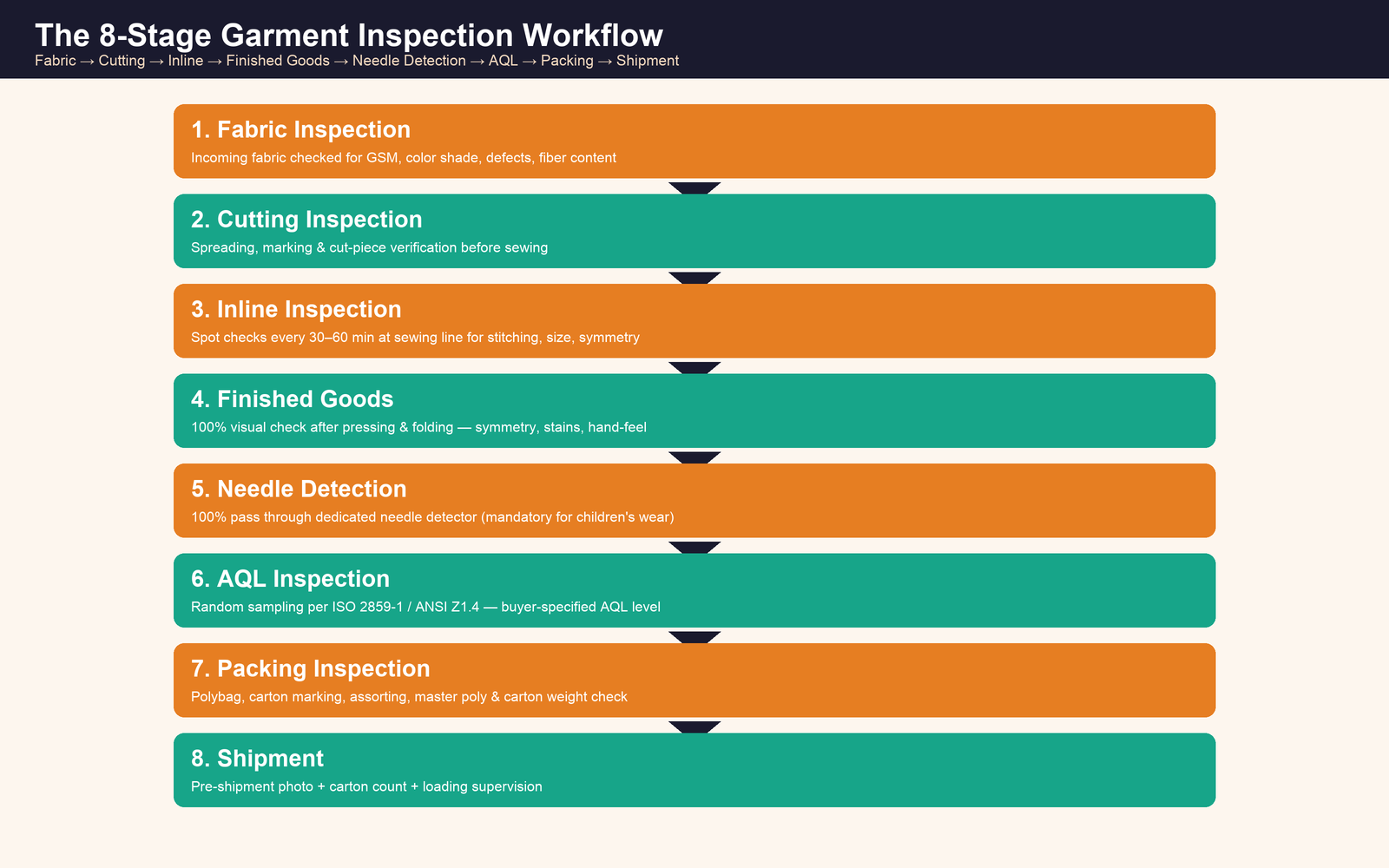
Each stage has a defined purpose, a defined frequency, and a defined owner.
Stage 1 — Fabric Inspection (Incoming)
Before any cutting begins, the fabric roll is checked at the receiving bay against the mill certificate: GSM (grams per square meter), fiber content, color shade against the approved lab dip, and visual defects (holes, slubs, stains, barre). A 4-point or 10-point system is used to score defects per 100 linear meters. Most mills accept up to 25–40 points per 100 m for general fabric; anything worse is either rejected or accepted with a discount.
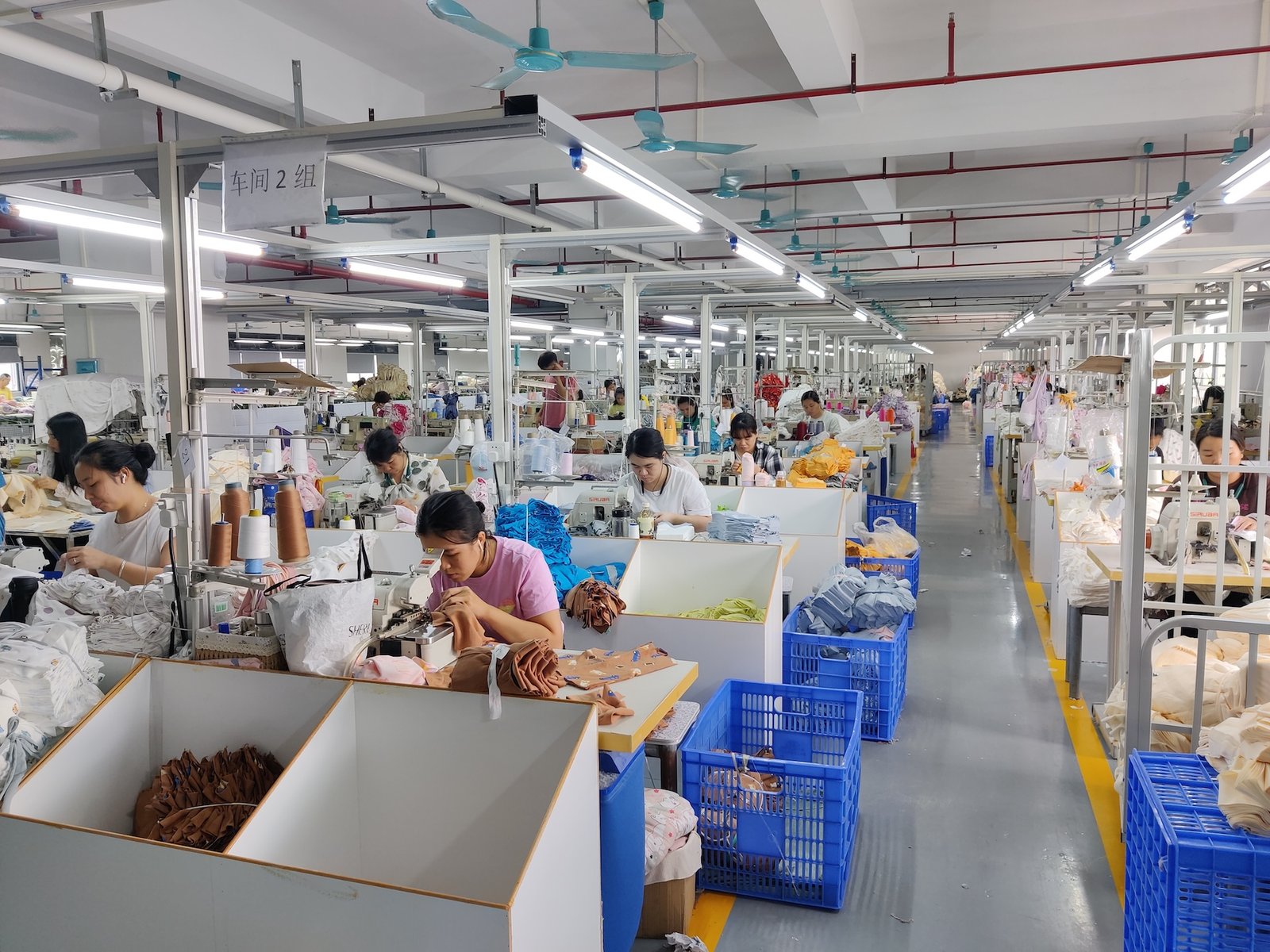
Stage 2 — Cutting Inspection
After spreading and cutting, cut-piece bundles are counted against the marker, grain direction is checked, and any cut defects (notches, fusion marks, ragged edges) are isolated. This stage catches problems that would otherwise be sewn into garments and only discovered at finished goods.
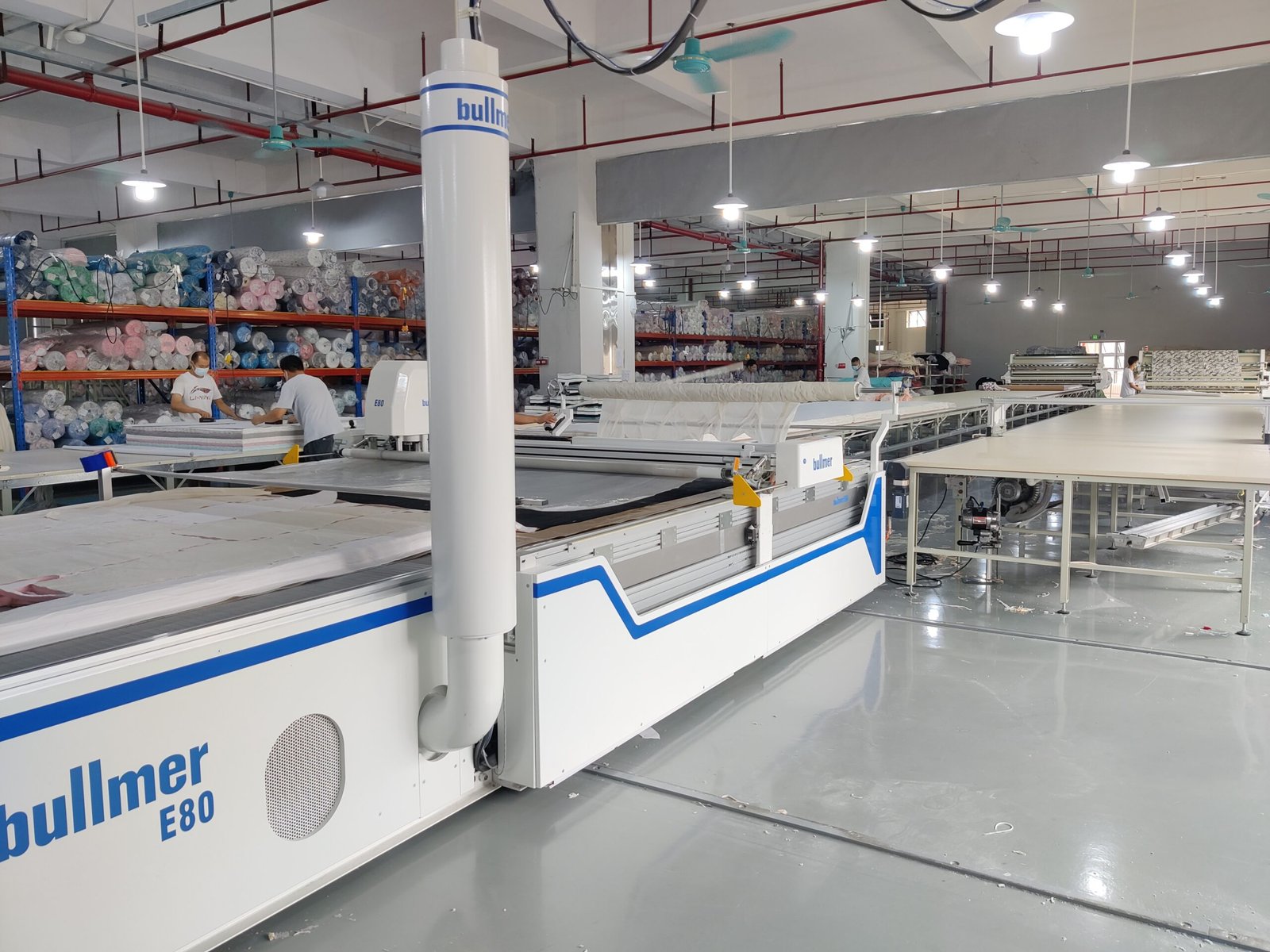
Stage 3 — Inline Inspection
On the sewing line, an inline inspector walks the line every 30–60 minutes, randomly pulling 5–10 garments to check stitching type and SPI (stitches per inch), elastic attachment, symmetry left-to-right, trim placement, and visible defects. Findings are written into a line-log so the floor manager can correct a problem before it propagates through the lot.
Stage 4 — Finished Goods Inspection (100% Visual)
After pressing and folding, every garment is visually checked: symmetry (left vs. right leg, front vs. back), measurements within ±0.5 cm of the size spec, stains, holes, off-color, hand-feel, and labels (care label, size label, country-of-origin). Defective pieces are pulled into a reject bin and the lot moves to needle detection.
Stage 5 — Needle Detection (Mandatory for Children’s Wear)
Every garment passes through a calibrated needle detector. The detector is set to the smallest ferrous and non-ferrous test piece the factory uses (typically 1.0–1.5 mm ferrous). Any trigger is isolated, traced back to the sewing line, and the affected operator’s work is re-inspected. The detector log is signed daily by the operator and the QC supervisor. This stage is non-negotiable for children’s garments — it is the single most important Critical-defect control in the program.
Stage 6 — AQL Random Inspection
Once the lot is 80–100% complete and at least 80% packed, an AQL inspection is conducted per ISO 2859-1 / ANSI Z1.4. The sample size and Ac/Re numbers come from the table earlier in this guide. Critical, Major, and Minor defects are counted separately and the lot receives a written pass/fail.
Stage 7 — Packing Inspection
Carton marking is verified against the buyer’s packing list: PO number, style number, color, size ratio, quantity per carton, country of origin. Assortment ratio (e.g. 1–2–2–2–1 across five sizes) is checked. Polybag, master poly, and carton weight are verified.
Stage 8 — Pre-Shipment Verification
A final photo set is taken at the loading dock: carton stack, carton marking close-up, container interior before loading, and loading in progress. These photos are emailed to the buyer as part of the shipment file. This stage is the buyer’s last look before the goods leave China.
Real Factory Case Study: How We Held Defects Below 0.3%
The numbers below are a composite drawn from typical OEM garment QC orders we’ve run at our Huizhou factory for U.S. and EU buyers. We’ve anonymized the brand and order, but the defect mix and stage-by-stage catches are representative of how the system performs on a real program.
The Order
- Buyer: Mid-market U.S. kids’ basics brand (anonymized)
- Product: Girls’ cotton briefs, sizes 100–150 (4T–12T), five colors
- Order quantity: 30,000 pieces across the five colors
- Fiber: 95% cotton / 5% spandex, 180 GSM single jersey
- AQL: Critical 0%, Major 2.5, Minor 4.0 (General Level II)
What the Eight Stages Caught
| Stage | Defect Type | Pieces Caught | Action Taken |
|---|---|---|---|
| 1. Fabric | Color shade drift on one dye lot | 2 rolls (~600 pcs) | Set aside; lab dip re-checked with buyer; lot accepted with shade-band tolerance. |
| 2. Cutting | Grain direction off on one panel | 14 pcs | Re-cut; line briefing updated. |
| 3. Inline | Elastic over-stretched on waistband | 23 pcs | Operator retrained; elastic tension adjusted on machine. |
| 4. Finished Goods | Loose threads, minor stains, slight off-size | 61 pcs | Repaired in finishing or pulled to reject bin. |
| 5. Needle Detection | Broken-needle trigger from sewing machine | 2 pcs | Both garments destroyed; line stoppage; all garments since last clean trigger re-inspected. |
| 6. AQL (sample 200 pcs) | Major defects | 4 pcs (Ac=10, Re=11 — pass) | Lot passed. |
| 6. AQL (sample 200 pcs) | Minor defects | 9 pcs (Ac=21, Re=22 — pass) | Lot passed. |
| 7. Packing | Carton marking typo on one color | 3 cartons | Re-marked; packing list corrected. |
Outcome
The lot passed AQL on first inspection with a final defect rate of approximately 0.27% — just below the factory’s <0.3% target. The buyer had zero chargebacks on the shipment and reordered the same program three times in the following year. The program illustrates why the early stages (1–5) matter more than the AQL gate (stage 6) itself: by the time the lot reaches AQL, most of the work has already been done upstream.
What this case study does not include: We’ve intentionally left out a specific year, brand name, and PO number. The defect mix and stage catches are illustrative composites drawn from real orders at our factory, anonymized to protect our customers. If you’d like to see an actual inspection report (with buyer permission), request one by replying to this page’s email address and we’ll send a redacted sample.
Common Defects Caught at Each Stage
The defect mix looks different at each stage. Knowing what to expect at each checkpoint is how a floor manager keeps the line ahead of the curve instead of reacting to a final AQL fail.
| Stage | Most Common Defects Found |
|---|---|
| Fabric | Off-shade vs. lab dip; GSM drift; barre; slubs; holes; stains; mill-side mislabeling. |
| Cutting | Off-grain panels; ragged edges; mis-marked notches; missing parts per marker. |
| Inline | Wrong SPI; skipped stitches; broken needles; elastic over-stretch; twisted trims; oil stains from machines. |
| Finished Goods | Visible stains; loose threads; off-size by >0.5 cm; holes <3 mm; mislabel; crooked print. |
| Needle Detection | Broken sewing-machine needle fragments embedded in fabric. |
| AQL | Same as Finished Goods, plus folding/packing presentation issues. |
| Packing | Wrong carton marking; wrong size ratio; polybag perforation; wrong carton weight. |
| Pre-Shipment | Cockroaches / insects in cartons (rare but real); short ship; mis-loaded cartons. |
Free Downloadable Resources
Two templates built from the same workflow above. Both are formatted for direct printing or PDF annotation.
1. Kids’ Underwear QC Checklist (2-page PDF)
A 7-stage checklist with checkbox items for every inspection stage: pre-production, cutting, inline, finished goods, needle detection, AQL, and packing. Header fields for PO, buyer, style, inspector, and date.
2. Garment AQL Inspection Report Template (1-page PDF)
Aligned with ISO 2859-1 / ANSI Z1.4 General Level II. Sections for order info, product & lot, sampling plan, defects found (Critical / Major / Minor), conclusion (pass / fail / pending), and triple signature (inspector, factory QC manager, buyer rep).
Both templates are formatted for SGS, TÜV SÜD, and Intertek inspection reports, so they can be used by your third-party inspector as well as by an in-house QC team.
Inside Our QC Workflow at Nuohua
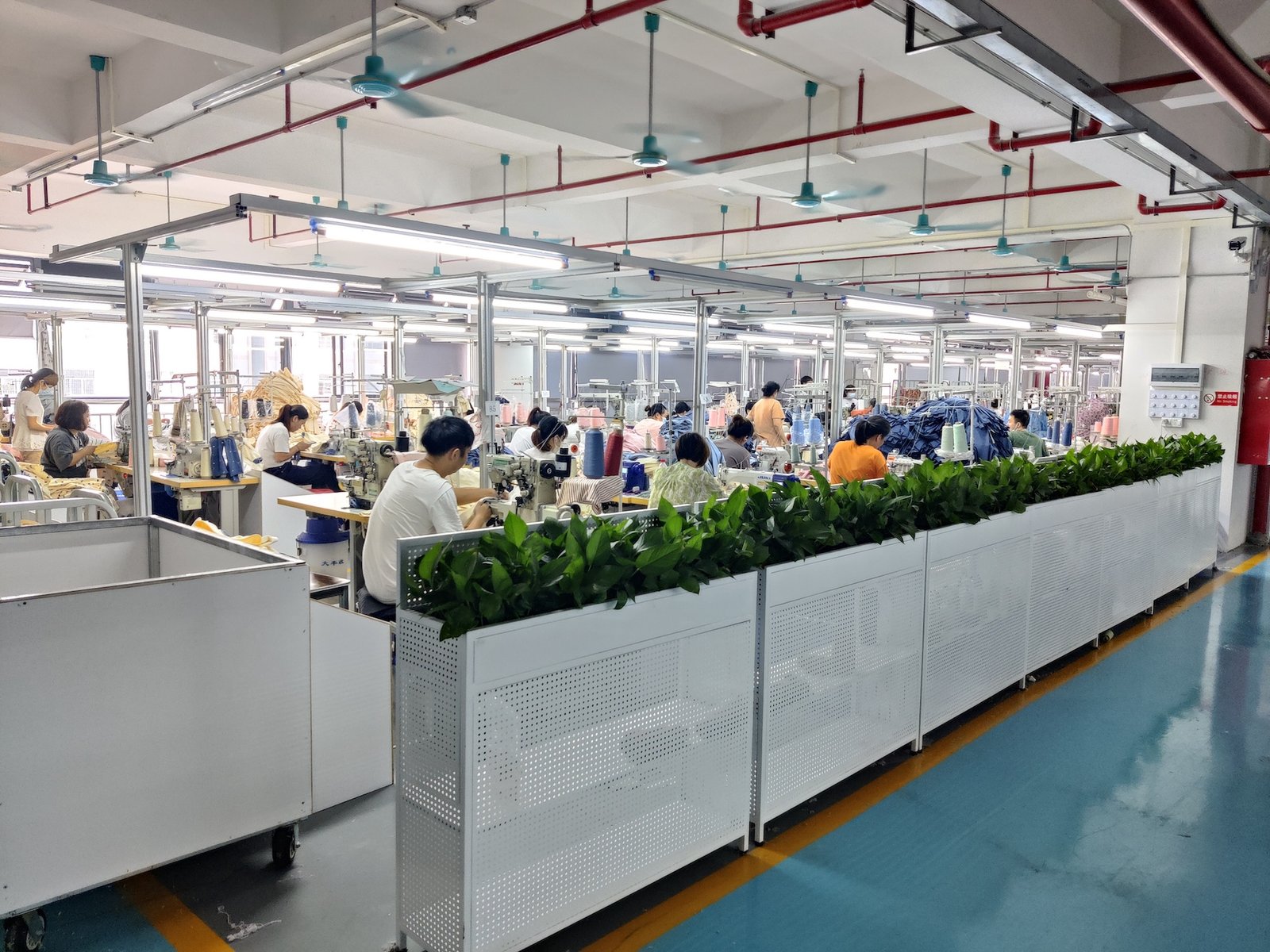
This is the section where we put on the factory hat. Everything above is industry-standard. What follows is specifically how we run it at our 8,000 m² Huizhou facility, with 300+ workers, 500 machines, and a monthly capacity of 1,000,000 pieces across cotton, cotton/spandex, bamboo, EcoCosy®, modal, and ice-silk fabrics.
Our Six Quality Checkpoints — the Real Daily Rhythm
- Pre-production review — tech pack, fabric mill certificate, and lab dip signed off before the first needle drops.
- Fabric inspection — 4-point system on every roll, logged into our ERP.
- Cutting inspection — cut-piece count vs. marker, grain direction, panel integrity.
- Inline inspection — line walks every 30–60 minutes, line-log captured in ERP.
- Finished-goods inspection — 100% visual + measurement on every garment.
- Needle detection + AQL final inspection — 100% needle-detector pass, then ISO 2859-1 AQL sample for the buyer’s release decision.
Every checkpoint is documented. Every defect is photographed and attached to the production order in our ERP. Every AQL inspection generates a written report signed by the QC supervisor, the factory production manager, and (for third-party programs) the buyer’s inspector.
Why Our Defect Rate Stays Below 0.3%
Three habits, not one magic tool:
- Upstream prevention beats downstream detection. Most of our defect reduction came from tightening Stages 1–4, not from tightening AQL. Once fabric, cutting, inline, and finished goods are clean, AQL is a formality.
- Needle detection is mandatory on every children’s garment, every time, no exceptions. The detector is calibrated at the start of every shift with a test piece; the log is signed.
- The defect list is in the tech pack, not in someone’s head. A buyer-approved defect list is the single best predictor of a clean shipment.
Certifications on File
Our children’s wear QC system is documented and audited by:
- GB 31701 Class A — the highest safety class for infant and children’s textile products in China.
- CPC (Children’s Product Certificate) — required for the U.S. market under CPSIA.
- OEKO-TEX Standard 100 (In Progress) — underway for the 2026 audit cycle.
- Independent verification by SGS, TÜV SÜD, and Intertek on file for fiber content, colorfastness, and seam strength.
What Audits Verify
Every claim above is supported by an audit document on file. GB 31701 Class A reports are renewed annually through SGS. CPC certifications are issued per shipment under CPSIA. OEKO-TEX Standard 100 is currently in progress for the 2026 audit cycle. SGS, TÜV SÜD, and Intertek reports cover fiber content, colorfastness, and seam strength. The audit documents themselves are not published on our website, but we share them by email on request — reply to this page’s email address with the document you need.
See It In Action — Factory Walkthrough Video
Every stage above is easier to understand in 90 seconds of video than in 90 paragraphs of text. We’ve prepared a private factory walkthrough video that shows our sewing floor, needle-detection station, finished-goods bench, and AQL inspection station in real production. The video is intentionally not published — it’s shared on a one-to-one basis so we can talk you through what you’re seeing.
Reply to this page’s email address and ask for the “QC Walkthrough” video. We’ll send a private link by email (no call required) along with the matching defect list and AQL report.
FAQ — 30 Buyer Questions Answered
1. What is AQL in garment quality control?
AQL (Acceptance Quality Limit) is the worst quality level, expressed as a percentage of defective items in a sample, that a buyer considers acceptable for a production lot. The lot is accepted or rejected based on whether defects in a random sample drawn under ISO 2859-1 / ANSI Z1.4 fall above or below a published Accept (Ac) / Reject (Re) number. It is the global standard for garment AQL inspection.
2. Why is AQL 2.5 the most common level in apparel?
AQL 2.5 balances statistical protection with practical inspection cost. It catches meaningful quality problems while keeping the sample size manageable (typically 1–5% of the lot). For most non-critical apparel, it is the default written into tech packs.
3. When should buyers use AQL 1.5 vs AQL 2.5 vs AQL 4.0?
AQL 1.5 (tight) is for premium or first orders with a new factory, where the buyer wants stronger protection. AQL 2.5 (standard) is the default for most kids’ underwear programs. AQL 4.0 (loose) is appropriate only for low-risk cosmetic defects on repeat programs with a proven factory.
4. Who decides the AQL level for an order?
The buyer decides, in the tech pack. The factory agrees by signing the tech pack. In a private label or OEM program, the buyer has full authority on AQL. In an ODM program, the factory may suggest a level based on the product category, but the buyer has the final say.
5. Does AQL guarantee zero defects?
No. AQL is a sampling plan, not a defect-elimination plan. It provides a statistical confidence level (typically around 95%) that the lot is below the chosen defect percentage. A passing lot still has defects — just below the Accept threshold. Zero-defect programs require additional measures (100% inspection, Six Sigma process control, or pre-production capability studies).
6. Can buyers change AQL mid-production?
Yes, but with consequences. Tightening AQL (e.g. from 2.5 to 1.5) will increase the lot rejection rate and may trigger 100% sorting. Loosening (e.g. from 2.5 to 4.0) will let more defects through. Any change should be in writing, dated, and signed by both parties before the next inspection.
7. Should kids’ underwear use AQL 1.5 for extra safety?
For Critical defects, AQL is always 0% — that’s the safety floor. For Major and Minor defects, AQL 1.5 instead of 2.5 is a defensible choice for premium or first-shipment programs. The cost is more frequent lot rejections and 100% sorts. For repeat programs with a proven factory, AQL 2.5 is generally sufficient.
8. What is the difference between AQL 1.0, 1.5, 2.5, and 4.0?
Numerically, the AQL value is the upper boundary of acceptable defects in the sample. Lower AQL = tighter quality. AQL 1.0 allows roughly 1% defective in the sample; AQL 4.0 allows roughly 4%. The practical effect is in the Ac/Re numbers (see the table above) and the resulting lot rejection rate.
9. What is a Critical Defect in garment inspection?
A Critical defect is one that endangers the user, fails mandatory regulation, or renders the product unsellable. For kids’ underwear, the most common Critical defects are broken needles (caught by detector), sharp metal, choking-hazard trims, flammability failures, and illegal dyes. Critical defects always have AQL 0% acceptance.
10. What is a Major Defect?
A Major defect reduces usability, sellability, or noticeably affects comfort and appearance. Examples: broken stitch, missing elastic, hole >3 mm, visible stain, off-size by >1.0 cm, twisted waistband, mislabel. Most kids’ underwear programs specify AQL 2.5 on Major defects.
11. What is a Minor Defect?
A Minor defect does not affect usability or sellability but falls below the brand’s finish standard. Examples: untrimmed loose thread, slight shade variance within A-class tolerance, light surface mark visible only on close inspection, minor pilling. Most programs specify AQL 4.0 on Minor defects.
12. What is ISO 2859-1?
ISO 2859-1 is the international standard titled Sampling procedures for inspection by attributes — Single sampling plans by AQL. It defines inspection levels (General I/II/III, Special S-1–S-4), lot-to-sample relationships, and the Ac/Re numbers used in every garment AQL inspection worldwide outside North America’s specific adoption.
13. What is ANSI/ASQ Z1.4?
ANSI/ASQ Z1.4 is the U.S. national adoption of the same system, published by the American Society for Quality. The Ac/Re numbers are identical to ISO 2859-1. North American buyers typically reference Z1.4; Asian and European factories typically reference ISO 2859-1. Both are correct.
14. How many pieces are inspected in an AQL sample?
It depends on the lot size. For a 1,200-piece lot at General Level II, the sample is 80 pieces (about 6.7%). For a 10,000-piece lot, the sample is 200 pieces (2%). For a 100,000-piece lot, the sample is 315 pieces (0.3%). Larger lots don’t need proportionally larger samples — that’s the statistical power of AQL.
15. What happens if a lot fails AQL inspection?
The factory has three options: (1) sort 100% of the lot, remove defects, and resubmit for a new AQL inspection; (2) scrap the failed lot and produce a new one; (3) accept the reject and ship at a discount (rare, only by mutual agreement). In most cases, option 1 is chosen because re-sorting is cheaper than scrapping.
16. What is General Inspection Level II?
General Inspection Level II is the default inspection level in ISO 2859-1 / Z1.4. It is what the Ac/Re numbers in this guide are based on. Level I is looser (smaller sample); Level III is tighter (larger sample). Special Levels S-1 through S-4 are for destructive tests only and are not used for visual AQL.
17. What are Special Inspection Levels S-1, S-2, S-3, S-4?
Special Levels are smaller sample sizes used when the test is destructive (the test piece is consumed) or expensive. They are not used for visual garment AQL inspection. Examples of where Special Levels apply: tensile-strength testing, colorfastness-to-washing, fiber-content lab analysis.
18. What is the difference between single sampling and double sampling?
In single sampling, one sample is drawn and the decision is made. In double sampling, a second smaller sample is drawn if the first sample falls in a “gray zone” (between Ac and Re for some categories). Single sampling is simpler and is the default in most garment programs.
19. What is needle detection and why is it required for kids’ underwear?
Needle detection passes every garment through a calibrated machine that detects ferrous and non-ferrous metal fragments — primarily broken sewing-machine needles that can become embedded in the fabric during sewing. For children’s garments, a single broken needle is a Critical defect (AQL 0%) because of the risk of laceration or ingestion. Needle detection is mandatory in any responsible children’s wear program.
20. Is AQL 2.5 enough for children’s garments?
For Major and Minor defects, AQL 2.5 is the industry standard and is considered sufficient for most kids’ underwear programs when paired with 100% needle detection and GB 31701 Class A certification. For Critical defects, AQL is always 0% regardless of the program. Premium or first-shipment programs may tighten to AQL 1.5.
21. How does pre-shipment inspection (PSI) differ from inline AQL?
Pre-shipment inspection (PSI) is the final AQL inspection done when the lot is 80–100% complete and at least 80% packed — the “release gate.” Inline inspection happens during sewing, every 30–60 minutes on the line, and is a process control, not a release decision. PSI is what determines whether the goods ship.
22. What is the Accept number (Ac) and Reject number (Re)?
Ac is the maximum number of defects allowed in the sample for the lot to pass. Re is the minimum number of defects that causes the lot to fail. For example, at AQL 2.5 / General Level II / Lot 501–1,200: Ac=5, Re=6 — the lot passes with 5 or fewer Major defects; the sixth Major defect rejects the lot.
23. Can buyers request AQL 1.0 for premium orders?
Yes. AQL 1.0 is a valid AQL level in ISO 2859-1 / Z1.4 and can be specified in the tech pack. It is commonly used for very premium or first-shipment programs. The trade-off is more frequent lot rejections and higher inspection cost. For most kids’ underwear programs, AQL 1.5 or 2.5 is more common.
24. What documents should a factory provide for QC?
At minimum: (1) signed tech pack with defect list and AQL spec; (2) fabric mill certificate; (3) lab dip approval record; (4) needle detector daily log; (5) inline inspection logs; (6) AQL inspection report with sample calculation, defects found, and pass/fail decision; (7) pre-shipment photo set; (8) packing list and commercial invoice. The downloadable report template in this guide covers items 6–7.
25. How long does an AQL inspection take?
For a typical 1,200-piece lot with an 80-piece sample, an experienced inspector needs about 4–6 hours including selection, examination, defect classification, and report writing. Larger lots take longer in absolute time but not proportionally — a 10,000-piece lot with a 200-piece sample typically takes 8–12 hours.
26. What is a good defect rate for kids’ underwear?
For a well-run factory with documented QC, a final defect rate (post-AQL) below 0.5% is achievable for most programs. Top-performing factories, including our own, target below 0.3% as a standard. Anything above 1% suggests a process control problem that should be addressed upstream, not just at AQL.
27. Can OEM factories self-inspect without third-party?
Yes, and most do. The AQL report can be issued by the factory’s own QC team provided the team is independent of the production floor. Many buyers still use a third party (SGS, TÜV SÜD, Intertek) for first orders or after a spec change, then switch to factory self-inspection for established repeat programs.
28. What is DUPRO (during production inspection)?
DUPRO is an inspection conducted when the lot is 20–40% complete, before full production has run. It catches problems early enough to correct mid-stream rather than at finished goods. Buyers often use DUPRO on first orders with a new factory, or after a fabric or style change, then rely on final AQL for repeat orders.
29. How does fiber composition testing fit with AQL?
Fiber composition is a Critical-adjacent regulatory requirement, not a visual AQL item. It is verified by a lab test (typically on a Special-Level S-2 sample) rather than by AQL random inspection. In the EU, fiber labeling failures have made up roughly 37% of all clothing compliance failures in recent market-surveillance sweeps — this is a separate risk from AQL but is part of the same QC program.
30. What is the connection between AQL and OEKO-TEX / GB 31701 Class A?
AQL inspects the physical garment for visible defects. OEKO-TEX Standard 100 and GB 31701 Class A test the materials for harmful substances. Together they cover both the look and the safety of the garment. A complete kids’ underwear QC program uses AQL for appearance/construction and OEKO-TEX / GB 31701 Class A for chemistry. At our factory, OEKO-TEX Standard 100 is currently in progress for the 2026 audit cycle.
Next Steps — Get a Quote or Tech Pack
If you’re sourcing kids’ underwear from China and want to see what a documented, audit-ready QC system looks like in practice, we can help:
- Reply to this page’s email with your target product (girls’ briefs, boys’ boxers, infant onesies, pajama sets, etc.), fiber preference, size range, and approximate annual volume.
- We’ll send back a capability sheet, a reference tech pack, and a sample AQL inspection report from a comparable program — all by email, no call required.
- If the fit is right, we’ll quote FOB Huizhou, send pre-production samples, and walk you through our 12-step customization process before the first needle drops.
For more on how we work end-to-end, see our private label kids’ clothing page, our wholesale OEM / ODM service page, or the factory and manufacturing overview. For compliance context that pairs with this QC guide, see what OEKO-TEX Standard 100 means for kidswear and our custom kids’ underwear FAQ.
Want the QC Checklist and Inspection Report as standalone PDFs?
Both templates are free to download — no email required. Use them with your existing factory, or bring them to us as the standard we will work to.
Download QC Checklist
Download Inspection Report
Request a Quote by Email