
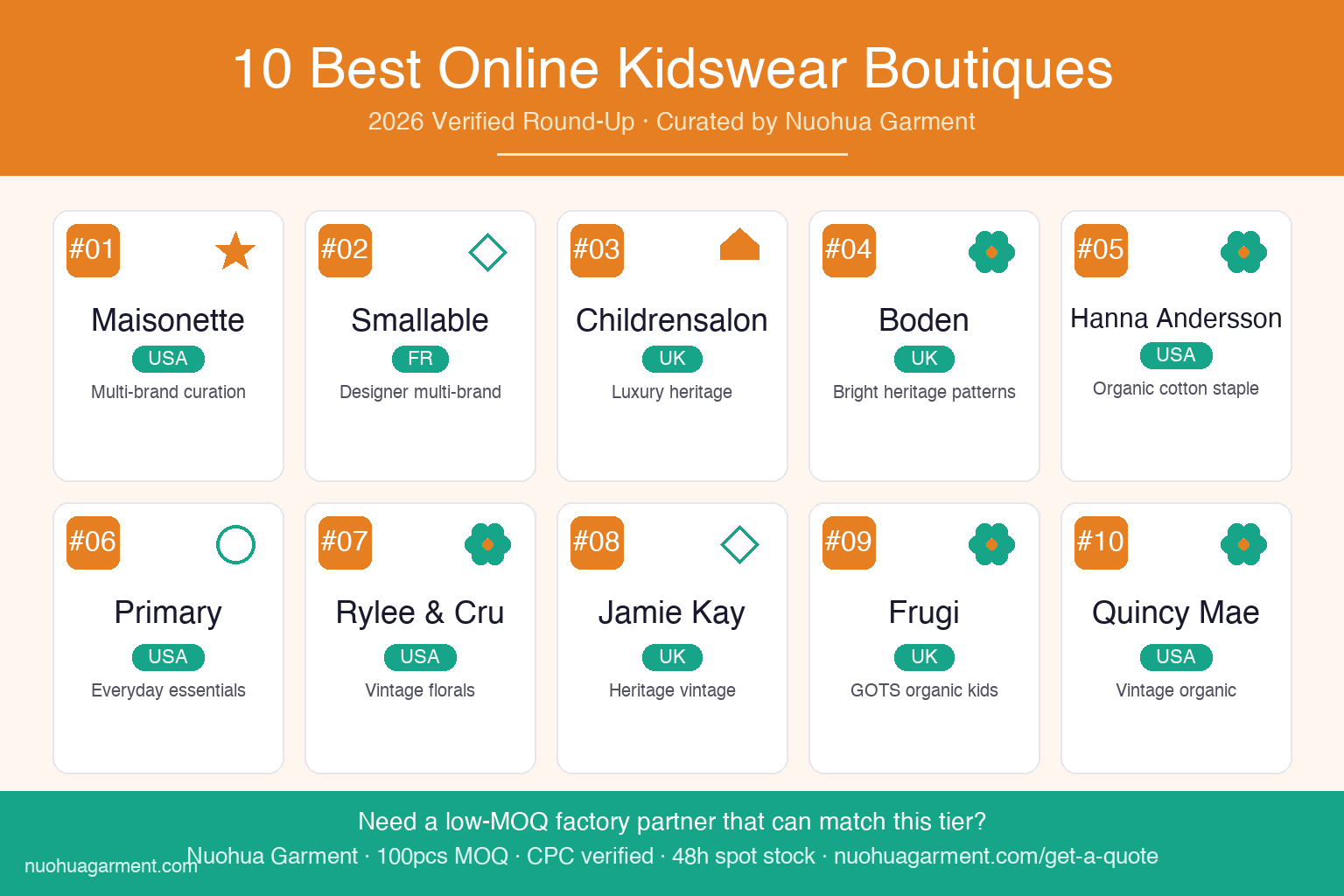
If you are building a kidswear brand — or already run a boutique — the fastest way to sharpen your own point of view is to study the stores that do “unique” well. This guide rounds up the best online kids clothing boutiques of 2026 — the 10 most distinctive, customer-loved stores we think a new label should study. None of them are manufacturers; they are the brands and retailers your future customers already shop. In other words, this is a map of your customer’s customer.
We selected these for how clearly each owns a niche — because a clear niche is exactly what a new kidswear label needs to survive the noise of a generic marketplace. A founder who can name the three boutiques their brand “sounds like” is already ahead of 90% of first-time labels.
How We Selected These Boutiques
We did not rank by revenue or Instagram follower count. Those numbers are noisy and easy to buy. Instead, every boutique on this list earned its place against five criteria we think actually matter for a brand studying the market:
- Distinct point of view — A clear, ownable aesthetic. Not another generic catalog of “cute kids’ clothes,” but a store you can recognize with the logo cropped out. This is the single hardest thing for a new label to build, and the easiest to spot when someone else has done it.
- Product integrity — Fabric quality, construction, and (where claimed) certification you can verify. We favored stores that talk about how a garment is made, not just how it looks.
- Cross-border reach — Ships beyond its home market. A boutique that serves three continents is a better study in scalable brand-building than one that only serves a zip code.
- Brand curation — Surfaces smaller labels worth knowing. Multi-brand stores that act as taste-makers teach you how a buyer’s eye actually works.
- Customer trust — Returns, reviews, and service that hold up under scrutiny. A beautiful store with a hostile return policy is a cautionary tale, not a model.
The throughline: each of these ten stores wins by being specific. That is the lesson, and it is the part most new brands skip.
The 10 Boutiques at a Glance
Before the deep dives, here is the quick comparison. “Price tier” is a broad read of where each store sits, not a precise number — use it to match a boutique to your own brand’s ambition.
10 Best Online Kids Clothing Boutiques
1. Maisonette (USA)
Maisonette is a curated marketplace rather than a single label — a vetted mix of children’s designer brands under one roof. That distinction matters: a marketplace’s job is taste, not manufacturing. For a founder, Maisonette is the cleanest possible study in curation as a business model. The store does not make the clothes; it makes the edit. Parents shop there for elevated, occasion-ready looks and the reassurance that someone with a buyer’s eye already filtered the noise. The lesson for a new label is uncomfortable but useful — before you obsess over your own product, obsess over the point of view that would make a store like this want to carry you. A brand that cannot answer “what shelf do I belong on?” is not ready to produce. Maisonette also shows how multi-brand framing lets a retailer serve a wide taste range without diluting any single label.
2. Smallable (France / EU)
Smallable is a Paris-rooted edit that blends kids’ fashion with toys, nursery, and lifestyle — a cross-category merchandising play. Where Maisonette is pure fashion curation, Smallable is a world. That matters because basket size and repeat visits are what keep a boutique alive, and a store that sells a child’s entire room (not just their outfit) naturally earns more touches per customer. For a brand founder, Smallable is the case study in lifestyle positioning: the clothing is the hook, but the broader context is what builds loyalty. The risk to study here is focus — a store that sells everything can drift into sameness. Smallable avoids it by keeping a consistent Parisian, cross-category sensibility across every category it adds. If your brand has a “world” behind it (a nursery aesthetic, a playroom mood), this is the model to reverse-engineer.
3. Childrensalon (UK)
Childrensalon is the reference point for premium positioning done at international scale. A long-established luxury children’s retailer carrying high-end designer labels and formalwear, it serves a global clientele that buys christening gowns, wedding-page outfits, and occasionwear with serious intent. For a founder, it is the proof that kidswear is not a discount category — there is a durable, high-margin market for clothing a family buys for a moment. The merchandising lesson is specificity of occasion: instead of “clothes for kids,” Childrensalon sells “what your child wears to the event that matters.” That clarity justifies price and builds trust. The cautionary flip side is that luxury positioning demands flawless service and returns handling; a premium promise broken once travels faster than a premium promise kept. Study the service model, not just the price tags.
4. Boden (UK)
Boden is known for colorful, characterful family clothing with a reputation for durable construction — and it is a masterclass in brand personality expressed through print and color. Where luxury stores win on restraint, Boden wins on exuberance that still reads as quality. The prints are recognizable without being loud; the color stories are confident. For a new label, Boden is the argument that “personality” is not decoration — it is the product. A founder who can describe their brand’s “print voice” in one sentence has a moat. Boden also shows how a family (not just kids) range extends lifetime value: a customer acquired for a child often stays for the whole household. The construction reputation matters too — durable is a promise you can keep, and keeping it is cheaper than advertising.
5. Hanna Andersson (USA)
Hanna Andersson is a heritage name in soft organic-cotton children’s basics and pajamas, with a strong reputation for snug-fit sleepwear and matching-family sets. It is the benchmark for organic-cotton trust built over decades, not claimed in a press release. For a founder, the lesson is patience: Hanna did not invent “organic” — it earned the association through consistent product. The snug-fit pajama line is also a quiet masterclass in compliance as a feature: sleepwear for children carries real safety rules, and a brand that makes compliance feel like care (not legalese) wins parent trust. The matching-family set strategy extends the brand into gifting and tradition. If your label touches skin — underwear, sleepwear, baby basics — Hanna is the standard for how “soft” and “safe” become one promise.
6. Primary (USA)
Primary is logo-free, mix-and-match organic essentials at accessible price points — a clean example of minimal positioning done without sacrificing quality cues. The absence of a loud logo is itself the statement: the clothes are confident enough to need no badge. For a founder, Primary is the proof that “minimal” is not “cheap” — the fabric and construction still have to read as considered. The mix-and-match system is a merchandising lesson in wardrobe logic: sell the combinations, not just the units. Price accessibility widens the funnel without dropping the quality signal, which is a hard balance most new labels get wrong on one side or the other. Primary shows the disciplined middle path. The takeaway: restraint, executed well, is a position you can defend against both cheaper and fancier competitors.
7. Rylee & Cru (USA)
Rylee & Cru is built on artist-driven collections with illustrated prints and a recognizable hand-drawn aesthetic — the case study for signature print identity. The prints are the brand; everything else (silhouette, palette) serves them. For a founder, this is the clearest example of a visual moat: a print library no one else has is defensible in a way a “style” is not. The risk is imitation, which is why original artwork (not licensed clip-art) matters — and why a manufacturer who protects your files and supports custom development is part of the strategy, not a footnote. Rylee & Cru also shows the power of a consistent hand: across seasons, the illustrated world stays recognizable even as individual prints change. If your brand’s future is in prints, study how a single artistic point of view scales across a catalog.
8. Jamie Kay (New Zealand)
Jamie Kay works in neutral, gentle palettes for baby and kids’ essentials with a soft, understated feel — and it shows how restraint can read as premium. In a category addicted to brightness, Jamie Kay’s muted tones signal calm, and calm signals quality to a specific parent. For a founder, it is the argument that “quiet” is a lane, not a lack of confidence. The softness is operational, too: fabrics and finishes have to actually feel gentle, or the palette reads as a costume. The lesson for a new label is that a narrow sensory promise (soft, neutral, calm) can support a full range without the brand ever shouting. Jamie Kay also demonstrates how a small, coherent world travels internationally — the aesthetic needs no translation.
9. Frugi (UK)
Frugi is a sustainability-led UK brand known for organic children’s clothing and playful character prints — proof that eco positioning and fun design coexist. Too many “green” labels mistake seriousness for virtue and forget the child. Frugi keeps the playful characters front and center while letting the organic story sit underneath. For a founder, the lesson is that values are a reason to look closer, not a substitute for delight. The organic claim also has to be specific to be believed — name the standard, show the chain. Frugi’s longevity shows that a values-led brand can outlast trend cycles if the product still makes a kid smile. The cautionary note: “eco” without documentation is just a word, so the certification behind the claim is the real asset.
10. Quincy Mae (USA)
Quincy Mae is minimal organic baby and kids’ basics in clean neutrals — a focused label that does a narrow range exceptionally well. The lesson, in two words: edit hard. Where other labels expand to fill the catalog, Quincy Mae stays in its lane and lets the discipline be the brand. For a founder, this is the antidote to the “more SKUs = more sales” trap. A tight range is easier to produce, easier to QC, easier to photograph, and easier for a customer to understand. The organic-cotton basics in clean neutrals also travel as gifts and staples, not just purchases. If you are a small label deciding what not to make, Quincy Mae is the example to sit with: the edit is the strategy.
Which Boutique Fits Your Needs?
Different founders should study different stores. Match the store to your stage:
- Pre-launch, defining your voice? Study Maisonette and Smallable — they show how curation and a “world” create desire before a single garment ships.
- Going premium or occasionwear? Childrensalon is the positioning reference; study its service model as much as its price tags.
- Building everyday organic trust? Hanna Andersson, Primary, Quincy Mae, and Frugi are the benchmarks — note how each expresses “organic” differently.
- Betting on a signature print? Rylee & Cru is the print-identity case study; protect the artwork.
- Drawn to restrained neutrals? Jamie Kay proves quiet can be premium — and travels without translation.
- Want personality through color? Boden shows exuberance and durability are not opposites.
Pick the one closest to your brand’s voice and reverse-engineer its buying logic — what it stocks, what it skips, and why. That logic is more valuable than any single product on its shelf.
What Should You Check Before Ordering From a Boutique?
Whether you are shopping these stores or benchmarking them, five checks separate a smooth purchase from a costly mistake:
- Shipping & duties — Does the price include landed cost to your country, or will duties arrive as a surprise invoice? Cross-border boutiques vary wildly here; the friendly sticker price is not the real price until duties are in.
- Sizing — Kids’ sizing varies by region (EU vs US vs UK vs AU). A “size 4” is not a “size 4.” Check the store’s size chart and, if you are a brand, build your own spec sheet so your manufacturer cuts to one standard.
- Fabric claims — “Organic” should name a standard (GOTS, OEKO-TEX, or an equivalent). If a store cannot name it, treat the claim as marketing, not fact. This is exactly the scrutiny your own customers will apply to you.
- Returns — Kids grow between purchase and wear. A fair return window is a signal of confidence, not a loophole. Study how each store handles it; that policy is part of the brand.
- Certification for skin-contact items — For underwear, sleepwear, and baby basics, look for documented compliance, not just reassuring words. A Children’s Product Certificate from a recognized lab, and a standard like GB 31701 Class A for skin-contact textiles, are the kind of proof that survives a customs check.
What Kidswear Brands Can Learn From These Boutiques
The boutiques above win on clarity: each owns a narrow idea — organic trust, the Parisian edit, artist prints, quiet neutrals — and says no to everything else. A new label that tries to be all of them at once loses. Pick one lane and defend it.
And here is the part that matters most if you are building a label rather than shopping one: every boutique on this list is a customer of a manufacturer. The product they sell was cut, sewn, printed, and QC’d by a factory behind the label. The boutique owns the taste; the factory owns the making. So the real question for a founder is not “which boutique do I admire?” but —
What Should a Kidswear Brand Look For in a Manufacturing Partner?
- Low MOQ — 2 pcs on selected in-stock styles, colors and sizes on stock-fabric programs lets you test a point of view without betting the warehouse. Most volume mills start at 500–1,000 pcs, which forces you to guess. Low MOQ turns guessing into learning.
- Verified compliance — A real Children’s Product Certificate from a CPSC-recognized lab (for example, EQ-T, Lab ID 1693) and GB 31701 Class A for skin-contact items. Ask for the lab name and ID — a vague “we are certified” is not compliance.
- Speed — A factory with spot-stock can ship basics in 48 hours; made-to-order should run 15–30 days after sample approval. Speed is a competitive asset, not a courtesy.
- QC discipline — Staged inline checks plus a dedicated needle-detection pass and a pre-shipment AQL report. The boutiques above would not survive one faulty zipper going viral; neither will you.
- Customization — Your prints, trims, and tech pack supported as original development, not just off-the-shelf relocation. Your signature print (see Rylee & Cru) is only defensible if the factory protects it.
A manufacturing partner who clears those five bars is what turns a boutique-inspired idea into a shippable, compliant, review-worthy product.
Conclusion
The best kidswear boutiques in 2026 win by being specific. Whether you shop them or study them, the takeaway is the same: own a narrow idea, prove product integrity, and — if you are the one making the label — partner with a manufacturer who makes compliance and low MOQ effortless. The boutiques on this list are your customers’ customers. Learn their logic, then go build the label they would want to carry.
—
Frequently Asked Questions
Are these boutiques manufacturers?
No. They are retailers and brands; the garments are produced by third-party factories. This guide is about curation and positioning, not production. If you need production, see the manufacturer checklist above.
Which boutique is best for organic kids’ clothing?
Hanna Andersson, Primary, Quincy Mae, and Frugi are widely known for organic-cotton lines. Always confirm the specific certification (GOTS, OEKO-TEX, or an equivalent) per product rather than trusting the word “organic” alone.
Can a new brand copy a boutique’s style?
You can study their positioning, but not their protected prints or trademarks. Build your own point of view and use a manufacturer for original development from your tech pack and artwork.
How do these boutiques ship internationally?
Most listed ship cross-border (EU/UK/US/AU/NZ). Check landed cost and duties before ordering — the displayed price is rarely the final price.
What MOQ do I need to launch my own kidswear label?
A verified low-MOQ specialist can start at 2 pcs on selected in-stock styles, colors and sizes on stock-fabric programs — enough to test the market and a single boutique’s buy without overstock.
Do I need CPC compliance if I sell via a boutique?
If you are the brand or importer selling children’s apparel into the US, you are responsible for the CPC regardless of sales channel. Your manufacturer should provide test support and name the lab.
What does GB 31701 Class A mean?
China’s strictest class for children’s textiles (infant and skin-contact). A compliant factory meets it for skin-contact kids’ items — a strong quality signal even for export markets.
How fast can a manufacturer ship?
Spot-stock basics can ship in 48 hours; made-to-order typically 15–30 days after sample approval. Confirm stock status per style before you promise a launch date.
What is a tech pack and do I need one?
It is your blueprint — sketch, measurements, fabric, trims, print, and packaging. Yes; a complete pack cuts sampling rounds. See our private-label guide.
Can a small brand get custom prints at low MOQ?
Yes. Low-MOQ specialists support custom prints and trims at 2 pcs on selected in-stock styles, colors and sizes on stock-fabric programs using your artwork or a print library, and should protect your files as original development.
How do I choose between a marketplace and a single-label boutique model?
A marketplace (like Maisonette) sells curation; a single label sells a point of view. If you are one label, study the single-label stores here for voice, and study the marketplace for how a buyer’s eye works. Most new brands should start as a single label with a sharp voice.
Why does fabric certification matter if the clothes look fine?
Because skin-contact children’s items face real safety rules and customs checks. Documented compliance (a named lab, a standard like GB 31701 Class A) protects you from recalls, seizures, and lost boutique accounts — none of which show up in a product photo.