
Reading Fabric Weight: What GSM Really Tells You About Kids’ Underwear Comfort
When a buyer opens a tech pack and sees “180 GSM” or “220 GSM,” it is tempting to treat that number as a quality score — higher must feel better, right? On the mill floor it does not work that way. Reading fabric weight correctly is the difference between a comfortable, sellable garment and an expensive miss for any GSM kids underwear project. GSM (grams per square metre) is a precise, useful measurement, but it only describes one property of a knit: how much fibre sits in a square metre of cloth. It says nothing about the yarn, the stitch structure, the finish, or the hand-feel. This guide explains what GSM actually tells you about kids’ underwear and bodysuits, which weight bands suit which products, and why our team at Nuohua Garment routinely talks boutique founders out of chasing the heaviest fabric on the shelf.
On this page
1. What GSM Actually Measures (and What It Doesn’t)
GSM is the mass of one square metre of finished knit fabric. It is a thickness/coverage proxy, not a softness or safety rating — a 240 GSM fabric can feel board-stiff or buttery soft depending entirely on yarn and knit structure.
GSM stands for “grams per square metre.” To measure it, a lab cuts a precise circle or square of fabric (often using a 100 cm² circular die), weighs it on a calibrated balance, and scales the result to a full square metre. A 100 cm² swatch that weighs 2.0 grams equals 200 GSM. The method is simple and repeatable, which is exactly why it shows up on every fabric specification sheet.
What GSM does not capture is the part of “comfort” that a parent actually feels. A 220 GSM single jersey and a 220 GSM interlock are the same weight per area, yet they behave like different materials: the interlock is stable, opaque, and substantial; the jersey is lighter-draping and will curl at the edges. The number is identical because the yarn mass is identical. The experience is not. So the first habit to build as a buyer is to read GSM next to the knit type and the fibre content, never in isolation.
At Nuohua Garment we record GSM on every incoming roll as part of our kids’ underwear manufacturing process. It is one input into a 6-stage QC system; it is never the only one. When a brand tells us “we want heavy, premium underwear,” our first question is not “how heavy” but “what problem are you solving — opacity, durability, or warmth?” The answer changes the right GSM band entirely.
2. GSM Bands for Kids’ Underwear and Bodysuits
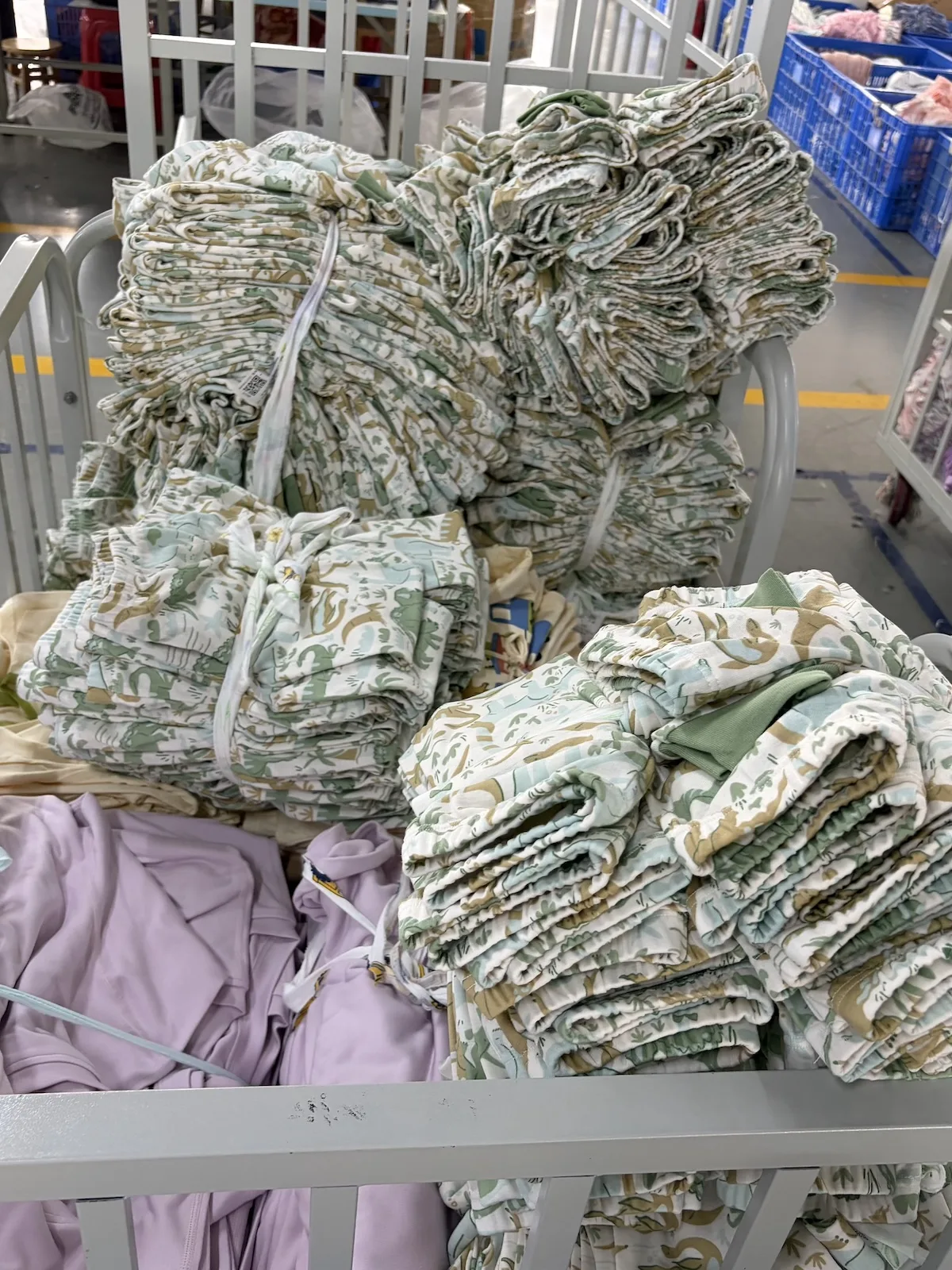
For kids’ underwear and bodysuits, the practical knit window is roughly 150–260 GSM. Lightweight 150–180 GSM suits summer jersey briefs; 200–240 GSM interlock is the workhorse for everyday underwear and bodysuits.
Knit fabrics used in children’s intimate apparel span a wide range, but most production lands in a narrow, deliberate band. The table below maps weight to typical use and to the hand-feel a brand should expect. These are educational industry ranges, not a fixed catalogue — exact numbers shift with fibre and knit.
| GSM band | Knit / common use | Typical product | Expected hand-feel |
|---|---|---|---|
| 120–150 | Light single jersey | Summer singlets, thin layering vests | Airy, translucent at edges, very light; needs careful opacity checks |
| 150–180 | Standard single jersey / light rib | Everyday briefs, light bodysuit bodies | Soft and breathable, drapes easily; moderate opacity |
| 180–210 | Midweight jersey / light interlock | Three-season underwear, leggings | Substantial yet flexible; good opacity for most skin tones |
| 210–240 | Interlock (double-knit) | Everyday underwear, bodysuits, sleep bodies | Stable, opaque, smooth both sides; the Nuohua in-stock sweet spot |
| 240–280 | Heavy interlock / French terry (no fleece) | Cool-season bodysuits, sleep rompers | Heavy, warm, very opaque; less stretch recovery if over-built |
Our two in-stock programmes sit firmly inside the proven window. The 91.9% Lenzing™ Modal + 8.1% Spandex interlock runs at 220–240 GSM, and the 49.9% Lenzing™ Modal + 43.3% Cotton + 6.8% Spandex interlock sits around 220 GSM. Both are double-knit interlocks — the structure, not just the weight, is what gives them their stable, opaque character. If you are building a private-label line, anchoring to an in-stock weight like this removes a development step and its setup fee.
3. Hand-Feel, Opacity, and Durability at Different Weights
Opacity and dimensional stability rise with GSM; softness does not automatically. Durability improves up to a point, then plateaus — an over-heavy knit can actually lose stretch recovery and feel rigid.
Let us separate the three properties parents care about most, because GSM affects each differently.
Opacity
This is where weight matters most for kids’ underwear. A single jersey at 150 GSM can become semi-translucent when stretched across a hip or when a lighter skin tone shows through. Interlock at 220 GSM stays opaque under the same strain because the double-knit construction stacks two face layers. If “no show-through” is a brand promise, specify both a minimum GSM and the knit structure — weight alone on a jersey will not guarantee it.
Durability
Heavier knits resist abrasion and snagging better in the wash, which helps with the 40–60 wash cycles a kids’ garment typically sees. But durability is also a function of yarn tenacity and stitch density. A 200 GSM fabric with a tight, well-set stitch will outlast a loosely knitted 240 GSM fabric. Weight is a contributor, not the whole story.
Hand-feel
Hand-feel (the “softness” a hand judges) is dominated by fibre and finish. A 220 GSM Lenzing™ Modal interlock feels smoother than a 220 GSM carded cotton interlock because the modal fibre has a rounder cross-section and a finer count. Chasing GSM to win a softness contest is the wrong lever — you should be choosing fibre and yarn count.
| Property | Low GSM (150) | Mid GSM (200) | High GSM (250) |
|---|---|---|---|
| Opacity | Variable | Good | Excellent |
| Breathability | Excellent | Good | Reduced |
| Stretch recovery | High (if elastane present) | High | Can drop if over-built |
| Wash durability | Moderate | Good | Very good |
| Drape | Flowy | Balanced | Stiff |
4. Breathability and the GSM Balance
Breathability falls as GSM climbs because there is simply more fibre blocking airflow. For a garment worn 12+ hours against skin, the sweet spot is usually 180–220 GSM with an open, well-relaxed knit.
Kids run warm and they do not sit still. An intimate layer that traps heat against the skin quickly becomes a comfort and rash risk. Heavier fabric is not “warmer” in a helpful way for underwear — it is just less permeable. The balance our pattern team recommends for all-day underwear is a midweight interlock around 210–230 GSM with a relaxed, breathable stitch, plus an elastane content (our in-stock blends use 6.8–8.1% Spandex) that lets the fabric recover without compressing the body.
There is a subtlety: a tightly packed 180 GSM jersey can be less breathable than a loosely knitted 220 GSM interlock, because stitch density (courses and wales per centimetre) also governs air permeability. This is why we always measure air permeability on development fabrics rather than inferring it from GSM. For sleepwear, the calculus shifts — see our notes on fabric weight and night comfort for sleepwear, where warmth matters more and the MOQ structure differs.
5. How to Specify GSM in a Tech Pack
Write GSM as a range (e.g., 215–235 GSM), paired with knit type, fibre composition, and an allowed tolerance. A single fixed number invites rejects over normal mill variation.
A tech pack is a contract between brand and factory. Vague weight specs cause more disputes than almost anything else. Here is how our development team likes to see GSM written so that bulk production passes first time.
| Field | How to write it | Why it matters |
|---|---|---|
| Target GSM | 215–235 GSM (range, not a point) | Absorbs normal ±5% knit variation |
| Knit structure | Interlock, double-knit | Weight alone does not define behaviour |
| Fibre composition | 91.9% Lenzing™ Modal / 8.1% Spandex | Tells the mill which yarn to run |
| Tolerance | ±5% on finished, relaxed fabric | Defines an acceptable pass/fail line |
| Test method | ISO 3801 / 100 cm² die, conditioned | Ensures both sides measure the same way |
| Relaxation | Measure after 24h flat relax | Wet finishing changes weight reading |
Two traps to avoid. First, specifying a single number like “220 GSM exactly” will generate false rejects because every knit varies across a roll and across lots. A range with a tolerance is realistic and defensible. Second, always state whether the GSM is measured on greige (unfinished) or finished/relaxed fabric — finishing (washing, compaction) can shift the reading by 5–10%. We measure on finished, relaxed cloth so the number matches what the garment becomes.
If you are starting from scratch, our fabric shortlist guide for manufacturers walks through choosing a base cloth before you lock a GSM.
6. Why Chasing the Highest GSM Backfires
Highest GSM usually means stiffer hand-feel, slower drying, higher cost, and reduced stretch recovery — none of which help a toddler’s comfort, and several of which raise defect risk.
From the manufacturer’s chair, the “give me the heaviest one” request is one we push back on every time, and here is the honest reasoning.
Stiffness kills wearability
Past about 250 GSM in an interlock, the fabric starts to stand away from the body and resist the constant folding a crawling, squatting toddler demands. A rigid brief rides up and a rigid bodysuit strains at the crotch snap. Softness perception drops even though the number went up.
Cost and sustainability
Every extra gram per square metre is more yarn, more dye, more water, and more freight per garment. A 30 GSM increase across a 100,000-piece run is tonnes of avoidable material. For a boutique brand watching margin and environmental footprint, that weight is better spent on a better fibre than on a bigger number.
Recovery and defects
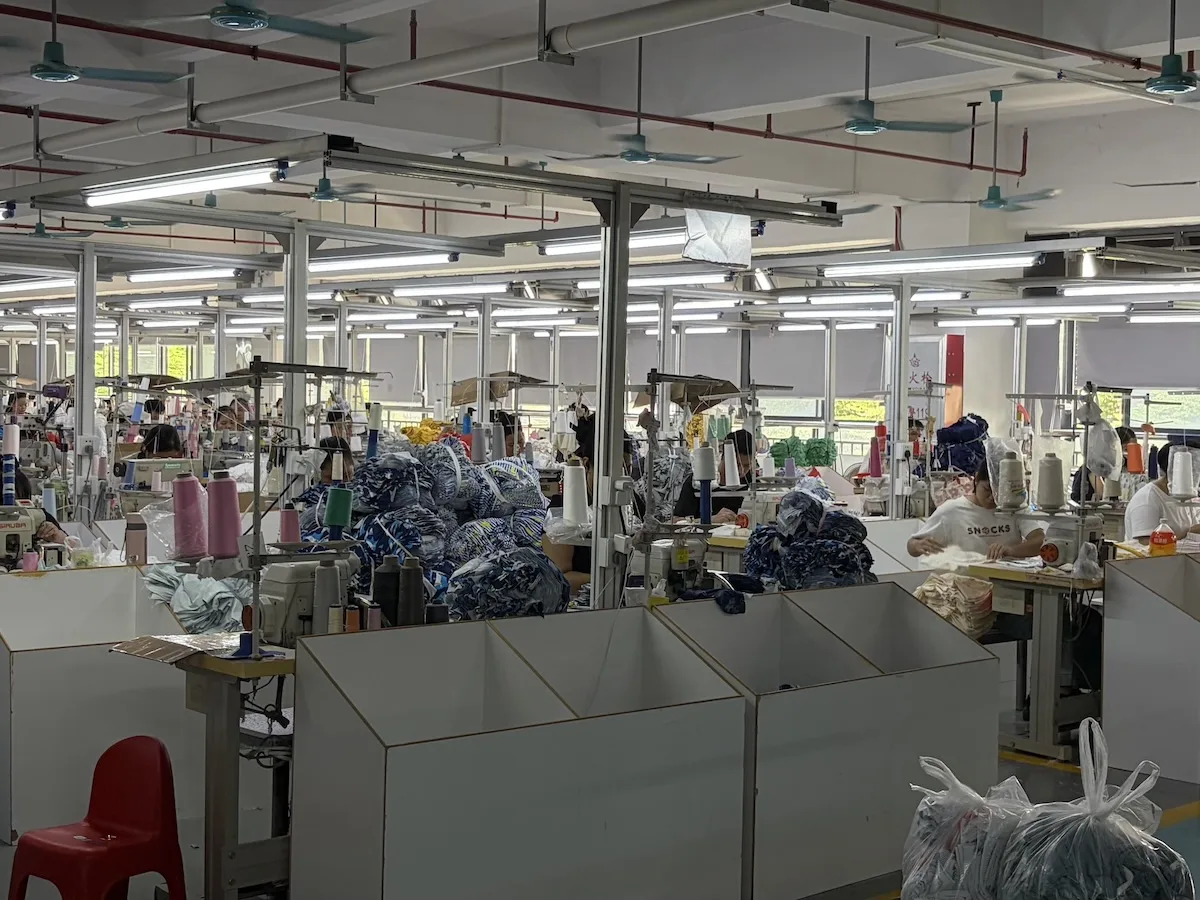
Over-built heavy knits are more prone to sewing and recovery defects — panel distortion, presser-foot marking, and slow elastane rebound. Our <0.3% defect rate depends on knits that behave predictably on the INA hanging production line, and very heavy cloth is the exception that misbehaves.
7. GSM, Shrinkage, and Incoming Quality Control
GSM is re-verified on arrival and after relaxation because finishing shrinkage changes the reading. Consistent GSM across a roll is a leading indicator of stable, low-defect bulk.
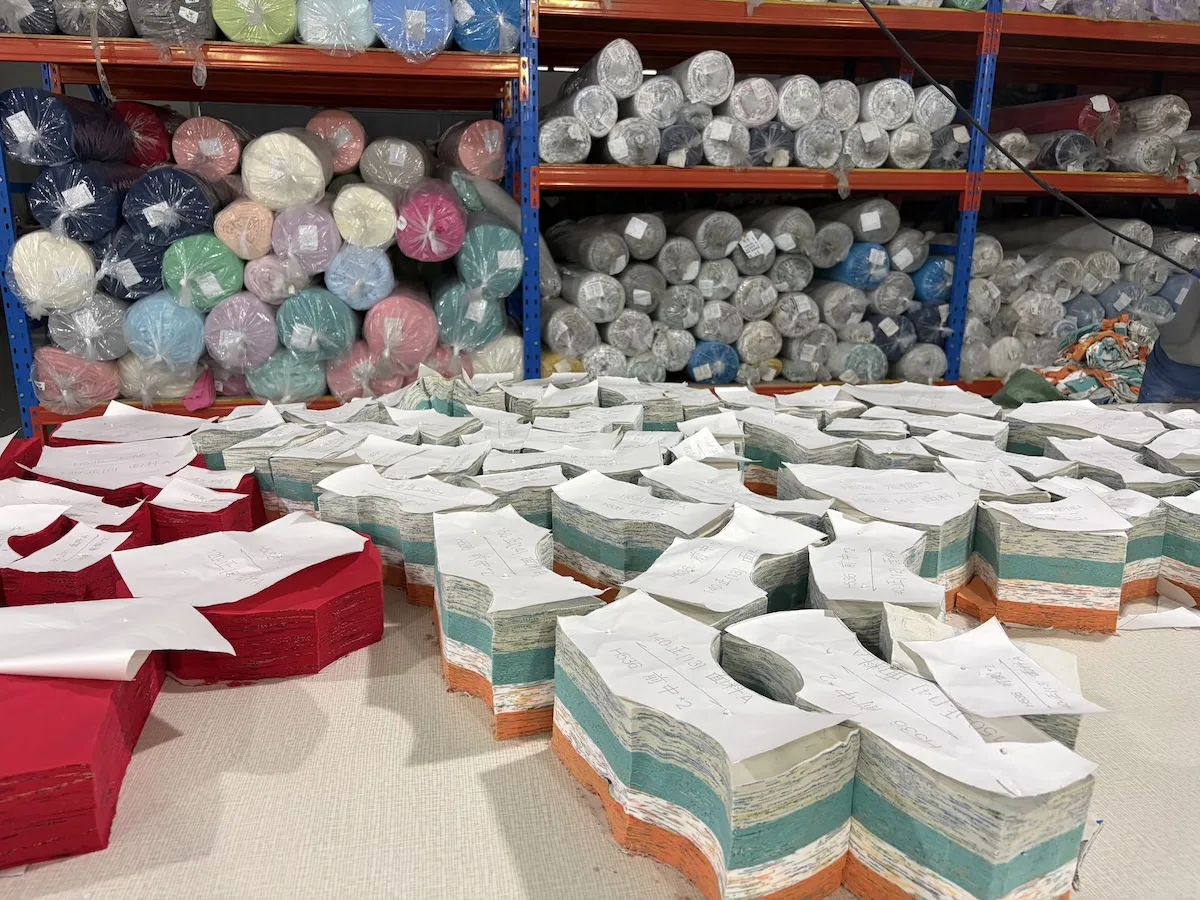
GSM is not a “set and forget” number. Fabric shrinks in length and width during compaction and wash, which concentrates the same mass into a smaller area and raises the finished GSM. If you measured only on greige cloth, your bulk garments could arrive heavier and stiffer than the approved sample. Our incoming QC therefore weighs and measures GSM on relaxed, finished fabric from every lot, and we track it against the tech-pack range.
We also watch consistency across the roll. A roll that drifts from 215 to 240 GSM end-to-end will produce garments with different hand-feel and slightly different fit in the same batch — a classic source of “why do these two look different” complaints. Stable GSM is one reason our 6-stage QC with needle detection protects the <0.3% defect rate we report. For brands, the lesson is simple: ask for the GSM range and the roll-to-roll consistency tolerance in the tech pack, and request a bulk lab-dip and weight report before full production — our swatch and lab-dip approval guide covers that handshake in detail.
Finally, remember the compliance floor. Children’s intimate apparel headed to many markets must meet GB 31701 Class A (China children’s A-class safety standard) for direct-skin contact, and can be third-party tested by SGS or CPC for restricted substances. OEKO-TEX Standard 100 is currently in progress at our facility. None of that is about weight — but all of it is part of a complete, defensible spec sheet, and GSM is only one row on it.
Building a kids’ underwear or bodysuit line and want a realistic GSM range that fits your product and your margin?