Kids Clothing Manufacturers for Startups: 2027 Sourcing Guide
On this page
- Choose a Factory by Product Category
- Understand OEM, ODM and Private Label
- Do Not Compare Factories by MOQ Alone
- Prepare a Useful RFQ
- Evaluate the Sample Process
- Build a Simple First Collection
- Check Fabric Before You Approve the Garment
- Make the Size Chart a Production Document
- Treat Compliance as a Market Requirement, Not a Supplier Badge
- Agree on QC Before Bulk Production
- Red Flags When Choosing a Manufacturer
- A Startup-Friendly Supplier Scorecard
- FAQ
- What a Startup Should Ask During a Factory Audit
- Sample Cost vs Production Cost
- Payment Terms and Risk Control
- Plan for Reorders Before the First Order
- A Practical First-Order Workflow
The best kids clothing manufacturer for a startup is not necessarily the factory with the lowest MOQ. It is the supplier whose product category, development process, communication, compliance support and production route match the brand’s first collection. A startup should shortlist factories by category expertise, request a structured quotation, sample before bulk, verify what is actually produced in-house, understand the MOQ by fabric/color/style, and agree on a QC plan before paying for mass production.
For a first collection, reduce variables. Use fewer fabric bases, fewer colors and fewer custom trims. A simpler range gives you better fit control, clearer sales data and an easier reorder path.
1. Choose a Factory by Product Category
“Kids clothing factory” is too broad. A supplier strong in school uniforms may not be the right partner for baby bodysuits. A factory that mainly sews woven dresses may not have the machines or fit experience for stretch underwear.
Start by matching the manufacturer to your product family:
| Product family | Capabilities to check |
|---|---|
| Kids underwear | stretch sewing, elastic application, grading, direct-skin-contact comfort |
| Sleepwear | fit classification, flammability route, soft seams, cuffs, waistbands |
| Baby apparel | small-size construction, snaps, neckline stability, soft seams |
| T-shirts/basics | jersey handling, neck rib, shrinkage, print/embroidery |
| Dresses/occasionwear | woven construction, lining, zips, embellishment, pressing |
A manufacturer that already produces your type of garment will normally identify technical risks earlier.
2. Understand OEM, ODM and Private Label
Startups often use these terms interchangeably, but they lead to different costs and timelines.
OEM
You provide the design or tech pack and the factory manufactures it. Best when your fit, construction and brand identity are distinctive.
ODM
You begin from the factory’s existing development base and modify fabric, fit, color, artwork or details. This can reduce development work while still creating a differentiated product.
Private label
You use an existing or lightly modified product and add your own labels and packaging. This is often the fastest route for market validation.
The right choice depends on what makes your brand valuable. If your competitive advantage is a proprietary fit, full OEM may be justified. If your advantage is curation, storytelling or distribution, private label or ODM may be more efficient for the first drop.
3. Do Not Compare Factories by MOQ Alone
A low number in a supplier profile may apply only to stock goods. Ask exactly what the quoted minimum covers.
Useful questions include:
- Is the MOQ per style, color, print or total order?
- Can sizes be mixed?
- Is stock fabric required?
- Does custom dyeing have a separate mill minimum?
- Does all-over print have its own minimum?
- Do woven labels, hangtags or polybags have separate supplier minimums?
- Does the MOQ change if I use an existing pattern?
At Nuohua, current routes include ready stock from 2 pcs on selected in-stock styles, selected custom styles from 150–300 pcs per color where applicable, category-specific higher minimums for programs such as existing kids underwear/print programs and full custom sleepwear, and full OEM/ODM quantities confirmed after the full specification is reviewed.
That structure is more realistic than presenting one number for every garment.
4. Prepare a Useful RFQ
Factories quote accurately when buyers provide useful inputs.
Your first RFQ should include:
- product type;
- reference photos or tech pack;
- target fabric composition;
- approximate GSM if known;
- size range;
- number of colors/prints;
- estimated quantity by style/color;
- destination market;
- custom label/packaging needs;
- target launch date;
- testing requirements if known.
Avoid opening with only: “What is your best price?” Price without specification is not comparable.
5. Evaluate the Sample Process
A startup should learn more from the sampling process than from the factory presentation deck.
Watch for:
- whether questions are specific or generic;
- whether the factory flags construction conflicts;
- whether measurements are checked before shipping;
- whether fabric substitutions are disclosed;
- whether sample revisions are documented;
- whether approved changes are carried into the next sample.
A good supplier does not simply say yes to every request. It explains which choices may create fit, quality or MOQ problems.
6. Build a Simple First Collection
Too many SKUs can hide whether the brand itself has product-market fit.
For a startup, consider a structure such as:
- 2–4 core styles;
- 1–2 fabric bases;
- 2–4 colors per base;
- a controlled size range;
- one packaging system;
- one label system.
This reduces sample rounds and makes QC easier. It also gives you cleaner sales data after launch.
7. Check Fabric Before You Approve the Garment
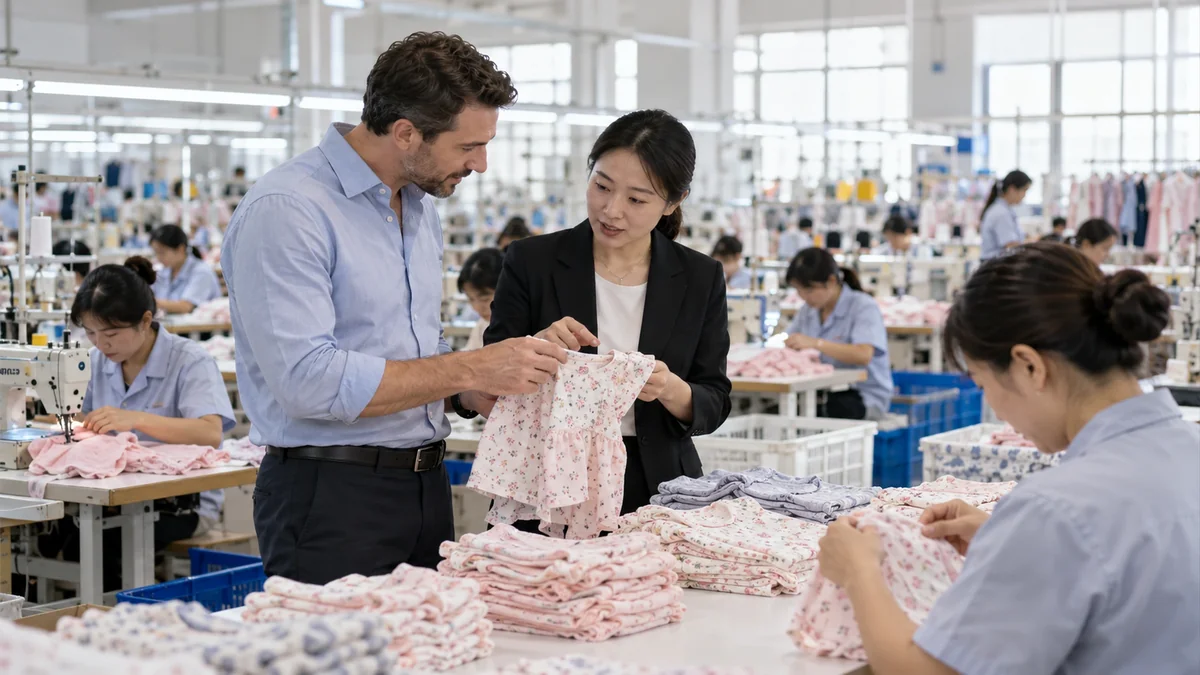
For children’s clothing, fabric performance is part of product quality.
Confirm:
- exact fiber composition;
- knit or woven construction;
- GSM;
- colorfastness expectations;
- shrinkage after wash;
- pilling tendency;
- stretch and recovery;
- hand feel;
- print compatibility;
- test needs for the market.
Do not approve a sample only because it feels soft before washing.
8. Make the Size Chart a Production Document
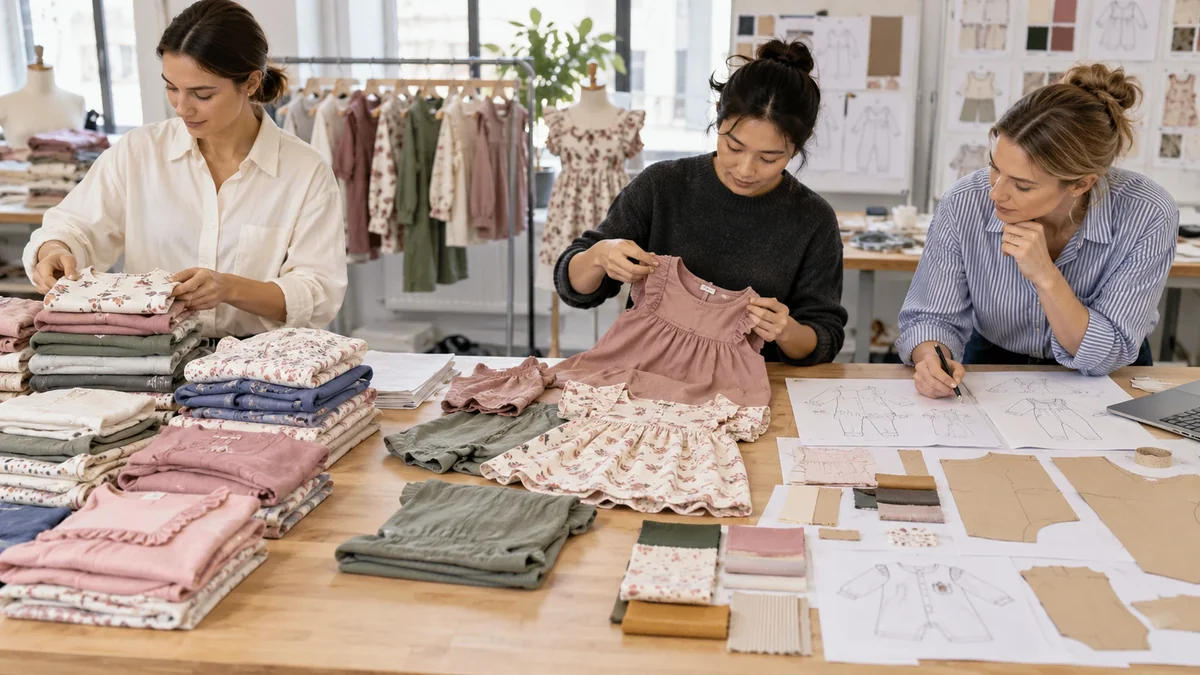
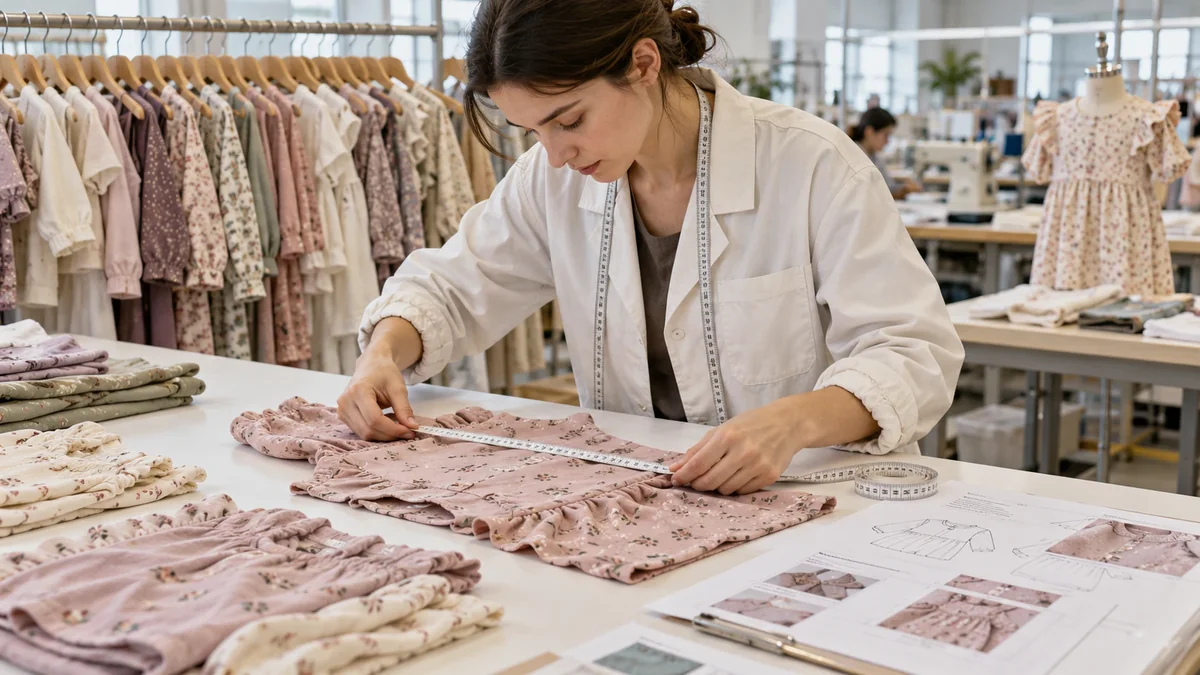
A size chart should include points of measurement, tolerances and grading logic. For baby and kidswear, the smallest and largest sizes are particularly important because grading errors become more visible at the ends of the range.
Ask for or provide:
- flat garment measurements;
- body-size reference where useful;
- POM diagram;
- grade increments;
- tolerance;
- fit notes;
- shrinkage basis.
9. Treat Compliance as a Market Requirement, Not a Supplier Badge
Different markets apply different rules to different products. For U.S. children’s products subject to CPSC rules, third-party testing and certification responsibilities can apply, and certificate eFiling requirements have been in effect for most regulated imports since July 8, 2026. Sleepwear also has product-specific flammability requirements.
The startup should tell the factory where the goods will be sold and should confirm the applicable standards with qualified testing/compliance partners when needed.
Do not rely on a generic “CPC compliant” sentence as the entire compliance plan.
10. Agree on QC Before Bulk Production
Your purchase order should not be the first time quality criteria are discussed.
Define:
- approved sample reference;
- measurement tolerances;
- color/shade acceptance;
- print placement tolerance;
- workmanship criteria;
- critical defect examples;
- packing count;
- inspection stage;
- whether third-party inspection is required.
For repeat orders, keep a sealed or documented approved standard where practical.
11. Red Flags When Choosing a Manufacturer
Be cautious when a supplier:
- promises every category with no evidence of specialization;
- refuses to explain what MOQ applies to;
- changes fabric composition without written approval;
- avoids giving measurable sample comments;
- uses certifications that cannot be verified;
- quotes an unrealistically short custom lead time before seeing the tech pack;
- pressures you to skip PP approval;
- gives a price far below comparable offers but cannot explain the cost difference.
12. A Startup-Friendly Supplier Scorecard
Score each shortlisted supplier from 1 to 5:
| Area | Weight |
|---|---|
| Product-category experience | 20% |
| Sample accuracy | 20% |
| Communication | 15% |
| Fabric sourcing | 10% |
| MOQ fit | 10% |
| QC system | 10% |
| Compliance support | 10% |
| Reorder/scaling capability | 5% |
The lowest unit price should not be the largest weight.
FAQ
How do I find a kids clothing manufacturer for a startup?
Start with manufacturers already producing your category, then compare sample process, MOQ basis, fabric capability, compliance support and QC. Use marketplaces and search engines for discovery, but verify the supplier through samples, documentation and direct communication.
Can a startup order only 100 pieces?
Sometimes, but it depends on the product and production route. Selected custom styles may support lower quantities when stock fabrics and existing constructions are used. Full custom programs can require higher minimums.
Should I use a sourcing agent or work directly with a factory?
Both can work. Direct factory relationships offer faster technical communication when you have a clear product brief. Agents can help when you need many unrelated categories or local supplier coordination. Know which model you are paying for.
What should I approve before bulk production?
At minimum: fabric, color, artwork, construction, measurements, labels, packaging, PP sample or equivalent approved standard, and the applicable testing/QC plan.
13. What a Startup Should Ask During a Factory Audit
Whether the audit is in person, by live video or through a trusted third party, focus on process rather than staged showroom displays. Ask to see the sample room, fabric inspection, cutting, sewing, inline QC, final inspection, needle-control process and packing area. Then ask the merchandiser to explain how one real order moves through those steps.
Useful audit questions include:
- Who makes patterns and grading in-house?
- Which operations are subcontracted?
- How are incoming fabrics inspected?
- How are shade lots separated?
- How are approved samples controlled on the sewing line?
- Who signs off a PP sample?
- How are measurement records stored?
- How are broken needles handled and documented?
- How are rejected pieces segregated?
- How are repeat-order specifications retrieved?
A startup does not need a perfect-looking factory. It needs a factory whose controls are understandable and repeatable.
14. Sample Cost vs Production Cost
Do not judge a supplier because a development sample costs more than the final bulk unit. Sampling is inefficient by nature: one garment may require pattern work, special cutting, one-off trim sourcing, artwork setup and repeated communication.
Ask the factory to separate:
- pattern/development charge;
- sample sewing charge;
- courier cost;
- custom print/embroidery setup;
- refundable sample fees if any;
- bulk unit price.
This makes it easier to compare suppliers fairly and to budget the true development phase.
15. Payment Terms and Risk Control
Payment terms vary by supplier, order size and relationship. Instead of chasing one “standard,” make sure the commercial milestones are clear.
Your purchase order should identify:
- deposit amount and due date;
- balance trigger;
- inspection rights;
- approved specifications;
- quantity tolerance if applicable;
- delivery terms;
- remedies for serious nonconformity;
- ownership of custom artwork/patterns where agreed.
For a first order, keep the structure simple enough that both sides know what must happen before the next payment milestone.
16. Plan for Reorders Before the First Order
A startup often focuses on launch and forgets replenishment. Ask the manufacturer what will be retained for future orders:
- pattern files;
- graded nest;
- print artwork;
- color references;
- label files;
- packaging dielines;
- approved sample records;
- fabric supplier information;
- QC notes.
If a winning style can be reordered from controlled records, the second order should be faster and more consistent than the first.
17. A Practical First-Order Workflow
A disciplined first order can follow this sequence:
- Define 2–4 core products.
- Prepare tech packs or structured briefs.
- Shortlist 3–5 category-relevant suppliers.
- Send the same RFQ to each.
- Compare specification, not only price.
- Develop samples with the best 1–2 candidates.
- Wash-test and measure samples.
- Confirm compliance/testing route.
- Finalize labels and packaging.
- Approve PP standard.
- Place bulk order.
- Perform inline/final inspection as appropriate.
- Approve shipping documents.
- Track sell-through by SKU.
- Use real sales data for the reorder.
This process may look slower than buying the cheapest listing immediately, but it prevents the expensive kind of speed: launching a product that must be remade.
Send a Production Brief, Not Just a Product Photo
For a more useful quotation, send Nuohua your product type, size range, fabric preference, quantity, destination market and branding requirements. The team can then identify whether ready stock, selected low-MOQ customization or a full OEM route is the better starting point.
Or explore our kidswear manufacturing capabilities.
Nuohua Garment is a kidswear OEM/ODM manufacturer producing children’s underwear, sleepwear, baby apparel and custom kidswear for brands, retailers and wholesalers, with an 8,000 m² production base in Guangdong, China. Guidance here reflects our production experience; confirm current regulations and requirements for your market and product before ordering.