
How to Start a Baby Clothing Brand in 2027: Factory Guide
On this page
- Decide What Your Baby Brand Is For
- Build a Small First Assortment
- Choose Fabric by Use Case
- Design for Dressing and Washing
- Create a Baby Size System
- Build a Tech Pack Before Requesting Final Pricing
- Select the Production Route
- Develop Samples in the Right Order
- Plan Compliance for the Destination Market
- Develop Labels and Packaging After the Product Is Stable
- Calculate the Real Landed Cost
- Use the First Order as Data
- FAQ
- Build a Brand Architecture Before Adding SKUs
- Work Backward From the Launch Date
- Create a SKU Plan That You Can Afford to Reorder
- Product Photography Should Match the Actual Production Standard
- What to Measure After Launch
- When to Move From Ready Stock to Full Custom OEM
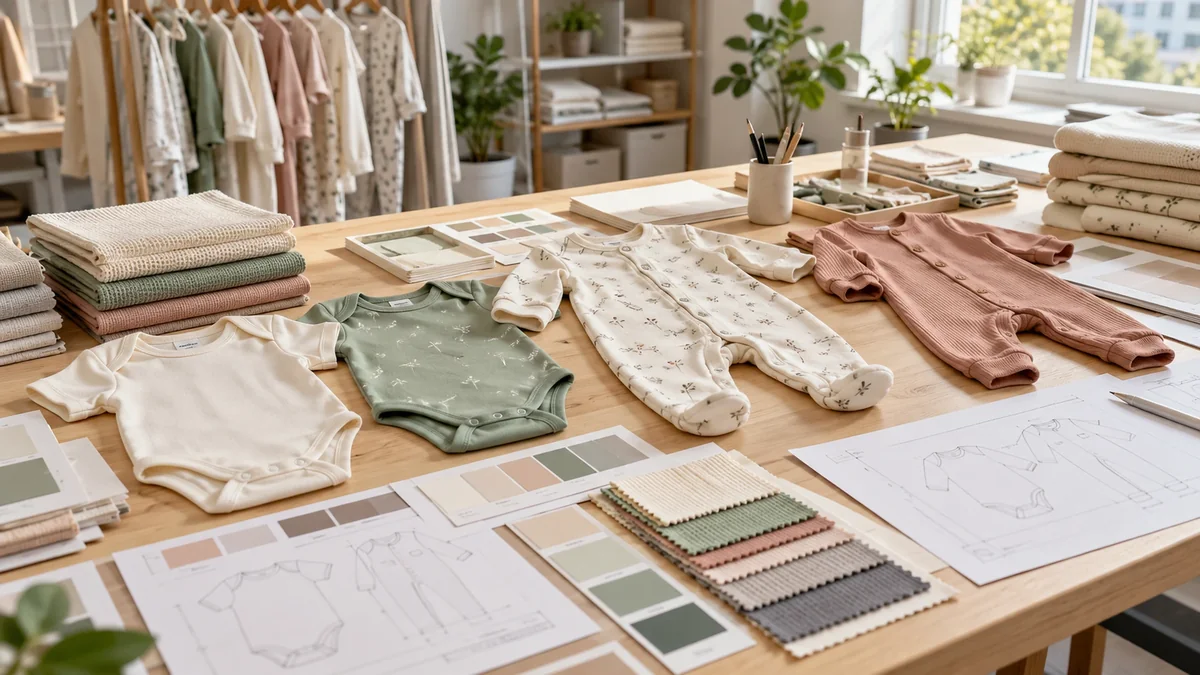
To start a baby clothing brand, choose a narrow customer and product position, build a small first assortment, define the fabric and size system, create technical specifications, select a manufacturing route, develop and wash-test samples, confirm compliance for the target market, approve packaging and quality standards, then place a controlled first production order. The most successful first collection is usually not the largest—it is the one that can be repeated consistently.
1. Decide What Your Baby Brand Is For
Baby clothing is crowded because the category looks simple from the outside. It is not. Bodysuits, sleepers and rompers are small garments with sensitive fit points, closures, skin-contact seams and frequent washing.
Choose a clear position such as:
- premium organic-cotton basics;
- soft stretch baby sleepwear;
- minimalist neutral essentials;
- colorful everyday playwear;
- boutique gift sets;
- warm-climate bamboo-viscose sets;
- value-focused wholesale basics.
A clear position controls fabric, color, packaging and price.
2. Build a Small First Assortment
A practical first collection might contain:
| Style | Role |
|---|---|
| Short-sleeve bodysuit | High-frequency basic |
| Long-sleeve bodysuit | Seasonal extension |
| Romper | Daywear hero |
| Two-piece set | Higher basket value |
| Sleepsuit | Sleep category extension |
Use one or two compatible fabrics across the range. This improves color matching and makes testing more efficient.
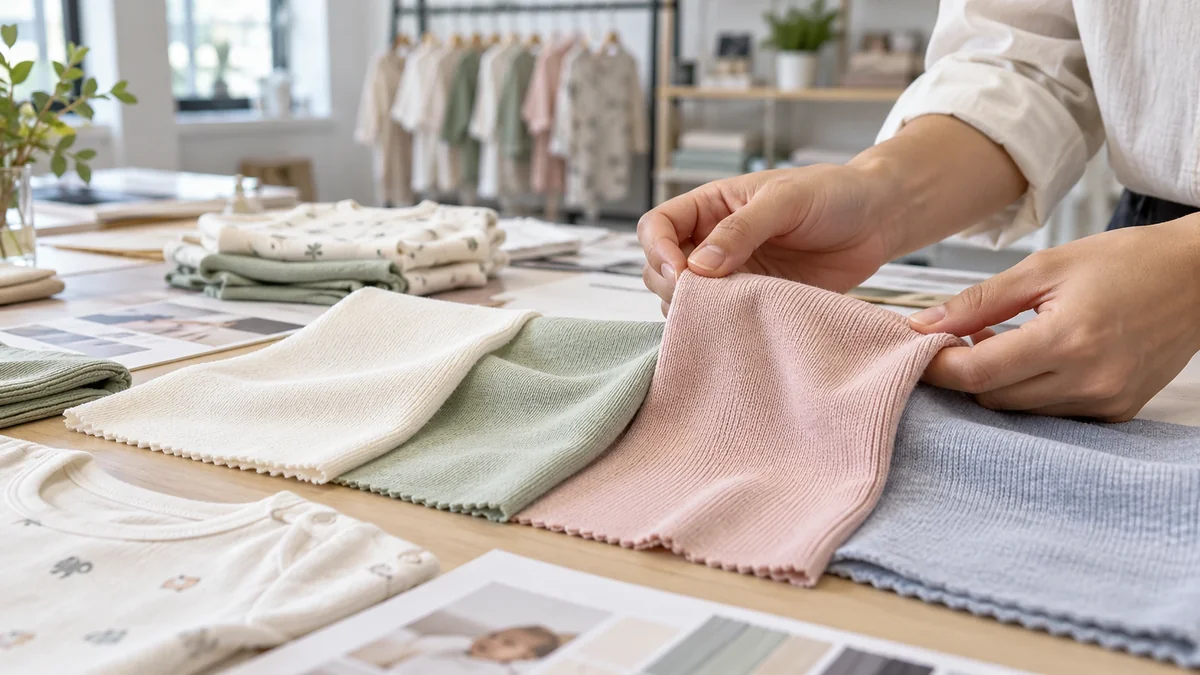
3. Choose Fabric by Use Case
Combed cotton jersey
Good for everyday bodysuits and tees. Check shrinkage, pilling and neck recovery.
Cotton interlock
More stable and substantial, useful for newborn basics, sleepers and cooler-season garments.
Organic cotton
Useful when organic sourcing is part of the brand proposition, but claims should be tied to verifiable supply-chain documentation rather than the word “organic” appearing only in a supplier message.
Viscose made from bamboo
Very soft and fluid, commonly used in baby pajamas and stretchy basics. In the U.S., correct fiber naming matters: regenerated rayon/viscose made using bamboo as the source should be labeled and advertised using the proper generic fiber name.
Modal
Soft with good drape; useful for premium basics. Test stability and recovery.
4. Design for Dressing and Washing
Parents interact with baby clothing repeatedly each day. Small construction decisions matter.
Consider:
- envelope or expandable neck openings;
- snap crotches positioned for easy changing;
- zipper guards on sleepers;
- soft covered elastic;
- seam placement away from sensitive contact points;
- printed or low-profile labels where appropriate;
- sufficient ease for diapers;
- shrinkage allowance after wash.
Do not add hardware simply because it looks premium. Every trim adds weight, cost, QC points and potential safety considerations.
5. Create a Baby Size System
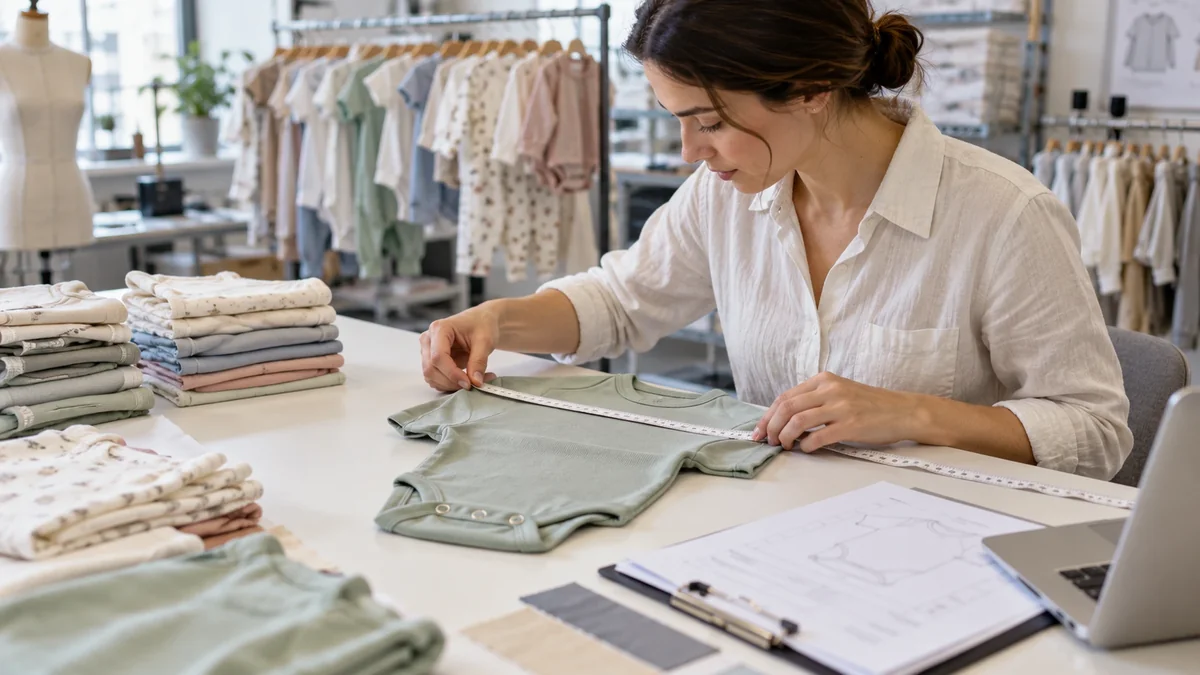
Age labels are convenient for shoppers but not precise enough for production. Use body height and garment measurements as the technical basis.
Your size specification should define:
- chest width;
- body length;
- sleeve length;
- shoulder or neck opening;
- hip width;
- rise;
- leg opening;
- inseam where applicable;
- garment tolerance;
- grade between sizes.
A baby brand should fit-test the smallest size carefully because small proportional errors are highly visible.
6. Build a Tech Pack Before Requesting Final Pricing
Your tech pack should include flats, fabric, color, construction, measurements, trims, label placement, packaging and artwork. If you do not have a full tech pack, at least create a structured style brief.
For each style confirm:
- style number;
- fabric composition/construction;
- target GSM;
- color standard;
- stitch/seam type;
- closure type;
- POM chart;
- label and care-label content;
- packaging;
- destination market.
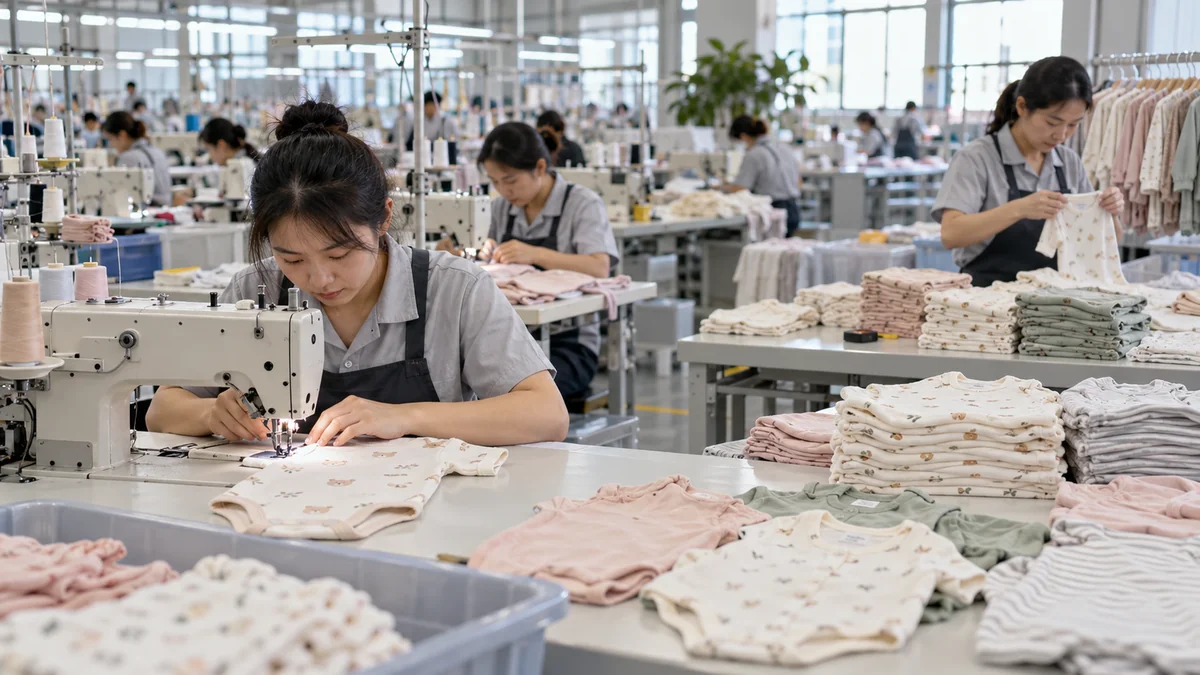
7. Select the Production Route
For baby apparel, there is a meaningful difference between testing an existing style and developing a fully custom program.
Nuohua’s current structure is:
- Ready Stock: from 2 pcs on selected in-stock styles, colors and sizes.
- Selected Low-MOQ Custom Baby Apparel: from 150–300 pcs per color on selected styles, depending on fabric, size range and customization requirements.
- Full OEM/ODM: MOQ confirmed after reviewing the full specification.
Do not assume every baby style can start at the same minimum.
8. Develop Samples in the Right Order
A professional sample review should answer four questions:
- Does it look right?
- Does it measure right?
- Does it perform after washing?
- Can the factory reproduce it in bulk?
Review construction and fit before spending heavily on custom packaging. If fit is wrong, branding does not rescue the product.
Sample-review checklist
- neckline opens and recovers correctly;
- snaps align and close securely;
- seam bulk is acceptable;
- diaper ease is sufficient;
- sleeve and leg openings are comfortable;
- garment meets the measurement chart;
- shrinkage is within the agreed tolerance;
- print scale/placement is correct;
- care label does not create unnecessary irritation.
9. Plan Compliance for the Destination Market
For the United States, many children’s products subject to CPSC-enforced rules require third-party testing and certification. Since July 8, 2026, importers of most regulated products subject to CPSC certification requirements must eFile certificate data.
The exact rules depend on the product, materials and intended use. Baby sleepwear can have different requirements from ordinary daywear. Do not copy a competitor’s compliance statement into your product listing; confirm what applies to your product.
10. Develop Labels and Packaging After the Product Is Stable
Private-label elements may include:
- brand label;
- printed neck label;
- size label;
- care/content label;
- hangtag;
- sticker;
- polybag;
- carton markings;
- gift box or retail box.
Verify mandatory information for the destination market before printing thousands of labels.
11. Calculate the Real Landed Cost
Your model should include more than the sewing price:
- garment cost;
- sampling;
- custom fabric/print setup;
- labels and packaging;
- testing;
- inspection;
- freight;
- duty/tax where applicable;
- fulfillment;
- returns and markdowns.
Build margin using landed cost, not ex-factory cost alone.
12. Use the First Order as Data
Track sales by size, style, color and fabric. If 6–12M sells twice as fast as newborn, the next order should reflect that. If one neutral color has high repeat demand, preserve its approved shade and fabric lot standard for replenishment.
A baby brand becomes operationally stronger when the second order is easier than the first.
FAQ
How many products should a new baby brand launch with?
There is no fixed number, but a focused group of 3–6 styles is often easier to fit, photograph, market and reorder than a broad 20-style collection.
What is the best fabric for baby clothes?
There is no single winner. Cotton, organic cotton, interlock, viscose made from bamboo and modal can all work. Choose based on use, wash performance, market positioning, cost and verified specification.
Do I need a tech pack?
A full tech pack is strongly recommended for custom OEM. For selected existing or private-label styles, a structured customization brief may be enough, but measurements, branding and packaging still need written approval.
Can I start with ready stock and move to custom production later?
Yes. That can be a sensible market-validation path if the stock product is close to your intended brand position.
13. Build a Brand Architecture Before Adding SKUs
Your collection should have a repeatable logic. A simple architecture may include a core fabric, a core color palette and a small set of silhouettes that can be refreshed seasonally.
For example:
- core fabric: cotton interlock;
- core products: bodysuit, romper, pants;
- permanent colors: ivory, oat, soft gray;
- seasonal colors: two rotating shades;
- seasonal print: one hero artwork.
This reduces development cost while giving customers a reason to return.
14. Work Backward From the Launch Date
A babywear launch calendar should include more than bulk production.
Work backward through:
- warehouse/fulfillment intake;
- international transit and customs;
- final inspection;
- packing;
- bulk sewing;
- fabric/trim production;
- PP approval;
- label/packaging approval;
- fit revisions;
- first sample;
- tech pack completion.
If a launch depends on a holiday or seasonal climate, add buffer. A factory cannot recover time lost to late artwork approval without changing something else—usually freight cost or production risk.
15. Create a SKU Plan That You Can Afford to Reorder
Every color-size combination becomes inventory. Four styles × five colors × eight sizes already creates 160 SKUs.
For a startup, decide:
- which sizes are core;
- which colors deserve full size runs;
- which styles are evergreen;
- which styles are seasonal;
- which products can share fabric and packaging.
A smaller SKU matrix often creates better availability than a wide range with only a few units per variant.
16. Product Photography Should Match the Actual Production Standard
Do not build your launch campaign around a prototype that bulk production cannot reproduce. Photograph either the approved PP sample or a sample that matches the approved production details.
Check before the shoot:
- final color;
- correct snaps/zip;
- correct labels;
- final fit;
- correct print scale;
- accurate fabric texture.
This reduces customer disappointment and return risk.
17. What to Measure After Launch
Your first collection should answer operational questions:
- sell-through by size;
- return rate by style;
- fit complaints;
- color preference;
- repeat purchase rate;
- average order value;
- which products are bought together;
- customer comments about fabric/feel;
- time to first stockout.
The second collection should be based on this evidence, not only on new trends.
18. When to Move From Ready Stock to Full Custom OEM
Move toward full custom development when you have evidence that customers value a distinctive fit, fabric, print or construction enough to justify higher development commitment.
Signals include:
- repeat sales in a specific silhouette;
- clear demand for an unavailable color/fabric;
- customer feedback that identifies a fit opportunity;
- stable reorder volume;
- margin sufficient to support development and testing.
Custom production is most powerful after you know what problem you are customizing to solve.
Turn a Babywear Concept Into a Production-Ready Brief
Send Nuohua your target product, size range, fabric preference, quantity, market and customization needs. We can help identify which development route should be solved first: fit, fabric, artwork, labels or production quantity.
Or explore our kidswear manufacturing capabilities.
Nuohua Garment is a kidswear OEM/ODM manufacturer producing children’s underwear, sleepwear, baby apparel and custom kidswear for brands, retailers and wholesalers, with an 8,000 m² production base in Guangdong, China. Guidance here reflects our production experience; confirm current regulations and requirements for your market and product before ordering.