
Best Fabrics for Kids’ Pajamas (+ US Flame-Resistance Rules Explained)
The best fabrics for kids pajamas flame resistance requirements start with the fiber itself. Choosing the right fabric for children’s pajamas is not just a comfort decision — for sleepwear it is also a compliance decision. Because pajamas sit against a child’s skin for 8–10 hours a night, the fiber, the hand-feel, and the way the garment behaves near heat all matter. This guide walks through the pajama fabrics we actually run at Nuohua Garment, and explains how US flame-resistance rules (16 CFR 1615 and 1616) really work for brands — without the myths.

Why fabric choice decides pajama comfort AND safety
Sleepwear is the one apparel category where a fabric’s behavior near an open flame is regulated by law in the United States. That makes the fiber choice the single most important spec a brand sets before sampling. A breathable, low-irritation fiber keeps a child comfortable; the right construction keeps the garment within the rules. The two goals are not in conflict — most skin-safe fibers are also the ones that behave predictably in testing.
For a private-label line, the fabric also drives your landed cost, your MOQ, and how the garment survives 50 wash cycles. Below is the library we run for kids’ pajamas and sleepwear, all available at our standard 2 pcs on selected in-stock styles, colors and sizes minimum.
Our pajama fabric library
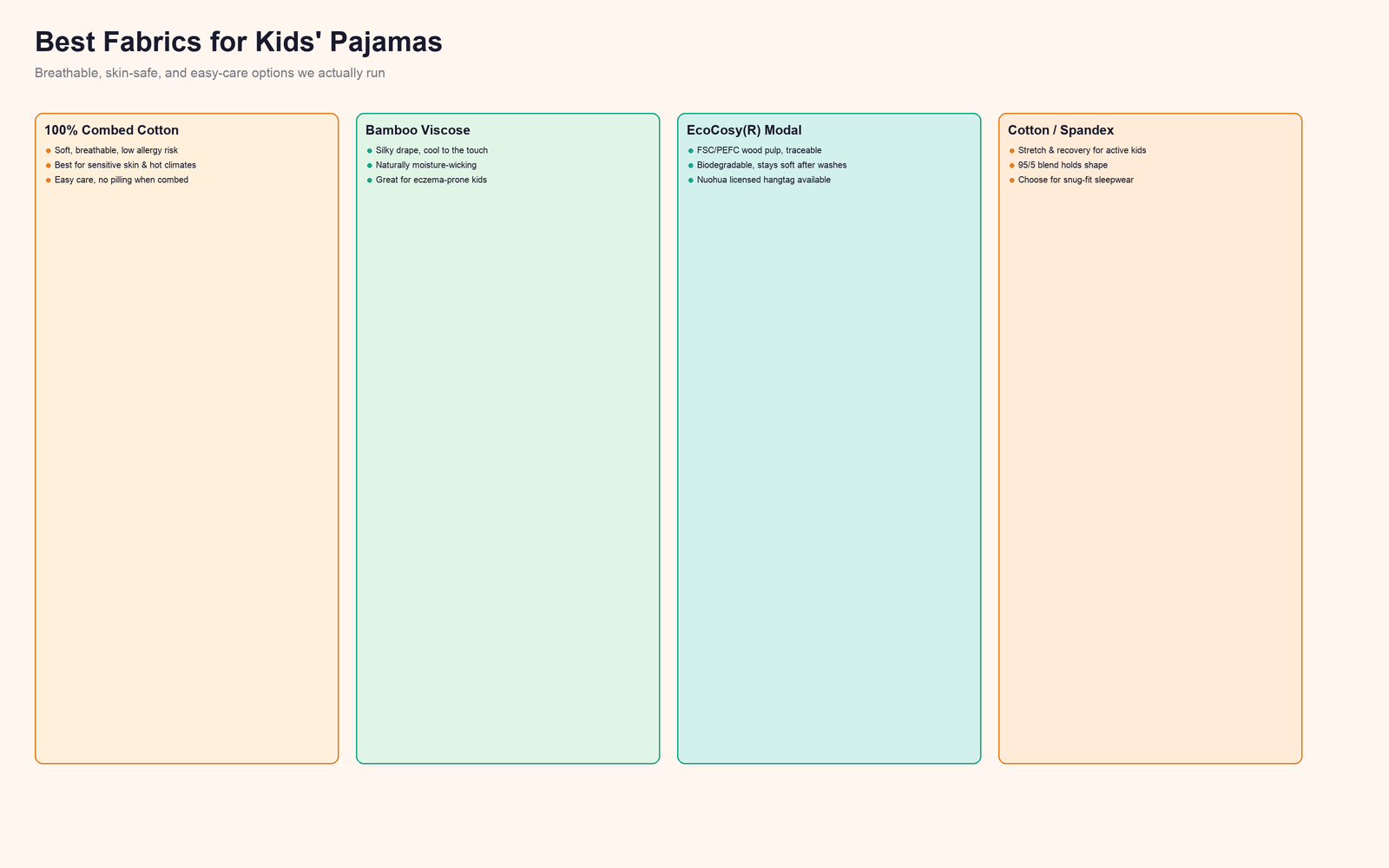
| Fabric | Typical GSM | Hand-feel | Best for |
|---|---|---|---|
| 100% Combed Cotton | 160–200 | Soft, breathable, natural | Sensitive skin, hot climates, everyday sleepwear |
| Bamboo Viscose | 150–190 | Silky, cool, drapey | Eczema-prone kids, premium soft lines |
| EcoCosy® Modal | 160–200 | Buttery, stable, stays soft | Brands wanting a traceable, licensed fiber |
| Cotton / Spandex 95/5 | 170–210 | Stretch, recovery, snug | Snug-fit sleepwear, active kids |
All four are skin-contact safe and produced to GB 31701 Class A (China’s strictest kids’ textile standard, which we hold for infant and children’s innerwear). For the US market, the fiber alone does not decide compliance — the fit does. That is where 16 CFR comes in.
Choosing by fabric: what each option actually gives you
The table above is a starting point. In practice, the fabric you pick decides three things at once: how the pajama feels on skin, how it behaves in a flame test or snug-fit exemption, and how much it costs per unit at your target MOQ. Here is the honest breakdown we give every brand before sampling.
100% Combed Cotton — the safe, breathable baseline
Combed cotton is the workhorse of kids’ sleepwear for a reason. Combing removes the short, loose fibers that cause pilling and itch, leaving a smoother yarn that is gentle on sensitive skin. It breathes well, washes cleanly, and takes dye evenly. The trade-off is recovery: pure cotton has no stretch, so the garment relies on cut for fit. For loose nightgowns and boxer-style sleep shorts it is ideal; for a snug-fit bodysuit you would want a little elastane. We run combed cotton at 160–200 GSM for pajamas — light enough to stay cool, heavy enough to survive 50+ wash cycles.
Bamboo Viscose — silky and cool for sensitive skin
Bamboo viscose (sometimes labeled “bamboo rayon”) is spun from bamboo pulp and finished into a filament that feels cooler and silkier than cotton. Parents of eczema-prone or heat-sensitive kids gravitate to it because the surface is very smooth and the fabric drapes without clinging. The nuance buyers miss: “bamboo” describes the raw material, not a single safety or sustainability standard — the processing route and the mill matter. We specify the pulp source and keep the finished cloth to GB 31701 Class A so the skin-safety claim is real, not just a marketing word.
EcoCosy® Modal — the traceable premium option
EcoCosy® modal is our recommended upgrade when a brand wants a licensed, documented fiber. It is made from 100% FSC / PEFC-certified wood pulp through a low-impact, closed-loop process and is fully biodegradable. Because Nuohua holds EcoCosy® authorization, the garment can carry the licensed hangtag and the supply chain can be proven to a retailer or customs officer. Hand-feel sits between cotton and bamboo — buttery, stable, and it stays soft wash after wash rather than softening unevenly like generic modal. For premium sleep sets where the story matters as much as the cloth, this is the one to spec.
Cotton / Spandex 95/5 — snug-fit and recovery
Adding 5% elastane to cotton changes the garment’s whole job. The spandex gives the cloth memory, so a snug-fit sleep set actually holds a snug fit through the night and through washes. That matters directly for US compliance: the snug-fit exemption from 16 CFR 1615/1616 only works if the garment is genuinely snug, and elastane is what makes “genuinely snug” achievable in production. The cost is slightly higher and a care note (low-heat dry) to protect recovery. We use 95/5 for snug-fit tops, leggings, and two-piece sets aimed at the US market.
Match the fabric to the season and the climate
GSM (grams per square meter) is your climate dial. The same fiber feels different at 150 GSM versus 200 GSM, and getting it wrong is the most common cause of “my summer pajamas are too hot” returns.
- Hot climates / summer: 150–170 GSM in bamboo viscose or combed cotton. Lighter cloth, more airflow, faster drying.
- Temperate / year-round: 170–190 GSM in combed cotton or EcoCosy® modal. The safe default for most Western markets.
- Cool climates / winter: 190–210 GSM, often in cotton-spandex or a modal blend, sometimes with a brushed interior for warmth without bulk.
- Layering pieces: a 160 GSM snug-fit top under a looser 200 GSM bottom lets parents adjust without a second wardrobe.
If you sell across hemispheres, spec two GSM variants per style rather than one “average” weight — it is a small change at the tech-pack stage that prevents a season of returns.
Common pajama-fabric mistakes first-time brands make
- Chasing the lowest price fiber. A cheap blend that pills or smells of finish after two washes generates more negative reviews than the savings were worth. Skin-contact garments are judged on hand-feel every single night.
- Forgetting the US fit rule when choosing fiber. Brands sometimes pick 100% cotton for a US line, then discover loose cotton sleepwear needs flame-retardant treatment. Specify snug-fit + elastane up front to use the exemption cleanly.
- Overlooking fiber content on the label. “Bamboo” pajamas must state “bamboo viscose” / “bamboo rayon” by fiber-content rules; mislabeling is a compliance strike, not a wording choice.
- Mixing GSM without telling the factory. If your size run spans S–XL, the same GSM may feel right on a small and thin on a large. Grade GSM with the size spec, not against it.
- Skipping the care label. Even a perfect fabric loses its properties if washed hot with bleach. We print care guidance on every Nuohua label so the end buyer does not have to remember it.
Quick rule: In the US, loose-fitting children’s sleepwear must pass flame-resistance testing. Snug-fitting sleepwear is exempt — but only if it is labeled correctly and actually fits snug. The fabric choice and the fit decision must be made together.
US flame-resistance rules: 16 CFR 1615 & 1616 explained
The US Consumer Product Safety Commission (CPSC) regulates children’s sleepwear under 16 CFR Part 1615 (sizes 0–6X) and 16 CFR Part 1616 (sizes 7–14). The rules require that sleepwear, when exposed to a small open flame, self-extinguishes and does not burn rapidly. Garments that must comply are typically treated with a flame-retardant finish OR made from inherently flame-resistant fibers.
Key points brands often miss:
- The rules apply to loose-fitting sleepwear, not tight garments.
- They cover robes, nightgowns, and two-piece sleep sets that are cut loose.
- Compliance is proven by third-party laboratory testing before sale.
- A Children’s Product Certificate (CPC) must back the shipment — and the importer issues the CPC, not the factory.
We support this by running pre-compliance reviews and working with SGS, TÜV SÜD, and Intertek for third-party testing. We do not issue the CPC (that is the importer’s legal duty), but we supply the test data and material documentation that make it straightforward.
Snug-fit vs loose-fit: the exemption that matters for brands
The practical escape hatch in the US rules is the snug-fit exemption. If a sleep garment is cut close to the body — tight at the waist, chest, and legs — it is far less likely to contact an open flame, so it is exempt from the flammability standard. But the exemption only works if:
- The garment is actually snug (generous cuts disqualify it).
- It carries the required snug-fit warning label (the “for child’s safety, garment should fit snug” statement).
- It is marketed and sized as sleepwear, not outerwear.
This is why our Cotton / Spandex 95/5 blend is popular for US private-label lines: the stretch lets the garment hold a true snug fit while staying comfortable. Many brands choose snug-fit cotton-spandex precisely to avoid the flame-retardant treatment and its documentation burden.
How Nuohua helps you specify a safe, compliant pajama fabric
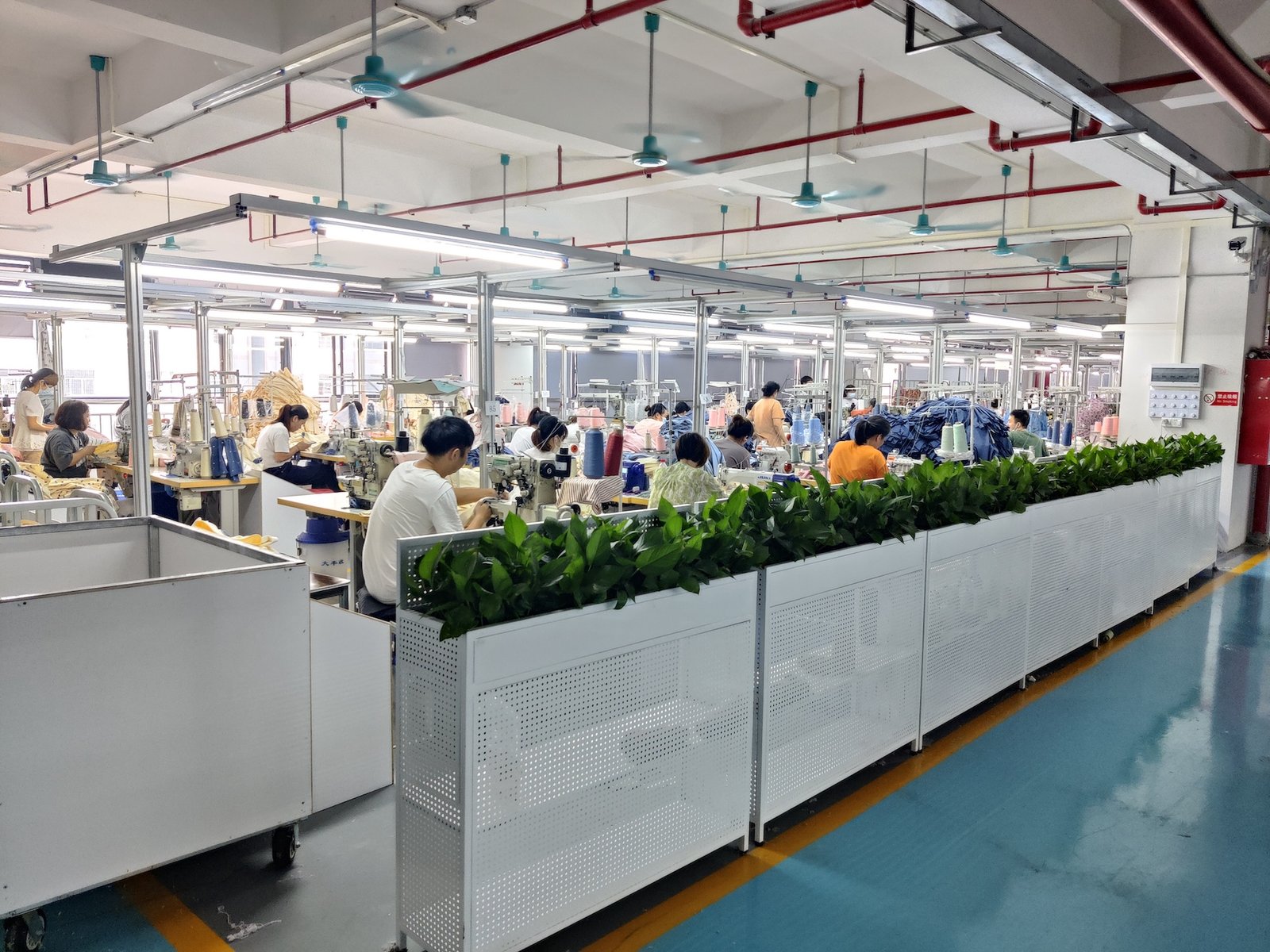
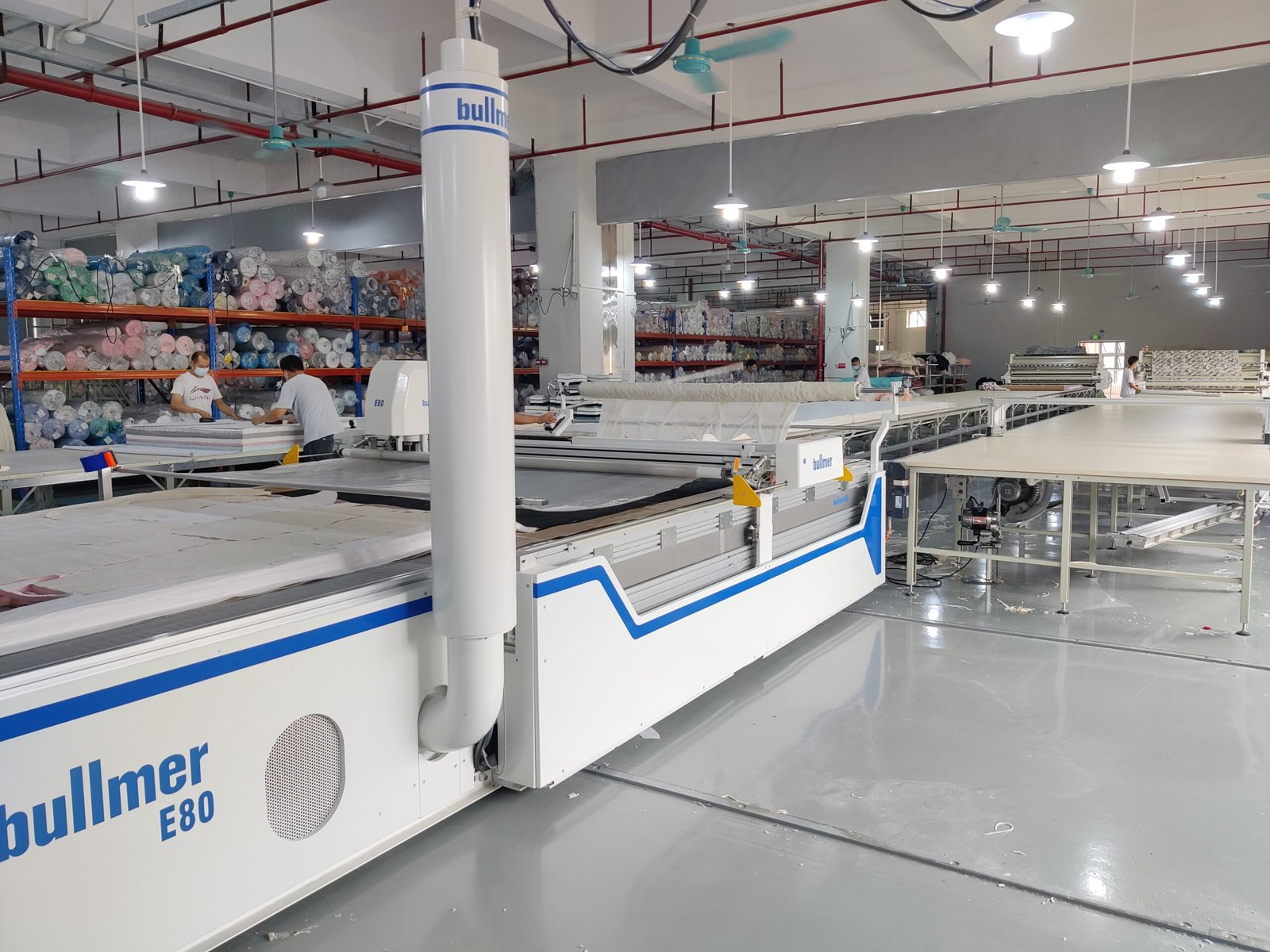
When you brief a pajama line with us, we help you lock three things early: the target market (US snug-fit vs EU general safety), the fiber and GSM, and the labeling. Our standard program includes:
- MOQ from 2 pcs on selected in-stock styles (ready stock) — low enough to test a fabric before scaling.
- GB 31701 Class A compliance for all skin-contact kids’ wear.
- Material documentation and third-party test coordination via SGS / TÜV SÜD / Intertek.
- Correct care and snug-fit labeling for the US market.
If you are selling on Amazon US, our bamboo sleepwear playbook for Amazon sellers covers FNSKU, polybag, and choking-warning requirements in depth.
Caring for kids’ pajamas so they stay safe and soft
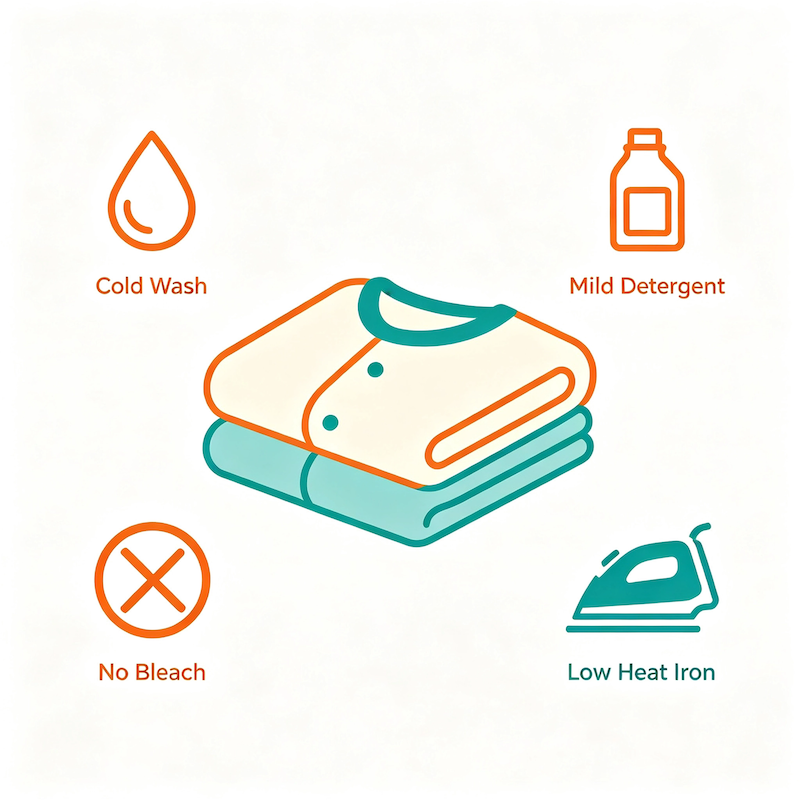
Standard care keeps the flame-resistant or snug-fit properties intact over the garment’s life. Hot washes can degrade elastane recovery and weaken printed labels; bleach can interfere with any flame-retardant treatment. We print this guidance on every Nuohua care label so the buyer does not have to remember it.
Washing and caring for kids’ pajamas so they stay safe and soft
Cold wash, mild detergent
Wash at 30–40°C with a mild, fragrance-light detergent. Cold water protects elastane recovery in cotton-spandex blends and keeps printed snug-fit warnings legible. A harsh detergent with optical brighteners can leave residue against a child’s skin and, over time, subtly weaken fabric finish.
No bleach, low-heat dry
Bleach is the fastest way to break down any flame-retardant treatment on loose-fit sleepwear and to yellow natural fibers. Tumble dry on low or line dry; high heat shrinks cotton and cooks the stretch out of spandex, so the snug fit that earned the exemption loosens after a few cycles.
Iron low, store clean and dry
If you iron, use a low setting and avoid the printed label area. Store pajamas clean and fully dry — damp storage invites mildew and odor in natural fibers, which reads as a quality defect to the end buyer even when the cloth is fine.
Care-label tip for brands: have the wash, bleach, tumble-dry, and iron symbols printed directly on the garment’s care label (we do this by default). A clear symbol survives translation better than a sentence and reduces return-rate complaints about “shrunk” or “lost stretch.”
Frequently Asked Questions
Do bamboo pajamas need flame-retardant treatment in the US?
Only if they are loose-fitting. A snug-fit bamboo viscose set can use the snug-fit exemption, provided it is labeled correctly.
Is combed cotton flame-resistant by itself?
No. Cotton is not inherently flame-resistant. Loose cotton sleepwear must either be treated or meet the standard another way; snug-fit cotton relies on the exemption.
Who issues the CPC for my pajama shipment?
The US importer of record issues the CPC. Nuohua supplies the test data and material specs that support it, but we do not issue the certificate.
Can I use EcoCosy® modal for US sleepwear?
Yes. EcoCosy® modal is a soft, traceable fiber; for the US it follows the same snug-fit vs loose-fit logic as any other cellulosic fiber.
What GSM is best for kids’ pajamas?
160–200 GSM is the sweet spot for comfort and durability. Lighter weights feel airy; heavier weights last longer through washes.
Can I mix fibers in one pajama line?
Yes. A common approach is a modal or bamboo top with a cotton-spandex bottom, or a 95/5 snug-fit set under a loose cotton gown. Just document each composition on its own label and keep the US fit rule in mind for the loose pieces.
Is polyester a good pajama fabric?
We generally advise against polyester next to a child’s skin for 8–10 hours. It traps heat and moisture and is not inherently flame-resistant without treatment. Natural or regenerated cellulosic fibers (cotton, bamboo viscose, EcoCosy® modal) are the safer, more comfortable choice for sleepwear.
Do I need flame-retardant treatment if I use EcoCosy® modal?
Only if the garment is loose-fitting. Snug-fit EcoCosy® modal sleepwear uses the same snug-fit exemption as any other cellulosic fiber, provided it is labeled and sized correctly.
How many pajama sets should I stock per size?
For a first run, a tight size curve (e.g., 4–6 key sizes) at 100 pcs each lets you test demand before widening. Because standard custom sleepwear runs from 1,000 sets per design and ready stock starts from 2 pcs on selected in-stock styles, colors and sizes, you can launch a full pajama line without over-committing to slow sizes.
Ready to spec your pajama line?
Tell us your target market, preferred fiber, and MOQ, and we will return a fabric and labeling recommendation plus a sample plan. Request a quote or read our custom production guide to see the full workflow.