
Turn a pajama design into a repeatable branded product.
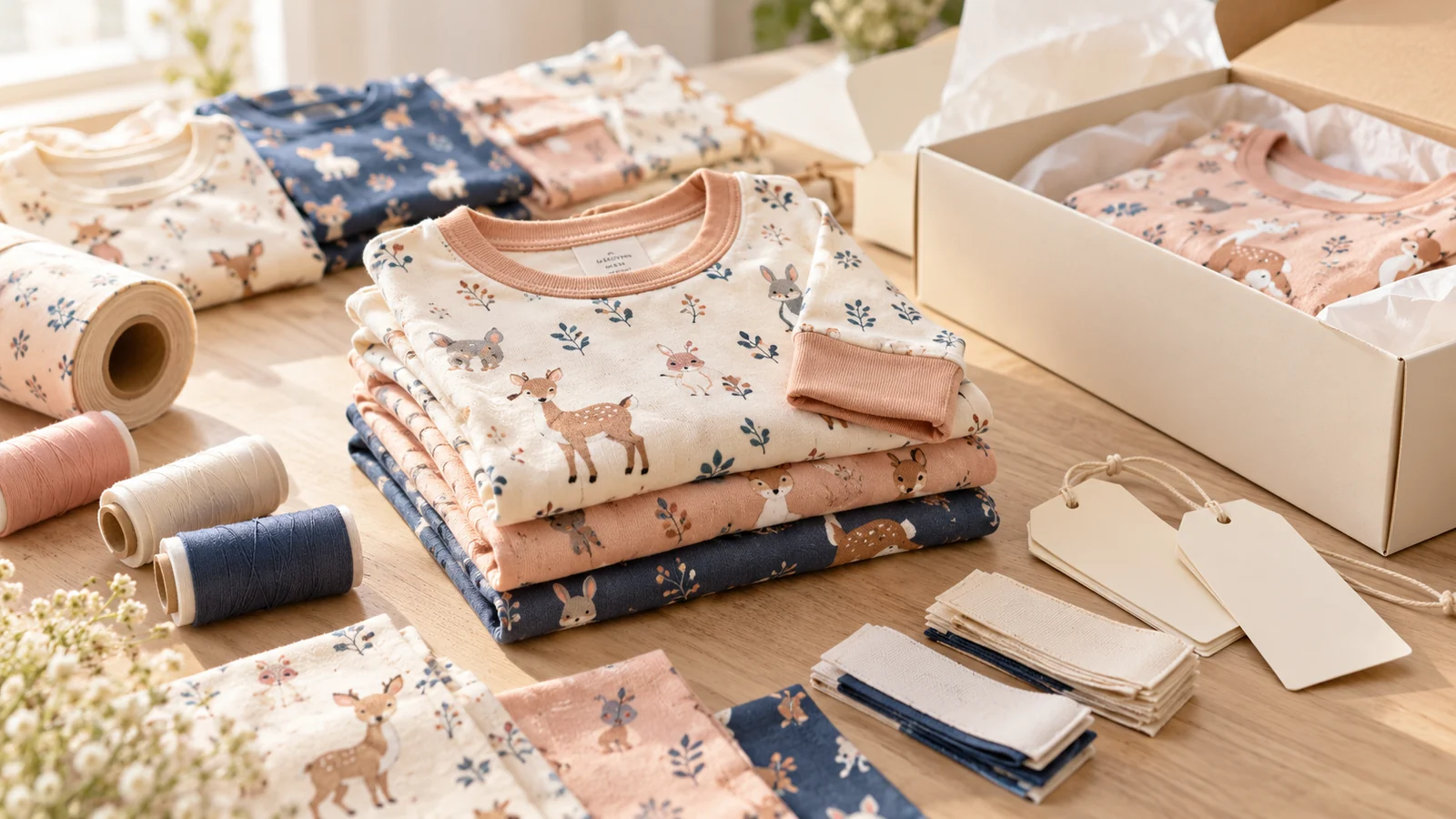
Private label kids pajamas require a consistent production specification covering fabric, labels, care instructions, decoration and packaging.
A private-label children’s pajama collection succeeds when the product, label claims and unboxing experience tell the same story. The smallest branding decisions—how a neck label feels, whether a care label remains legible after washing, how a multi-size set is identified—have operational and legal consequences. This guide focuses on execution, rather than repeating the startup-cost guide.
On this page
- 1. Separate what is yours from what is the factory's
- 2. Build a complete branding bill of materials
- 3. Distinguish decoration from legally required information
- 4. Choose skin-friendly label application
- 5. Plan packaging as a fulfillment system
- 6. Give artwork to the factory in production format
- 7. Watch the hidden economics of private label kids pajamas
- 8. Use a four-gate launch approval
- Brand artwork approval template
- Example: the hidden cost of changing a label after production
- Make packaging work for international sales
- Frequently asked questions
1. Separate what is yours from what is the factory’s
Private label may mean putting your marks on an existing manufacturer’s style, or developing exclusive fabric, pattern and construction. These two routes have different ownership and commercial terms. Your purchase agreement should state who owns original artwork, print repeat files, patterns, molds, photography and excess branded packaging. Confirm how rejects and unsold units carrying your brand will be handled.
For stock styles, ask if another customer may buy the same garment under a different label. For exclusive designs, agree when ownership transfers and whether the factory can display the product in its portfolio. This is particularly important for character artwork and novelty prints, where licensing rights must be validated.
2. Build a complete branding bill of materials
Do not approve branding from one logo mockup. Write a bill of materials listing each branding component, physical dimensions, material, placement, supplier, artwork file version and sign-off owner.
| Component | Decisions to record |
|---|---|
| Neck label | Woven or heat transfer; size, position, skin-contact comfort |
| Fiber/care label | Verified composition, origin, care text, regulatory format |
| Tracking/lot marking | Factory, date, batch or traceability reference as applicable |
| Hangtag | Size, warnings, brand copy, barcode and market language |
| Polybag/gift box | Dimensions, material, print artwork, carton fit |
| Carton label | SKU, quantity, size assortment, weights and destination |
3. Distinguish decoration from legally required information
In the United States, most textile apparel needs accurate fiber content, country-of-origin and responsible-business labeling, along with required care instructions. The FTC apparel labeling guidance explains the relevant principles. Children’s products may also need tracking labels and sleepwear-specific warnings depending on the product classification. Decorative brand marks cannot replace these disclosures.
If your garment uses bamboo-derived rayon/viscose, do not casually call it “100% bamboo” merely because the cellulose plant source was bamboo. The FTC bamboo textile guidance explains compliant naming practices. Similarly, a supplier’s test for one material is not authorization to use broad claims like “non-toxic,” “antibacterial” or “certified organic” across your whole line.
4. Choose skin-friendly label application
Woven labels can feel premium, but a rigid or exposed edge may irritate skin. Printed or transfer marks can reduce bulk, but require wash durability testing and a clear decision about which legally required information can be provided in that format. Place branding away from high-friction areas where practical, and check the appearance after the intended number of wash cycles.
Never eliminate required warnings or product traceability merely to achieve a minimal aesthetic. In children’s sleepwear, fit and trim restrictions may also affect where decorative attachments are appropriate.
5. Plan packaging as a fulfillment system
Start with the retail channel. An independent boutique may want a shelf-ready wrap with a hanging card; an e-commerce brand may prefer a protective bag with SKU barcode; a gift collection may justify a recyclable rigid box. Each option changes carton cube, storage, shipping damage risk and handling cost.
Test packaging with the actual folded garment and the entire size range. One box size might be suitable for toddler sets but compress larger long-sleeve sizes. Request an assembled packaging sample rather than approving only a flat dieline.
6. Give artwork to the factory in production format
Send vector logo assets, fonts converted to outlines where appropriate, color references, size and safe-zone specifications, print repeat information, artwork licensing confirmation and the intended packaging language. Keep all files version-controlled: Brand_PJ01_NeckLabel_v03_Approved.pdf is more useful than logo_final_new2.jpg.
An approval pack should include artwork proofs against real materials, a printed strike-off where needed, finished sample photography, physical label tests, final barcodes and any mandatory warning copy reviewed for the target market.
7. Watch the hidden economics of private label kids pajamas
One-time artwork setup, packaging minimums, custom woven-label runs, special hangtags, label attachment labor and extra cartons can be more important at smaller quantities than garment sewing. Calculate the packaging cost per sellable set and account for leftover labels if a design changes. New print/color combinations can also change safety testing scope; coordinate approvals before scaling.
Compare the new branding spec to the Nuohua private label startup cost article, which discusses broader collection budgeting. This guide’s focus is the execution package your team should give a manufacturer.
8. Use a four-gate launch approval
- Identity: trademark clearance, artwork ownership, defined target customer and channel.
- Specification: approved garment, labels, care instructions, compliance route and packaging bill of materials.
- Pre-production: physical reference sample with final print, fit, labels and packout.
- Release: carton inventory, barcodes, shipment traceability, final QC and archived approved files.
For a growing brand, a well-kept approval library is an asset. It allows each reorder to reproduce what shoppers actually reviewed and bought, instead of relying on an old email thread.
Brand artwork approval template
An email saying “logo approved” is not a complete manufacturing instruction. Use an artwork register with separate rows for the neck mark, care label, outside hangtag, polybag, gift box and carton sticker. For each item, identify the print technique, substrate, dimensions, placement coordinates, color standard, legal text, artwork version, approver and approval date. Attach photographs of a production-like sample instead of relying solely on a computer rendering.
A simple approval table might track these steps:
| Review step | Proof required | Who approves |
|---|---|---|
| Brand artwork | Editable vector, color reference and use rights | Brand owner |
| Mandatory label text | Market-appropriate language and content | Compliance lead |
| Physical application | Sewn/printed sample and wash assessment | Technical QA |
| Retail packaging | Assembled sample, size range and barcode scan | Merchandising/operations |
| Bulk release | Final golden sample and matching artwork revisions | Authorized buyer |
Example: the hidden cost of changing a label after production
Imagine a brand approves a neck transfer with a large logo and discovers during the wash trial that its printing method cracks or irritates the skin. The correct response is to update the specification, approve an alternative and confirm that mandatory labeling remains durable—not to simply ask the factory to press the same artwork for longer. A single revised transfer may affect sampling, cost, delivery and stock already manufactured. This is why physical proof and wash assessment belong before bulk release.
Make packaging work for international sales
For brands selling into more than one country, do not assume identical labels or warnings can be used across all markets. Separate globally common artwork from market-specific regulatory copy. Plan translations, recycling instructions where required, retailer barcode placement and retailer-specific packout instructions. Avoid environmental claims such as “fully recyclable” without verifying the actual packaging structure and local recycling access.
If the same print sells through boutiques and online channels, consider whether one universal pack can serve both without increasing damage or pick/pack costs. Sometimes an inner protective pack plus different outer merchandising sleeves is more efficient than two entirely separate product runs.
Frequently asked questions
Can I private-label ready-stock pajamas?
Sometimes. Confirm which styles may be relabeled, minimum quantities, existing origin/care and safety labels, and whether the work affects packaging or certification.
Do I need a separate woven brand label and care label?
Not always; compliant information may be combined where rules permit. The final content, durability and format should be reviewed for the destination market.
Can I claim bamboo pajamas are naturally antibacterial?
Do not make a health or antimicrobial claim without appropriate substantiation. Bamboo-derived regenerated fibers also require accurate FTC fiber disclosures.
How do I keep the same branding on reorders?
Archive signed proofs, print colors, exact label suppliers, material codes, measurement drawings and a physical approved reference sample.
Content is intended for wholesale sourcing and educational use. Product specifications, quotations, certifications, labeling and import obligations must be confirmed for the actual style, market and shipment. References to regulatory guidance were checked October 2026.
Ready to discuss your kids sleepwear collection?
Share designs or reference images, target market, fabric, style/color quantities, size range and required delivery date. Nuohua can review OEM/ODM feasibility and provide a specification-based quotation.