
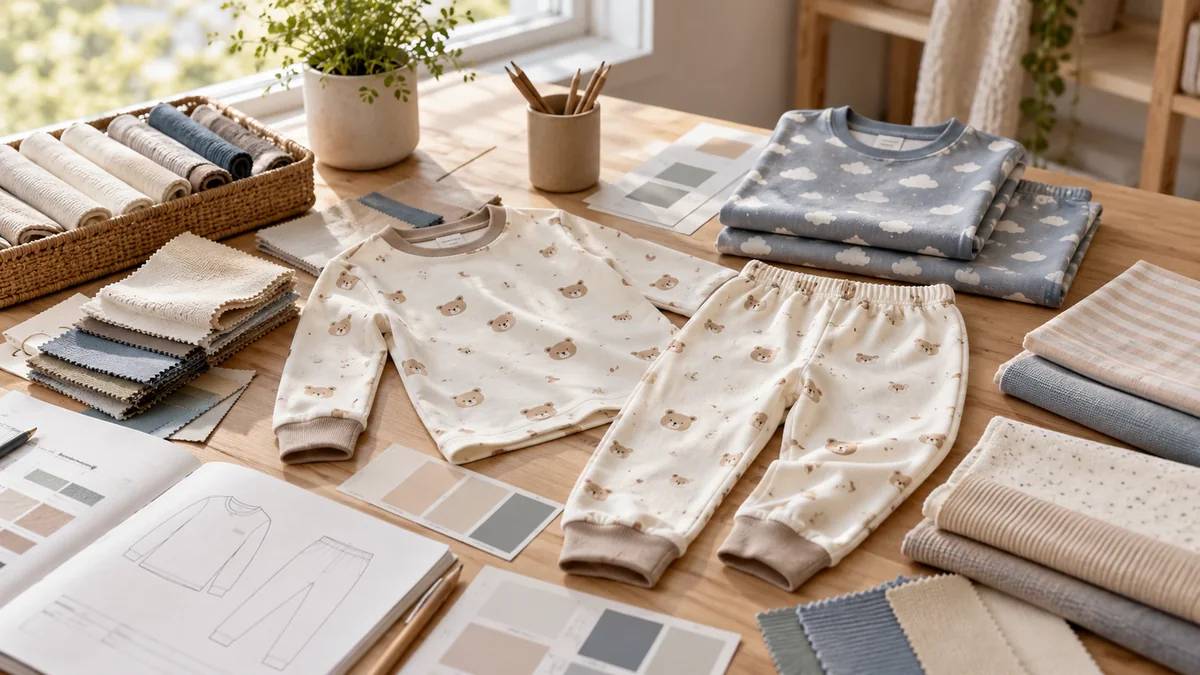
How to Start a Kids Sleepwear Brand in 2027
On this page
- Start With a Clear Sleepwear Position
- Define the Market Before the Fabric
- Choose the Right Fabric Base
- Build the Fit Around Real Measurements
- Create a Tech Pack That a Factory Can Actually Use
- Choose the Right MOQ Route
- Sample in Stages, Not With One “Final Sample”
- Build Compliance Into Development
- Approve Bulk With a QC Plan
- Price the Collection as a System
- Launch Small, Then Scale the Winners
- Buyer Checklist: Before You Place Your First Sleepwear Order
- FAQ
To start a kids sleepwear brand, define the age range and destination market first, then build a small launch assortment around one or two reliable fabric bases. Decide whether you are using ready-stock, selected low-MOQ custom styles, or full OEM development; create a technical specification for fit, fabric, trims and labeling; approve samples before bulk; and confirm the testing and certification responsibilities for your market. For the United States, sleepwear above size 9 months and through size 14 is subject to specific flammability rules unless the garment qualifies under a defined exception such as tight-fitting sleepwear. The right production route is the one that matches your product, budget and compliance plan—not simply the lowest advertised MOQ.
A new sleepwear brand does not need twenty styles. It needs a small range that fits consistently, survives washing, photographs well and can be reordered without rebuilding the product from scratch.
1. Start With a Clear Sleepwear Position
“Kids pajamas” is a product category, not a brand position. Before contacting a factory, decide what the customer is buying from you that they cannot get from a generic marketplace listing.
Common positions include:
- premium cotton pajama sets with clean, restrained prints;
- soft stretch sleepwear using viscose made from bamboo or modal;
- seasonal family or children’s pajama collections;
- warm-weather short-sleeve sets;
- cold-weather long-sleeve sets;
- toddler sleepwear focused on easy dressing;
- boutique private-label ranges with custom prints;
- value-driven wholesale programs built around repeatable stock fabrics.
Your position affects almost every technical decision that comes later. A premium print-led brand may accept higher print-development minimums. A startup testing demand may be better served by selected in-stock styles first. A brand selling in the U.S. must settle its sleepwear classification and flammability route before approving the fit.
A practical first collection
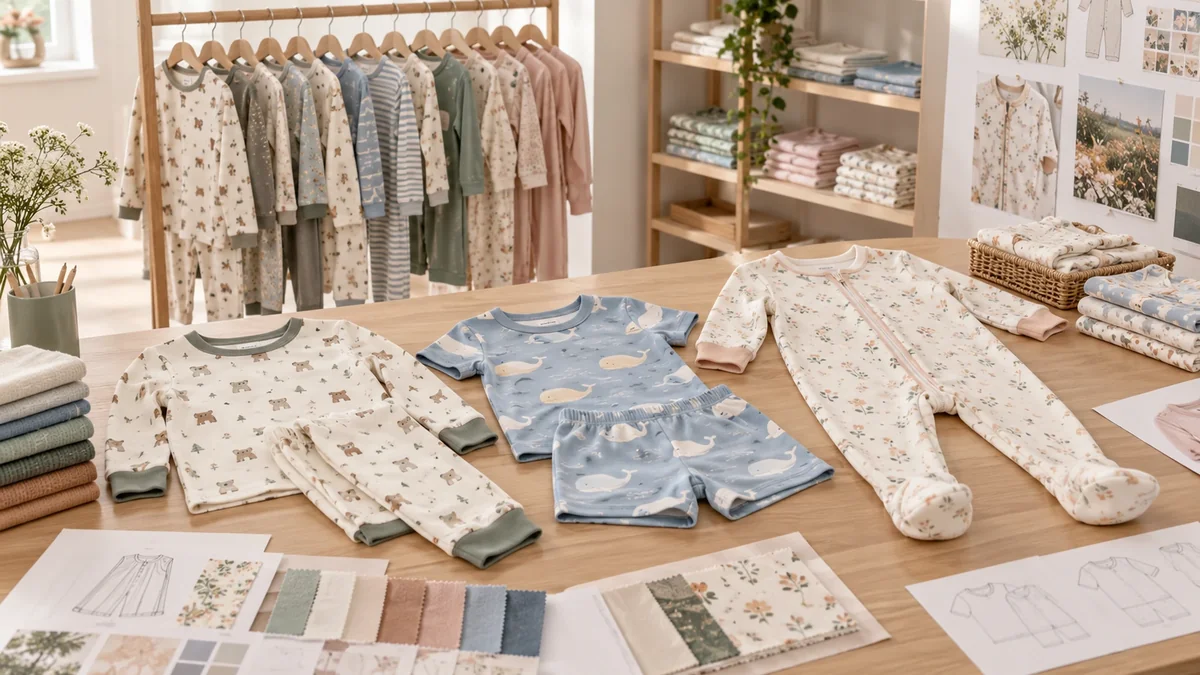
For most new brands, a disciplined first range is stronger than a wide one. A practical launch might include:
| Product | Suggested role | Why it works |
|---|---|---|
| Long-sleeve two-piece set | Core style | Easy to photograph, merchandise and repeat |
| Short-sleeve two-piece set | Warm-season extension | Uses the same visual language with lower development complexity |
| One-piece sleeper | Baby/toddler extension | Adds a different use case without requiring a new brand direction |
| One hero print | Brand recognition | Gives the range a memorable visual identity |
| Two or three solids | Reorder base | Easier to replenish and combine with future drops |
Do not start by creating a different fabric, neckline, waistband and print method for every style. Shared fabric bases and shared trims reduce shade risk, simplify testing and make repeat orders easier.
2. Define the Market Before the Fabric
Children’s sleepwear is one of the apparel categories where the selling market can materially affect construction. In the United States, CPSC rules cover children’s sleepwear above size 9 months and through size 14. Depending on the garment, the product may need to meet the applicable children’s sleepwear flammability standard or qualify as tight-fitting under the rule’s dimensional and labeling requirements.
That means a U.S. sleepwear program should not be designed as an ordinary loose lounge set first and “made compliant later.” The classification, fit route and testing plan belong in development from the beginning.
For other markets, requirements differ. The factory should know where the product will be sold, but the brand or importer should also confirm the regulations that apply to the final product, labeling and claims.
Put this in the first RFQ
Tell the manufacturer:
- destination country or countries;
- intended product use: sleepwear, loungewear or general apparel;
- age and size range;
- fiber composition target;
- fit preference;
- whether you need custom print or solid color;
- logo, labels and packaging requirements;
- expected first quantity and reorder scale;
- testing or documentation expectations.
This gives the factory enough information to identify whether the proposed construction and MOQ route are realistic.
3. Choose the Right Fabric Base
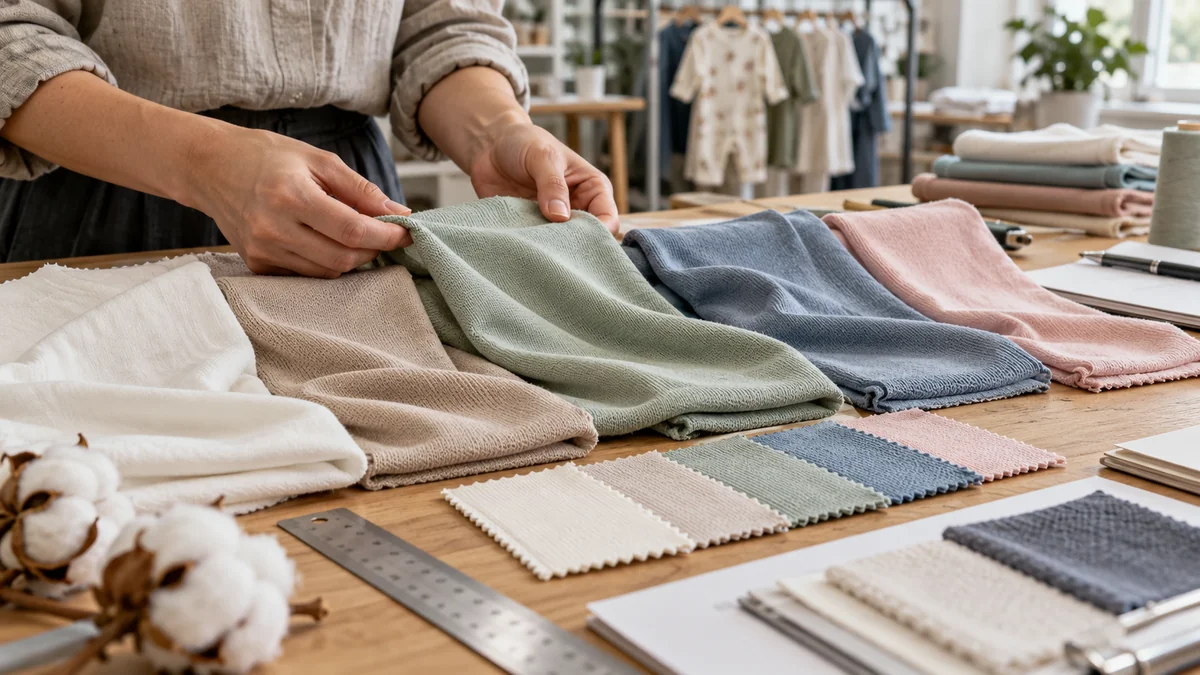
The best sleepwear fabric is not the one with the most fashionable fiber name. It is the one that delivers the hand feel, fit, wash performance, print result and cost your customer expects.
Cotton jersey
Cotton jersey is familiar, breathable and easy for customers to understand. For close-fitting pajama sets, cotton is often blended with a small amount of elastane/spandex to improve stretch recovery. The key development questions are yarn quality, GSM, shrinkage, spirality, pilling and colorfastness.
Cotton interlock
Interlock is generally denser and more stable than single jersey. It can provide a smooth surface and good body for baby and colder-season sleepwear. It also consumes more yarn and normally costs more than a light single jersey.
Viscose made from bamboo
This fabric can deliver a very soft, fluid hand and comfortable stretch when blended with spandex. In U.S. labeling and advertising, a regenerated cellulose textile made from bamboo should be identified using the proper generic fiber name, such as “viscose made from bamboo,” rather than simply being represented as natural bamboo fiber.
Modal
Modal can offer softness, drape and good color appearance. As with any regenerated cellulose base, test dimensional stability, pilling, recovery and print compatibility instead of choosing it only from a swatch.
What to specify
A useful fabric line in a tech pack includes more than composition. Specify or confirm:
- fiber composition;
- knit construction;
- target GSM;
- usable width if relevant;
- stretch direction and recovery expectation;
- color or Pantone reference;
- print method;
- shrinkage tolerance;
- pilling expectation;
- hand-feel reference;
- required testing for the destination market.
4. Build the Fit Around Real Measurements
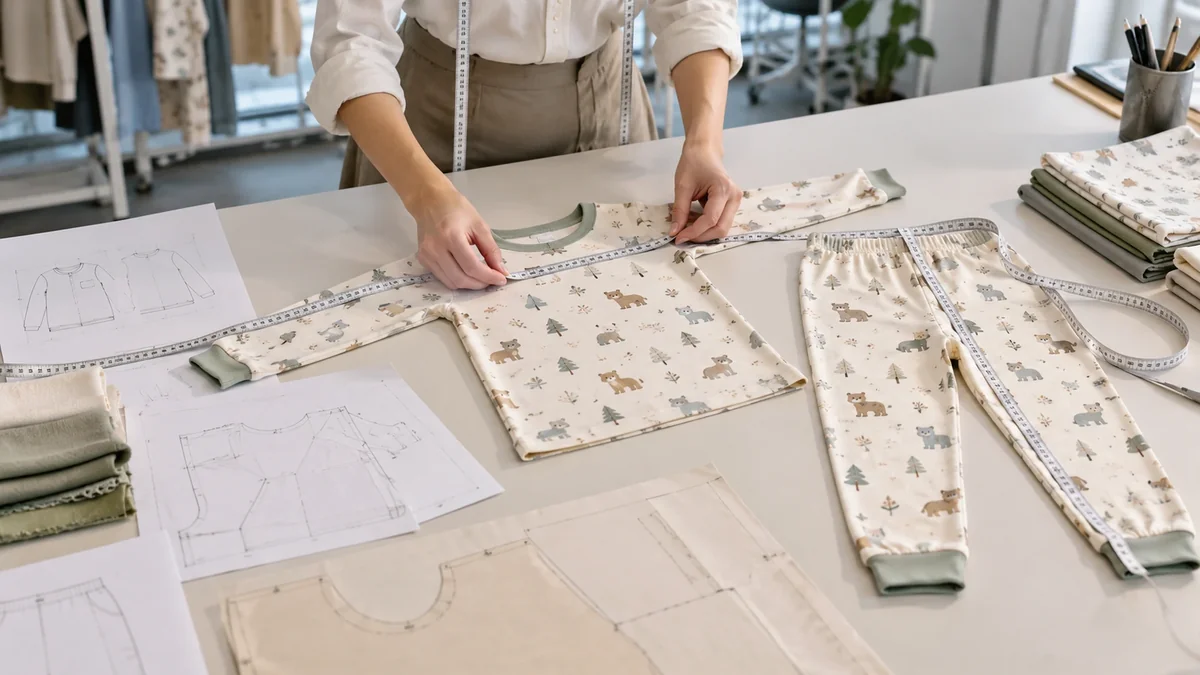
Sleepwear fit is a technical system. Chest width, body length, sleeve length, bicep, cuff opening, waist, hip, rise, inseam and leg opening all interact.
For a two-piece set, do not approve the top and bottom independently. Check the complete outfit on the intended body size. A waistband that looks correct on a flat table can still be uncomfortable if elastic tension is too high. A sleeve can meet the chart yet feel short after wash shrinkage. A neckline can stretch during sewing if binding tension is inconsistent.
Your size chart should contain
- point of measurement name;
- sketch showing where each measurement is taken;
- measurement by size;
- tolerance by point;
- garment condition: relaxed, stretched or half measurement;
- wash-test condition if shrinkage is evaluated;
- fit notes for the sample reviewer.
For U.S. tight-fitting sleepwear, do not substitute a brand’s ordinary body-fit chart for the dimensional requirements of the applicable regulation. The route must be checked specifically.
5. Create a Tech Pack That a Factory Can Actually Use
A beautiful mood board is useful for design direction, but it is not a production instruction. The factory needs decisions.
A practical kids sleepwear tech pack should include:
- front and back flats;
- style number and revision date;
- fabric composition and construction;
- target GSM;
- color references;
- artwork with repeat size and placement;
- stitch and seam notes;
- neck, cuff and waistband construction;
- elastic width and tension requirement;
- size specification and tolerances;
- label content and placement;
- packaging specification;
- destination market;
- testing requirements;
- sample comments and revision history.
The more clearly the tech pack distinguishes “must match” from “factory may suggest,” the fewer arguments you will have at sample approval.
6. Choose the Right MOQ Route
MOQ should be treated as a consequence of the production route, not a universal number.
At Nuohua, the current production logic is:
- Ready Stock: from 2 pcs on selected in-stock styles, colors and sizes.
- Selected Low-MOQ Custom Styles: from 150–300 pcs per color on selected styles, depending on fabric, size range and customization requirements.
- Kids Sleepwear Custom Programs: typically from 1,000 sets per design where the project is a full custom sleepwear program.
- Full OEM / ODM: MOQ is confirmed after reviewing fabric composition, GSM, yarn count, size range, artwork, print method, construction and other customization requirements.
Why can two similar pajamas have different MOQs? Because fabric dyeing, print setup, trim purchasing, cutting efficiency and size breakdown can change the economic minimum.
What changes MOQ most often
| Variable | Why it changes MOQ |
|---|---|
| Custom fabric color | Dyeing mills have minimum batch quantities |
| All-over print | Printing setup and fabric wastage increase |
| Many sizes | Small quantities per size reduce cutting efficiency |
| Special elastic or trim | Supplier minimums can exceed garment quantity |
| Custom packaging | Printed packaging has its own MOQ |
| Unique fabric construction | Mill development may be required |
A professional quotation should state what the MOQ actually applies to: style, color, print, fabric lot or order.
7. Sample in Stages, Not With One “Final Sample”
For a new brand, sampling is where assumptions become measurable.
A typical development flow may include:
- reference or development sample;
- fit sample;
- revised fit sample if required;
- size-set sample for critical programs;
- pre-production or PP sample;
- approved bulk standard.
You do not need every sample type on every simple ready-stock program. But for custom sleepwear, especially with new prints or a regulated fit route, reducing sampling too aggressively can push the problem into bulk production.
What to check on the sample
Check more than appearance:
- garment measurements against spec;
- stretch and recovery;
- seam comfort;
- neckline shape after dressing;
- waistband pressure and twisting;
- print scale and registration;
- color under neutral light;
- hand feel after washing;
- shrinkage and spirality;
- label position;
- packaging fold and presentation.
Write sample comments as measurable changes. “Sleeve too loose” is weaker than “reduce bicep width 1.0 cm at this size and grade proportionally, keeping cuff opening unchanged.”
8. Build Compliance Into Development
For the U.S., children’s products subject to CPSC-enforced rules require the responsible domestic manufacturer or importer to certify compliance based on applicable testing. Since July 8, 2026, importers of most regulated consumer products subject to CPSC certification requirements must electronically file certificate data with U.S. Customs and Border Protection.
For sleepwear, confirm whether the product falls under 16 CFR Part 1615 or 1616, qualifies as tight-fitting, is an infant garment under the applicable definition, or is instead subject to general wearing-apparel flammability requirements. Do this before bulk.
Compliance is not a logo that a factory adds to a hangtag. It is a chain of product classification, construction, testing, records and certification responsibility.
9. Approve Bulk With a QC Plan
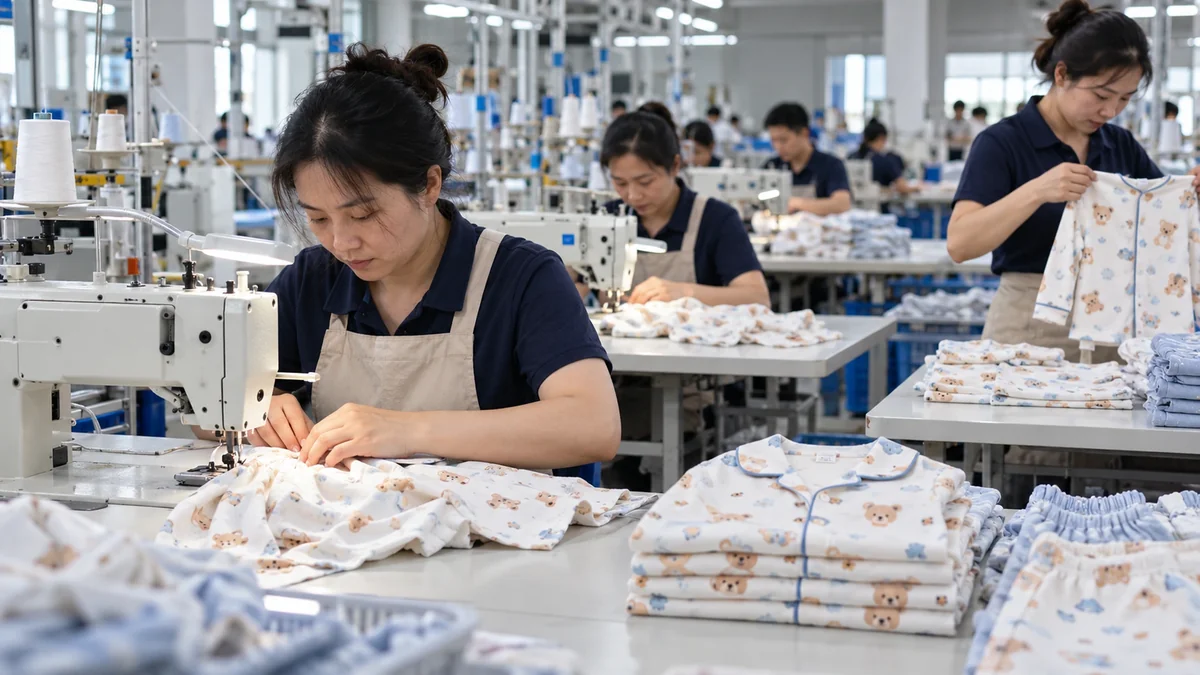
Bulk consistency is where a sleepwear brand earns repeat customers.
Your QC plan should cover:
- fabric inspection;
- shade and lot control;
- cutting accuracy;
- inline sewing checks;
- critical measurements;
- print placement;
- elastic length/tension;
- seam appearance;
- loose threads and contamination;
- metal/needle control where applicable;
- final inspection;
- packaging verification.
For a new style, identify the three highest-risk points and tell the factory to check them earlier than final inspection. Typical examples include neckline stretch, cuff opening, waistband twisting, print placement and post-wash length.
10. Price the Collection as a System
Do not set retail price by multiplying one factory quote by a random number. Your landed cost can include:
- garment unit cost;
- labels and packaging;
- testing;
- sampling amortization;
- inspection;
- freight;
- duty/tax where applicable;
- fulfillment;
- marketplace or payment fees;
- returns and defects;
- marketing allowance.
A cheap factory price can become an expensive product if the order requires repeated air shipments or rework. Build a landed-cost model before placing bulk.
11. Launch Small, Then Scale the Winners
Your first order is a learning order. Track sales by size, color and print—not just total style sales.
Ask after launch:
- Which sizes sell out first?
- Which colors are viewed but not purchased?
- Are returns caused by fit, fabric expectation or color?
- Do customers buy sets or individual pieces?
- Does the hero print outperform solids?
- Which product needs replenishment first?
Use that data for the second production order. A good manufacturing relationship becomes more valuable once the factory has an approved pattern, known fabric base and documented QC standard for repeat production.
Buyer Checklist: Before You Place Your First Sleepwear Order
- [ ] Target market confirmed
- [ ] Product classification reviewed
- [ ] Size range finalized
- [ ] Fit route confirmed
- [ ] Fabric composition and GSM specified
- [ ] Print method selected
- [ ] Tech pack completed
- [ ] Label content reviewed
- [ ] Packaging brief completed
- [ ] Testing plan agreed
- [ ] MOQ basis understood
- [ ] Sample approved by measurement and appearance
- [ ] Wash test reviewed
- [ ] Bulk QC checkpoints agreed
- [ ] Landed-cost estimate completed
- [ ] Reorder plan prepared
FAQ
How much does it cost to start a kids sleepwear brand?
There is no reliable universal figure because startup cost depends on product route, number of styles, custom fabric or print, sample rounds, testing, packaging and order quantity. A selected ready-stock test can require far less capital than a fully custom printed collection. Build the budget from the specification rather than starting with a target factory price.
Can I start with a low MOQ?
Yes, if the product is suitable for an in-stock or selected low-MOQ route. A fully custom sleepwear program with custom fabric, print and construction normally needs a higher quantity because fabric and print suppliers have their own minimums.
Is bamboo fabric good for kids pajamas?
Viscose made from bamboo can produce soft, fluid sleepwear with good comfort, especially when blended with spandex. The product should still be evaluated for stretch recovery, pilling, shrinkage, colorfastness and correct fiber labeling.
Do children’s pajamas need flame-resistant fabric in the U.S.?
Not every children’s sleepwear product uses the same route. U.S. rules provide different treatment depending on product definition, size and whether the garment qualifies as tight-fitting or another defined exception. Brands should review the applicable CPSC requirements for the final design and market before production.
What should I send a manufacturer for a quote?
Send the product type, reference or tech pack, fabric preference, size range, color/print count, quantity, destination market, branding and packaging requirements. The more complete the brief, the more meaningful the quotation.
Build Your Kids Sleepwear Range Around a Real Production Plan
Send Nuohua your product type, fabric preference, size range, artwork or reference images, quantity and destination market. We can review the project route before sampling and confirm which details need to be fixed in the tech pack for production.
Or explore our kidswear manufacturing capabilities.
Nuohua Garment is a kidswear OEM/ODM manufacturer producing children’s underwear, sleepwear, baby apparel and custom kidswear for brands, retailers and wholesalers, with an 8,000 m² production base in Guangdong, China. Guidance here reflects our production experience; confirm current regulations and requirements for your market and product before ordering.