
Baby Clothing Size Chart: US, UK, EU and AU Guide
On this page
- Baby Clothing Size Conversion Reference
- Why Baby Sizes Differ Between Brands
- Body Measurements vs Garment Measurements
- Essential Measurements for Baby Bodysuits
- Essential Measurements for Rompers and Sleepsuits
- How Grading Works
- Fabric Changes the Size Chart
- Wash Testing Before Final Grading
- Tolerances Matter
- Converting EU Height Sizes to Age Labels
- How to Build Your Own Baby Size Chart
- Common Size-Chart Mistakes
- FAQ
- Build a Master Fit Block
- Size-Set Sampling
- Create Consumer-Facing Size Guidance From the Production Chart
- How to Measure Consistently
- Fit Comments Should Be Quantified
- Keep Size-Chart Version Control
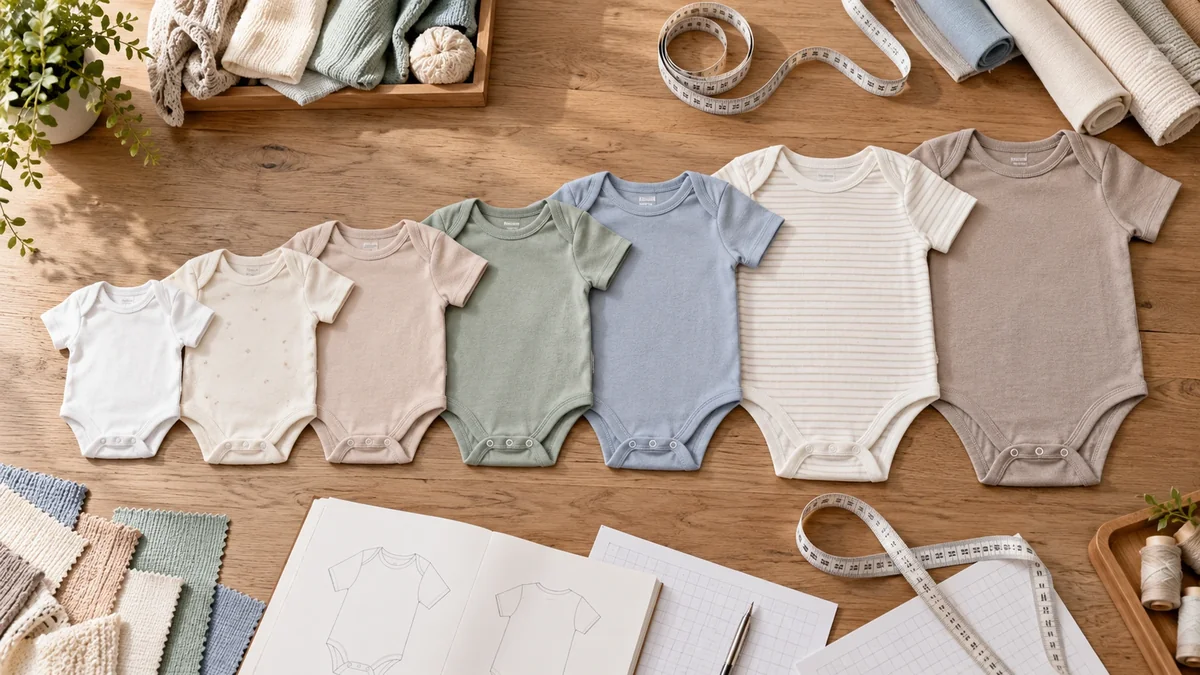
Baby clothing sizes are not globally standardized. U.S., UK and Australian retail labels often use age ranges such as 0–3M or 6–12M, while European sizing often references body height in centimeters. For manufacturing, age labels should never be the only sizing input. Brands should define a body-size target, garment measurements, points of measurement, grading increments and tolerances for every style.
The table below is a market-orientation reference—not a universal legal or fit standard. Always validate the final size chart against your own target customer and garment construction.
Baby Clothing Size Conversion Reference
| Approx. age | Common US label | Common UK/AU label | Common EU height reference | Typical development note |
|---|---|---|---|---|
| Newborn | NB | Newborn | 50–56 cm | Keep neck/arm openings easy to dress |
| 0–3 months | 0–3M | 0–3M | 56–62 cm | Allow diaper ease and wash shrinkage |
| 3–6 months | 3–6M | 3–6M | 62–68 cm | Check torso length carefully |
| 6–9 months | 6–9M | 6–9M | 68–74 cm | Mobility increases; avoid restrictive openings |
| 9–12 months | 9–12M | 9–12M | 74–80 cm | Review crawling/sitting ease |
| 12–18 months | 12–18M | 12–18M | 80–86 cm | Transition toward toddler proportions |
| 18–24 months | 18–24M | 18–24M | 86–92 cm | Confirm rise, inseam and top length |
Retail brands use different body-height and weight assumptions, so do not copy this table directly into production without fit validation.
1. Why Baby Sizes Differ Between Brands
Two garments labeled 6–12M can fit differently because brands use different:
- target body measurements;
- ease allowance;
- diaper allowance;
- fabric stretch;
- shrinkage assumptions;
- brand fit (slim, standard, relaxed);
- grading rules.
Age is a merchandising label. Production requires measurements.
2. Body Measurements vs Garment Measurements
A body chart describes the baby. A garment spec describes the product.
For example, a bodysuit chest width is not the same as chest circumference on the body. The garment may include negative ease if the fabric is highly stretchy or positive ease if the product is relaxed.
A professional tech pack should make that distinction explicit.
3. Essential Measurements for Baby Bodysuits
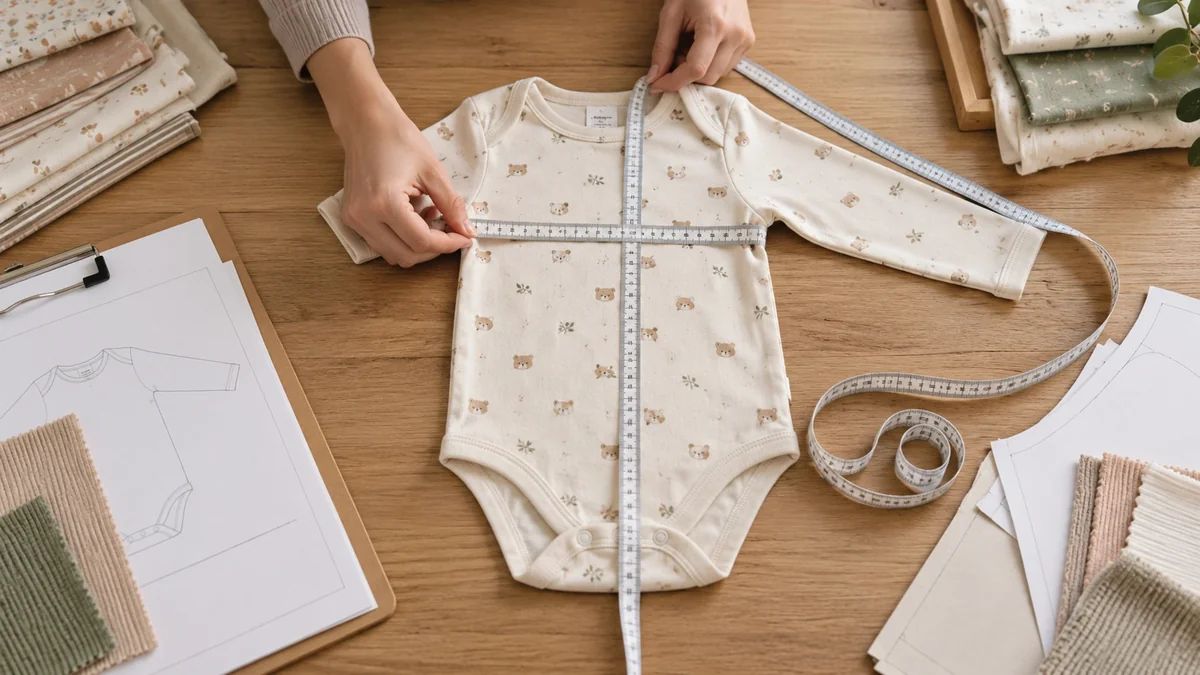
Typical points of measurement include:
- half chest;
- body length/HPS to crotch;
- shoulder width where applicable;
- sleeve length;
- bicep;
- sleeve opening;
- neck width;
- front neck drop;
- back neck drop;
- leg opening;
- crotch width.
For envelope-neck bodysuits, also check overlap and opening recovery.
4. Essential Measurements for Rompers and Sleepsuits
Add:
- hip width;
- rise;
- inseam;
- thigh;
- leg opening/cuff;
- foot length for footed styles;
- zipper length and guard placement where applicable.
Long one-piece garments magnify torso-length grading errors, so fit-test more than one size when possible.
5. How Grading Works
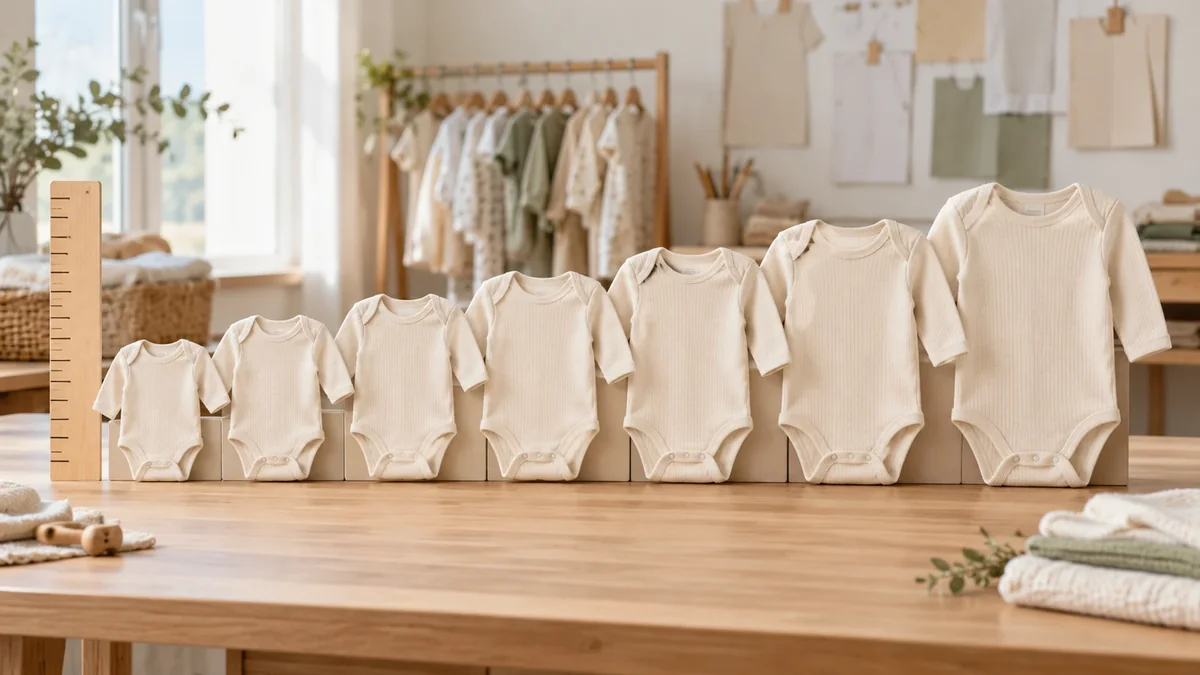
Grading is the controlled change from one size to the next. It should not be a simple percentage applied to every measurement.
Different body areas grow at different rates. A neck opening may change slowly while body length changes more quickly.
A grading sheet should list the increment by POM. For example:
| POM | Example grading logic |
|---|---|
| Half chest | small incremental increase each size |
| Body length | larger linear increase |
| Sleeve length | moderate increase |
| Neck width | small controlled increase |
| Leg opening | increase tied to fit/ease |
The actual increments should be set from your fit standard, not copied from a generic internet chart.
6. Fabric Changes the Size Chart
A 100% cotton interlock bodysuit and a high-stretch viscose/spandex bodysuit should not automatically use the same finished measurements.
Consider:
- stretch percentage;
- recovery;
- fabric weight;
- wash shrinkage;
- seam stability;
- intended fit.
The measurement chart is part of the fabric decision.
7. Wash Testing Before Final Grading
Measure samples before washing, wash them using the intended care method, condition them, then measure again.
Track:
- length shrinkage;
- width shrinkage;
- spirality;
- neckline distortion;
- snap/zip behavior;
- color change;
- pilling.
If the fabric shrinks materially, the pre-wash garment spec may need compensation.
8. Tolerances Matter
Not every measurement needs the same tolerance.
Critical fit points may require tighter control than a less sensitive measurement. Your tolerance table should reflect the product and production method.
Avoid unrealistic zero-tolerance specifications for sewn knit garments. They increase disputes without necessarily improving fit.
9. Converting EU Height Sizes to Age Labels
European baby sizes often use height-based labels such as 56, 62, 68, 74, 80, 86 and 92. A brand selling in multiple markets may map these to age labels, but the mapping should be treated as merchandising guidance.
A cleaner international system is:
- maintain one master body/garment specification;
- create market-specific consumer-facing labels;
- ensure the labels correspond to the same approved fit.
10. How to Build Your Own Baby Size Chart
- Define target customer and market.
- Choose a reliable body-data source or established internal fit block.
- Fit the middle/core size.
- Finalize garment ease.
- Wash-test the base fabric.
- Grade all POMs deliberately.
- Make a size set or at least test endpoint sizes for important programs.
- Record tolerances.
- Keep version control.
11. Common Size-Chart Mistakes
- using age labels as the only technical information;
- mixing body and garment measurements;
- grading every POM by the same increment;
- ignoring diaper ease;
- approving fit before wash testing;
- changing fabric without reviewing measurements;
- measuring different samples with inconsistent methods;
- failing to define whether measurements are half or full circumference.
FAQ
Are US and EU baby sizes the same?
No. U.S. sizing commonly uses age labels while EU sizing often uses body height in centimeters. Brands also use their own fit standards.
What does size 80 mean in baby clothes?
It generally refers to a height-based European size around 80 cm, but the exact garment fit still depends on the brand’s specification.
Should I use weight in a baby size chart?
Weight can help consumer guidance, but factories still need garment measurements and POM definitions. Weight alone cannot define garment fit.
How do I prevent baby clothing from becoming too small after washing?
Specify the fabric, test shrinkage, set an acceptable tolerance, and compensate the pattern/finished measurements where appropriate.
12. Build a Master Fit Block
If your brand sells several babywear categories, create a consistent base fit rather than developing every style independently.
A master fit block can define:
- target body dimensions;
- preferred ease;
- neck proportions;
- sleeve proportions;
- torso length;
- rise/diaper allowance;
- standard grade rules.
New styles can then start from a known fit foundation.
13. Size-Set Sampling
A perfect middle size does not guarantee a good full range.
For important styles, review at least:
- smallest size;
- middle/core size;
- largest size.
Look for proportional problems such as:
- oversized neck opening in larger sizes;
- insufficient diaper ease in smaller sizes;
- sleeves growing too quickly;
- leg openings becoming disproportionately wide;
- crotch length not keeping pace with body growth.
14. Create Consumer-Facing Size Guidance From the Production Chart
Your ecommerce size guide should be derived from the same approved fit system used in production.
Include:
- age as a convenience reference;
- body height;
- weight if your fit data supports it;
- key garment measurement where useful;
- note about choosing between sizes;
- fit description: slim, standard, relaxed.
Do not publish a generic size chart that does not match your garments.

15. How to Measure Consistently
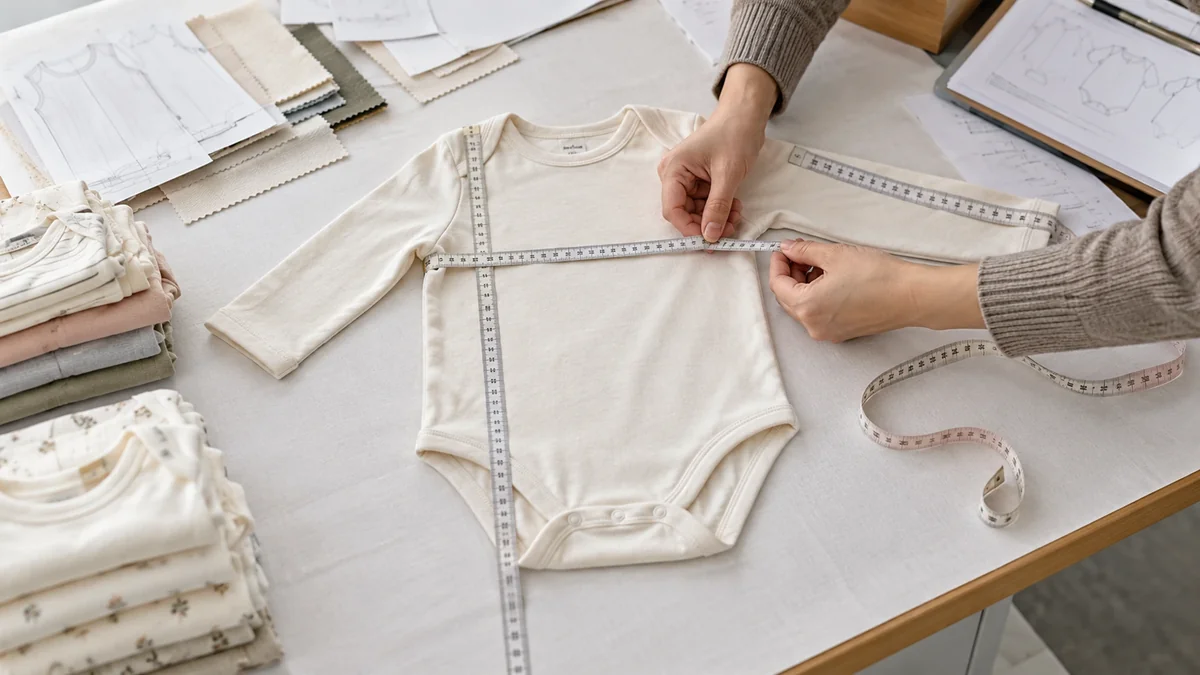
Define the method for each POM. For example, “half chest 2 cm below armhole” is more reproducible than “chest width.”
Specify:
- garment laid flat or relaxed;
- whether stretch is applied;
- exact reference points;
- whether curved seams are measured along curve or straight;
- measurement tool;
- rounding convention.
Consistency between buyer and factory prevents false measurement disputes.
16. Fit Comments Should Be Quantified
Replace comments such as:
- “make it a little bigger”
- “neck too tight”
- “body too short”
with:
- “increase half chest by 0.5 cm”
- “increase neck width by 0.3 cm while keeping front neck drop unchanged”
- “add 1.0 cm body length from HPS to crotch.”
Quantified comments make the next sample objectively reviewable.
17. Keep Size-Chart Version Control
Use a version/date on every size chart. When the fit changes, archive the previous version rather than overwriting it.
The purchase order and PP sample should reference the exact approved version. This is especially important when repeat orders happen months later.
Need a Size Chart Turned Into a Production Spec?
Send the target age/height range, garment type, fabric and reference fit. Nuohua can review the POM list and identify where fabric stretch, shrinkage or grading needs to be resolved before sampling.
Or explore our kidswear manufacturing capabilities.
Nuohua Garment is a kidswear OEM/ODM manufacturer producing children’s underwear, sleepwear, baby apparel and custom kidswear for brands, retailers and wholesalers, with an 8,000 m² production base in Guangdong, China. Guidance here reflects our production experience; confirm current regulations and requirements for your market and product before ordering.