
Build an import-ready US sleepwear evidence file.
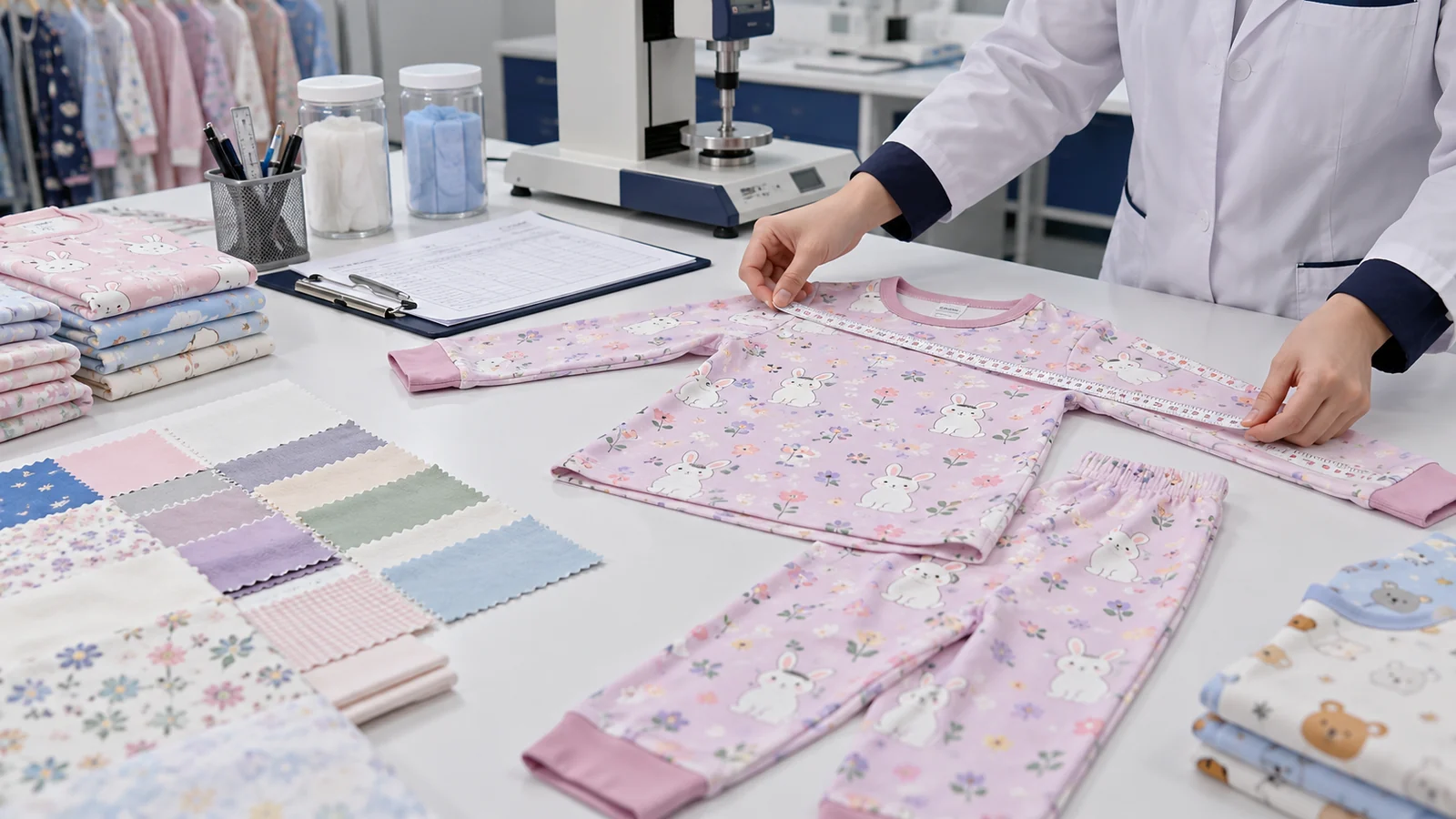
US kids sleepwear compliance requires product-specific classification, applicable testing, tracking records, certification and import documentation.
Children’s sleepwear compliance is not a single test certificate uploaded once and forgotten. It is a coordinated file of product classification, technical measurements or testing, traceability, labeling and importer certifications. For US importers, this became even more operationally important when CPSC certificate eFiling entered into effect for most covered imported products on July 8, 2026.
On this page
- 1. Start US kids sleepwear compliance with the garment classification decision
- 2. Know who is responsible for the CPC
- 3. What changed with CPSC eFiling in 2026?
- 4. Build a document register for each SKU
- 5. Make labels part of pre-production approval
- 6. Connect testing to production control
- 7. Pre-arrival handoff between factory, importer and broker
- 8. Final compliance release checklist
- How to prepare certificate data before your broker asks
- Four situations that should trigger a compliance review
- A production-to-entry control example
- Frequently asked questions
1. Start US kids sleepwear compliance with the garment classification decision
US regulations for children’s sleepwear generally distinguish products within 16 CFR Parts 1615 and 1616 from categories covered by defined exceptions, including qualifying tight-fitting and certain infant garments. These exceptions have precise conditions; a marketing term such as “loungewear” or “snug fit” does not decide the legal classification. Review CPSC’s sleepwear FAQ and the existing Nuohua US sleepwear flammability article for the detailed regulatory routes.
Before commissioning tests, assemble photos, finished measurements, sizes, planned consumer use, fiber and trim specifications, and product-listing descriptions. Ask a competent specialist and CPSC-accepted laboratory to identify the applicable rules and test scope. Uncertainty at this stage often leads to expensive retesting later.
2. Know who is responsible for the CPC
For imported regulated children’s products, the US importer generally must issue the CPC, using qualifying supporting testing from a CPSC-accepted laboratory or valid exclusions and determinations where applicable. The laboratory provides test results; it does not replace the responsible firm’s certification obligation. CPSC describes the CPC elements and responsibilities.
The CPC must accurately identify the specific product, applicable regulations, responsible party, records custodian, manufacturing location/date, testing date/location and laboratory information as required. A certificate copied from a different fabric or unrelated season is not a reliable compliance file.
3. What changed with CPSC eFiling in 2026?
According to CPSC’s official implementation announcement dated July 8, 2026, importers of covered regulated consumer products must submit certificate information electronically through the import process. The CPSC certificates guidance states the general imported-products date as July 8, 2026, with a later January 8, 2027 date for certain foreign-trade-zone entries.
Not every apparel article automatically requires identical certificate fields; determine which rules and certification requirements apply to the specific item. The importer should work with its customs broker on Product Registry or full PGA message-set workflow as relevant, confirm the applicable HTS and verify that the certificate data sent matches the goods that are arriving.
4. Build a document register for each SKU
| Record | Maintained by | Why it matters |
|---|---|---|
| Intended-use and size classification | Brand/importer and compliance specialist | Determines relevant regulatory route |
| Approved tech pack and size chart | Brand + factory | Defines the finished product to be made |
| Lab reports / exclusion basis | Qualified lab and responsible party | Supports certification against cited rules |
| Children’s Product Certificate | Responsible US importer | Required certification for covered children’s products |
| Tracking and sleepwear labels | Factory + brand | Enables identification, warnings and traceability |
| SKU-lot-shipment map | Factory, importer and broker | Connects a specific carton to the evidence file |
| eFiling confirmation | Importer/broker | Connects entry submission and certificate data |
Use a controlled folder structure such as Year/Collection/Style/Color/Revision/Lot. Each record should have a date, owner and version. If the factory changes a fabric, trim or approved pattern, determine whether existing evidence remains valid before treating the lot as cleared for shipment.
5. Make labels part of pre-production approval
Children’s sleepwear can require multiple pieces of information: fiber identity, country of origin, care instructions, responsible entity, permanent tracking identifiers, and additional sleepwear-specific tags or care/warning provisions. Requirements depend on classification. The FTC apparel labeling guidance and relevant CPSC rules should be reviewed together.
For tight-fitting sleepwear, the CPSC specifies dimensional requirements and detailed warning and hangtag criteria; these are not solved with a generic “wear snugly” sticker. For covered flame-resistant sleepwear, applicable unit identification and flame-resistance care instructions may be required. Have label artwork reviewed before any printing run.
6. Connect testing to production control
Pre-production test evidence is only valuable if the produced goods remain within its tested scope. Require a revision log showing any fabric, print, trim, finish or pattern change. Check incoming material IDs, the actual produced sizes and any grouping decisions used in testing. Reconcile fabric and garment production unit records where those apply to the chosen route.
If a supplier proposes a lower-cost alternative after testing, pause for a technical assessment. Seemingly minor changes—elastic composition, finishing temperature, fit grading or decorative trim—can affect either the testing route or the finished dimensions.
7. Pre-arrival handoff between factory, importer and broker
The importer should request the commercial invoice, packing list, accurate product descriptions, fiber composition, origin details, shipping marks, supporting product file, CPC data and any additional required entry information in time for the broker’s deadlines. Do not wait until the container reaches the destination port to reconcile product codes and certificate descriptions.
A good handoff maps PO → SKU → size/color → production lot → report/certificate → cartons → entry line. If multiple styles share one shipment, build this mapping for each relevant product; one generic folder called CPC_2026 is not enough.
8. Final compliance release checklist
- Intended use, age/size range and applicable regulation confirmed.
- Finished garment or exception pathway documented.
- Current laboratory scope and reports reviewed.
- CPC owner and data fields confirmed.
- Product, packaging, care, tracking and warning labels approved.
- Actual material and lot match the approved evidence.
- Broker has the correct CPSC eFiling and entry information.
- Production/shipment archive retained under a retrievable identifier.
Important: This is a general sourcing guide, not a compliance determination for your exact product. CPSC and customs procedures can change. Have qualified US counsel, a CPSC-accepted laboratory and your importer/broker validate your current obligations.
How to prepare certificate data before your broker asks
CPSC eFiling adds an electronic handoff to a compliance process that already depends on accurate records. A practical importer workflow assigns a named owner for product classification, certificate content, laboratory scope, factory manufacturing data and entry transmission. Make a field map linking each finished product to the relevant regulations and certificate data. Confirm the latest CPSC data requirements with the broker or eFiling integration provider rather than reusing a pre-2026 spreadsheet.
Before shipping, reconcile the company names, product identifiers, manufacturing date/location, testing information and any claimed exclusions. A broker should not have to guess whether a generic item description such as “children’s clothes” maps to a specific two-piece sleepwear set in the carton list.
Four situations that should trigger a compliance review
- Pattern alteration: A cuff, waist, sleeve or leg measurement changes after a tight-fitting design has been reviewed. Recheck the size-specific basis of the exception.
- Material substitution: The approved knit or trim is replaced, even if the new fabric has the same nominal fiber percentage. Determine whether prior test evidence still applies.
- New size group: A collection expands from toddler sizes into larger children’s sizes. Confirm the correct regulation and documentation grouping.
- Sales-description change: The garment was approved as a specific product type but is now marketed primarily for bedtime or sleep. Reevaluate intended-use classification.
These are review triggers, not automatic declarations that every change requires the same new test. The scope should be decided using the actual rule, laboratory evidence and qualified technical advice.
A production-to-entry control example
Suppose PO 2026-041 contains two prints of one style. The factory initially plans one fabric lot, but it receives a second lot for the last 400 sets. The buyer should request the lot split, final produced size/print counts and test-evidence applicability, then ensure each carton can be traced to the correct production records. If evidence covers both lots under a permitted grouping, document why. If it does not, resolve the gap before customs filing.
Keep a written reconciliation sheet; don’t rely on photos with no lot identifier. Auditable records help the importer answer agency or retail-customer questions without reconstructing the shipment months later.
Frequently asked questions
Does a lab report automatically count as a CPC?
No. The importer generally issues the CPC based on qualifying evidence and must include the prescribed information.
Is a snug-looking pajama automatically exempt from sleepwear testing?
No. The tight-fitting exception requires specified dimensions and other conditions in the actual rules.
Do all sizes, colors and trims need entirely separate tests?
Not necessarily; grouping may be permissible subject to detailed regulatory conditions and sufficient supporting evidence. The laboratory should determine which grouping is supportable.
Can my freight forwarder decide product compliance?
A customs broker can support entry and eFiling, but product classification under CPSC rules and certification require the responsible firm’s technical assessment and evidence.
Content is intended for wholesale sourcing and educational use. Product specifications, quotations, certifications, labeling and import obligations must be confirmed for the actual style, market and shipment. References to regulatory guidance were checked October 2026.
Ready to discuss your kids sleepwear collection?
Share designs or reference images, target market, fabric, style/color quantities, size range and required delivery date. Nuohua can review OEM/ODM feasibility and provide a specification-based quotation.