Finding a manufacturer that can make kids underwear well is not the same as finding one that can make it legally and consistently. Children’s underwear sits at the intersection of strict safety standards, tight-tolerance sewing, and a market where a single recall — or a single batch of itchy, misshapen waistbands — can end a new brand. In our experience, most sourcing disasters trace back to one failure: the buyer never actually verified the supplier before wiring the deposit.
This guide is a practical factory audit for anyone searching for a reliable kids underwear manufacturer. It covers how to tell a real factory from a trading company, which capacity and quality-control numbers actually prove something, what compliance paperwork to demand, and the red flags that mean you should walk away.
A reliable kids underwear manufacturer is one you can verify on three fronts: real production capacity you can see with your own eyes, a documented multi-stage quality-control system with needle detection, and correct children’s-safety compliance — GB 31701 Class A on the production side and a CPC supported by third-party testing for the US market. If a supplier cannot show you the factory floor on a live walkthrough, cannot name the safety standard that applies to your product, or hesitates on defect-rate data, treat it as a red flag.
On this page
- 1. Real Factory vs Trading Company vs Sourcing Agent
- 2. Capacity Audit: How to Verify the Hard Numbers
- 3. QC Audit: Inspection Stages and Needle Detection
- 4. Certification Audit: GB 31701 Class A and CPC
- 5. The Factory Audit Checklist
- 6. Video and Livestream Audit Red Flags
- 7. Questions to Ask the Factory
- 8. Why Kids Underwear Factories Demand Extra Scrutiny
1. Real Factory vs Trading Company vs Sourcing Agent
A trading company buys finished goods from a factory and resells them with a markup; a sourcing agent finds factories for you and takes a fee; a real factory owns the floor, the machines and the workforce. For kids underwear — where compliance continuity and QC consistency matter more than a one-off low price — a real factory is usually the shortest route to the source of truth.
Why the distinction matters: when you buy children’s underwear through a middleman, you lose line of sight into exactly the things that protect you — which fabric was actually used, whether the safety standard was actually applied, and whether the inspection stage actually happened. For a compliance-heavy product like kids underwear, every extra layer between you and the sewing floor is another place where a detail can quietly go missing.
You can separate the three in a short exchange. First, check the business license and the registered address — a trading company’s registration is typically a city office block, not a production site. Second, ask who signs the production documents and the test reports; if every document carries a different factory name, you are buying through a reseller. Third, ask for a live video walkthrough of a working floor with machines and staff. A real factory can show you the floor today, not “next week, after our engineer is available.”
Middlemen are not inherently bad — a trading company suits a very small first trial, and a sourcing agent helps when you buy several unrelated categories at once. The point is not to avoid them, but to know which one you are talking to so you can price and contract accordingly. The problems start only when a reseller presents itself as the manufacturer.
| Attribute | Real Factory | Trading Company | Sourcing Agent |
|---|---|---|---|
| Who owns production | Owns floor, machines, staff | Buys from other factories | Finds factories for a fee |
| Price | Factory-direct, no markup | Adds a margin | Adds a fee or commission |
| MOQ flexibility | Negotiates directly | Aggregates to lower MOQ | Depends on factory found |
| QC visibility | You watch stages live | Out of sight | Trust-based |
| Compliance control | Direct over fabric and standards | Hard to verify inputs | Depends on factory |
| Best for | Brands that re-order and scale | One-off trial runs | Multi-category sourcing |
2. Capacity Audit: How to Verify the Hard Numbers
Verify capacity with numbers you can cross-check: floor area, headcount, sewing lines, monthly output and the equipment you can actually see. A supplier that claims large capacity but will not show the production floor is not a factory, whatever the website says.
A kids underwear order is rarely a one-time purchase. It is a recurring, size-run program — multiple sizes, multiple colors, and seasonal re-orders that must match the first run. A factory without genuine capacity quietly farms your re-order out to another workshop, and consistency — the thing customers notice first — breaks. That is why a capacity audit comes first.
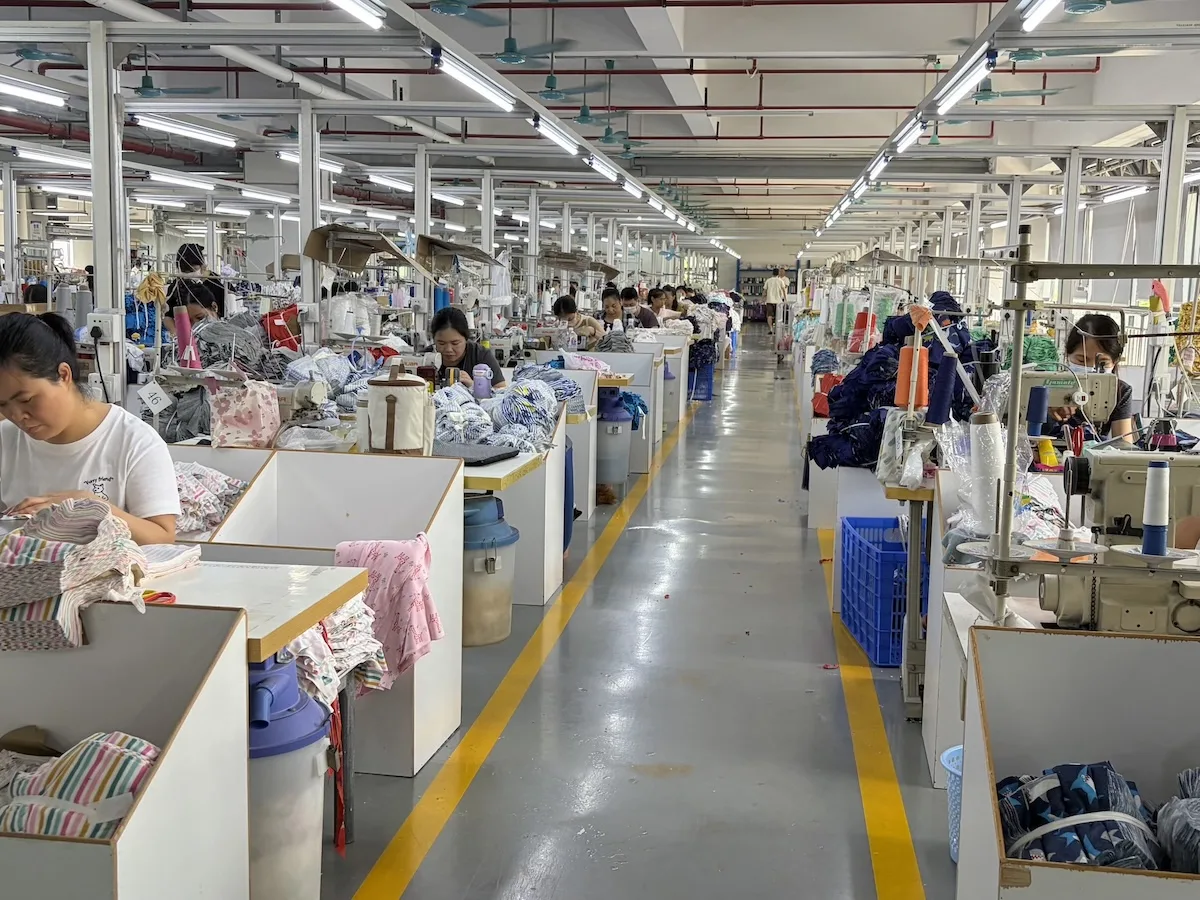
Use a credible reference point. Our own facility is a useful benchmark for what a real kids underwear factory looks like on paper: around 8,000 square meters of floor space, 300+ staff, and a monthly capacity above 1,000,000 pieces. The key is that these three numbers must be internally consistent. A claim of 300 workers inside a 2,000-square-meter “factory” does not add up, and a monthly output of a million pieces with only a handful of sewing lines is a fantasy. Ask for all three numbers together and check whether they fit.
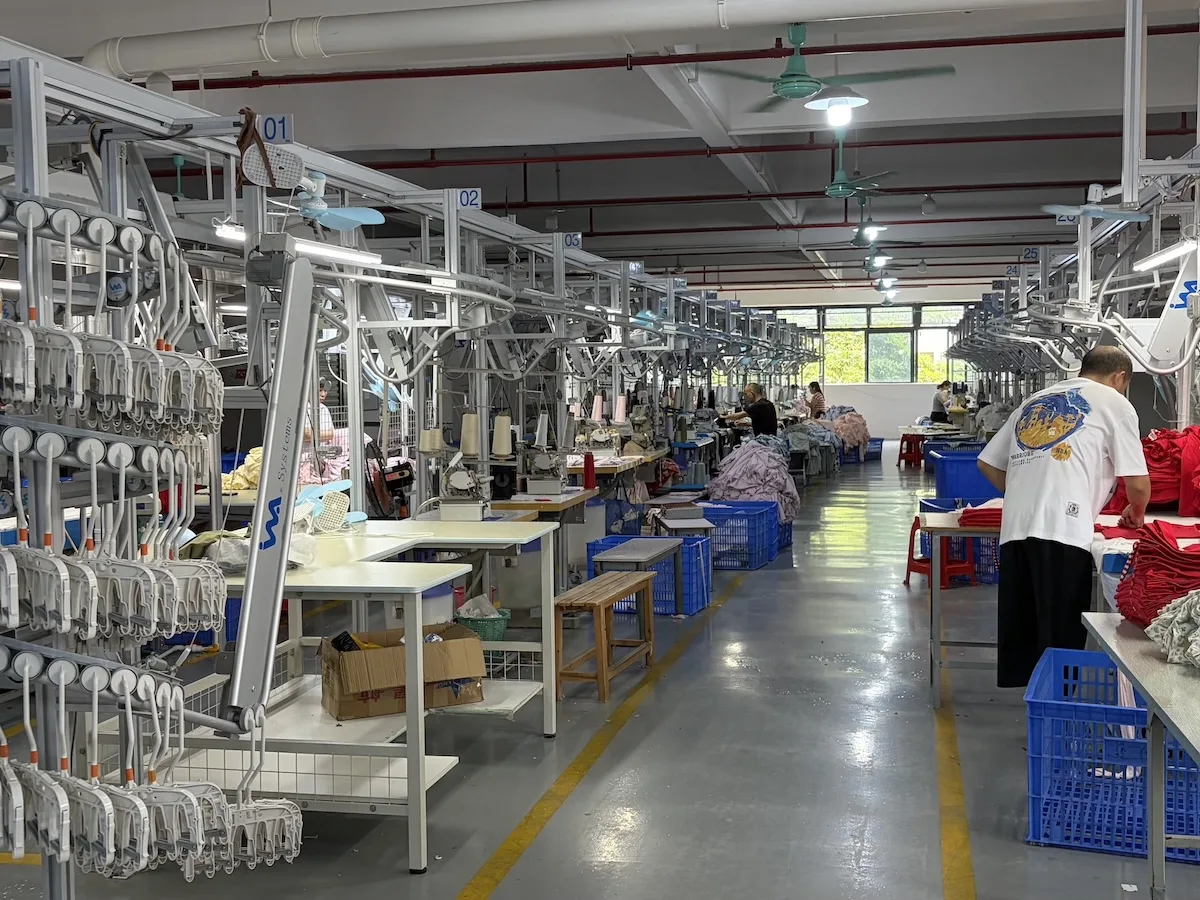
Equipment is the proof that numbers on paper cannot fake. A factory running an INA hanging production system moves each garment between workstations automatically rather than in bundles, which reduces handling, cuts transit damage and improves stitch consistency — a specific, checkable detail you can ask to see on video. Likewise, a print library of 3,000+ designs is a concrete asset; a supplier who claims a huge design archive should be able to show it, not just describe it.
| Indicator | Credible factory | How to verify | Red flag |
|---|---|---|---|
| Floor area | Around 8,000 sqm | Live walkthrough of the floor | Office-only premises |
| Headcount | 300+ staff | See workers at stations | Numbers don’t match the floor |
| Monthly output | 1,000,000+ pieces | Production records | Big claim, no evidence |
| Production system | INA hanging line | Show it running | Can’t describe their line |
| Print archive | 3,000+ designs | Show the pattern room | “We can source any print” |
3. QC Audit: Inspection Stages and Needle Detection
A trustworthy kids underwear factory runs a defined, multi-stage QC process, not a single end-of-line glance. Ask how many inspection stages there are, whether needle detection is part of the flow, and what the documented defect rate is — then confirm each stage exists on a video walkthrough.
Kids garments are worn directly against the skin and pulled, stretched and washed daily. A missed seam defect or a stray needle fragment is not a cosmetic issue in this category — it is a safety issue. That is why a single final inspection before packing is not enough, and why the depth of a factory’s QC process is one of the strongest signals of whether it is actually a reliable kids underwear manufacturer.
A serious QC flow is staged. Our own line runs six distinct checkpoints: incoming fabric inspection, cutting inspection, in-line sewing inspection, finishing and trimming inspection, final end-of-line inspection, and needle detection before packing. Each stage catches a different class of defect — fabric faults at intake, size deviation at cutting, stitching problems in-line, loose threads at finishing, and final appearance at the end of the line.
Two numbers matter most. First, needle detection: every finished piece should pass through a needle detector — a metal-detection machine — before packing, because a broken needle fragment left inside a garment is a recall-level event. Second, the defect rate: a well-run line holds below 0.3% across production. A supplier who cannot quote a defect rate, or cannot explain how they measure it, does not have real QC.
You can also use AQL, or Acceptable Quality Level, to set the inspection bar for a given lot before shipping. It defines how many defects are tolerated in a random sample at a given level — useful when you and the factory need a shared, written definition of “acceptable” rather than a subjective “good enough.”
| Stage | What is checked | Why it matters |
|---|---|---|
| 1. Incoming fabric | Weight, color, faults, shading | Catches defects before cutting |
| 2. Cutting | Panel size, grain, notches | Prevents size and fit deviation |
| 3. In-line sewing | Stitch tension, seams | Stops a fault from repeating |
| 4. Finishing & trimming | Loose threads, labels | Skin-contact items must be clean |
| 5. Final inspection | Appearance, measurement, AQL | The last visual gate |
| 6. Needle detection & packing | Metal scan on every piece | Removes broken-needle risk |
Needle detection is non-negotiable. In children’s apparel, a broken needle fragment is a safety hazard, not a quality nit. Confirm the machine exists and runs on every piece — if a supplier skips this detail, their whole QC story is suspect.
4. Certification Audit: GB 31701 Class A and CPC
Two documents matter most for kids underwear: GB 31701 Class A (China’s mandatory children’s A-class safety standard) on the production side, and a CPC (Children’s Product Certificate) backed by third-party testing for the US market. A lab name is not a certificate — labs test, standards certify.
GB 31701 Class A is China’s mandatory safety standard for infants’ and children’s textile products, and Class A is its strictest tier. A factory that makes kids underwear should be able to name this standard without prompting and show test reports covering limits on formaldehyde, pH and colorants. If a supplier answers a compliance question with “we follow EU and US standards” without naming a single one, they have not actually done the work.
For the US market, the relevant document is the CPC, or Children’s Product Certificate. The importer or brand issues the CPC, but it must be supported by laboratory testing for lead, phthalates and other CPSIA requirements — and that testing is done by independent third-party labs, most often SGS, TÜV SÜD or Intertek. This is where buyers most commonly go wrong: a factory coordinates third-party testing; it does not “hold” a CPC the way it holds a standard.
The single most revealing mistake is confusing a testing lab with a certificate. “We are SGS certified” is a red flag, not a credential — SGS is a lab, not a certification. The correct phrasing is “third-party tested by SGS” for a specific, named report. Whenever a supplier attaches a lab’s brand to itself as if it were their own certificate, slow down and ask for the report number and scope.
OEKO-TEX wording matters. Our OEKO-TEX Standard 100 status is currently in progress — not certified. A supplier who claims a completed OEKO-TEX certificate should be able to produce the certificate number and its exact scope instantly; if they cannot, they are inflating.
| Document | What it is | Who issues it | When you need it |
|---|---|---|---|
| GB 31701 Class A report | China’s children’s A-class safety test | Lab / factory | For China-produced kids items |
| CPC | Children’s Product Certificate for the US | Importer or brand, lab-backed | Before US import |
| CPSIA lab report | Lead, phthalates and other limit tests | Third-party lab | Supports the CPC |
| Third-party test report | Independent test by SGS / TÜV SÜD / Intertek | The named lab | On request, per product |
| OEKO-TEX Standard 100 | Substance-limit certification | Certification body | In progress for us — verify honestly |
| Fiber & care label | Fiber content and care instructions | Factory / brand | Every garment |
5. The Factory Audit Checklist
A real audit is a numbered checklist you can run yourself, remotely or on-site, across five pillars: identity, capacity, quality control, compliance and commercial terms. Score each pillar on evidence — a document or a live video — not on a reassuring sentence.
Run the checklist below as a scorecard. For every item, mark “evidence shown” or “promise made.” A promise is not a pass, and two or three promise-only marks in the compliance or QC pillars are enough to disqualify a supplier — those are precisely the pillars where a kids underwear brand cannot afford to guess.
| Pillar | Check | Pass evidence | Fail signal |
|---|---|---|---|
| Identity | Business license | Shows a production site | Registered office only |
| Identity | Live video walkthrough | Floor shown the same day | “Engineer is unavailable” |
| Capacity | Floor area and headcount | Around 8,000 sqm, 300+ staff | Numbers don’t add up |
| Capacity | Monthly output | 1,000,000+ pieces with records | “We are big” with no data |
| QC | Inspection stages | 6-stage flow documented | “We check before shipping” |
| QC | Needle detection | Machine shown on video | Hidden or absent |
| QC | Defect rate | Below 0.3% with data | No measurement at all |
| Compliance | GB 31701 Class A | Report shown for the product | Only “EU/US standards” talk |
| Compliance | CPC / lab report | Lab report available | “Certified by a lab” |
| Commercial | MOQ and samples | 2 pcs on selected in-stock styles, colors and sizes; sample offered | Refuses samples |
6. Video and Livestream Audit Red Flags
A live video walkthrough is the cheapest reliable way to confirm a factory is real. But what a supplier avoids showing matters more than what they show: if they refuse to show the sewing floor, the QC area or the needle detector, you are probably not talking to the manufacturer.
You cannot fly to every factory before a first order, but a live video walkthrough — on a phone, in real time, following your instructions — is very hard to fake convincingly. Ask the person to walk from the entrance to the sewing floor without stopping, to show machines actually running, and to pan to a clock or a current date. A pre-recorded, edited video is worth far less, because it can be shot anywhere, or borrowed from another factory.
There are five things a real kids underwear factory can show you immediately: the cutting table, the sewing lines with workers at stations, the fabric warehouse or in-stock fabric rolls, the QC and inspection area, and the needle detection machine. A trading company has a desk, a showroom and a folder of sample photos.
| Red flag | What it usually means |
|---|---|
| Refuses a live walkthrough | Not a factory, or hiding subcontracting |
| Shows only an office and a showroom | Trading company, not a manufacturer |
| Pre-recorded, edited video only | Cannot show live production |
| Cannot show the needle detector | QC is not real, or not theirs |
| Cannot name the safety standard for your product | No kids-specific compliance knowledge |
| Quotes a low price with no sample | Likely swapped fabric or cut corners |
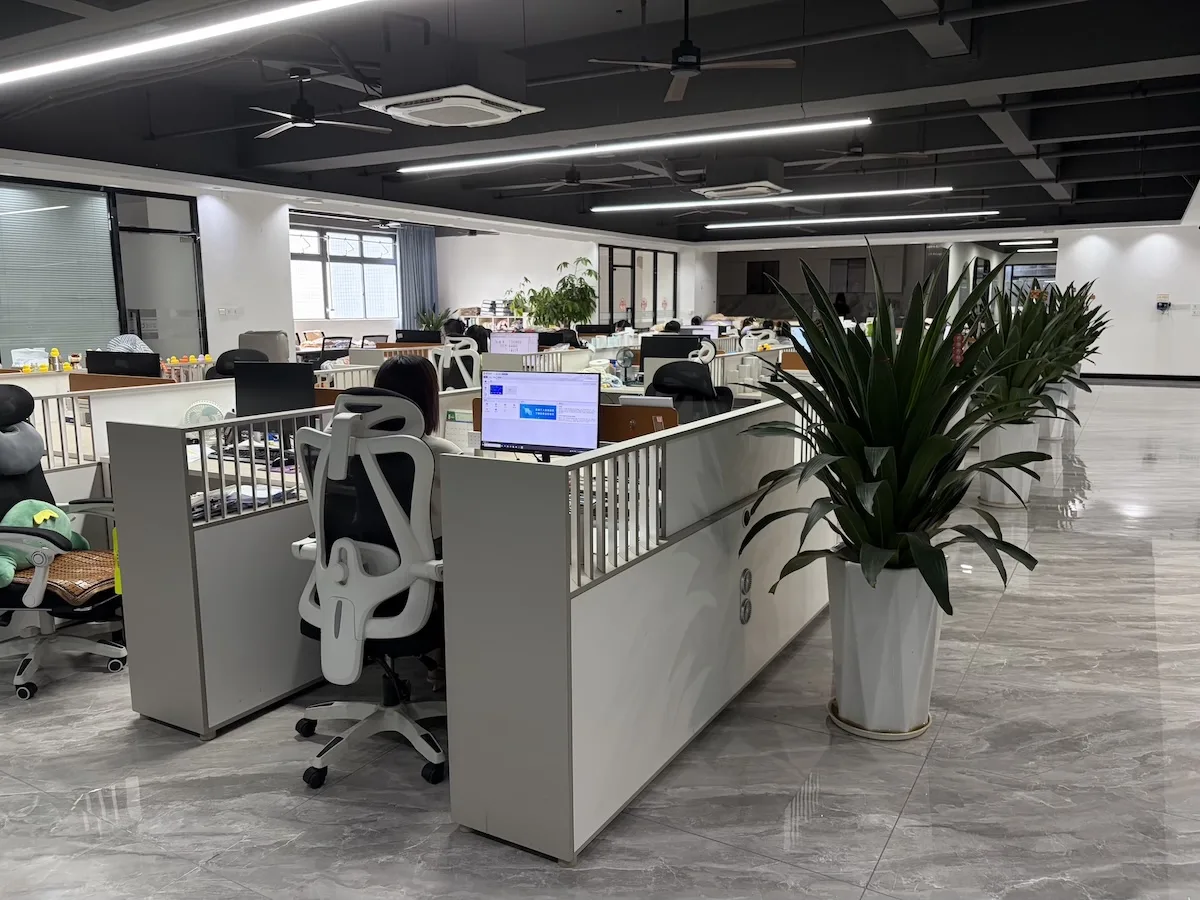
Use the live walkthrough as your leverage. A supplier that is proud of its floor will happily show it. A supplier that dodges the camera is telling you something. If they will not walk the floor live, do not send the deposit.
7. Questions to Ask the Factory
Ask questions that force evidence instead of opinion. “What safety standard applies to this product?” and “Show me your needle detection machine” reveal far more than “Are you reliable?” — and a factory that answers fast with specifics is the one worth shortlisting.
The quality of your sourcing decision is set by the quality of your questions. Vague questions get vague answers; specific questions force a supplier to show proof or reveal a gap. Work through the three groups below and note which answers come with evidence.
Identity and ownership
- Who owns the production? Do you subcontract any part of my order?
- May I see your business license and registered production address?
- Can you walk me through the factory floor on a live video call right now?
Quality control and compliance
- How many inspection stages do you run, and what happens at each one?
- Do you run needle detection on every finished piece? Can you show me the machine?
- What is your documented defect rate, and how do you measure it?
- Which safety standard applies to my product? Can you show a GB 31701 Class A report?
- Can you coordinate third-party testing by a lab such as SGS, TÜV SÜD or Intertek for a CPC?
- What is your OEKO-TEX Standard 100 status?
Commercial terms
- What is your MOQ for kids underwear, and does it vary by style and color?
- Which fabrics are available in stock, and which require custom development?
- Can you send a pre-production sample before the bulk order?
- What is your lead time from approved sample to shipment?
8. Why Kids Underwear Factories Demand Extra Scrutiny
Children’s skin is thinner, their bodies are smaller, and the regulators are stricter. A factory that makes adult basics comfortably may still fall short of the A-class safety threshold a kids line legally requires — which is why kids underwear sourcing needs a tougher audit than general apparel.
Children’s underwear sits against the skin all day, and children’s skin is thinner and more permeable than adult skin. Chemical limits — formaldehyde, pH and colorants — are set tighter for children’s garments, and GB 31701 Class A marks the strictest tier. A factory that has only ever made adult basics may never have built the processes or paperwork around these thresholds, and that gap surfaces only at an inspection or a customs check.
Physical safety adds another layer. Small components, drawcords and loose threads are regulated far more strictly for children, and needle detection — a basic expectation in kids apparel — is precisely the kind of step a general adult-garment workshop may have skipped. When you audit a kids underwear supplier, you are partly auditing for the safety systems an adult line never needed.
The risk is asymmetric in a way that shapes the whole decision. In adult apparel, a defect is a refund. In children’s underwear, a compliance failure can be a customs hold, a recall, or a safety report — any one of which can end a new brand before it really starts. That is why the bar for a reliable kids underwear manufacturer is higher, and why the audit is not optional overhead: it is the cheapest insurance you will ever buy.
Ready to put a real factory through this checklist? Start with a development request and we will walk you through our floor, our QC stages and our compliance documents.