
Kids’ Underwear & Sleepwear Compliance Checklist: US (CPSIA/CPC) + EU (GPSR/REACH)
Compliance is where most first-time kids’ apparel brands lose a shipment. For underwear and sleepwear — garments in direct, prolonged skin contact — the rules are stricter than for ordinary clothing, and they differ by market. This checklist covers what a US or EU buyer must have in place before production, and where a China-based manufacturer like Nuohua fits in.

Why compliance is stricter for skin-contact kids’ wear
Underwear and sleepwear sit against a child’s skin for hours and are worn closest to the body’s most sensitive areas. Regulators treat them as higher-risk, so the testing, labeling, and documentation bar is higher than for a jacket or a T-shirt. Two consequences for brands:
- Material safety (formaldehyde, pH, azo dyes, flammability) is checked, not assumed.
- Traceability — who made it, from what, and to what standard — must be documented end to end.
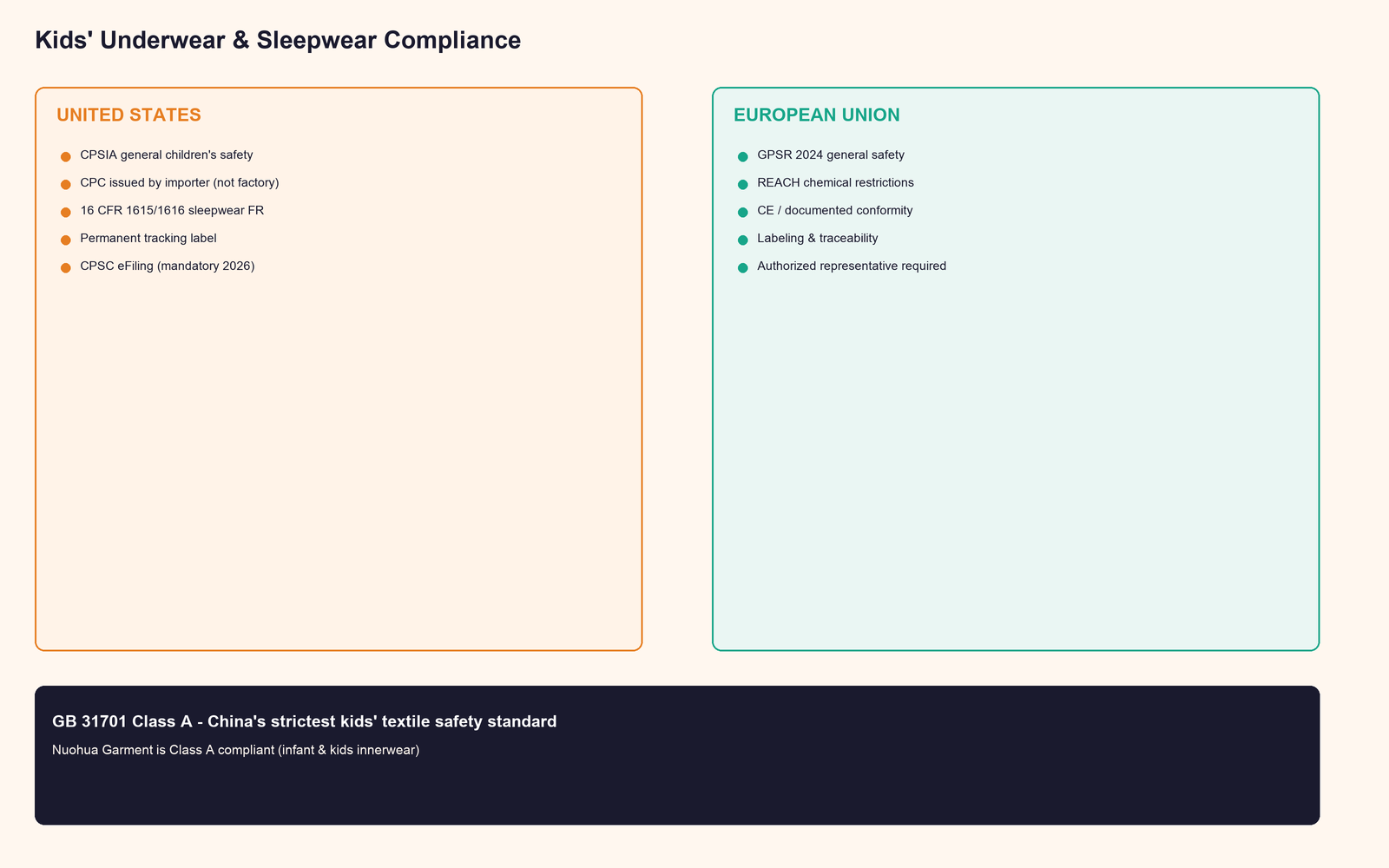
At Nuohua we build every skin-contact kids’ line to GB 31701 Class A, China’s strictest kids’ textile standard, as the baseline. That baseline lines up with what US and EU buyers expect, which makes the market-specific layers easier to add.
US checklist: CPSIA / CPC / 16 CFR / tracking label / eFiling
CPSIA — the general safety baseline
The Consumer Product Safety Improvement Act (CPSIA) sets the floor for all children’s products: total lead limits, phthalate restrictions on accessible plastic components, and a requirement that the product pass third-party testing at a CPSC-accepted laboratory before it is sold. For underwear and sleepwear this means the fabric, elastics, prints, and any plastic trims are all in scope — not just the cloth.
CPC — the certificate the importer issues
The Children’s Product Certificate is a document, not a physical stamp. It lists the product, the applicable rules, the test lab, and the importer of record, and it is backed by the underlying test reports. Critically, the US importer issues it — not the factory. Nuohua supplies the material test data and documentation; the importer certifies. Trying to have the factory “just issue the CPC” is the single most common reason a first shipment stalls at the border.
16 CFR 1615 / 1616 — sleepwear flammability
These rules govern children’s sleepwear (sizes 0–6X under 1615, 7–14 under 1616). Loose-fitting sleepwear must self-extinguish when exposed to a small open flame; snug-fitting sleepwear is exempt but only with the correct snug-fit warning label and an actual snug cut. The fabric choice and the fit decision are linked — pick them together at the tech-pack stage, not after sampling.
Tracking label — the second certificate
Every children’s product needs a permanent tracking label with the manufacturer, the production location, and the date (or batch). It must appear on the garment and on the package. Buyers underestimate this; customs and Amazon both check it. We build the tracking-label block into the tech pack so it is not an afterthought.
CPSC eFiling (mandatory from July 8, 2026)
From July 8, 2026, importers must submit compliance and certificate data electronically through CPSC eFiling before the shipment clears the border. This turns the CPC from a paper form into a pre-clearance step. Plan the certificate early — a missing eFiling blocks the whole container, not just the non-compliant SKU.
We support this with material documentation and third-party testing through SGS, TÜV SÜD, and Intertek. Our full CPC guide breaks down each element, and our Amazon sleepwear playbook covers the marketplace-specific layers.
Common US mistake: assuming the factory issues the CPC. It does not — the US importer of record does. Budget for that step before you ship.
EU checklist: GPSR / REACH / CE / traceability
GPSR — the 2024 safety framework
The General Product Safety Regulation (in force from December 2024) requires that products placed on the EU market are safe and traceable, and that a responsible person established in the EU can be identified for safety documentation. For a non-EU brand, appointing that responsible person is mandatory — without one, the product is not lawfully marketable.
REACH — chemical restrictions that hit textiles
REACH restricts hazardous substances in textiles: certain azo dyes, specific finishes, and heavy metals. Because underwear and sleepwear are skin-contact, the restricted-substance list is applied strictly. We screen materials against REACH as part of normal production, which is also what makes the US path shorter — the same restricted-substance discipline applies.
Labeling and traceability
The EU requires accurate fiber composition, care instructions, and importer details on the garment and the packaging. Unlike the US CPC, there is no single certificate to file; instead the brand keeps a documented conformity file and makes it available on request. The discipline is the same — prove the material safety with test data — just presented as a file rather than a certificate.
The EU path is less about a single certificate and more about a documented safety file plus a local representative. We provide the material test data; the brand appoints the EU responsible person.
The China advantage: GB 31701 Class A

Because we already manufacture to GB 31701 Class A — China’s strictest standard for infant and children’s textiles — much of the safety groundwork for US and EU compliance is already in place: restricted substances, pH, and skin-contact testing are part of our normal process. That shortens the path to a CPC or a GPSR file; it does not replace the importer’s own certification duties, but it removes the usual material-safety surprises.
Our trust center summarizes the certifications and third-party testing we operate, and our production-readiness checklist shows what to lock before the line starts.
GB 31701 Class A: what the China standard actually tests
GB 31701 Class A is China’s strictest tier for infant and children’s textiles, and it is the baseline Nuohua builds every skin-contact line to. Understanding what it tests explains why a China-made garment often sails through US and EU material checks.
Formaldehyde, pH, and azo dyes
Class A limits free formaldehyde, requires a skin-neutral pH range, and bans azo dyes that can release carcinogenic amines. These are the same substance families US CPSIA and EU REACH target, so testing to Class A pre-clears most of the chemical screen.
Color fastness and physical safety
The standard also checks color fastness to skin and saliva, plus physical hazards like small attachments and cord length. For underwear and sleepwear this is exactly where a cheap line fails — a loose rhinestone or a long drawstring is a recall waiting to happen.
Why it shortens the US/EU path
Because Class A already covers restricted substances, pH, and skin-contact testing, the gap to a CPC or a GPSR file is small. It does not replace the importer’s own certification, but it removes the usual material-safety surprises that delay a first shipment.
Common recall and hold cases — and how to avoid them
US holds from a missing or wrong CPC
The most frequent US issue is a CPC that lists the factory as issuer, or omits the importer of record. CBP and Amazon both reject it. Fix: have the importer issue the CPC and keep Nuohua’s test data attached as the evidence.
EU actions from no responsible person
A non-EU brand without an EU responsible person cannot lawfully place product on the market under GPSR. Fix: appoint the representative before the first EU shipment, not after a marketplace takedown.
Recall triggers in the garment itself
Loose trims, long cords on children’s sleepwear, and unlabeled snug-fit exemptions are the classic physical recalls. These are caught at our in-line QC before shipment when the tech pack specifies them — which is why the spec, not the inspection, is the first line of defense.
Pre-launch self-check list for brands
Before you approve production, confirm each of these. If any is missing, fix it at the tech-pack stage:
- Market decided: US, EU, or both — and the stricter elements specified from the start.
- Material safety tested: CPSC-accepted lab (US) or REACH-screened (EU); Nuohua supplies the data.
- CPC owner named: the US importer of record, with test reports attached.
- EU responsible person appointed: for any non-EU brand selling into the EU.
- Sleepwear rule applied: 16 CFR 1615/1616 test, or a correct snug-fit label on a genuinely snug garment.
- Tracking label in the tech pack: manufacturer, location, date — on garment and package.
- Fiber content and care labels accurate: exact composition, no mislabeled “bamboo”/”modal”.
- eFiling planned: US importer ready to file before the border (effective July 8, 2026).
Printable compliance checklist for buyers
| Step | US | EU |
|---|---|---|
| Material safety test | CPSIA lab (CPSC-accepted) | REACH-compliant lab |
| Certificate | CPC by importer | GPSR safety file |
| Sleepwear rule | 16 CFR 1615/1616 or snug-fit label | General safety + labeling |
| Traceability | Permanent tracking label | Importer + rep details |
| Border step | CPSC eFiling (2026) | Doc available on request |
Frequently Asked Questions
Does Nuohua issue the CPC?
No. The US importer of record issues the CPC; we supply the test data and material documentation that support it.
Is GB 31701 Class A accepted in the US or EU?
It is not a substitute for CPC or GPSR, but it covers the same skin-safety fundamentals, so the gap to market compliance is small.
What changed with CPSC eFiling in 2026?
From July 8, 2026, importers must file compliance data electronically before clearance. Plan the certificate early so the border step is routine.
Do I need an EU representative if I am not in the EU?
Yes — GPSR requires an EU-based responsible person for non-EU brands.
Can one line serve both markets?
Often yes, if you spec the stricter elements (tracking label, REACH-restricted materials, correct sleepwear labeling) from the start. We help you brief that.
What does Nuohua test in-house versus at a third party?
We run in-line checks for construction, trim safety, and labeling, and we coordinate material safety testing through SGS, TÜV SÜD, and Intertek for the formal certificates the importer needs.
Is OEKO-TEX part of your compliance program?
We are advancing OEKO-TEX Standard 100 certification (in progress). Today we meet the same substance-safety fundamentals through GB 31701 Class A and third-party testing, and we will add the OEKO-TEX certificate as it completes.
How early should I start the compliance paperwork?
At the tech-pack stage. The CPC, tracking label, and EU responsible person are far cheaper to design in than to retrofit after a container is packed.
Do baby bodysuits have extra rules?
They sit in the highest-risk class (infant, Class A), so pH, formaldehyde, and small-attachment rules are applied most strictly. We grade them to Class A by default.
Ready to build a compliant line?
Send your target markets and we will return a compliance map and a sample plan built around 2 pcs on selected in-stock styles, colors and sizes. Request a quote or read our CPC guide for the full US path.