
China vs Vietnam for Kids’ Underwear Manufacturing: An Honest 2026 Comparison
If you are sourcing children’s underwear, training bras, or kids’ sleepwear for a Western brand, you have almost certainly heard the advice to “diversify out of China” and move production to Vietnam. It is a reasonable instinct in a tariff-volatile world — but it is also a recommendation that is usually made about generic apparel, not about small, skin-contact, low-MOQ children’s basics.
Kids’ underwear is a deceptively demanding category. The units are small, the margins are tight, the compliance bar for skin-contact wear is high, and the order quantities for a new brand are often tiny. Those four facts change the China-vs-Vietnam math more than most sourcing guides admit. This article gives you an honest, balanced comparison built specifically around children’s underwear — not hoodies, not denim, not outerwear.
Why This Comparison Is About Kids’ Underwear, Not Generic Apparel
Most “China vs Vietnam” articles are written for brands making dresses, jackets, or cotton tees. Children’s underwear is different in four ways that matter for sourcing:
- Small units, small runs. A kids’ brief or training bra is a low-fabric, high-SKU item. New brands often want 100–300 pieces per style/color to test the market, not 3,000.
- Skin-contact compliance. Underwear sits against a child’s skin all day. Standards like China’s GB 31701 Class A, US CPSIA, and chemical limits for phthalates and AZO dyes are non-negotiable and test-driven.
- Knitwear, not woven. Kids’ underwear is almost entirely knit (cotton, cotton-spandex, modal, bamboo viscose). That means the relevant ecosystem is knit fabric mills and small-cut-and-sew houses, not large woven garment factories.
- Fast reaction. Sizing, prints, and bundle packs change seasonally. The ability to reorder a small top-up in 3–4 weeks is often more valuable than a 10% FOB saving.
Keep those four points in mind as we go through the numbers.
The Headline Numbers
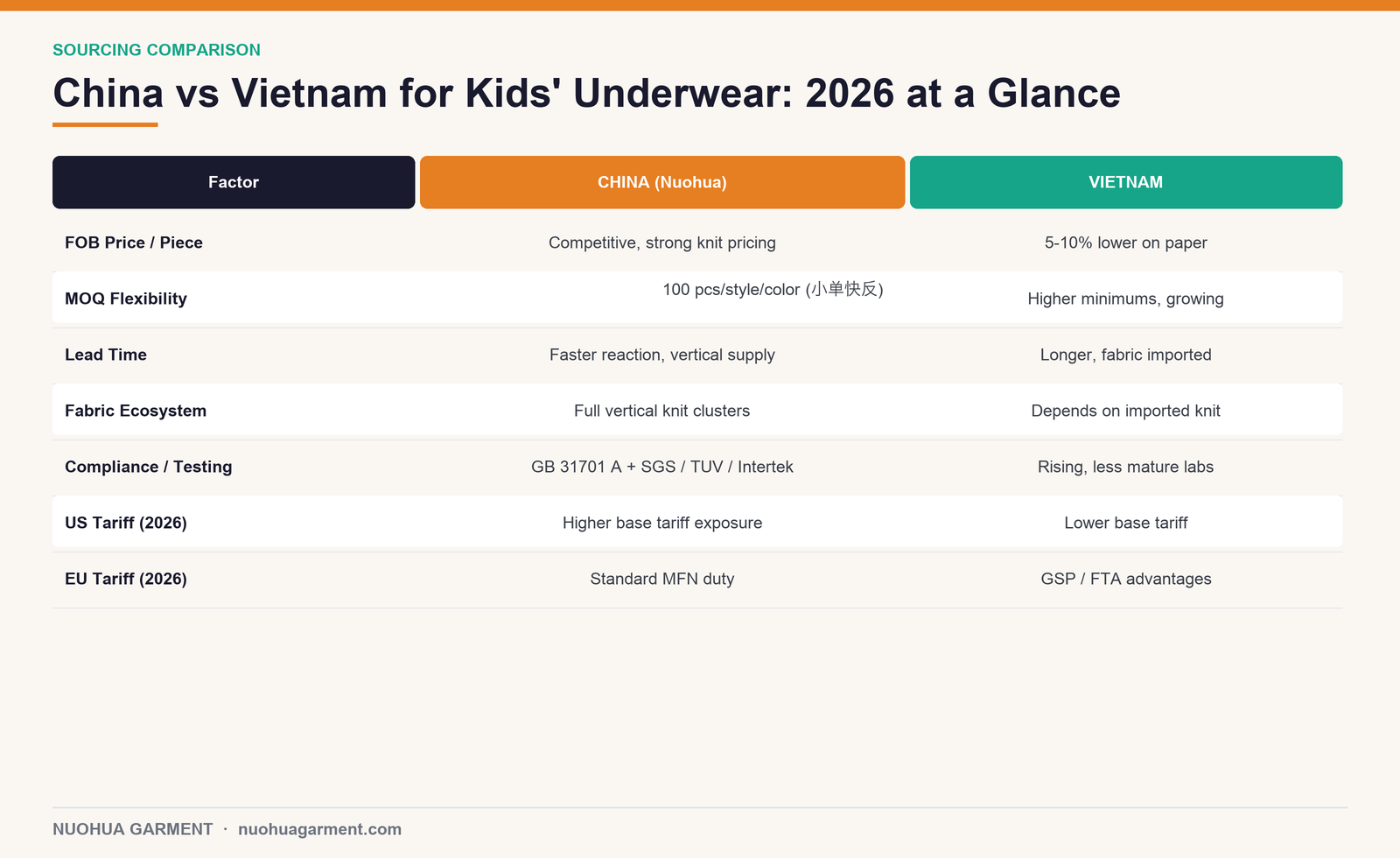
The table below summarizes industry-typical ranges for 2026. Treat every figure as directional — actual quotes vary by fabric, style complexity, and order volume. Where a number is genuinely uncertain, it is flagged.
| Factor | China (coastal knit hubs) | Vietnam |
|---|---|---|
| Typical factory wage (monthly) | $650–$1,100 (coastal) | $300–$500 |
| Lowest realistic MOQ / style | 2 pcs on selected in-stock styles, colors and sizes (small-batch houses) | 300–1,000 pcs (often higher) |
| First-run production lead time | 30–45 days (often) | 60–90 days (often) |
| Fabric sourcing | Vertically integrated; knit fabric onshore | 60–80% fabric imported (often from China) |
| US import duty (knit tops, 2026) | Eased to often under 20% post-détente* | ~16–18% MFN* (verify current HTS) |
| EU import duty | ~12% MFN | 0% under EVFTA (yarn-forward) |
| Compliance/testing ecosystem | Mature; many third-party labs onshore | Growing; fewer onshore labs |
*Tariff figures shift rapidly. Some 2026 reports cite much higher US reciprocal add-ons on Vietnamese goods, while others show China’s duties falling below 20%. Always confirm the current HTS schedule before you quote a landed cost.
Cost Per Piece — Does Vietnam Really Win?
The FOB vs Landed Cost Trap
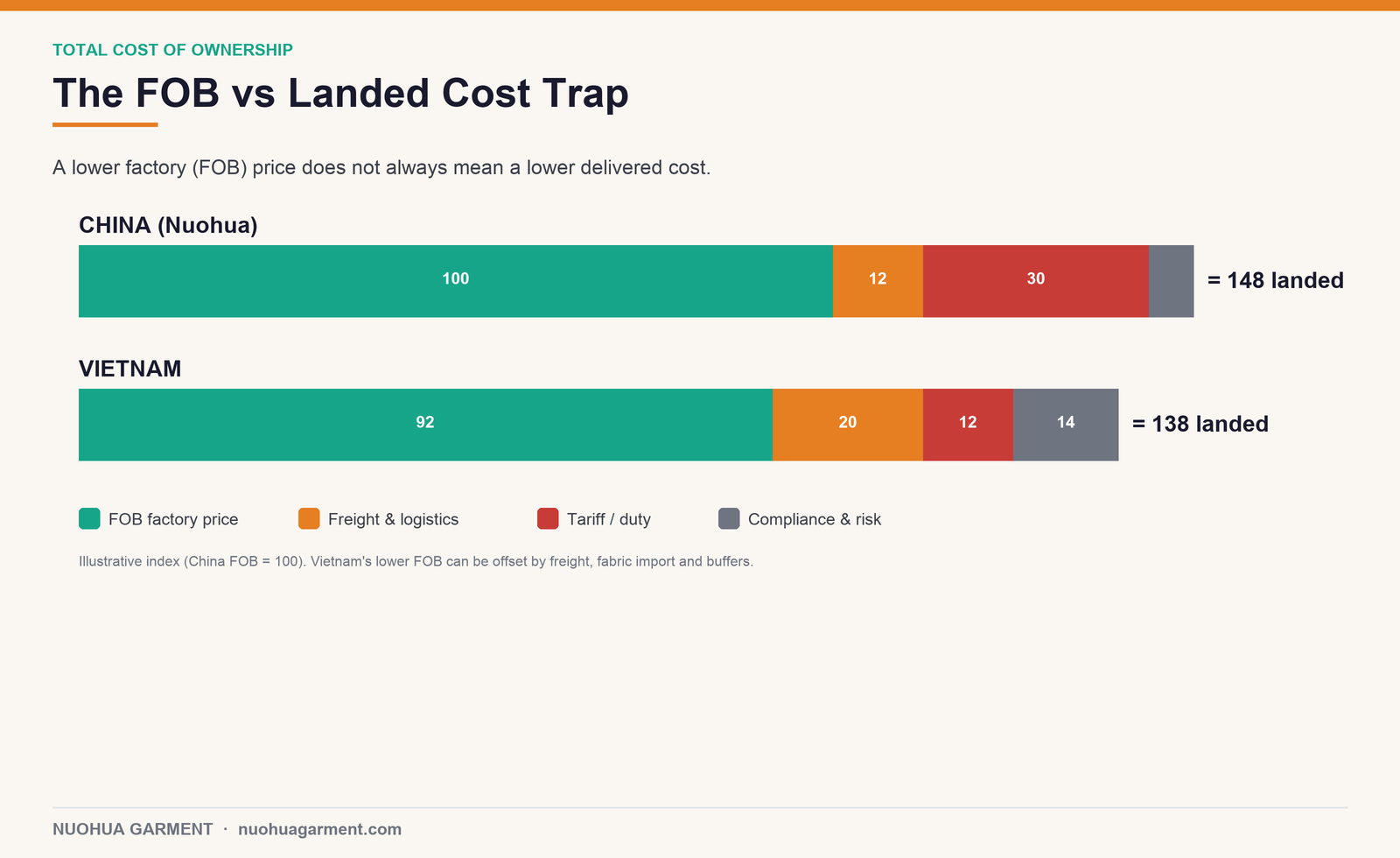
The single most common sourcing mistake is comparing factory prices (FOB) and stopping there. For kids’ underwear, the honest comparison has to include duty, freight, and compliance testing — and that is where the “Vietnam is cheaper” story gets complicated.
Vietnam’s labor cost is genuinely lower, often roughly 40–55% below China’s coastal wages. But labor is a small share of a children’s underwear unit’s total cost, and Vietnam imports much of its fabric and trims (often from China), which adds both cost and lead time. Several 2026 landed-cost models put a basic cotton tee at similar or slightly higher total cost from Vietnam than from China once duty and freight are included — precisely because China’s FOB has compressed while its supply chain keeps fabric and trim costs down.
China’s Knitwear Pricing Power
China produces a dominant share of the world’s knit fabric and finished garments, with spinning, knitting, dyeing, and finishing co-located in clusters like Guangdong and Fujian. That vertical integration lets a Chinese factory quote a children’s cotton-spandex brief competitively even at small volume, because the fabric mill is in the same industrial zone. The “small-batch, fast-reaction” culture — born from a decade of Alibaba-driven demand — means pricing for 100–300 piece runs is normalized, not penalized.
To pressure-test any quote you receive, our guide on how BOM details affect kids’ underwear cost and sampling walks through the fabric, trim, and labor variables that move the per-piece number.
MOQ Flexibility — China’s Small-Batch Edge
The “Small-Batch, Fast-Reaction” (小单快反) Model
For a new kids’ underwear brand, MOQ is often the deciding factor. Chinese coastal factories — especially in the Pearl River Delta — have spent years building a low-MOQ ecosystem. It is realistic to find reputable, compliant houses willing to run 2 pcs per selected in-stock style/color, which lets a brand launch a 6-SKU starter line with roughly 600–1,200 units total.
This flexibility is exactly what our Alibaba sourcing safety guide is built around: how to find those small-batch factories without falling for trading-company middlemen pretending to be manufacturers.
Vietnam’s Rising but Larger Minimums
Vietnam’s apparel base is real and growing — activewear, performance knits, and structured tailoring are genuine Vietnamese strengths. But its clothing factories tend to be larger and oriented toward medium-to-large programs. Typical kids’ wear MOQs in Vietnam land around 300–1,000 pieces per style, with many quality-export plants preferring 1,000+. That is workable for an established brand, but it prices out a pre-launch test run.
There is also a hidden fabric-MOQ trap: a cut-and-sew house may quote a 500-piece garment MOQ while the fabric mill demands an 800 kg minimum per color. You can end up paying for far more fabric than your order needs. Always confirm fabric MOQ in kilograms and per color before signing.
Lead Times — Speed vs Planning
Lead time is not just sewing. It includes fabric sourcing, sampling, slot booking, production, QC, and ocean transit. On that full timeline:
- China: first-run production is often 30–45 days, with reorder top-ups frequently achievable in 3–4 weeks thanks to fabric held in-zone.
- Vietnam: first-run production is often 60–90 days, partly because fabric must be imported and booked. Reorders with fabric already committed run shorter, but the opening orders are slower.
For a fast-moving kids’ brand reacting to a best-seller or restocking before a holiday, China’s shorter cycle is often decisive. For a brand that plans collections 6–9 months ahead, Vietnam’s timeline is perfectly manageable — provided you build in a buffer for your first two or three orders while the factory learns your standards.
Ecosystem Maturity — Clusters and Vertical Integration
China’s Guangdong and Fujian Knitwear Clusters
China’s advantage is not one factory — it is an entire system. Guangdong (Guangzhou, Dongguan, Foshan) and Fujian host dense knitwear clusters where fabric mills, trim suppliers, dye houses, print shops, and sewing lines sit within a short drive of each other. For a children’s underwear line, that means:
- Knit fabric (combed cotton, cotton-spandex, modal, bamboo viscose) sourced and lab-dipped locally;
- Small-batch sampling turned in days, not weeks;
- Easy access to specialist finishes (flatlock seams, bonded labels, tagless prints) that matter for sensitive skin.
Our deeper look at China’s kids’ underwear manufacturing regions breaks down which clusters suit which product types.
Vietnam’s Growing Base and Fabric Dependency
Vietnam’s garment sector is the world’s second-largest apparel exporter, with strong groups (Vinatex, TAL, Maxport, and others) and roughly 6,000 active garment factories. Its weakness for children’s underwear specifically is fabric: Vietnam imports an estimated 60–80% of its textile raw materials, predominantly from China, South Korea, and Taiwan. That dependency adds lead time, customs complexity, and cost volatility to what is, for underwear, the single most important input — the knit fabric against the child’s skin.
Vietnam is investing in domestic spinning and weaving, and the base is improving year over year. But in 2026 the fabric gap is still real for small, custom, skin-contact orders.
Compliance and Testing Maturity — The Skin-Contact Factor
This is where kids’ underwear diverges most sharply from generic apparel, and where China’s maturity shows.
GB 31701 Class A and Third-Party Labs
Children’s skin-contact wear must meet strict chemical and physical safety limits. In China, the benchmark is GB 31701 Class A — the strictest tier of China’s textile safety standard, applying to infant and young-children’s products worn directly against the skin. A manufacturer serving both domestic and export kids’ wear should be fluent in this standard.
Beyond China’s standard, Western-bound kids’ underwear typically needs third-party testing for restricted substances, flammability (where applicable), and mechanical safety. China’s coastal hubs host a deep bench of international third-party labs — SGS, TÜV SÜD, and Intertek all operate testing and coordination services onshore, which shortens the test-report cycle and keeps documentation tight.
At Nuohua we hold GB 31701 Class A for skin-contact wear and coordinate testing through SGS, TÜV SÜD, and Intertek partners. We are advancing OEKO-TEX Standard 100 certification (in progress) and hold EcoCosy® fiber authorization — a licensed, traceable, biodegradable fiber option. For US-bound goods, we supply the test data your importer needs to issue the Children’s Product Certificate (CPC); note that the importer — not the factory — is the party that issues the CPC.
Our kids’ underwear and sleepwear compliance checklist lays out the full documentation trail you should expect from any factory, China or Vietnam.
Documentation and Audit Traceability
A children’s underwear factory is only as good as its paper. You want batch records, fabric test reports, and a clear chain of custody for every dye lot. China’s mature export ecosystem makes this documentation routine. In Vietnam, the capability exists at tier-1 export plants, but audit-trail gaps are more common at smaller or newer facilities — ask for a current (within 12 months) social-audit report in the factory’s own legal name, not a certificate belonging to a different entity.
Note: when evaluating any factory’s social-compliance claims, verify the audit is current and in the correct legal name. We cover red flags in our guide to how to vet a kids’ underwear manufacturer in China.
Language, Logistics, and Day-to-Day Working
- Language: Coastal Chinese factories that serve export markets typically have English-speaking sales and QA staff accustomed to Western buyers. Vietnam’s English capability is improving fast but is less uniformly available, especially outside Ho Chi Minh City and the large export groups.
- Logistics: China’s port network (Shenzhen, Ningbo, Shanghai, Guangzhou) is the deepest in the world, with frequent, predictable sailings to the US and EU. Vietnam’s ports (Cat Lai, Cai Mep, Hai Phong) are growing but can congest in peak season.
- Iteration speed: Because China’s fabric and trim are local, a spec change or a second sample round is far faster to execute — a real advantage when you are still refining a kids’ fit or print.
Tariffs — The Decisive Variable in 2026
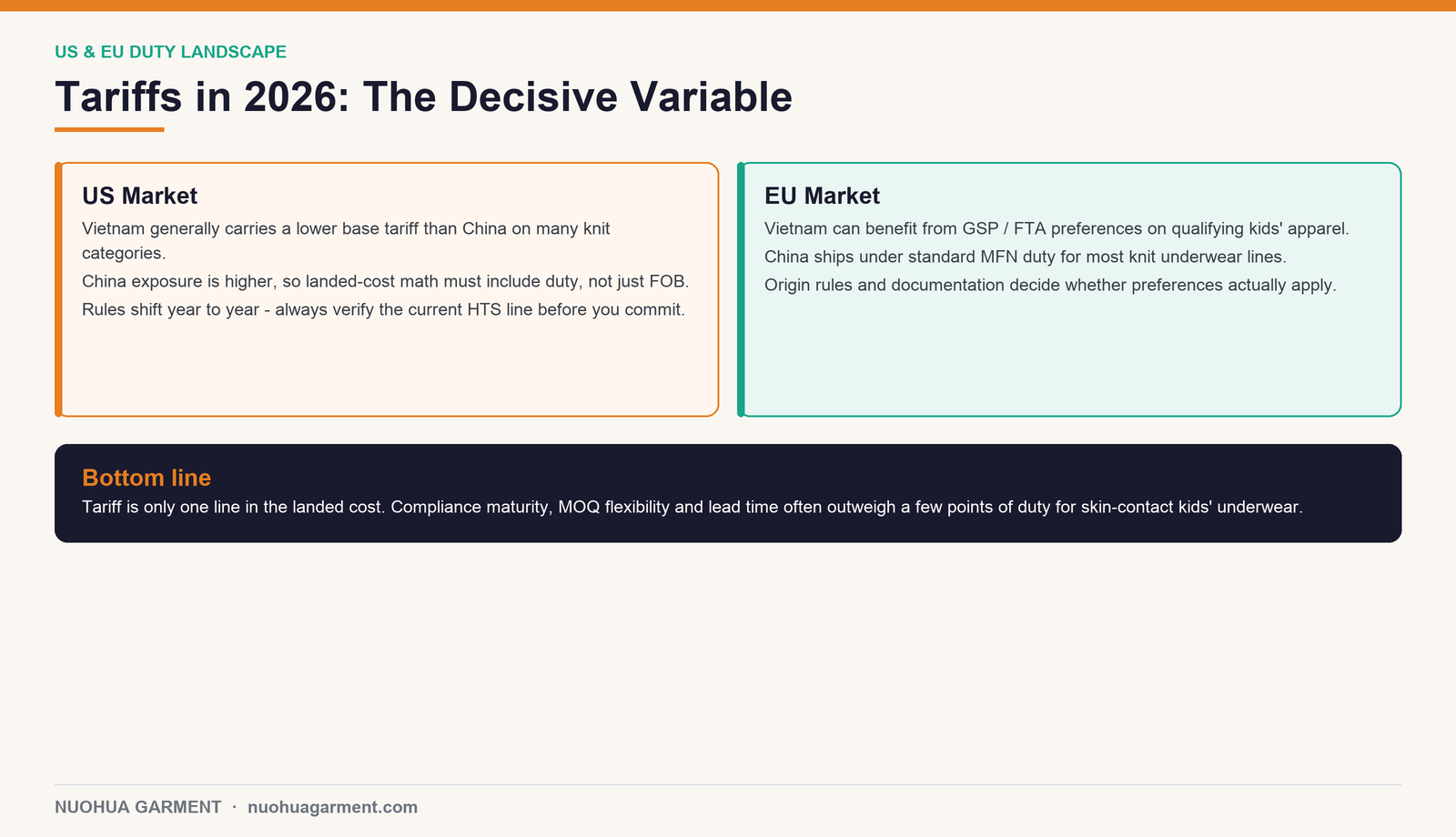
No China-vs-Vietnam decision is complete without the duty math, and 2026 is a year of unusual flux.
US Market
US duties on Chinese apparel have eased substantially from the ~50%+ peaks seen in 2025 and are, for many knit HTS codes, often under 20% following the 2025–2026 tariff-relief framework. Vietnamese knit apparel into the US carries standard MFN rates of roughly 16–18% for tops — but some 2026 reports cite much higher reciprocal add-ons, so the gap is narrow and shifting. The practical read: for US-bound kids’ underwear, China’s duty disadvantage has shrunk dramatically, and its FOB and speed advantages often win on total landed cost.
EU Market
Here the equation flips. Under the EU–Vietnam Free Trade Agreement (EVFTA), qualifying yarn-forward garment imports from Vietnam move toward 0% duty. Chinese apparel into the EU faces standard MFN rates of roughly 12%. For an EU-focused brand shipping at scale, Vietnam’s duty edge is real — provided your supply chain meets the yarn-forward rules of origin (the fabric and yarn must genuinely originate in Vietnam or a cumulating partner, not merely be cut-and-sewn there).
Which Should You Choose? By Brand Stage
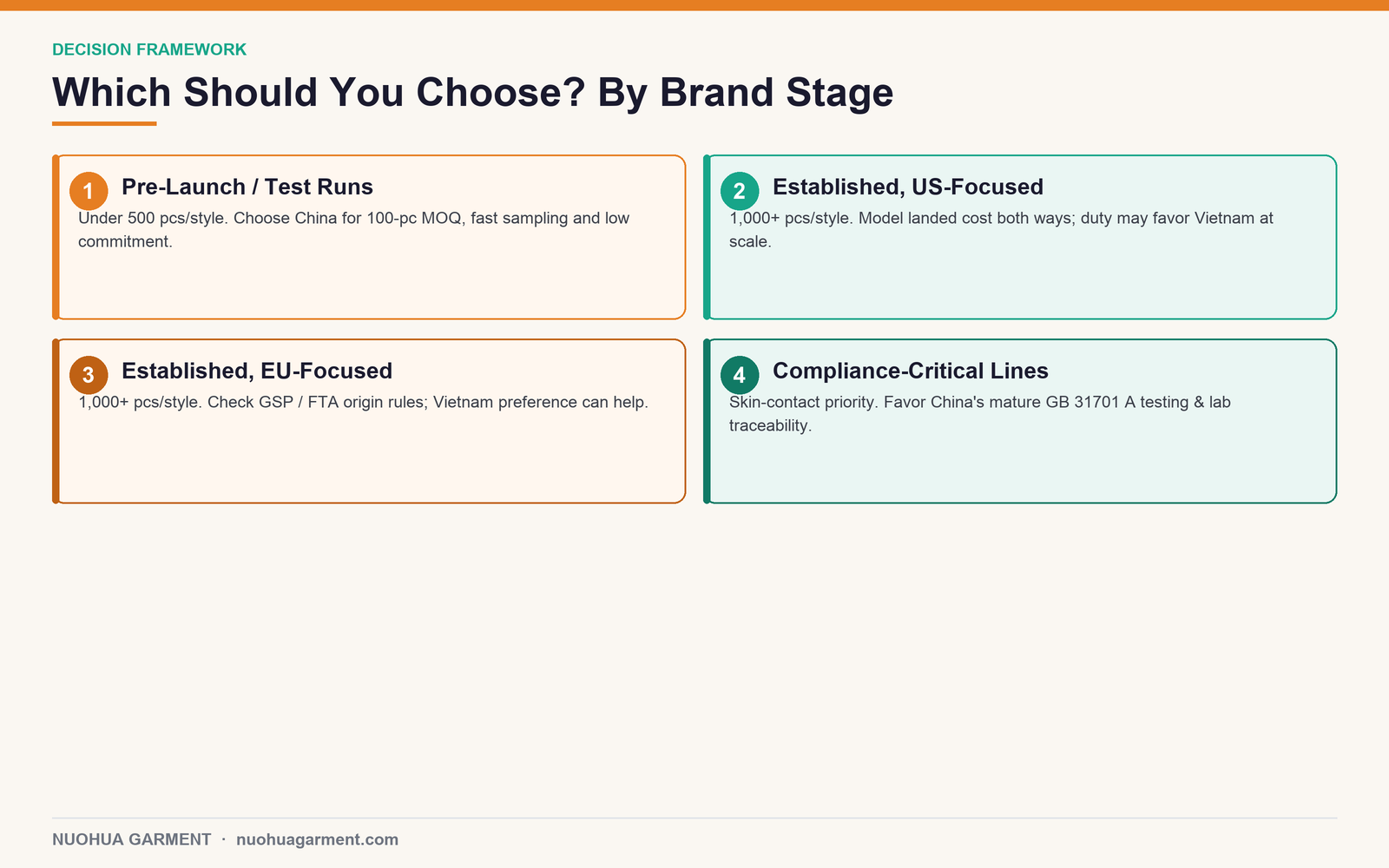
There is no single winner. The right answer depends on your stage, market, and order size.
Stage 1 — Pre-Launch / Test Runs (under 500 pcs/style, US or global)
Choose China. You need ready-stock minimums from 2 pcs, fast sampling, and local fabric. Vietnam’s MOQs and lead times will frustrate a first launch. China’s small-batch ecosystem is built for exactly this.
Stage 2 — Established Brand, US-Focused, 1,000+ pcs/style
Usually China, but model it. With US duties on China now lower and Vietnam’s FOB advantages modest for small knit basics, China’s speed, fabric integration, and testing maturity typically win on landed cost and risk. Re-run the numbers if your volumes are very high.
Stage 3 — Established Brand, EU-Focused, 1,000+ pcs/style
Vietnam becomes compelling. The 0% EVFTA duty, combined with Vietnam’s strong knit-export base, can offset its higher MOQ and longer lead time — provided you can meet yarn-forward origin rules and plan 60–90 day cycles.
Stage 4 — Compliance-Critical Skin-Contact Lines
China’s maturity leads. For children’s underwear and training bras, where GB 31701 Class A, CPC test data, and third-party lab access are central, China’s documented ecosystem reduces both compliance risk and time-to-report. A factory like Nuohua that already holds GB 31701 Class A and coordinates SGS/TÜV SÜD/Intertek testing shortens your path to a defensible compliance file.
Before you commit, run through our kids’ underwear OEM production-readiness checklist to confirm your tech pack, BOM, and compliance docs are order-ready.
Frequently Asked Questions
Is Vietnam always cheaper than China for kids’ underwear?
No. Vietnam’s lower labor cost is real, but kids’ underwear is fabric- and compliance-heavy, and Vietnam imports most of its knit fabric. On a full landed-cost basis (FOB + duty + freight + testing), China is frequently cheaper or comparable, especially for US-bound or low-volume orders.
What is the realistic minimum order for children’s underwear in each country?
In China’s coastal knit hubs, 2 pcs per selected in-stock style/color is realistic at compliant small-batch houses. In Vietnam, expect 300–1,000 pieces per style, often higher, plus a separate fabric MOQ in kilograms per color.
How long does production take?
China first-run production is often 30–45 days, with reorders in 3–4 weeks. Vietnam first runs are often 60–90 days, largely due to imported fabric and capacity. Always add a buffer for your first two orders.
Which country is better for compliance and testing?
For skin-contact children’s wear, China’s ecosystem is more mature: GB 31701 Class A familiarity, onshore third-party labs (SGS, TÜV SÜD, Intertek), and routine batch documentation. Vietnam’s tier-1 export plants are capable but less uniformly set up for small, test-heavy kids’ lines.
Does Vietnam have a tariff advantage?
For the EU, yes — EVFTA drives duty toward 0% for yarn-forward goods, versus ~12% MFN for China. For the US in 2026, the gap has narrowed: China’s duties have eased below ~20% for many knit codes, while Vietnam’s MFN sits around 16–18% (with some reports of higher reciprocal add-ons). Verify the current HTS schedule before deciding.
Can I split production between both countries?
Yes — a “China plus one” structure is common. Many brands keep low-MOQ test runs and compliance-critical skins in China while shifting high-volume EU-bound basics to Vietnam once volumes and lead times justify it.
What should I verify before choosing a factory in either country?
Confirm the factory’s legal name matches its audit and test reports, check that social audits are current (within 12 months), confirm fabric MOQ separately, and require a full compliance documentation trail for skin-contact wear. Our manufacturer vetting guide covers the red flags in detail.
Ready to Compare Quotes?
The honest answer to “China or Vietnam?” is “it depends on your stage, market, and order size” — and the only way to know is to put real numbers on the table. If you are launching or scaling a kids’ underwear, training-bra, or sleepwear line and want a compliant, small-batch quote from a China knitwear specialist, request a quote from Nuohua and we will walk you through fabric, MOQ, lead time, and the full compliance file.