
Kids’ Underwear Size Chart: US / EU / UK / AU (By Age, Height, Waist)
Sizing is the most common reason a kids’ underwear launch gets returned — and the least-written-about topic in B2B sourcing. Outerwear size charts exist everywhere; underwear-specific charts, built around waist and hip rather than garment length, are rare. This guide gives you a practical, export-ready size chart across the four biggest markets and shows you exactly how to measure a child so your tech pack specs actually fit.
Why underwear sizing is different from outerwear
Underwear wraps the body’s narrowest, most variable points: the waist and the hip. A child’s “age 6” T-shirt size tells you almost nothing about their underwear size, because trunk length and shoulder width are irrelevant to a brief or a boxer. For underwear you care about three numbers: height, waist circumference, and hip circumference.
That is also why a single global size label is a mistake. The same “6–8” tag means different bodies in the US, EU, UK, and AU. If you sell across markets, you need a conversion chart your fulfillment team and your customers can both trust.
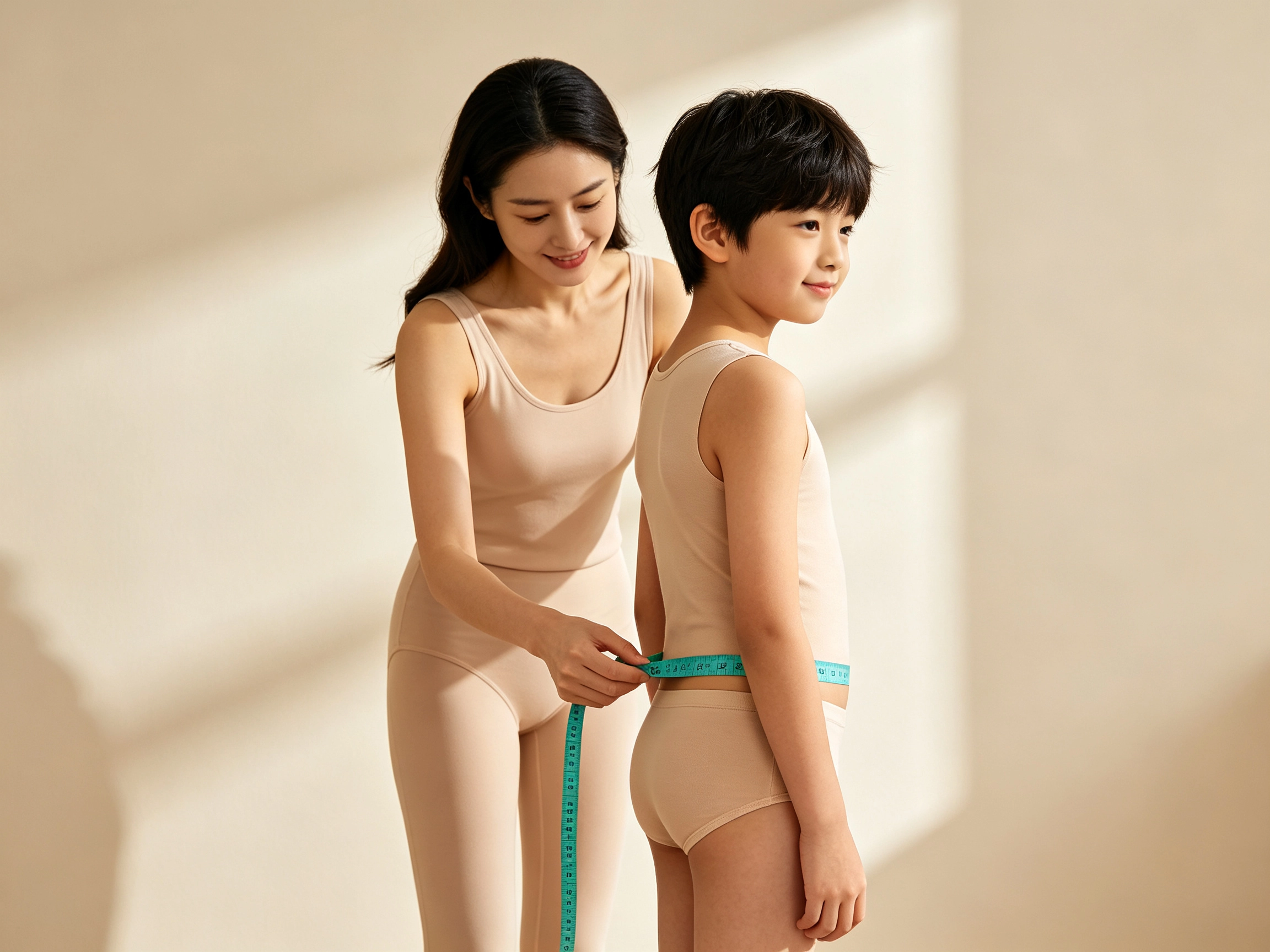
How to measure a child for underwear
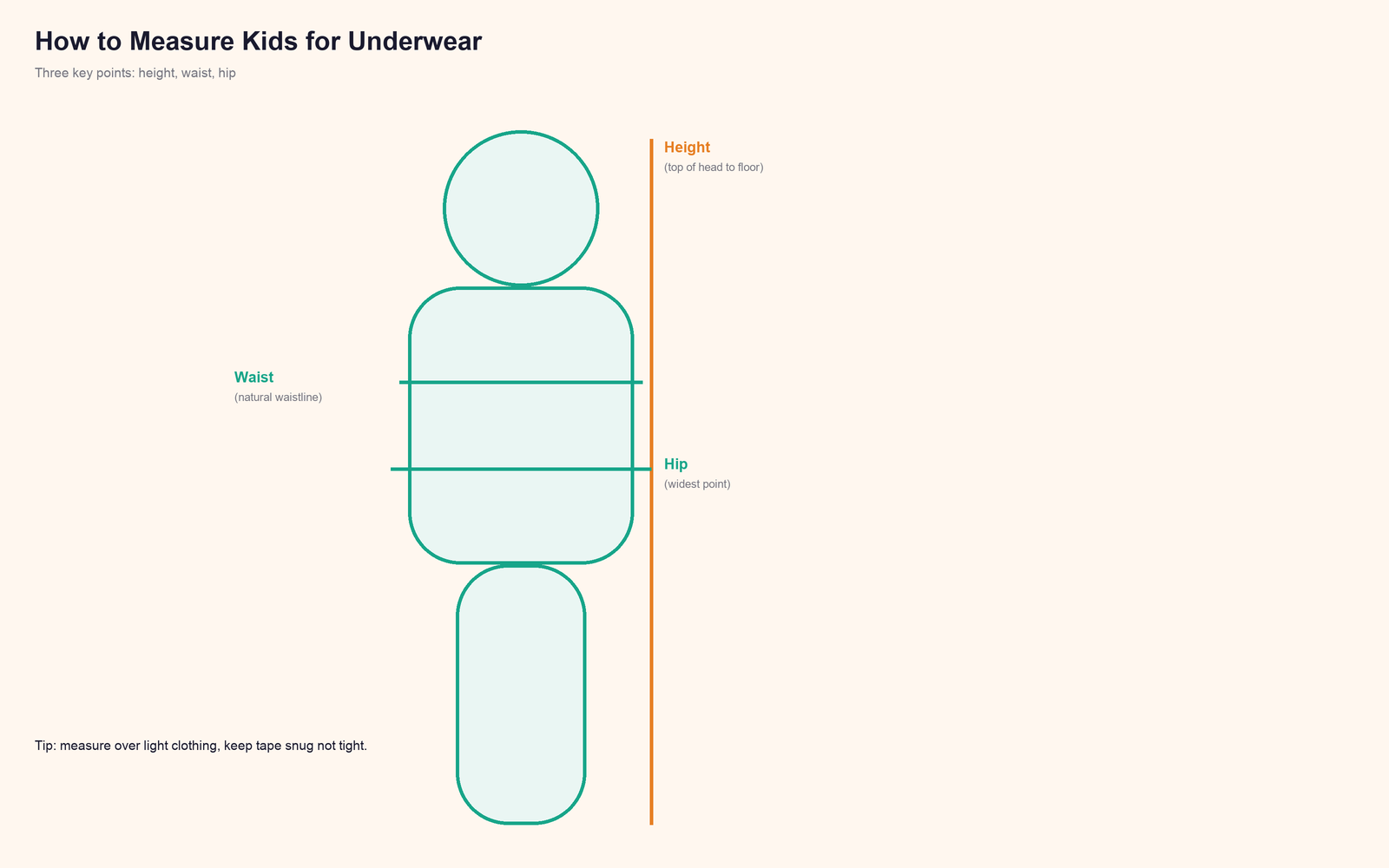
- Height: child stands straight, barefoot, from top of head to floor.
- Waist: the natural waistline, usually just above the navel — the narrowest part of the trunk.
- Hip: the widest point around the seat, with the child standing relaxed.
Record the values in centimeters first, then convert. Working in cm internally avoids the rounding errors that creep in when you convert US inches to EU cm too early.
Measuring step by step: the three numbers that decide fit
Height — the frame, not the fit
Height sets the overall garment length and where the waistband will sit. Measure barefoot, standing straight, from the crown of the head to the floor. Use it as a cross-check against waist/hip, not as the primary sizing driver — a tall, slim child and a short, round child can share a height but need different underwear sizes.
Waist — the number that actually matters
The natural waist is the narrowest part of the trunk, usually just above the navel. Wrap the tape so it sits flat but not tight, and let the child breathe normally — a sucked-in stomach produces a size too small and a return later. For underwear this single measurement does more to prevent gaping or binding than anything else on the spec.
Hip — the seat allowance
Measure the widest point around the seat, standing relaxed. This is where boys’ boxers and girls’ briefs differ most: a boxer needs more hip ease to sit loose, a brief needs the hip held without cutting. Record the hip even for briefs — it tells the pattern where to grade the leg opening.
Regional fit differences: Asia vs West, and why one tag lies
A “size 6” is not a “size 6” across the world, and the gap is widest between Asian and Western body types. East-Asian children tend to be slimmer through the waist and hip at the same height, so an Asian size 6 often corresponds to a smaller waist measurement than a US or EU size 6. If you buy a “6” off a template built for one region and sell it in another, the result is returns — or worse, a garment that binds.
- US & AU: roomier through the hip, more ease built into the block. AU sizes track UK closely.
- UK: close to US but with slightly different age bands; the cm waist is the real source of truth.
- EU: height-driven (92, 98, 104…), generally slimmer than US at equal height.
- Asian markets: slimmer waist/hip at equal height; grade down ~2–4 cm on the waist if you reuse a Western block.
The fix is not a different tag — it is one cm-based spec translated into each market’s tag. Build your tech pack around the waist/hip cm, then print the local size as a translation of that number.
Kids’ underwear size chart: US / EU / UK / AU
| Age (approx) | Height cm | Waist cm | US | EU | UK | AU |
|---|---|---|---|---|---|---|
| 2–3 Y | 90–98 | 46–48 | 2T–3T | 92–98 | 2–3 | 2–3 |
| 3–4 Y | 98–104 | 48–50 | 3T–4T | 98–104 | 3–4 | 3–4 |
| 4–5 Y | 104–110 | 50–52 | 4–5 | 104–110 | 4–5 | 4–5 |
| 5–6 Y | 110–116 | 52–54 | 5–6 | 110–116 | 5–6 | 5–6 |
| 6–7 Y | 116–122 | 54–56 | 6–7 | 116–122 | 6–7 | 6–7 |
| 7–8 Y | 122–128 | 56–58 | 7–8 | 122–128 | 7–8 | 7–8 |
| 9–10 Y | 134–140 | 58–62 | 9–10 | 134–140 | 9–10 | 9–10 |
| 11–12 Y | 146–152 | 62–66 | 11–12 | 146–152 | 11–12 | 11–12 |
Training-bra and older kids’ ranges extend further; for pre-teen lines, waist and hip matter more than age. Always grade by body measurement, not by the printed size tag.
Tip for brands: print the cm waist range on your inner care label alongside the market size. It cuts returns and supports GB 31701 Class A traceability documentation for skin-contact garments.
Boys vs girls: what actually changes
For briefs and boxers the difference is mostly cut and rise, not the size scale. Boys’ boxers sit lower and looser through the hip; girls’ briefs and training styles sit higher at the waist. The waist/hip numbers in the chart above apply to both — only the pattern changes. If you run a unisex line, grade to the larger hip allowance and use a mid-rise cut.
Sizing special cases: plus-size, tall, and training-bra ranges
Plus-size and taller kids
Standard children’s charts stop where real bodies keep going. For plus-size or tall kids, extend the waist/hip grading past the last row rather than forcing them into an adult XS — adult blocks sit differently at the rise and leg. Grade by the measured waist and add a little more hip ease so the garment does not ride or bind.
Growth ease: how much to add
“Size up for growth” is the wrong instinct because a size up changes the whole block, not just the room. Instead, spec 1–2 cm of positive ease on the waist for 100% cotton (no stretch) and 2–4 cm of negative ease for 95/5 cotton-spandex (the elastane recovers). The child grows into the ease without the garment looking oversized on day one.
Training bras and the older-kids range
Training bras follow the older end of the chart — chest and underbust matter more than waist. We treat them as a separate graded block in the tech pack so the cup and band develop on their own curve, not as a relabeled underwear size. If your line spans underwear and first bras, keep two graded blocks and a clear hand-off point.
Unisex grading
For a unisex line, grade to the larger hip allowance and use a mid-rise cut; the waist/hip numbers stay the same, only the pattern changes. This avoids the common mistake of a “unisex” brief that fits boys loosely and girls tightly.
Common sizing mistakes brands make
- Trusting age alone. Two “5-year-olds” can differ 8 cm in height. Grade by measurement.
- Mixing US and EU on one tag. A “6” is not a “6” everywhere — use the conversion chart.
- Ignoring stretch. A 95/5 cotton-spandex brief recovers; a 100% cotton brief does not. Add ease for non-stretch fabrics.
- No size spec in the tech pack. Your factory cannot grade what you do not write down.
Our tech pack guide shows exactly where the size spec block belongs, and our quote checklist lists the measurements a factory needs before sampling.
Frequently Asked Questions
Should I size up for growth?
No — size to the measured waist and add 1–2 cm of ease in the spec. Sizing up blindly creates gaps and returns.
What is the difference between US and UK kids’ sizes?
They are close for underwear but not identical in age bands; use the cm waist as the source of truth and treat US/UK/EU/AU tags as translations of it.
How much stretch ease should I add?
For 95/5 cotton-spandex, 2–4 cm negative ease is normal. For 100% cotton, add 1–2 cm positive ease so it does not bind.
Do training bras use this chart?
Training bras follow the older-kids waist/chest range; we treat them as a separate graded block in the tech pack.
Can Nuohua grade to my own size standard?
Yes. Send your target market and measurements; we grade and sample to your spec at 2 pcs on selected in-stock styles, colors and sizes.
Why do my US and EU returns differ if the tag says the same size?
Because the block behind the tag differs. The cm waist is the only stable reference; if your EU and US versions share a tag but not a graded block, the fit drifts and returns climb in one market.
Should the care label show the cm waist?
Yes — we recommend printing the cm waist range on the inner label alongside the market size. It helps customer support answer “will this fit?” and supports GB 31701 Class A traceability for skin-contact garments.
How do I handle a child between two sizes?
Grade to the measured waist and rely on fabric ease: a 95/5 cotton-spandex brief bridges a 2 cm gap comfortably; a 100% cotton brief needs the next size up or it will bind.
Do baby bodysuits use the same chart?
Bodysuits add a snap crotch and a higher rise, so they follow the same waist/hip numbers but a different leg opening. We grade them as their own block in the tech pack.
Ready to lock your size spec?
Send your target markets and a waist/hip range, and we will return a graded spec and a sample plan. Request a quote or review our production-readiness checklist before you brief the line.