
Interlock vs Jersey Knit: Choosing the Right Base for Kids’ Bodysuits
Two knit constructions sit behind almost every kids’ bodysuit and underwear body on the market: interlock and jersey. This interlock vs jersey kids bodysuits guide explains the trade-offs in plain manufacturing language so you can spec the right base with confidence. They look similar on a hanger yet behave completely differently once a toddler is crawling, squatting, and pulling at the neckline. As a manufacturer, we make this choice before a single panel is cut, because it dictates opacity, recovery, printability, and sewing behaviour. This guide explains both constructions from the production floor and gives a clear recommendation by product type.
On this page
1. The Two Constructions, Plainly
Jersey is a single-knit fabric (one set of needles) that is smooth on the front and slightly textured on the back, and its edges curl. Interlock is a double-knit (two needle beds interlocked) that is identical on both faces, stable, and does not curl.
Jersey is the oldest and most common weft knit. A single set of needles forms loops in one direction; the result is a fabric with a smooth “face” and a flatter, tacky “back.” Cut an edge and it curls — front edges roll toward the face, back edges roll the other way. That curl is harmless in a finished garment but a headache at the cutting and sewing stage.
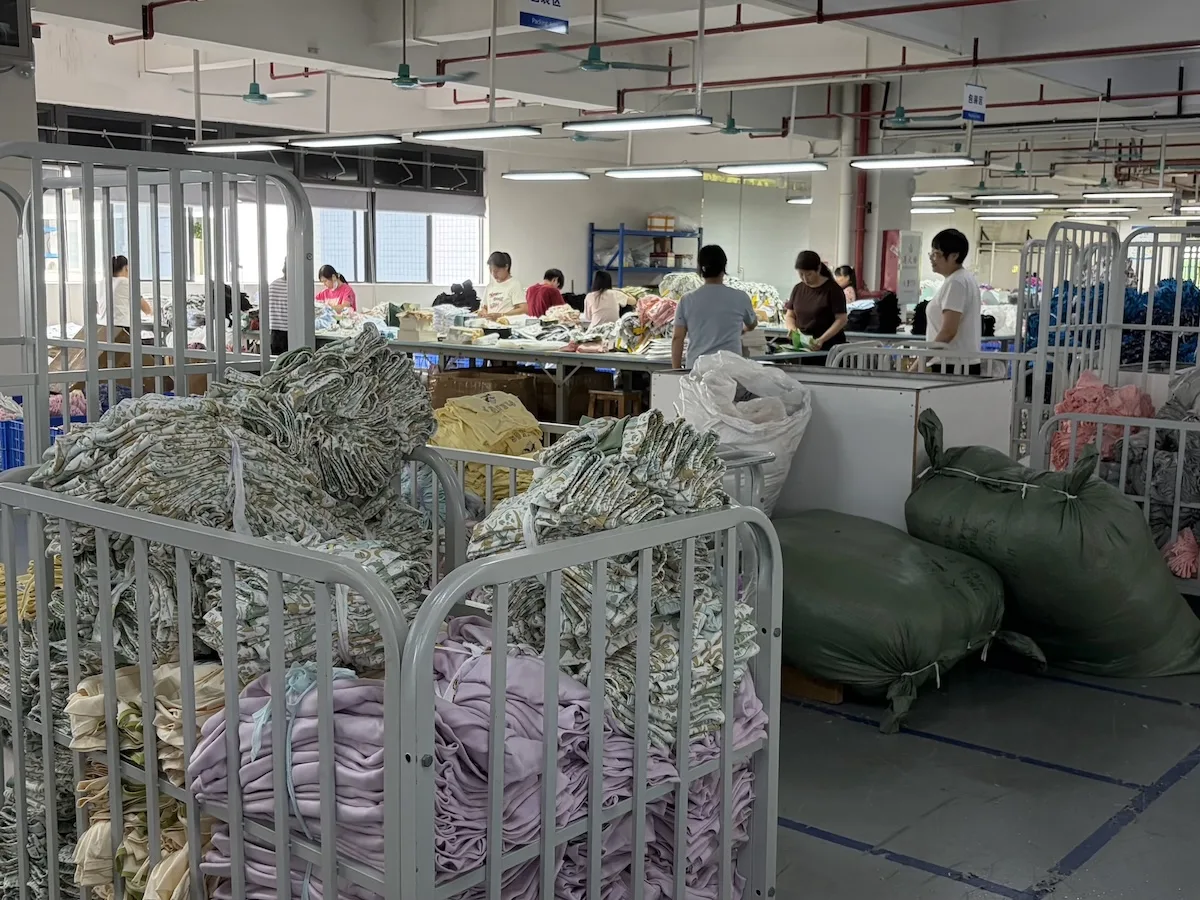
Interlock is essentially two jersey fabrics knitted simultaneously and interlocked, using two needle beds. The two faces are mirror images, so the cloth looks and feels the same on both sides. Crucially, the structure is balanced, so it lies flat and does not curl. It is heavier per given yarn because you are effectively knitting two layers. Our in-stock bodysuit bases are both interlocks — at 220–240 GSM (91.9% Lenzing™ Modal + 8.1% Spandex) and ~220 GSM (49.9% Lenzing™ Modal + 43.3% Cotton + 6.8% Spandex) — precisely because the stability matters for a garment with snaps and a stretching neckline.
2. Recovery and Stability on a Moving Body
Interlock holds its shape better and resists bagging at knees, elbows, and the crotch; jersey is more elastic and drapes closer but can stretch out and “grow” on a very active child.
A bodysuit lives a hard life: it is stretched over a head, pulled down at the legs, and snapped tight at the crotch dozens of times a day. Recovery — the fabric’s ability to spring back to size — decides whether the garment still fits in week six.
Interlock recovery
The double-knit structure is inherently more dimensionally stable. Combined with a small elastane content (6.8–8.1% Spandex in our blends), interlock resists permanent stretch and keeps its panel shape. This is why premium bodysuits and our everyday underwear lines use it: fewer returns for “it got baggy.”
Jersey recovery
Single jersey is more extensible and drapes beautifully, but without careful elastane balancing it can over-stretch at stress points and not fully return. For a wriggling toddler that means knee and crotch bagging. It is not a dealbreaker — many fine lightweight briefs are jersey — but the designer must spec the elastane and stitch deliberately.
| Behaviour | Interlock (double-knit) | Jersey (single-knit) |
|---|---|---|
| Edge curl | None | Curls at cut edges |
| Dimensional stability | High | Moderate |
| Stretch recovery | Excellent with elastane | Good, needs elastane balance |
| Opacity | High (two layers) | Lower, varies with GSM |
| Drape | Stable, holds form | Flowy, body-skimming |
| Weight at same yarn | Heavier | Lighter |
3. Opacity and Coverage
Interlock is the safer choice for opacity because two face layers block show-through even when stretched. Jersey can become translucent at the hip or shoulder unless you push GSM up.
Coverage is a non-negotiable for kids’ underwear and bodysuits — parents notice show-through immediately. Interlock wins by construction: the interlocked double layer means light and skin tone rarely pass through, even at a stretch point like the shoulder or seat. Jersey, being a single layer, can thin visibly when pulled across a curve; you compensate by raising GSM (toward 180–210) and by choosing a denser stitch, but that edges it toward interlock’s weight anyway.
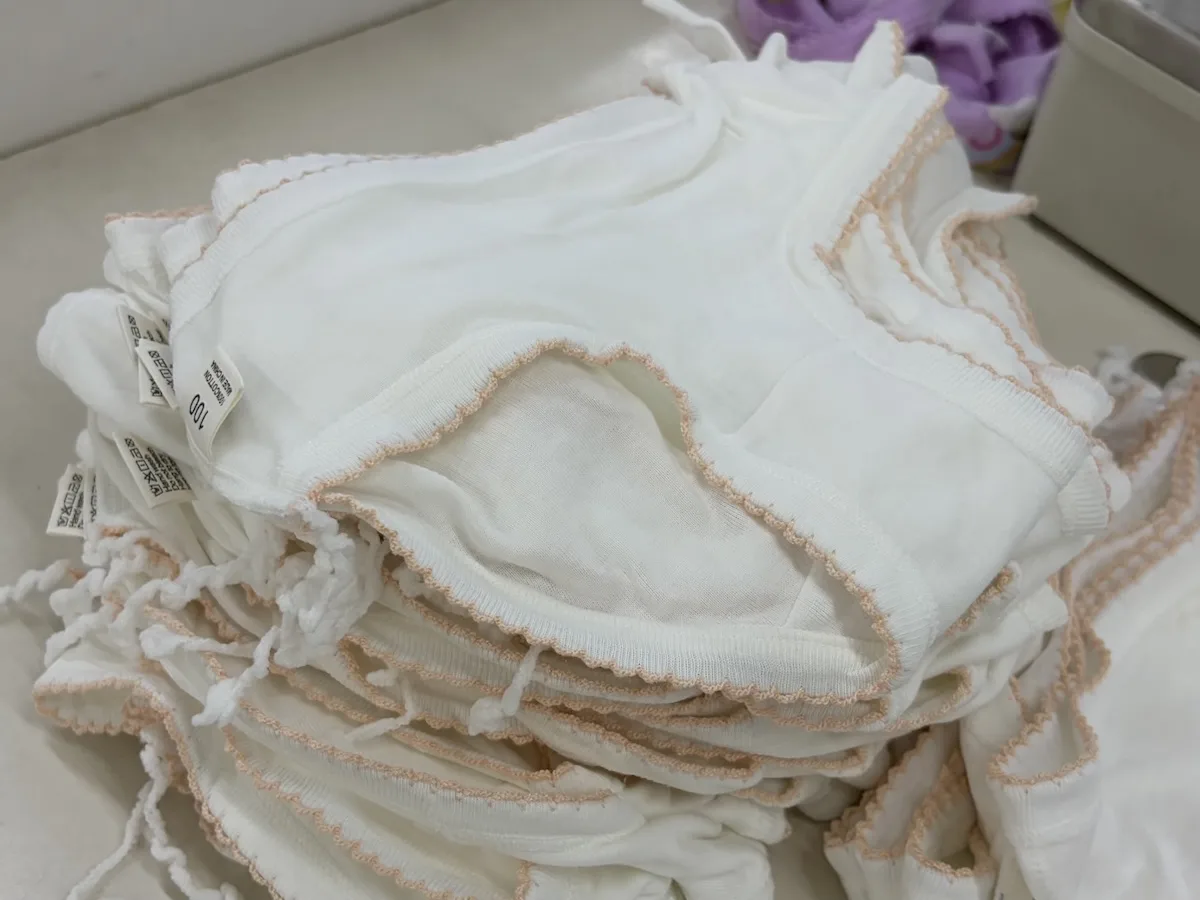
For white and pastel bodysuits especially, we default to interlock. A white jersey brief at 160 GSM is a returns-risk; a white interlock at 220 GSM reads clean and substantial. This ties directly to our opacity and density notes — structure and colour must be specified together.
4. Printability and Surface
Interlock’s flat, stable, two-sided surface prints more evenly and resists press marks; jersey can shift and curl under the print bed and shows the back texture through light prints.
With 3,000+ prints in our library, print behaviour is something we watch closely. Interlock lies flat and presents a consistent face, so screen and digital prints land evenly and registration stays true across a run. Its stability also means less fabric movement under the print head — fewer misaligned or ghosted prints.
Jersey’s curl and lighter hand can cause the cloth to lift or shift during printing, and because its two sides differ, a light or semi-transparent print may reveal the back’s texture. That is manageable with backing or careful ink choice, but it adds a production variable. For printed bodysuits with all-over or placement art, interlock is the lower-risk base; jersey suits solid colours or very light prints.
5. Sewing, Cost, and Production Behaviour
Interlock sews cleaner (no curl, stable feed) and pairs well with bound or flatlock seams; jersey is lighter and cheaper but needs edge control to avoid defects. Both run on our INA hanging line.
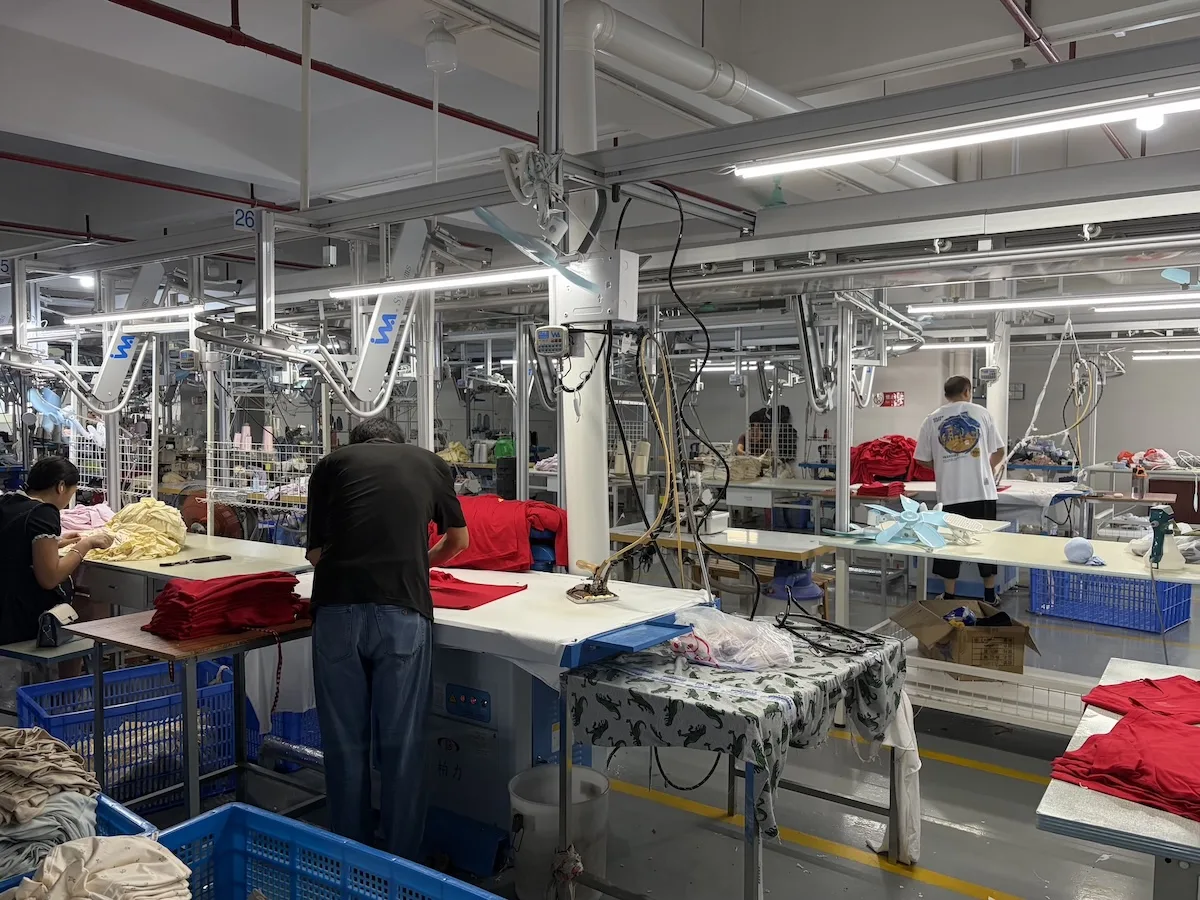
Construction choice ripples into the sewing room. Interlock feeds steadily through our INA hanging production system because it does not curl or distort, which protects the <0.3% defect rate we target. Jersey demands more handling — operators weight edges, use temporary tape, or overlock quickly to lock the curl before it becomes a skipped seam.
Seam construction
For kids’ intimate wear, seam comfort is as important as fabric. Interlock’s stable edge supports clean bound or flatlock seams that lie flat against skin; jersey, being thinner, also takes these seams but the finished edge is less substantial. We never use “seamless” as a claim for these kids’ lines — the garments are cut-and-sewn, and we are transparent about that.
Cost
Interlock uses more yarn per square metre (two layers), so it costs more in material than a jersey of equal fibre. Jersey is the economical base for high-volume, lighter styles. The right call balances material cost against returns risk: a cheaper jersey that bags or shows through can cost more in returns than the interlock upgrade.
6. Recommendation by Product Type
Use interlock for everyday bodysuits, white/pastel colours, and printed all-over styles; use jersey for lightweight summer briefs, deeper colours, and cost-sensitive high-volume basics.
Here is the practical mapping we give brands during development.
| Product | Recommended base | Reason |
|---|---|---|
| Everyday bodysuit (all colours) | Interlock ~220 GSM | Stable, opaque, snap-area recovery |
| White / pastel bodysuit | Interlock | Opacity and clean surface |
| All-over printed bodysuit | Interlock | Flat, stable print bed |
| Summer lightweight brief | Jersey 150–180 GSM | Breathable, drapes, lower cost |
| Deep-colour everyday brief | Either; jersey ok | Opacity less critical in dark shades |
| Leggings / sleep body | Interlock 220–260 GSM | Stretch recovery, warmth |
This guidance pairs naturally with fibre choice — see our modal vs cotton comparison to pick the fibre, then use this table to pick the knit. Both decisions belong in the tech pack before sampling.
7. How Nuohua Builds Bodysuit Bases
We keep two in-stock interlock bases (modal-rich and modal-cotton) at ~220 GSM so brands can launch bodysuits without a custom development cycle or setup fee; custom jersey or cotton bases go through development.
Our standard bodysuit programme is built on interlock for the reasons above. The two ready bases — 91.9% Lenzing™ Modal + 8.1% Spandex (220–240 GSM) and 49.9% Lenzing™ Modal + 43.3% Cotton + 6.8% Spandex (~220 GSM) — both deliver the opacity, recovery, and print stability a bodysuit needs, with no setup fee. They are the fastest route from brief to bulk for a new brand.
If your concept needs a specific jersey or cotton-dominant base, that is a custom fabric development path. Either way, we verify the cloth through our 6-stage QC with needle detection and confirm shade and weight consistency via swatch and lab-dip approval before full production. Compliance for direct-skin children’s apparel follows GB 31701 Class A (China children’s A-class safety standard), with restricted-substance checks available through third-party testing by SGS or CPC; OEKO-TEX Standard 100 is currently in progress at our facility.
For the broader manufacturing picture, our kids’ clothing manufacturer and OEM/ODM service pages explain capacity (1,000,000+ pieces/month across an 8,000 sqm facility with 300+ staff) and how an in-stock base becomes your labelled line. If seams are your next question, our bound vs flatlock seam guide picks up where this one ends.
8. Specifying the Knit Base in Your Tech Pack
Write the knit as “interlock, double-knit” (or “single jersey”) together with target GSM, stitch type, and an allowed tolerance. Pairing it with fibre and seam type on one spec prevents the most common bodysuit bulk defects.
The knit structure is one of the most frequently omitted fields in tech packs we receive, and its absence is a leading cause of “this isn’t what the sample felt like” disputes. A developer who writes only “220 GSM cotton” has not told the factory which construction to run — and a 220 GSM interlock and a 220 GSM jersey are different garments. Lock the structure explicitly.
| Field | How to write it | Why it matters |
|---|---|---|
| Knit structure | Interlock (double-knit) or Single jersey | Defines curl, stability, opacity behaviour |
| Target GSM | 215–235 GSM (range + tolerance) | Absorbs normal mill variation |
| Stitch / gauge | e.g., 24G interlock, balanced set-out | Sets density, recovery, and appearance |
| Fibre composition | 91.9% Lenzing™ Modal / 8.1% Spandex | Names the exact yarn to order |
| Seam type | Bound or flatlock at leg/neck | Comfort and defect control at stress points |
| Finish | Relaxed / compacted, no silicone if sensitive | Affects hand-feel and skin safety |
The knit, the GSM, the fibre, and the seam type are not four separate choices — they are one system, and they should sit together on the same spec sheet. A stable interlock at 220 GSM with a bound leg seam behaves predictably on our INA hanging line and passes the 6-stage QC cleanly; the same fibre as a loosely set jersey with an overlocked edge is a different, higher-risk garment. When a brand asks us to “make it softer,” the answer is rarely a different fibre — it is usually a tuned stitch, a relaxed finish, and the right construction for the product type.
Before any bulk run, we confirm the base against an approved lab-dip and weight report through our swatch and lab-dip approval process, and we align on seam construction so the sample and the production match. That handshake is what keeps a bodysuit consistent from the first box to the ten-thousandth.
Choosing the right knit base is the first step to a bodysuit that fits at week one and week ten. Tell us your product type and we will recommend the base.