
Why Kids’ Underwear Fails QC: A Field Guide to Defects and Their Causes
Every defective pair of children’s underwear returned by a parent is a small, visible failure of a long production chain, and most kids underwear defects are anything but random. From the factory floor, “defect” is not a vague complaint — it is a specific, nameable fault with a specific, fixable root cause. This field guide walks through the seven defects we see most often in mass-produced kids’ underwear, explains where each one is born on the production line, and shows how a disciplined, multi-stage QC system — including metal needle detection — keeps them out of the box. Written by a manufacturer for sourcing teams and private-label founders, not a marketing desk.
On this page
- Why defect rates matter more for kids’ underwear
- The defect map: seven faults and where they are born
- Loose threads and needle holes / broken stitches
- Pilling and elastic failure (loss of recovery)
- Print bleed, crocking, and asymmetry
- Foreign objects and why needle detection is non-negotiable
- The 6-stage QC system that catches them
- How a measured <0.3% defect rate is actually held
1. Why defect rates matter more for kids’ underwear
A defect rate that an adult basics brand might quietly absorb becomes a safety and trust problem in kidswear: a broken needle fragment is a hazard, a lost elastic waistband is a returned product, and a bleeding print is a compliance failure. Kids’ underwear is held to tighter acceptance levels precisely because the wearer cannot complain for themselves.
Adult underwear is forgiving. A stray thread is brushed off; a slightly uneven waistband is hidden under clothes. Children’s underwear sits against the most sensitive skin for the longest hours of the day, and the buyer is a parent scanning for anything wrong. Three realities make the defect conversation different here:
- Safety is part of quality. A missing needle fragment is not a cosmetic issue — it is an injury risk. That is why metal detection is built into kidswear QC, not added as an extra.
- Small garments magnify small faults. A 2 mm asymmetry on an adult brief is invisible; on a 3–4 year size it reads as a second-quality product.
- Returns are reputation, not just cost. One scratchy seam or bleeding print becomes a review that names your brand. Catching it at the line costs pennies; catching it post-shipment costs the relationship.
At Nuohua Garment we measure our finished-goods defect rate at below 0.3% across custom kids’ underwear production. That number is the product of process control, not luck — and the rest of this guide explains the mechanism.
2. The defect map: seven faults and where they are born
The seven recurring kids’ underwear defects are loose threads, needle holes / broken stitches, pilling, elastic failure (loss of recovery), print bleed / crocking, asymmetry, and foreign objects. Each maps to a specific stage — cutting, sewing, finishing, or inspection — which is why prevention has to be staged, not inspected in at the end.
Most sourcing teams think of QC as a final gate. On a real production line, defects are seeded at every stage, so the only way to hold them down is to attack each at its source. The table below is the map we train our line leaders with — defect on the left, the production step that usually causes it in the middle, and the control that stops it on the right.
| Defect | Typical root cause in production | Prevention control |
|---|---|---|
| Loose threads | Uncut chain ends at overlock/coverstitch; no thread-behind trim pass | Auto-trim machines + dedicated thread-pulling station |
| Needle holes / broken stitches | Blunt or wrong-size needle; too-tight knit; skipped stitches from timing | Needle class spec by fabric; timed needle change; SPI check |
| Pilling | Fibre/finish choice; surface friction; loose yarn twist | Fibre selection (Modal/spandex), low-pill finish, wash test |
| Elastic failure (recovery loss) | Over-stretched spandex; wrong cure; heat damage at fusing | Spandex % spec; tension control; recovery test on waistband |
| Print bleed / crocking | Poor dye fixation; low cure temp; weak rub-fastness recipe | Cure-profile control; crocking test; approved ink/dye set |
| Asymmetry | Marker/lay misalignment; single-side cutting drift; wrong placement | Symmetric marker; placement templates; measure audit |
| Foreign objects | Broken needle; metal off-cut; hardware left in garment | Needle-count log; metal detection; lockable needle policy |
Notice that none of these is “the inspector’s fault.” They are process faults. A final audit can catch them; only staged controls prevent them. That distinction drives everything in section 7.
3. Loose threads and needle holes / broken stitches
Loose threads come from uncut chain ends at the overlock or coverstitch; needle holes and broken stitches come from a blunt or wrongly sized needle hitting a tight knit, or from skipped stitches caused by mistimed machines. Both are prevented at the machine, not the finishing table.
These two are the most common “first look” defects a buyer flags, and they come from opposite ends of the same sewing operation.
Loose threads
Kids’ underwear is sewn mostly on overlock and coverstitch machines that produce chain stitches. If the thread chain is not trimmed at the machine or at a dedicated thread-pulling station, ends poke out of the leg opening and waistband. On light interlock and jersey, those ends are highly visible. The fix is mechanical and procedural: auto-trimmers on the machines plus a hand-finishing pass where an operator pulls and clips every exposed end.
Needle holes and broken stitches
A needle hole is a permanent micro-tear in the knit where the needle punched through rather than parted the loops. Causes:
- Blunt needle — a needle that has struck a pin or presser foot deforms and tears instead of piercing. We run a timed needle-change policy (every X hours / per lot) so points stay sharp.
- Wrong needle class or size — a heavy ballpoint on a fine interlock leaves a hole; a too-fine point on a denser knit breaks. Needle size is specified against the fabric, not left to the operator.
- Too-tight knit / high tension — when the fabric is stretched under the foot, the hole stays open after relaxation. Feed control and a light presser-foot pressure reduce this.
Broken stitches (skipped stitches, press-off) usually trace to machine timing or thread tension, not the operator’s hand. A skipped stitch leaves a visible gap in the seam that fails at the first wear. Line leaders check stitches-per-inch (SPI) and run a seam-strength pull on setup garments before a lot releases.
4. Pilling and elastic failure (loss of recovery)
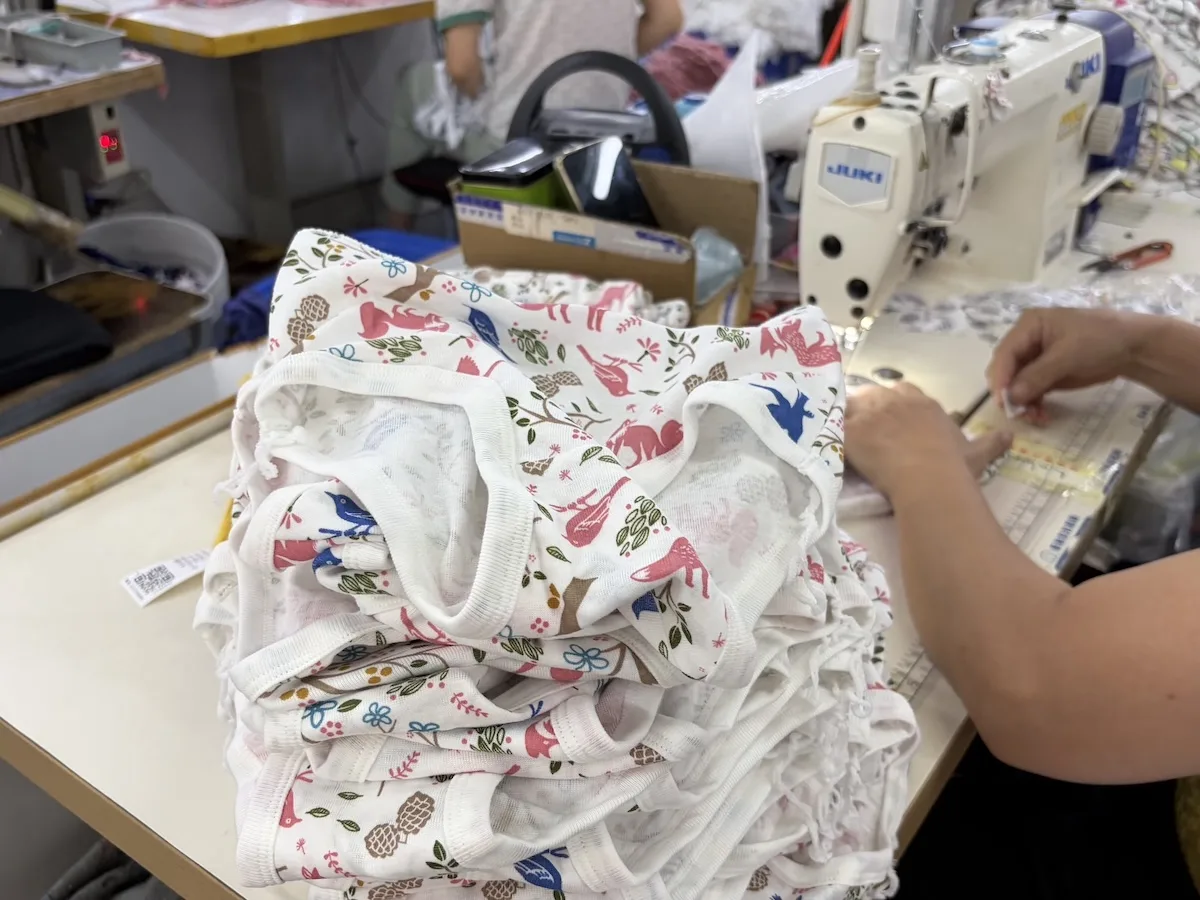
Pilling is a fibre- and surface-finish issue driven by friction on loosely twisted yarn; elastic failure (loss of recovery) is a spandex issue caused by over-stretching during sewing, wrong curing, or heat damage at fusing. Both are designed out in the BOM and confirmed by a wash and recovery test, not caught by eye alone.
Pilling
Pilling is the formation of small fibre balls on the surface after rubbing — think the inside of a waistband or the seat after a day of play. It is rarely a “bad machine” problem; it is mostly:
- Fibre choice. Long-staple, round fibres pill less. Our in-stock Lenzing™ Modal / spandex and Modal / cotton / spandex bases are selected partly for low-pill behaviour; a loose, short-staple yarn pills far more.
- Surface finish. A low-pill finishing treatment reduces the loose fibre ends that ball up.
- Construction. A tighter knit (interlock) pills less than an open jersey because fewer fibres are free to migrate.
We confirm pilling with a standard rub/abrasion and wash test on the sealed sample, not by guess. If a custom fabric pills above the agreed level, it goes back to development before bulk.
Elastic failure (loss of recovery)
The waistband and leg openings of kids’ underwear rely on spandex (elastane) recovery. When a band “stretches out and won’t bounce back,” the root cause is usually one of:
- Over-stretch during sewing. If the feeder pulls the band 30% longer than the body, the spandex is pre-loaded past its recoverable range and relaxes permanently. Feed/tension control on the coverstitch is the control.
- Heat damage. Spandex degrades above a temperature threshold. A fusing or curing step set too hot can cook the elastane, leaving a dead, loose band.
- Wrong spandex ratio. A band with too little elastane simply lacks recovery for the size. Our in-stock bases run 6.8–8.1% spandex, spec’d for the garment type.
The confirmation test is boring but essential: stretch the finished waistband to a defined extension, release, and measure recovery after a set cycle. Below the agreed return, the lot does not ship.
5. Print bleed, crocking, and asymmetry
Print bleed and crocking (colour rubbing off) come from poor dye/ink fixation and low cure temperature; asymmetry comes from marker and lay misalignment or wrong placement during sewing. All three are caught by a crocking test and a measure-against-template audit rather than by a quick look.
Print bleed / crocking
“Crocking” is the industry term for colour transferring to another surface through rubbing — onto skin, onto a sibling garment, onto a sofa. In kidswear it is also a compliance signal: children’s garments are tested for colourfastness to saliva, perspiration, and rubbing under standards such as GB 31701 Class A (China children’s A-class safety standard) and the US CPC program. A print that crocks fails those expectations.
Root causes are process, not pigment:
- Under-cure. The dye or print ink did not reach fixation temperature/time, so colour sits on the surface instead of bonding. Cure-profile control (the oven curve) is the single biggest lever.
- Wrong recipe for the fibre. A pigment that fixes on cotton may migrate on Modal. The dyehouse matches the recipe to the fibre.
- Over-softener. Too much hand-feel softener can lift surface colour and worsen crocking — a real trade-off between “soft” and “fast.”
Asymmetry
Asymmetry — one leg longer than the other, a waistband sitting crooked, a side seam off-centre — is almost always a cutting or placement fault:
- Marker / lay drift. If the marker (the cutting layout) is not symmetric, or the lay shifts during spreading, every piece cut from that stack is skewed.
- Placement error. A printed motif or labelled waistband placed by eye instead of a template drifts piece to piece.
The control is a symmetric marker plus placement templates and a measure audit on the first piece of every size run. A 1 cm drift that passes on the table becomes a visible defect on a small child.
6. Foreign objects and why needle detection is non-negotiable
Foreign objects — most dangerously a broken needle fragment — enter garments when a needle breaks on the line and is not accounted for. Prevention is a lockable needle policy with a needle-count log; detection is a metal needle-detection pass on finished goods. In kidswear, the detection step is non-negotiable, not optional.
Of all seven defects, the foreign object is the only one that is a direct safety hazard rather than a quality or comfort issue. A broken needle that vanishes into a bundle of briefs can end up against a child’s skin. That is why the control is two-layered:
- Prevention — needle accountability. Every machine is issued needles against a count. If a needle breaks, the operator logs it and must account for both the machine and the broken piece before production resumes. Needles are stored in a lockable box; loose needles do not float on the line.
- Detection — metal needle detection. Finished garments pass through a metal detector tuned to find ferrous fragments down to a defined sensitivity. Anything that alarms is pulled and the bundle re-checked.
This is the step we will not skip. Nuohua Garment runs needle detection as part of a 6-stage QC process, and it sits at the end of the line precisely because it is the last guard against the one defect that must never reach a child.
7. The 6-stage QC system that catches them
A single end-of-line check cannot hold defects down because faults are born at cutting, sewing, finishing, and packing. Nuohua’s 6-stage QC — incoming fabric, in-line sewing, finished-goods AQL, needle detection, packing audit, and shipment review — puts a control at the source of each defect class above.
A defect born at cutting cannot be “inspected out” at packing; it has to be stopped where it appears. The six stages map directly onto the defect map in section 2:
| Stage | When | Primary defects caught |
|---|---|---|
| 1. Incoming fabric & trim check | Before cutting | Low-weight/low-opacity lots, shade drift, off-spec spandex |
| 2. In-line sewing audit | During production | Needle holes, broken stitches, asymmetry, tension faults |
| 3. Finishing / thread trim | After sewing | Loose threads, pilling-prone surface, trim placement |
| 4. Finished-goods AQL inspection | Pre-pack | Print bleed/crocking, asymmetry, overall workmanship (commonly AQL 2.5 for major) |
| 5. Needle detection | Pre-pack, per lot | Broken-needle fragments and metal foreign objects |
| 6. Packing & shipment audit | Before carton seal | Wrong size mix, mislabel, damaged-in-pack, count error |
The finished-goods stage is typically run against an AQL 2.5 acceptance level for major defects (the industry-common plan for general apparel), with critical/safety defects — anything needle-related — treated as zero-tolerance regardless of the sampling plan. AQL sets how many pieces are inspected from a lot; it does not lower the bar on safety.
8. How a measured <0.3% defect rate is actually held
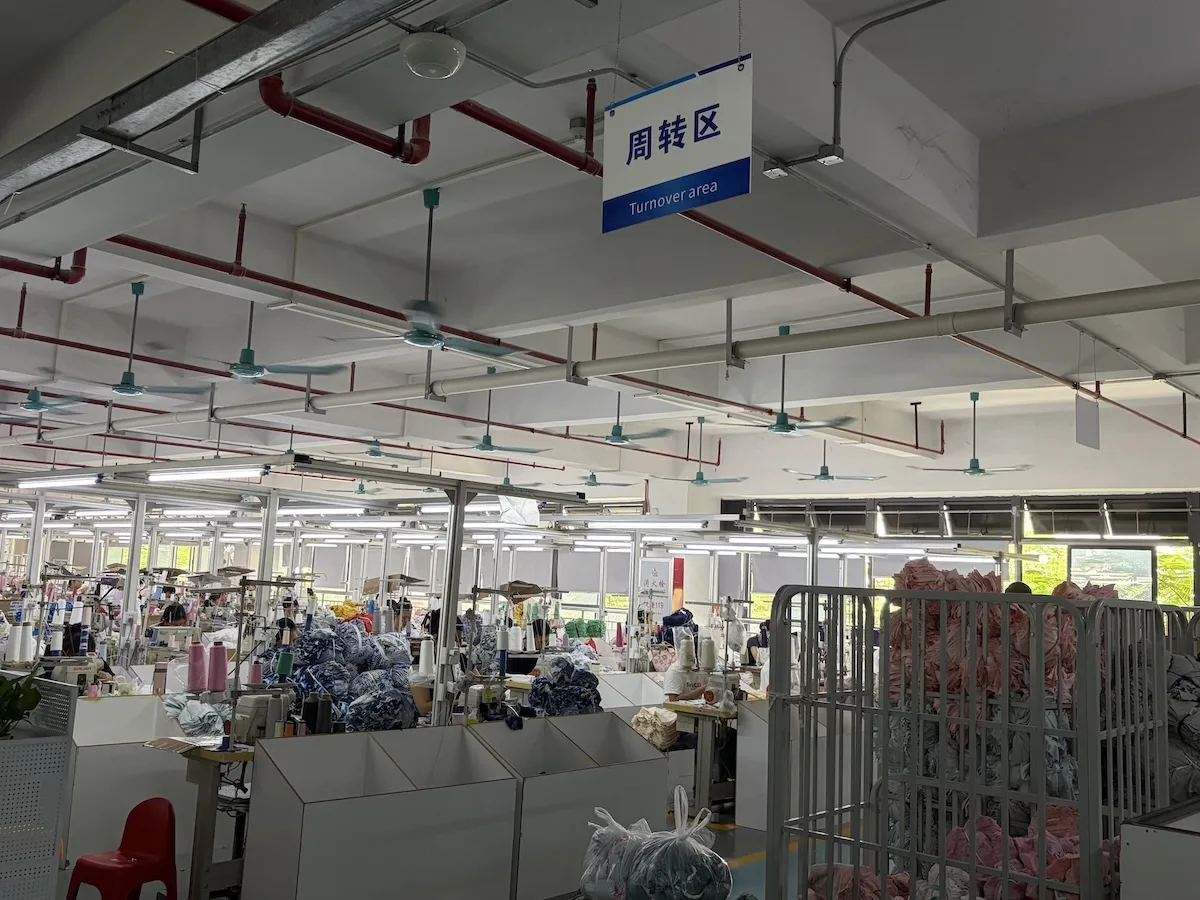
A sub-0.3% defect rate is held by staged prevention (fabric check, in-line audit, finishing trim, AQL, needle detection, packing audit) on a 8,000 sqm, 300+ staff line running about 1,000,000+ pieces per month — not by a single hero inspection. The number is a measured output of process control, stated honestly as a result, not a slogan.
It is fair to be sceptical of any factory that prints a defect number. Ours is a measured, sustained figure across custom kids’ underwear production, and the honest explanation is structural, not heroic:
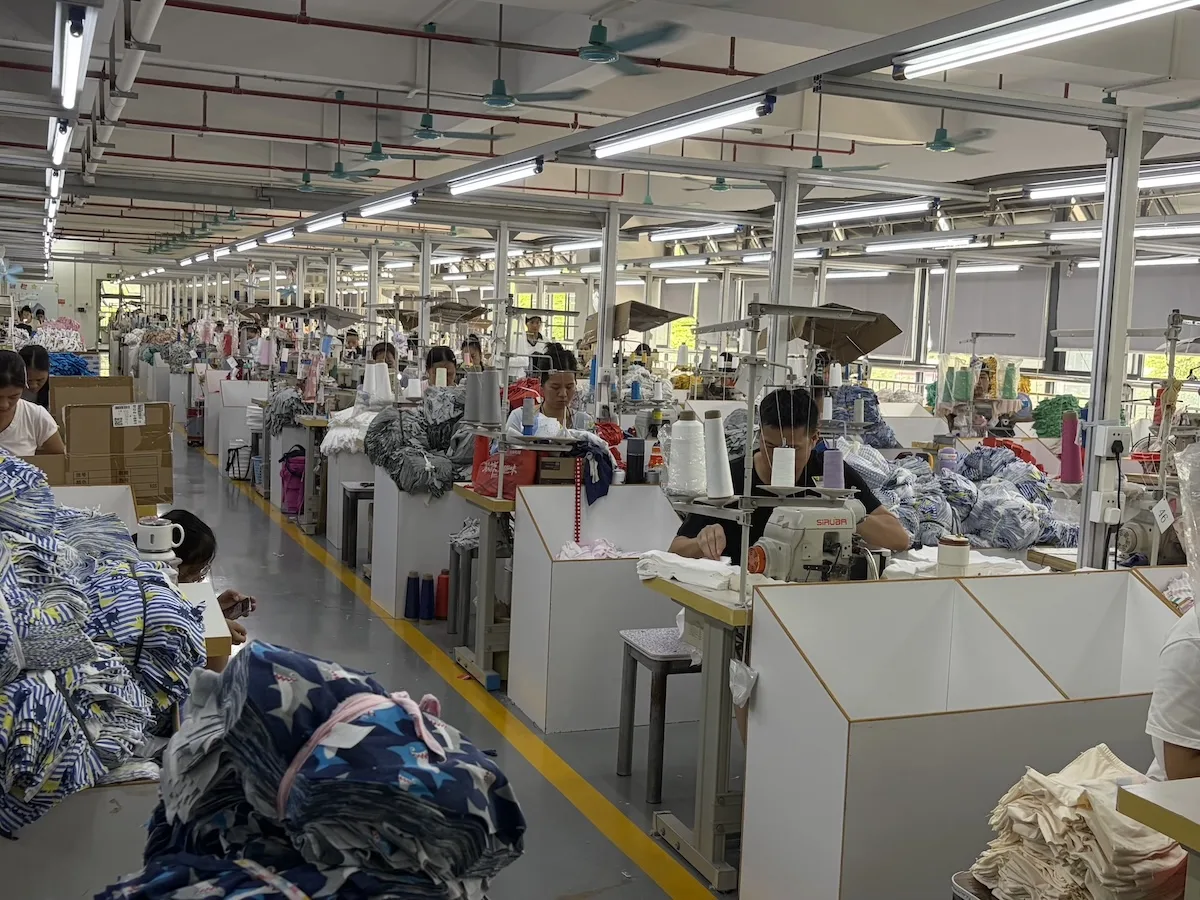
- Scale with discipline. A 8,000 sqm facility with 300+ staff and an INA hanging production system lets us keep pieces moving without pile-ups that hide faults, and lets line leaders audit in real time rather than after a mountain of finished goods forms.
- Prevention before count. Most faults are removed at stages 1–3, so the AQL stage mostly confirms, not rescues.
- Safety is zero-tolerance. Needle detection is non-negotiable; a single alarm stops a lot.
- Compliance is in the BOM. Base fabrics are sourced and tested toward GB 31701 Class A, with third-party testing handled through labs such as SGS, TÜV SÜD, and Intertek. Our OEKO-TEX Standard 100 work is currently in progress — we state that plainly rather than imply a grant we do not yet hold.
For a private-label founder, the practical takeaway is simple: ask for the stage map, the needle policy, and the measured rate — and treat any supplier who cannot show all three as a risk. The defect rate is the easy number to quote; the process behind it is the part worth auditing.
Building a kids’ underwear line and want defects designed out at every stage — including needle detection?