
Fabric Opacity, Density and Colour: What They Really Mean in Kids’ Underwear
Three words come up in almost every sourcing conversation about children’s underwear — opacity, density and colour — and they are usually used as if they all meant the same thing. They do not. Opacity is about whether light passes through the fabric. Density is about how tightly the yarns are packed in the knit. Colour is about the dye, and it quietly controls how much opacity you can actually achieve. Get the first two right and you can forecast the third before a single metre is cut. This guide explains each term from the factory floor, how they interact, and how to write them into a tech pack so the sample and the bulk shipment agree.
On this page
- Why opacity matters more in kidswear than it looks
- Fabric density: the structure behind the hand-feel
- GSM vs density: two numbers, one garment
- How colour changes the opacity equation
- What see-through actually costs a brand
- Specifying opacity, density and colour in a tech pack
- How a factory checks these at bulk
- Putting it together: the 30-second brief
1. Why opacity matters more in kidswear than it looks
Opacity decides whether a garment stays decent, stays durable and stays printable. In children’s underwear and bodysuits it is a comfort and dignity issue, a print-quality issue, and a returns issue — in that order.
Adults rarely think about underwear opacity because most adult underwear is dark or patterned enough to hide what is behind it. Children’s underwear is different: a large share of the market is white, pastel or single-layer, and the garments are short. A pair of white briefs in a light-weight single jersey can be visibly translucent even in normal light, which parents notice immediately and quietly stop buying. The garment is not defective by any construction standard — it just fails the invisible quality bar that the shopper holds in their head.
Opacity also sits behind two technical problems. First, print: an opaque base lets an ink layer sit on the surface of the fabric where it can be seen at full strength; a translucent base lets the skin tone or the fold shadows bleed through the print, which reads as “muddy” even when the colour match is perfect. That link is covered in more depth in our guide to print colourfastness and opacity in bulk kidswear. Second, durability: opacity and density usually rise together, and the denser constructions hold their shape through more washes. In short, opacity is not a nicety — it is the first thing a customer’s eye checks.
2. Fabric density: the structure behind the hand-feel
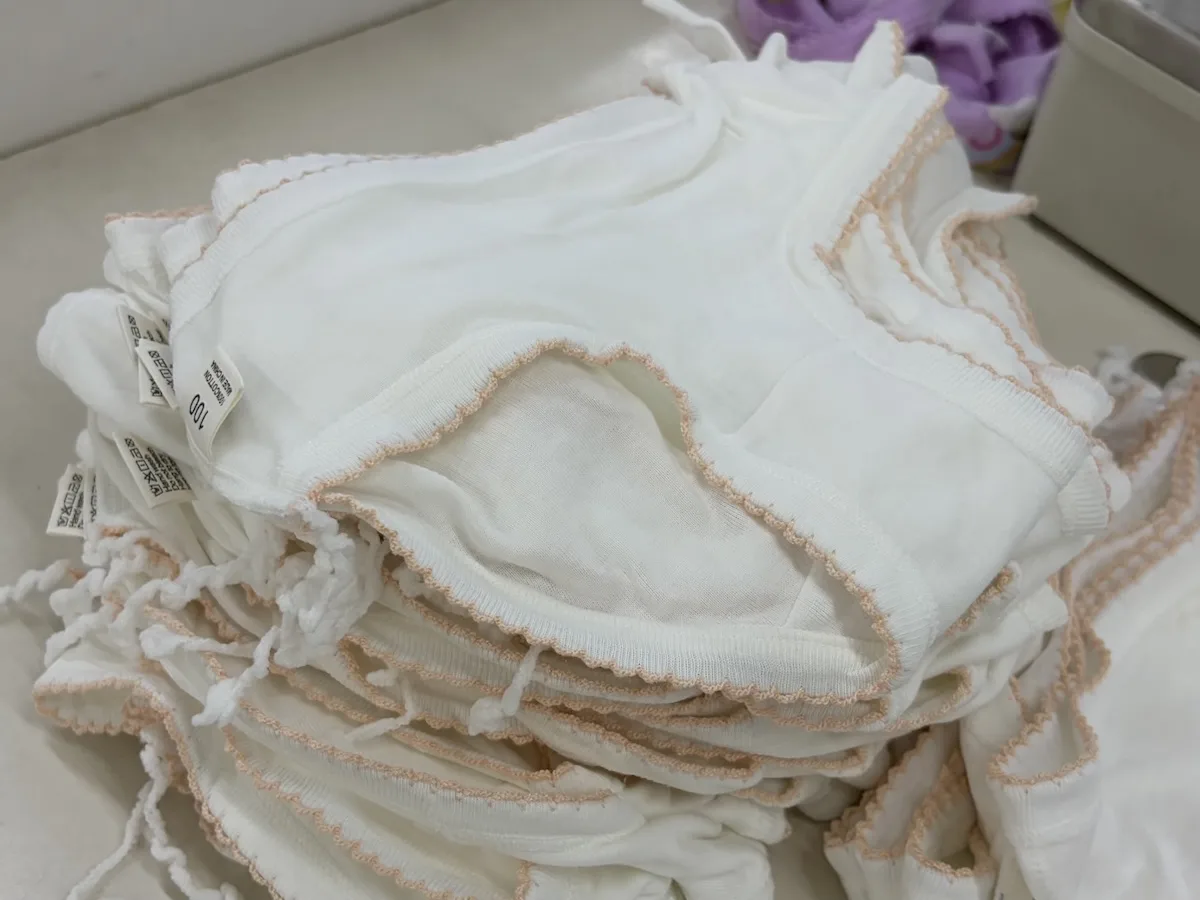
Density is how many yarn loops per unit area a knit contains. Higher density means a closer, firmer, more opaque fabric at the same fibre and the same weight — and it is the dial a factory turns when a buyer asks for “not see-through” on a light colour.
In a knitted fabric, density is expressed two ways: course density (horizontal rows, courses per centimetre) and wale density (vertical columns, wales per centimetre). Multiply the two and you get the loop count per square centimetre — the closest single number to “how tightly the fabric is built”. Two fabrics can share the same GSM yet feel completely different if their densities differ, because density changes how the yarn sits and how much air is trapped between loops.
The knit structure matters as much as the count. Three structures dominate children’s underwear:
- Single jersey — the lightest, most breathable, and the most see-through at low GSM. Fine for summer tees, risky as single-layer white underwear.
- Rib — more elastic, clings closer to the body, used for cuffs and waistbands rather than the body panel of most briefs.
- Interlock — effectively two layers of jersey knitted together face to face. It traps air between the layers, which gives warmth, softness, stretch recovery and markedly better opacity at the same GSM as single jersey.
This is why interlock is the default for children’s underwear bodies: it buys opacity and recovery without adding a second plied-up garment. Our comparison of interlock vs jersey knit for kids’ bodysuits goes into the structural detail, and the kids’ underwear fabric shortlist shows which bases we actually run.
3. GSM vs density: two numbers, one garment
GSM is a weight per area; density is a loop count per area. They correlate but are not the same thing — spec both, or you hand the factory the freedom to hit the weight with a looser, more see-through knit.
GSM (grams per square metre) tells you how heavy the fabric is; it does not tell you how the weight is arranged. A 180 GSM single jersey and a 180 GSM interlock weigh the same but the interlock will be more opaque, warmer and firmer because the same weight is distributed across a denser loop structure. If a tech pack only states GSM, the factory can legitimately meet it with either construction — and the buyer who pictured an opaque garment may receive a translucent one.
| Property | Predicted by GSM? | Predicted by density? | Why it matters |
|---|---|---|---|
| Weight and shipping cost | Yes — direct | Partial | Freight and duty are often weight-based |
| Warmth | Largely | Partly | Trapped air, not just fibre mass, insulates |
| Opacity (see-through risk) | Weak | Strong | Loop closeness blocks light, not weight alone |
| Stretch recovery | Weak | Strong | Tighter loops snap back better after washing |
| Drape and softness | Partial | Partial | Hand-feel is a mix of fibre, structure and finish |
The honest rule we use in the factory: treat GSM as a costing number and density as a construction number, and write both into the spec. If you want a quick mental model of how weight and structure map to comfort, our GSM reading guide for kids’ underwear walks through the ranges we see across real orders.
4. How colour changes the opacity equation
Darker colours absorb more light, so a navy brief at 140 GSM can look more opaque than a white brief at 200 GSM. White and pastel are the hard cases — they need extra density or weight to reach the same coverage.
Opacity is a property of the whole system — fibre, structure, weight and dye — not of the fabric alone. Dye absorbs light across the visible spectrum: a deep colour absorbs most of it regardless of how loosely the fabric is knitted, while a white or very light colour reflects and scatters light, and the small amount that passes between loops becomes visible. In practical terms this means the colour a buyer chooses sets a floor for how much fabric they need to buy.
Three colour-related behaviours are worth knowing before you brief a factory:
- White is the worst case. It needs the densest construction or a heavier GSM of the same construction to hit the same opacity as a mid-tone. This is a real cost difference, not a preference.
- Deep tones forgive loose knits. A dark print or dark solid hides loop gaps — which is convenient, but it means the same base fabric has different “acceptable opacity” per colourway. Acceptance should be set per colour, not per fabric.
- Printing on white needs the white to stay white. If the base is translucent, the print sits over a shadow and the colour reads dull. Print approval therefore depends on opacity; the two should be approved together.
Factory note: in our in-stock kids’ underwear programme, white and pastel colourways are run on the same 220–240 GSM interlock base (91.9% Lenzing™ Modal / 8.1% spandex) precisely so that opacity holds on the lightest shades without a custom fabric. If you want the same construction story, we can share the base spec sheet by email.
Because shade acceptance and opacity interact at bulk, the shade band guide is a natural companion to this article — it explains how much a dye lot is allowed to drift before your eye stops reading it as “the same colour”.
5. What see-through actually costs a brand
Translucency converts into returns, negative reviews and print failures — three costs that appear long after the fabric was cheap enough to feel like a saving.
A fabric that is 15% cheaper per metre but visibly translucent is rarely a saving. Trace the failure chain and the numbers are uncomfortable: a customer buys the pack, finds the garment see-through, returns it — the brand eats return shipping and restocking — then a photo of the fabric reaches a review thread, and the next batch of customers simply does not convert. For a private-label brand with a small catalogue, one “sheer” review can depress the whole line, not just the single SKU.
The same translucency also sabotages print. Ink is laid down to cover; on a translucent base the printer must compensate with extra ink passes, which risks stiffening the print area on a garment meant for a child’s skin. The result is a print that is either too heavy (stiff, crack-prone) or too light (muddy colour). Both outcomes show up in the bulk print quality more often than in the sample, because sample sizes are small and colours are chosen flatteringly.
Costing insight: when we quote a kids’ underwear style, opacity is one of the four inputs behind the number (fibre, GSM, density, print coverage). A request like “white, single-layer, no see-through” is a higher-cost brief than the same garment in a mid-tone — and it is better to know that before the PO than after the first bulk rejection.
6. Specifying opacity, density and colour in a tech pack
Write density as a construction (structure + wales/courses), state GSM, name the colourway, and add one line for opacity expectation per colour — that is enough for a factory to build the right fabric instead of guessing.
Most tech packs fail on opacity by omission: they specify fibre and GSM, and assume the rest. The fix is four short lines:
| Field | Example for a white kids’ brief | Why it is written this way |
|---|---|---|
| Fibre content | 91.9% Lenzing™ Modal, 8.1% spandex | Modal gives softness and recovery; spandex keeps shape |
| Knit structure | Interlock | Two-layer loop structure for opacity at moderate GSM |
| GSM | 220–240 | Weight band, checked against a sealed fabric master |
| Density | e.g. wales ~24/cm, courses ~30/cm (from fabric master) | Locks the loop count so weight cannot be met loosely |
| Colourway + opacity line | White — must not read translucent at single layer | Sets the acceptance bar per colour, not per fabric |
| Opacity check | Single-layer visual check over a standard card, D65 light | Repeats the exact test the factory will run at bulk |
A few cautions. Do not over-specify numbers you cannot verify — a density figure copied from a competitor’s site is worse than none, because the factory will chase a target that may not match the structure. If you have not yet chosen the base, ask the factory to recommend the in-stock construction that meets the opacity bar, then lock the numbers after the first fabric swatch. The swatch, lab-dip and bulk-approval sequence is where these numbers get confirmed, and the private-label kids’ underwear page explains how the brief becomes a sealed master.
7. How a factory checks these at bulk
Opacity and density are checked on the incoming fabric roll before cutting, again on the first finished garments, and in the final inspection — three checkpoints, not one.
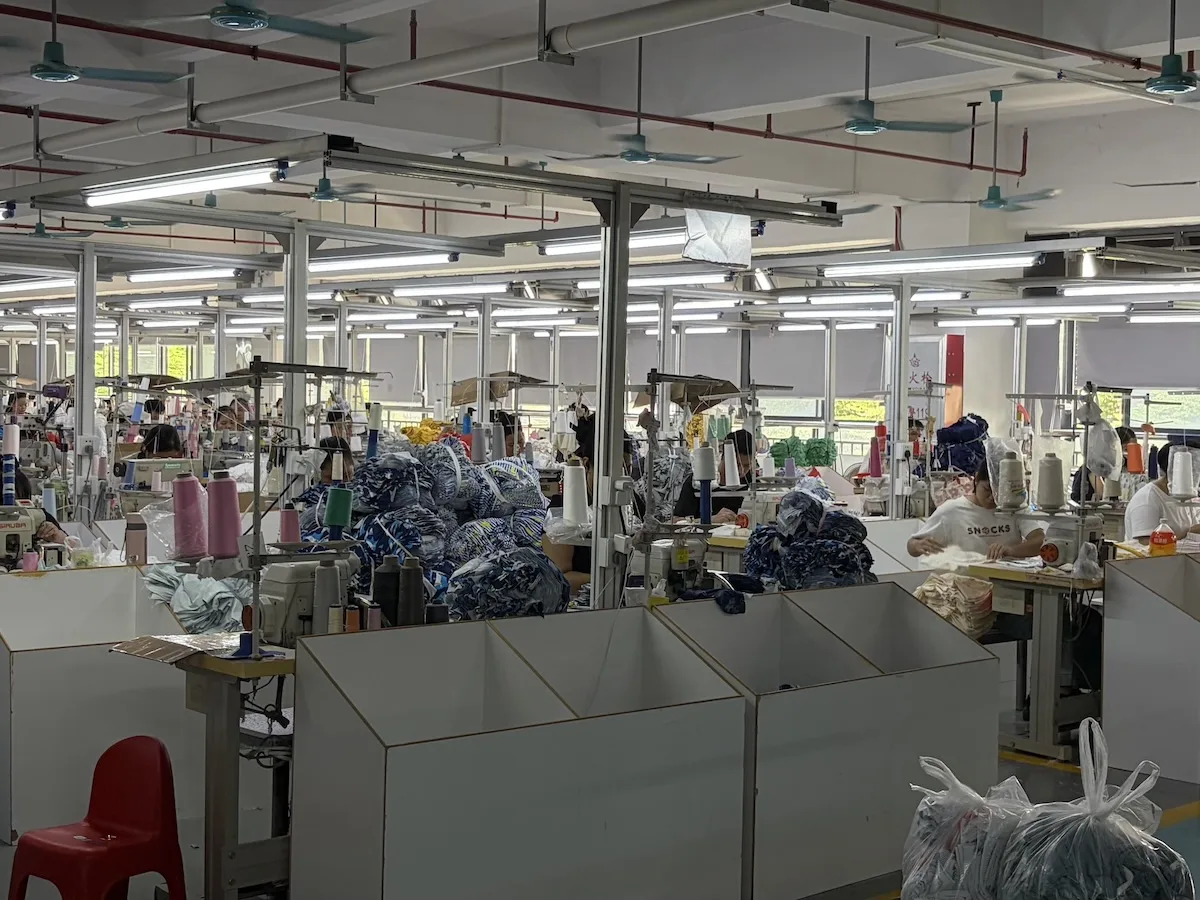
Opacity is not a lab-only measurement; the useful checks happen on the production floor. At Nuohua Garment the sequence looks like this:
- Fabric receiving. Each roll is checked against the sealed fabric master — GSM weighed, density sampled, and a single-layer opacity look over a standard card under a standard light source. Rolls outside the band are flagged before cutting, not after.
- First-pieces check. After the first sewing run, finished garments are held to the light and compared with the approved sample. This catches the case where a fabric passed alone but fails sewn — seams and folds concentrate translucency.
- Final inspection. The six-stage QC flow includes a needle detection pass and a shade-and-opacity pass on the finished goods; any garment that reads differently from the sealed standard is pulled.
If a bulk lot drifts, the factory’s job is to tell you early — which colourways are affected, what the delta is, and whether it can be saved by re-cutting or re-dyeing a portion. That honesty is part of why kids’ underwear manufacturers like ours quote real lead times: the inspection stages are built into the schedule, not bolted on at the end.
8. Putting it together: the 30-second brief
State fibre, structure, GSM, density (from the master), the colourway, and one opacity line per colour — then let the factory confirm against an in-stock base before you commit to custom development.
You do not need to become a textile engineer to brief a factory well. You need four decisions and one question. The decisions: what fibre family (Modal-based for softness and recovery, cotton-blend where a natural hand-feel is the priority), what structure (interlock for underwear bodies), what weight band, and which colourways. The question: which of these can come from an in-stock base with no weaving setup fee, and which require custom fabric development?
That single question is usually the difference between a two-week sample cycle and a six-week one. On our side, the in-stock base for kids’ underwear is a 220–240 GSM interlock — 91.9% Lenzing™ Modal / 8.1% spandex, no cotton — and there is also an in-stock Modal/cotton/spandex blend (49.9% / 43.3% / 6.8%, ~220 GSM) where a natural cotton content matters to the brief. Cotton-only bases and other blends move into the custom development line, which carries its own setup and lead time; the Modal vs cotton comparison helps you decide which family fits the story you want to tell.
| If you see… | Change this first | Cost impact |
|---|---|---|
| White fabric reads translucent at single layer | Move to interlock or raise GSM band | Moderate — structure change, same fibre |
| Mid-tone fabric reads translucent | Check density against the master; suspect looser knit | Low — verify, then re-seal master |
| Print looks muddy over the base | Re-test print on the approved opacity bar, not the sample fabric | Medium — print passes or ink density |
| Bulk lot drifts from the sealed standard | Roll-level receiving checks, quarantine before cutting | Low — caught early, re-cut only affected rolls |
Opacity, density and colour are three levers, and they move together. Nail the construction and the weight, and colour takes care of most of the rest — with white and pastel always the honest exception. If you are starting a kids’ underwear line and want the in-stock base sheet or a sample set to hold against the light, reply by email and we will send the spec and photos over.
Ready to brief your first kids’ underwear style with the right specs?