
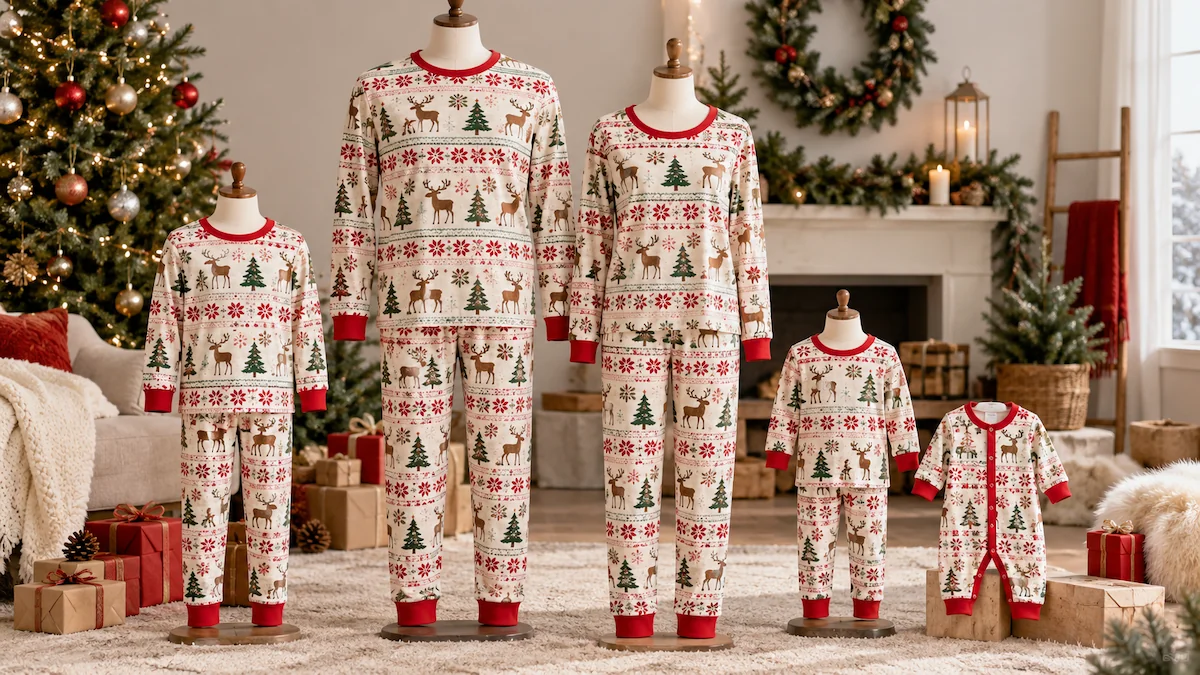
Christmas Family Pajamas Wholesale: A Production Timeline for Brands
Christmas is the one season where a kidswear order fails on calendar, not on price. A family pajama set can be beautifully designed, correctly priced and still miss the selling window entirely — because the print approval took three weeks longer than planned, or because the buyer assumed one compliance path covered every size in the order.
This guide is written for brands, retailers and buying teams planning Christmas family pajamas wholesale programs. It covers the two sourcing routes available, the production timeline you should work backwards from, what “family matching” actually changes in manufacturing, why children’s and adult sizes in the same order follow different US requirements, and what MOQ and packaging decisions look like for a gift-driven season.
On this page
- Why holiday programs miss the window
- Two routes: late-season top-up vs planned program
- The holiday buying calendar: lock each decision by this date
- The Christmas production timeline
- What “family matching” actually changes in manufacturing
- Fabric and construction choices for holiday sets
- Why a family set follows two different requirement paths
- MOQ for holiday programs
- Gift-ready packaging
- Buyer checklist before you approve a holiday order
Quick answer
To land Christmas family pajamas in time, work backwards from the in-market date. Ready-stock programs can ship within weeks and start from 2 pcs on selected in-stock styles, colours and sizes. Custom printing and new development require a longer runway — typically brief and tech pack two to three months before bulk, lab dips and print approvals before that, and a pre-production sample locked before the line starts. Confirm which compliance path applies to children’s sizes and which applies to adult sizes, because family sets contain both. Then lock packaging early, because gift-ready sets need more than a polybag.
Why Holiday Programs Miss the Window
Most late holiday orders are not late because the factory was slow. They are late because three decisions were made in the wrong order:
- Artwork was approved before fabric was confirmed. A print approved on a screen behaves differently on the production fabric — and on stretch knits it can crack, migrate or distort.
- The size set was assumed, not reviewed. Family sets span baby, kids and adult blocks. One approved sample size does not validate the rest of the range.
- Packaging was treated as an afterthought. For gift-driven SKUs, packaging is part of the product. Leaving it to the final week is how December deadlines slip.
The fix is not speed. It is sequencing.
Two Routes: Late-Season Top-Up vs Planned Program
There are only two realistic ways to buy Christmas family pajamas, and the right one depends entirely on how much runway you have left.
Route 01 — Fastest
Ready Stock
Buy existing holiday styles, colours and prints that are already produced or held in stock. No print development, no lab dips, no new pattern work.
- From 2 pcs on selected in-stock styles, colours and sizes
- Dispatch confirmed by current stock position
- Suited to testing a market or topping up a proven SKU
- Private-label branding applied where the route allows
Route 02 — Full Control
Custom OEM / ODM
Develop your own print, colourway, size range and branding. Requires a defined brief, approvals and a production window before the season opens.
- Your artwork, Pantone targets and size specification
- Sampling and pre-production approval before bulk
- Higher control over fabric, fit and gift packaging
- Needs the full timeline below — not a compressed version of it
The Holiday Buying Calendar: Lock Each Decision by This Date
The timeline above reads well in a planning meeting. The version below is the one buyers actually work from, because it is organised by the month a decision has to be locked rather than by how long a process takes.
The dates assume a December selling season in the northern hemisphere. If your market sells holiday sets in November, shift everything forward by a month; if you sell into a January clearance window, you can shift back — but only on the packaging and freight steps, never on print and fit approvals.
| Window | What must already be locked | What it costs you if it slips |
|---|---|---|
| 5–6 months out Jun–Jul | Product brief, size range, target market, fabric direction, artwork intent, and the route decision — ready stock or custom. | Every downstream step is a dependency, so this is the one delay that cannot be recovered later without changing the route. |
| 4–5 months out Aug–Sep | Lab dips and shade bands approved; strike-off approved on the production fabric; print scale confirmed per size block; fabric booked. | Colour and print approval loops are the single most common cause of a late holiday arrival — not slow sewing. |
| 3–4 months out Sep–Oct | Fit samples reviewed across the full size set, with grading checked for baby, kids and adult blocks. | A fit failure found here costs one revision round. Found after cutting, it costs the season. |
| About 3 months out Early Oct | Pre-production sample approved as the bulk reference; labels and gift packaging components ordered. | Packaging has its own lead time. Treating it as a week-one task is how December deadlines slip in November. |
| 2 months out Oct–Nov | Bulk production running against the approved PP sample, with agreed in-line checkpoints and tolerances. | Starting bulk without a signed-off reference pushes every quality question into final inspection, where there is no time left. |
| 1–2 months out Nov | Final inspection, gift packing, carton plan and freight booking confirmed. | Peak-season capacity tightens every week from late October. Freight booked late is often freight that arrives late. |
| Selling season Late Nov–Dec | Sell-through read, and a reorder decision prepared in advance. | Reorders only move quickly when fabric, print and construction were locked repeatably the first time. |
How to read this table: the “window” column is a planning aid for a custom holiday program, not a factory commitment. Confirm the actual schedule against your in-market date, the fabric booking position and the print method you choose — a two-colour placement print and a multi-colour all-over print do not have the same approval load.
The Christmas Production Timeline
Work backwards from the date the product must be live and sellable, not from the date you want to place the order. For a December selling season with a custom program, this is the sequence that holds up in practice:
months
Brief, tech pack and fabric selection
Product category, size range, target market, fabric direction and artwork intent. This is where the compliance path is decided — not after sampling.
months
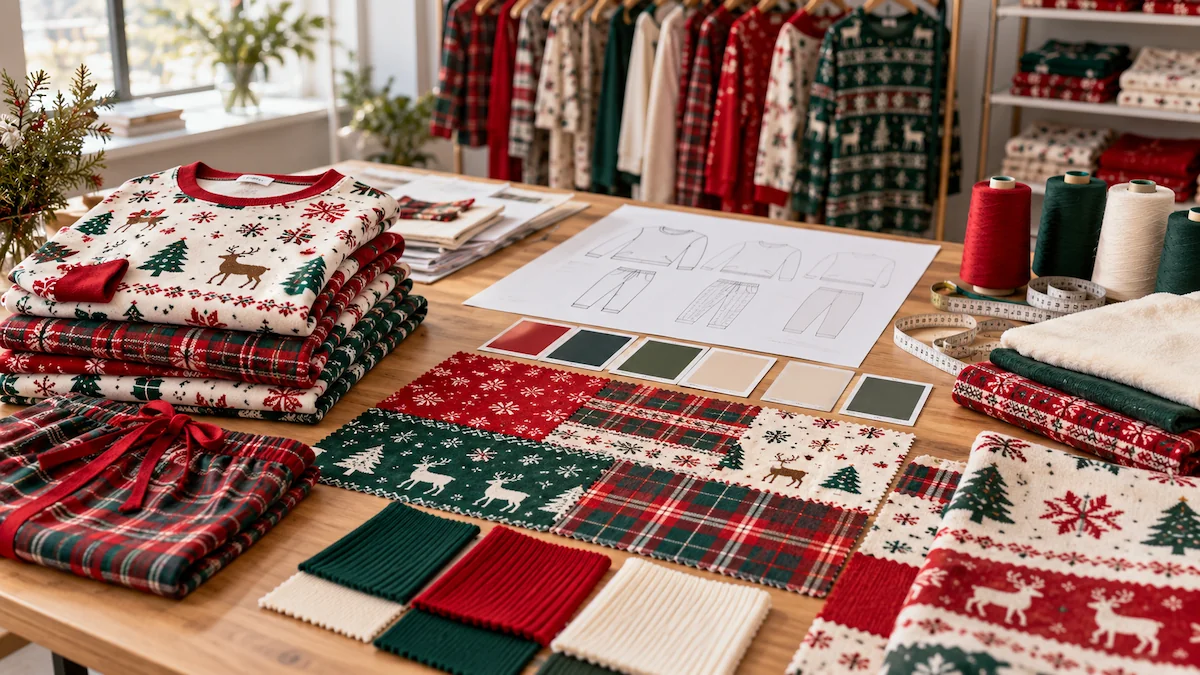
Lab dips, print development and fabric approval
Colour standards approved against shade bands. Print tested on the actual production fabric, not on a substitute.
months
Sampling and fit review across the size set
Review measurements and grading across baby, kids and adult blocks. One sample size is not a size set.
Pre-production sample approval
Fabric, colour, measurements, construction, print, trims, labels and packing all locked. This sample becomes the bulk reference.
Bulk production and in-line quality control
Production runs against the approved PP sample with documented checkpoints and defined tolerances.
months
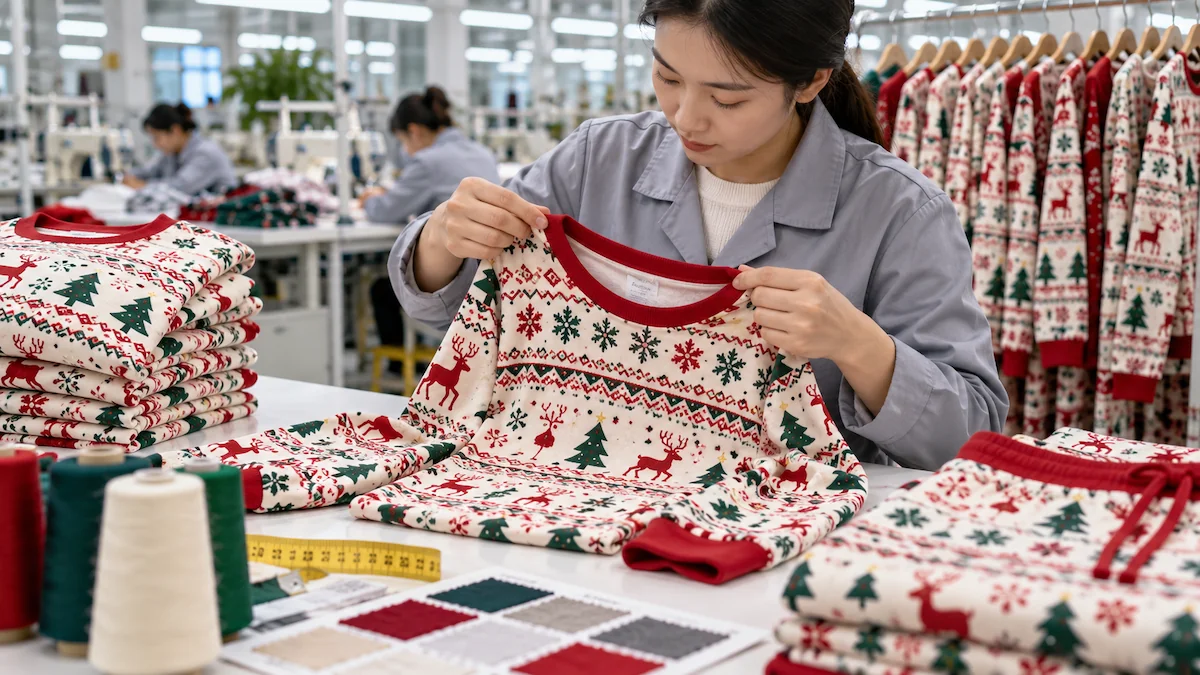
Final inspection, packing and shipment
Finished goods inspection, gift packaging assembly, carton planning and freight booking.
season
In-market and reorder decision
Reorders on approved styles move faster because fabric, print and construction are already locked.
If that runway is already gone, switch routes. Compressing a custom program does not save the season — it produces a rushed approval chain and a late arrival. Ready stock is the honest answer for a late decision.
What “Family Matching” Actually Changes in Manufacturing
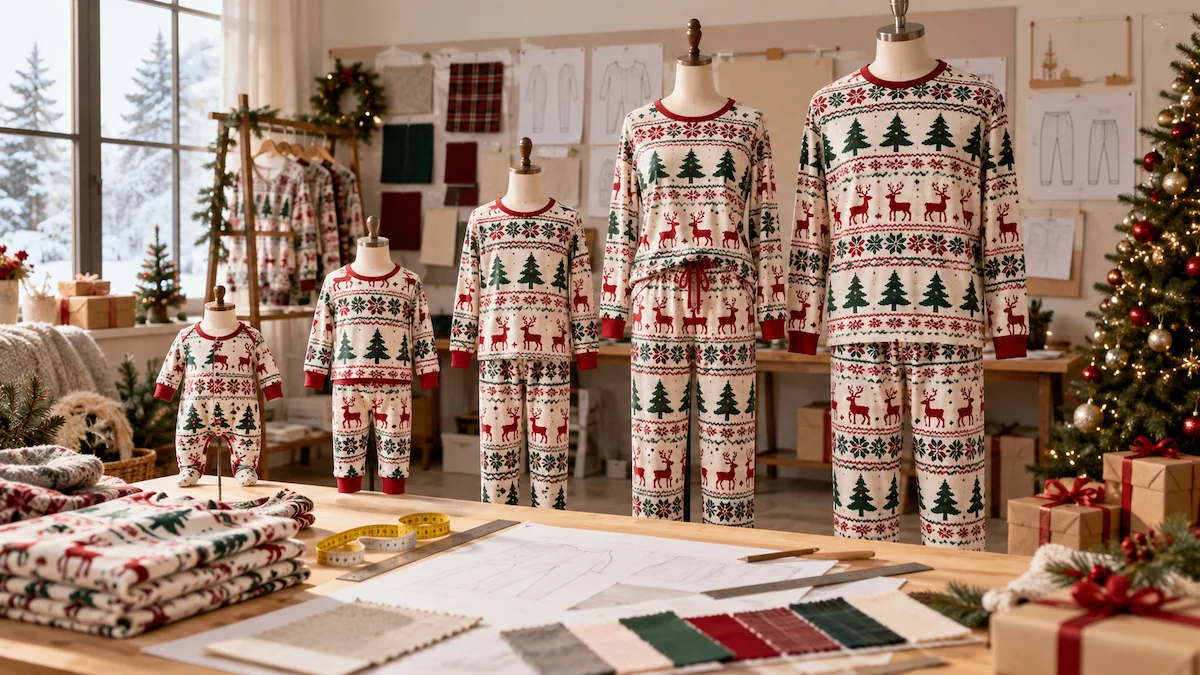
A family set is not a kids product with extra sizes. It is several products that must look like one product. That creates four manufacturing problems that single-category orders do not have:
| Challenge | What it means in production | What buyers should confirm |
|---|---|---|
| Two size systems | Baby and kids blocks are graded differently from adult blocks. Sleeve, rise and body length do not scale at the same ratio. | A full grading spec across every size in the set, not one fit sample. |
| Print scaling | An all-over or placement print must be resized per size block. The same motif on a baby romper and an adult top is two different artwork files. | Print scale confirmed per size range before strike-off. |
| Colour consistency | If baby, kids and adult pieces use different fabric bases, the same Pantone target can read differently across the set. | One colour standard and shade band applied across all bases. |
| Shrinkage alignment | Different knits shrink at different rates. Mixed bases in one set risk mismatched fit after the first wash. | Shrinkage performance confirmed per fabric before bulk cutting. |
Print method changes the risk, not just the price
Holiday sets carry the most artwork of any kidswear category, so the print decision deserves its own review. The method you choose determines how many approval loops sit between you and the line.
| Print method | Where it works well | What to watch on a holiday deadline |
|---|---|---|
| Placement screen print | A bold front or back graphic, one or two seasonal motifs. | Registration and cure on stretch knits, and whether the motif distorts when the garment is worn. |
| All-over screen print | Repeating seasonal patterns across the whole set. | Scale must be re-approved per size block, and each added colour adds an approval and a cost step. |
| Digital print including sublimation where the fabric base allows | Fine detail, many colours, or artwork that would be uneconomic to separate. | Colour behaviour differs between fabric bases, so the same file can read differently on a baby romper and an adult top. |
| Embroidery | Small chest logos, initials, and gift-oriented detail. | Backing adds bulk on small sizes; thread colour has to be matched against the approved shade band, not the screen. |
| Raised / puff print | Textured seasonal graphics on casual sets. | Durability at high-stretch areas, and how the raised surface behaves after repeated washing. |
Fabric and Construction Choices for Holiday Sets
Holiday sets are usually the softest thing a brand sells all year, which is why they are also the category where a fabric decision is most visible to the customer. The question is not which fabric is best — it is which fabric still behaves predictably once it is printed, washed and worn by three different age groups.
| Fabric direction | Works well for | What to watch in a holiday program |
|---|---|---|
| Cotton interlock / jersey mid-weight knit | Classic printed family sets and the everyday pyjama look. | Shrinkage alignment across baby, kids and adult bases — confirm per fabric before cutting, not after washing. |
| Cotton with stretch jersey or rib | Fitted sets, cuffs and neckbands that need to recover their shape. | Print behaviour on a stretch base: a motif that passes on a flat swatch can distort once the garment is worn. |
| Rib knit | Fitted tops, cuffs and trims within a set. | Fine artwork distorts across the ribs. Keep motifs simple if the panel is ribbed. |
| Brushed-back / fleece-family knits including French Terry | Cooler-climate holiday gifting and winter sets. | Packing volume and carton planning; surface texture can soften fine print detail. |
| Modal and viscose blends | Soft-hand premium gifting where feel is the selling point. | Consistency of hand feel and colour across bases, especially when the same shade runs on more than one fabric. |
| Thermal and waffle structures | Cold-climate markets and gift sets positioned on warmth. | Print feasibility on a textured surface, and how the structure reads after washing. |
Construction matters as much as the base cloth. On holiday sets, three details decide whether the product feels premium or simply printed:
- Neckband recovery. A neckline that opens after two wears undermines an otherwise good set — the elastic behaviour of the trim matters more than the fabric of the body.
- Seam comfort. Where a set sits against the skin, flat-felled or covered seams read as a quality signal. Overlocked seams on a sleeping garment do not.
- Label construction. Tagless or soft labels matter more in this category than in daywear, because the garment is worn for eight hours at a time.
Confirm the specification, don’t assume it. Composition, weight and shrinkage performance should be confirmed for your specific fabric and order before sampling — the same fabric name from two mills is not the same product. Where a figure has not been confirmed for your project, confirm it rather than carrying a number over from a previous season.
Why a Family Set Follows Two Different Requirement Paths
This is the part most holiday programs get wrong. A family matching order contains children’s sleepwear and adult sleepwear in the same shipment, and they are not assessed the same way in any major market.
Children’s sizes
Children’s sleepwear sits in a stricter category than general clothing in most major markets. Which path applies depends on the garment’s classification, its fit and construction, and the size range it is sold in — an infant garment, a close-fitting pyjama and a loose nightgown do not necessarily follow the same route.
Adult sizes
Adult sleepwear is not children’s sleepwear. It is generally assessed as general wearing apparel, which means one family design concept can carry two different requirement sets in a single order.
Why this page does not quote clause numbers. The specific standard, its current version and the test method it requires depend on your destination market, the garment’s classification and the size range — and they change over time. Quoting a clause number here without confirming it against your own market and order would be less useful to you than pointing out exactly where to confirm it. Verify the applicable requirements for each SKU with your testing laboratory, importer or compliance specialist before you finalise construction, fit and labelling.
The practical consequence: do not assume one compliance statement covers the whole family set. Confirm the classification, intended use and size range per SKU before you lock the build — that decision belongs in the brief, not in final inspection.
MOQ for Holiday Programs
MOQ depends on product and specifications. For sleepwear programs, the structure generally looks like this:
| Route | MOQ | Notes |
|---|---|---|
| Ready stock | From 2 pcs | On selected in-stock styles, colours and sizes. Availability confirmed by colour and size before ordering. |
| Standard custom sleepwear (existing styles with your print or colour) | Typically from 1,000 sets per design | Final MOQ may depend on fabric, print method, size range and construction. Mixed sizes available. |
| Fully custom development (custom fabric or custom dyeing) | Confirmed per project | MOQ is confirmed after reviewing fabric composition, GSM, yarn count, size range, artwork, print method, construction and other customization requirements. |
Where the money actually moves
Holiday programs are usually negotiated on unit price alone, which is where the leverage is smallest. These are the levers that change the total cost of a season:
| Lever | What drives it | Where the saving is — and isn’t |
|---|---|---|
| Print method and colour count | Number of colours, all-over versus placement, and the print process itself. | A placement print in fewer colours usually costs less per piece than a multi-colour all-over — and needs fewer approval rounds. |
| Number of colourways | Each colour is a separate dye lot with its own setup. | Consolidating colourways for the first season reduces setup cost more reliably than pushing on unit price. |
| Size mix | How evenly the order is distributed across the size range. | A very uneven mix can create cut-plan waste. A realistic size curve is cheaper than a perfect one that doesn’t sell. |
| Gift packaging | Box versus sleeve versus bag, and whether sets pack individually or as one family unit. | This is a real per-unit cost, not an afterthought. Deciding it late is what forces expensive airfreight to protect the date. |
| Order structure | Ready stock versus custom development. | Ready stock removes development cost and risk, but limits your choice of print and colour. That is the trade, not a discount. |
For a first holiday season, the lower-risk structure is usually a ready-stock test followed by a custom program once the winning print and size mix are known.
Gift-Ready Packaging
Christmas pajamas are frequently bought as gifts, which means packaging is part of the product experience. Decide this early — packaging components often have their own lead times.
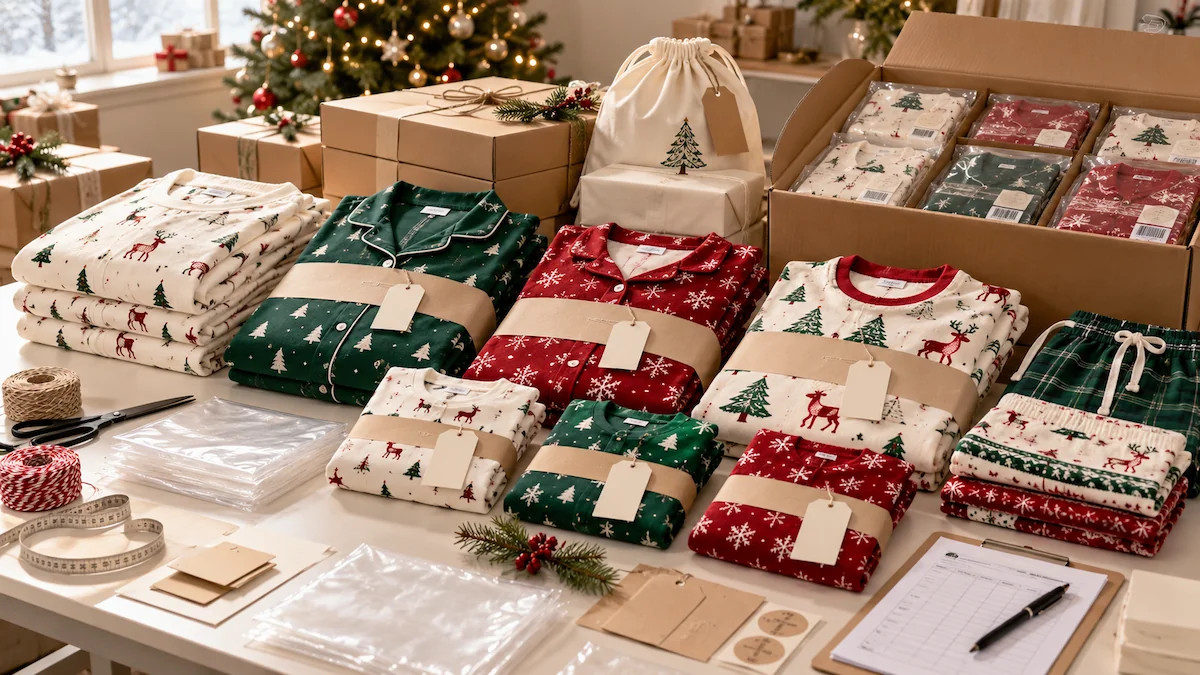
- Individual gift packaging — branded box, sleeve or drawstring bag per set
- Family-set packing — multiple sizes packed and labelled as one gift unit
- Hangtags and inserts — size, care and brand story cards
- Carton planning — how sets are grouped for warehouse or 3PL receiving
- Retail or marketplace readiness — barcodes, polybag and labelling requirements where applicable
Buyer Checklist Before You Approve a Holiday Order
- Target market confirmed, and the applicable requirements identified per size range
- Product classification agreed — sleepwear, loungewear or daywear, because the path differs
- Fabric composition, GSM and shrinkage performance confirmed
- Print tested on the production fabric at the correct scale per size block
- Full size grading reviewed, not a single sample size
- Pre-production sample approved as the bulk reference
- QC tolerances, inspection points and packing specification agreed in advance
- Labelling and traceability information planned before production starts
- Gift packaging components ordered with their own lead time
- Freight mode and delivery window booked against the in-market date
Related Products
Explore Manufacturing Solutions
Ready to Plan Your Holiday Program?
Send your tech pack, reference sample or product brief with your target market, size range, quantity and required in-market date. We will confirm the route that fits your runway — ready stock or custom development — along with MOQ, sampling and production timing.
Regulatory note
This article is provided for general informational purposes and does not constitute legal, regulatory, compliance or product-testing advice. Requirements vary by market, product category, age range, construction, labelling and intended use. This article deliberately does not quote specific standards, clause numbers or numeric limits, because the applicable route depends on your market and order and is subject to change. Before sampling or placing a bulk order, confirm the current requirements, applicable clauses, labelling rules and required test methods for your specific product with your testing laboratory, importer, legal adviser or compliance specialist.
Sourcing note
MOQ ranges, production-route examples, feasibility comments and planning timelines in this article reflect Nuohua’s own production routes and project experience. They are practical sourcing guidance, not industry-wide standards. Final feasibility depends on product category, fabric, trim, construction, testing scope and order structure.