
Most kids’ underwear returns are not about quality — they are about size. A parent buys by age, the child measures two sizes off, and a perfectly good garment comes back as “didn’t fit.” For a brand, that is a margin problem disguised as a customer-service problem. This kids underwear size guide is written from the factory floor, where sizing decisions are made before a single pattern is cut. It covers how to size briefs, boxer briefs and triangle styles by height and waist, how to measure correctly, and how fabric stretch quietly changes everything.
On this page
- Quick answer: how to size kids underwear by height and age
- Briefs vs boxer briefs vs triangle: a style comparison
- Kids underwear size chart by height and waist
- How to measure a child’s waist and hip correctly
- Which underwear style fits each growth stage
- How fabric stretch changes underwear sizing
- Common kids underwear sizing mistakes (and fixes)
- A size chart template for private-label brands
1. Quick Answer: How to Size Kids Underwear by Height and Age
Size kids’ underwear by height first, waist second, and age last. Height is the most stable anchor because a child’s standing height tracks their torso and hip development far better than age does. Waist is the fine-tune: pick the size where the garment’s relaxed waist sits comfortably and its stretched waist covers the child’s actual measurement with room to grow.
Age is the weakest sizing signal in children’s apparel, and underwear is the extreme case. Two six-year-olds can be 108 cm and 126 cm tall, which are two different sizes, while two children of the same height can carry different waist and hip shapes. If your size chart leads with age, you have already introduced the single largest source of fit errors.
The working order we use in our own sample room is simple: start from standing height, map it to a size band (we grade kids’ underwear in 10 cm height steps, from 90 cm up to 160 cm), then confirm against waist. The chart in section 3 follows exactly this logic, with age shown only as a rough reference column — never as the primary selector.
For a manufacturer, this order also changes how you build the size run. If you grade patterns off age, you get inconsistent jumps. If you grade off height, the waist, hip and leg-opening increments stay even, which keeps the whole run consistent and makes reorders predictable. That consistency is what a private-label brand should be asking for.
2. Briefs vs Boxer Briefs vs Triangle: A Style Comparison
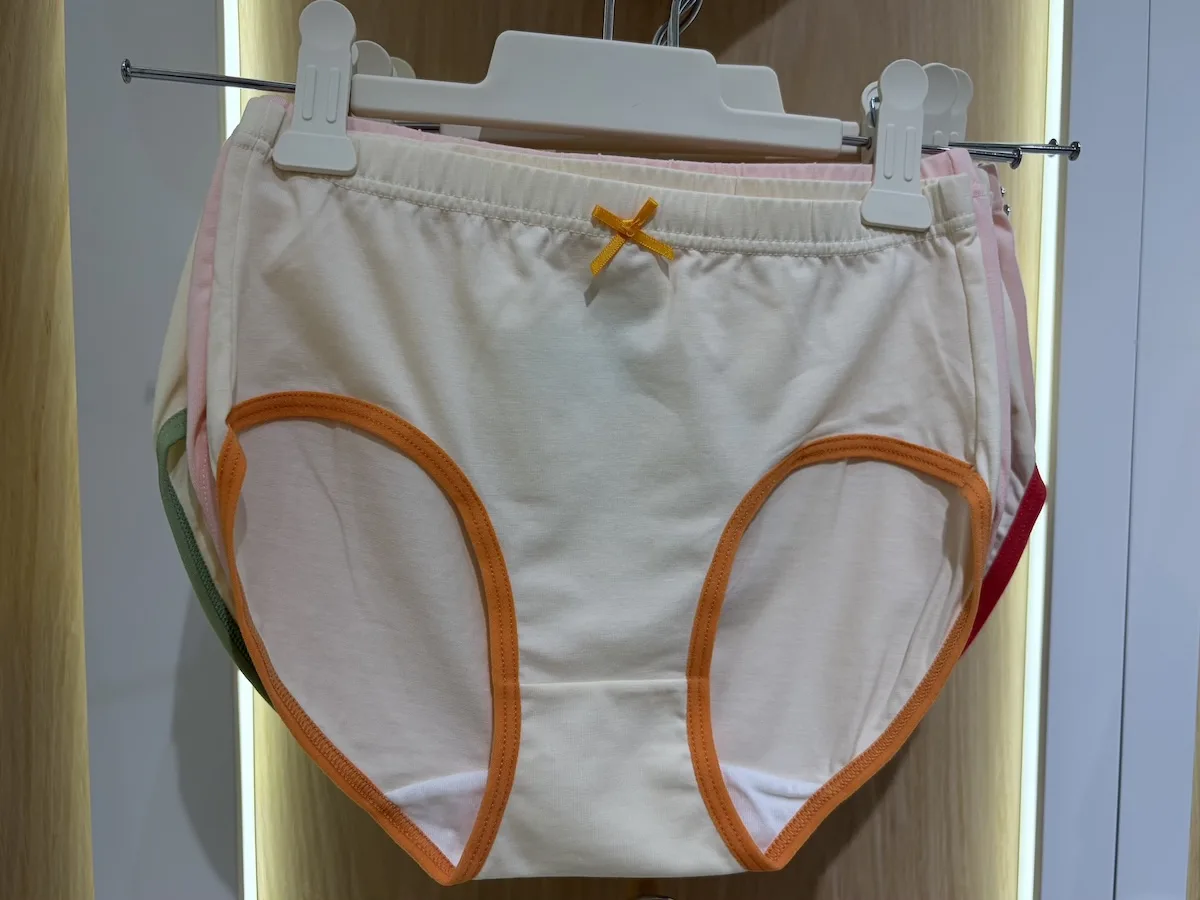
Briefs give full front coverage with a classic cut and suit toddlers through older kids. Boxer briefs add a short leg for thigh coverage and are the most common pick for school-age children and active days. Triangle styles are a minimal, high-cut cut with narrow side panels, mostly chosen for warmer weather and slim fits.
Before you build a size run, you need to know that these three styles do not size the same way, even in the same height band. The differences are in coverage, leg length, and how much ease the pattern carries around the hip. That means a size chart is never one-size-fits-all — a brief, a boxer brief and a triangle in “Size 110” will sit differently on the same child.
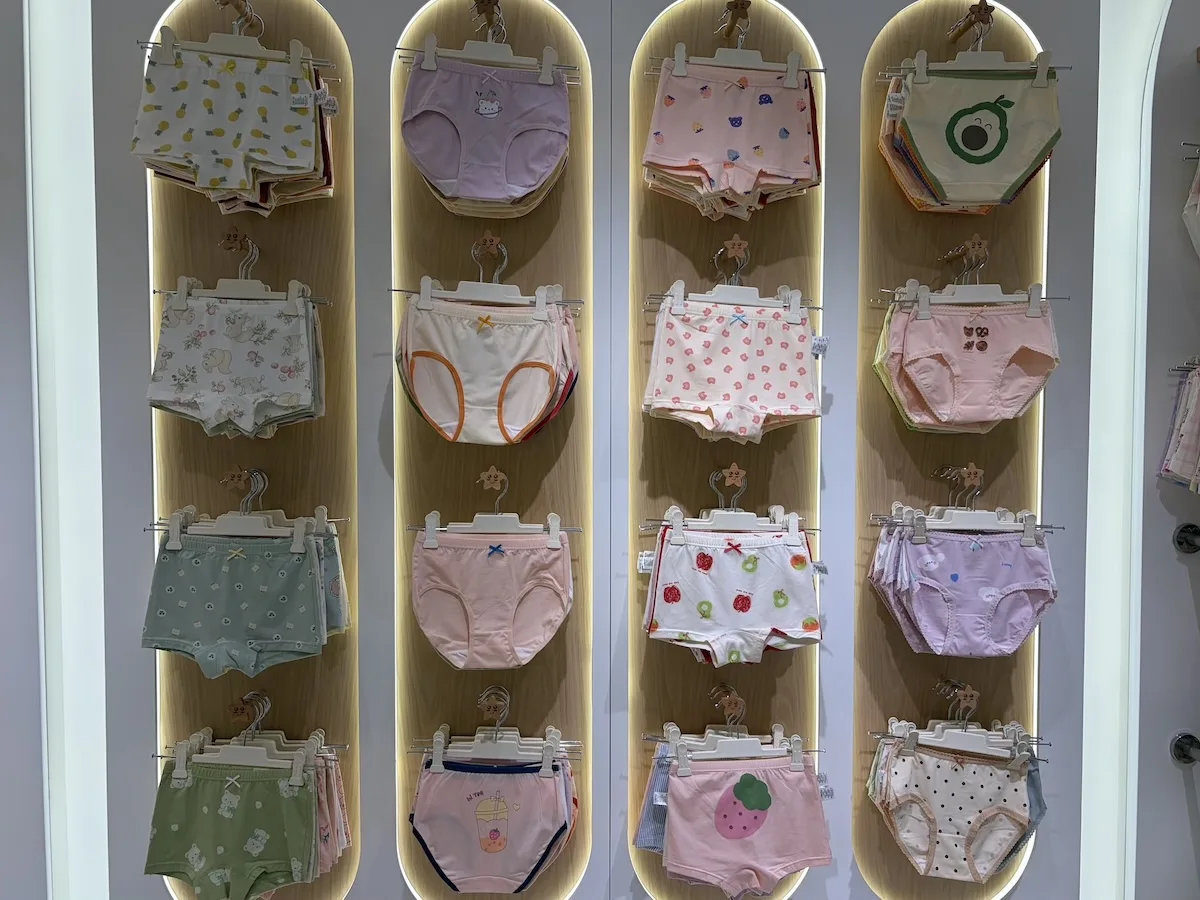
The table below is the comparison we use internally when a brand asks which cut to lead with. Note that “best for” is guidance, not a rule — many brands run all three across the full size range and let the parent decide.
| Feature | Brief | Boxer Brief | Triangle |
|---|---|---|---|
| Front coverage | Full panel, classic cut | Full panel, extended | Full panel, minimal |
| Leg length | None to short | Short leg (3–8 cm) | None, high-cut leg |
| Side panel width | Medium | Wide (shorts-like) | Narrow |
| Hip ease | Moderate | Higher (thigh room) | Lower (slim) |
| Typical age band | 2–14 years | 4–14 years | 2–10 years |
| Best for | Everyday, under dresses | Active days, school, boys’ lines | Warm weather, slim fits |
| Waistband style | Elastic, 2–3 cm | Elastic, 2.5–3.5 cm | Elastic, 2–3 cm |
One detail that matters more than most brands expect: the leg opening. A boxer brief with a too-tight leg hem will leave red marks and get returned; one with too-loose a hem will ride up. The leg elastic needs its own size rule, separate from the waist. We cover this in the construction notes in section 6.
3. Kids Underwear Size Chart by Height and Waist
Use a height-based size chart graded in 10 cm steps (90 cm to 160 cm), with waist as the confirmation measurement. The relaxed waist is the garment measurement at rest; the stretched waist is the maximum the fabric reaches. A child fits when their waist sits between those two numbers.
The chart below is the reference range we build from in our sample room. It is not a universal standard — there is no legally binding global kids’ underwear size standard — but it reflects how stretch-knit underwear is graded in practice. Treat the numbers as a starting point and validate them against your own fit tests before locking a size run.
| Size (height, cm) | Approx age | Waist relaxed (cm) | Waist stretched (cm) | Hip (cm) |
|---|---|---|---|---|
| 90 | 2–3 years | 44 | 60 | 54 |
| 100 | 3–4 years | 46 | 62 | 56 |
| 110 | 4–5 years | 48 | 64 | 60 |
| 120 | 5–6 years | 50 | 68 | 64 |
| 130 | 7–8 years | 52 | 72 | 68 |
| 140 | 9–10 years | 55 | 76 | 72 |
| 150 | 11–12 years | 58 | 80 | 76 |
| 160 | 13–14 years | 62 | 86 | 82 |
Three things to notice in these numbers. First, the waist grades in small steps (2–4 cm per size) while height jumps 10 cm — that is deliberate, because a knit waistband stretches far more than the torso grows. Second, the gap between relaxed and stretched waist is the child’s “fit window.” A 110 cm child with a 52 cm waist fits a Size 110 even though the relaxed waist is 48 cm, because the fabric stretches to 64 cm. Third, the hip number runs larger than the waist, which is normal once a child’s hip begins to develop.
4. How to Measure a Child’s Waist and Hip Correctly
Measure the waist at the natural waistline — the narrowest point above the belly button — and the hip at the widest point across the seat. Keep the tape snug but not tight, and take the measurement over light clothing. For underwear, the hip is the number that decides comfort, so never skip it.
A size chart is only as good as the measurement behind it, and most fit errors start with a badly taken waist measurement. The two most common mistakes are measuring too low (at the hip, where underwear actually sits) and pulling the tape too tight to “get a smaller number.”
Here is the correct sequence we use for fit testing in the sample room:
- Waist: find the natural waistline — the narrowest point of the torso, usually just above the belly button. Wrap the tape around it and let it lie flat against skin, snug enough to stay in place but not indenting.
- Hip: measure around the widest point of the seat, with the child standing with feet together. This is the number that predicts whether a boxer brief binds or a brief digs in.
- Leg (for boxer briefs): measure the thigh at its widest point, then compare it to the leg-opening measurement of the garment. This is the step most brands skip and later regret.
- Rise (for boxer briefs and longer briefs): from the natural waist at the front, down through the crotch, to the natural waist at the back. A rise that is too short is the classic cause of “rides up.”
For a published size chart, keep the parent’s job as short as possible. Waist and hip are enough for briefs and triangle styles; add a thigh measurement only if you sell boxer briefs. Every extra measurement you ask for costs you conversion — a two-measurement chart outsells a four-measurement chart every time.
5. Which Underwear Style Fits Each Growth Stage
Toddlers and young children are easiest in briefs or triangle styles because they change nappies and clothes often and need a forgiving cut. School-age children move into boxer briefs for coverage during activity. Older kids choose by preference and body shape, which is why a brand should offer at least two cuts in the upper sizes.
Growth is not linear, and the right cut changes as a child’s proportions change. The pattern below maps style to stage, but treat it as a default, not a law — a child who prefers briefs at ten should not be forced into boxers because the chart says so.
| Stage | Age | Height | Recommended style | Why |
|---|---|---|---|---|
| Toddler | 2–3 | 90–100 cm | Brief / triangle | Quick changes, forgiving fit, no leg binding |
| Pre-school | 4–5 | 110–120 cm | Brief / boxer brief | Independence in dressing, active play |
| School age | 6–9 | 120–140 cm | Boxer brief | Coverage and comfort through a full school day |
| Pre-teen | 10–12 | 140–150 cm | Boxer brief / brief | Body change, preference-driven choice |
| Teen | 13–14 | 150–160 cm | Boxer brief / brief | Sized near adult small; preference rules |
For a brand planning a first production run, this table has one practical consequence: do not launch with a single cut across all sizes. If you only run boxer briefs, you exclude the toddler range where briefs are easier. If you only run briefs, you miss the school-age demand for coverage. A lean first run usually leads with two cuts and expands later.
One more manufacturer observation: the transition from “parent chooses” to “child chooses” happens around age seven. After that, colour, print and a character a child likes often override fit preference. If your upper sizes underperform, it is usually a style and design problem, not a size problem.
6. How Fabric Stretch Changes Underwear Sizing
Fabric stretch is the hidden variable in any kids underwear size guide. A knit with high stretch and good recovery can be cut smaller in the waist and still fit a wide range, while a low-stretch knit must be cut closer to the true body measurement. The stretch percentage and recovery of your fabric decide how forgiving your size chart can be.
This is the section that separates a chart that works from one that looks right on paper. A size chart assumes a fabric. Change the fabric and you change the fit, even if the numbers stay identical.
Stretch in knit underwear comes mostly from the spandex (elastane) content and the knit structure. A fabric with 5–8% spandex in an interlock construction will stretch 60–100% and, crucially, recover — meaning it snaps back instead of bagging out after a day of wear. A fabric with little or no spandex stretches less and holds its shape less well, so the pattern must carry more ease to compensate.
In practice, this is why our in-stock base — a 91.9% Lenzing™ Modal / 8.1% Spandex interlock at 220–240 GSM — is forgiving on sizing. The high stretch means one size comfortably covers a wider waist range, which reduces the number of SKUs a brand has to carry. A lower-stretch cotton-only base, by contrast, is a custom-development line where each size must be graded tighter to the body, which is one reason cotton-led programs cost more to build and fit.
The takeaway for a brand is simple: fix the fabric before you fix the numbers. If you build your size chart on a high-stretch modal blend and then switch to a low-stretch cotton, the same chart will produce a smaller, tighter fit. Always lock the base fabric first, then grade, then publish.
7. Common Kids Underwear Sizing Mistakes (and How to Fix Them)
The two biggest mistakes are buying too small (parents under-estimate growth) and buying by age instead of height. Both produce the same visible failure: red marks at the waist and leg, and a “didn’t fit” return. The fix is a chart that leads with height and gives a clear waist range.
From the factory side, sizing mistakes fall into a short list, and almost all of them are avoidable. Here are the ones we see most often across private-label programs.
| Mistake | What happens | How to fix it |
|---|---|---|
| Buying too small | Red marks, riding up, returns | Lead with height, show a stretched-waist range |
| Buying by age only | Two same-age kids, wrong fit | Demote age to a reference column |
| Ignoring hip | Boxer briefs bind at the seat | Publish waist and hip |
| Leg opening too tight | Thigh marks after a day | Grade the leg elastic separately from the waist |
| Rise too short | Rides up constantly | Add rise to the pattern, test on a real child |
| Switching fabric mid-program | Same chart, different fit | Lock the base fabric before grading |
| No fit test on kids | Chart looks right, fits wrong | Fit-test on a live sample, not a mannequin |
Two of these deserve more detail. The first is the leg-opening problem, which only appears in boxer briefs and only after wear. The pattern rule is to keep leg elastic at a slightly lower stretch than the waistband, so the leg stays put without pinching. The second is the “no fit test on kids” mistake — an adult trying on a child’s size 110 on a mannequin learns nothing, because kids’ proportions and movement are nothing like an adult form.
For a brand, the most expensive version of these mistakes is the reorder trap: the first order fits fine, the brand switches a fabric or supplier to save cost, the second order fits differently, and reviews tank a product that was doing well. Consistency in the size run is worth more than a few cents per garment.
8. A Kids Underwear Size Chart Template for Private-Label Brands
A defensible size chart has four columns — size (height), waist relaxed, waist stretched, and hip — plus a one-line “how to measure” note and a fit disclaimer. Keep it to two measurements for the customer, publish it on the product page, and version it so reorders stay identical.
Here is a working template you can hand to a manufacturer as part of your brief. It is deliberately simple, because a chart with ten columns does not sell more underwear — it scares the customer off.
- Columns: Size (height, cm) · Waist relaxed (cm) · Waist stretched (cm) · Hip (cm). Add a thigh column only if you sell boxer briefs.
- Age: show it as a reference only, in a separate “approx age” column, never as the primary selector.
- How-to-measure note: one sentence plus a small diagram. “Measure the waist at the natural waistline above the belly button; keep the tape snug.”
- Fit disclaimer: one honest line — “If between sizes, choose the larger size; knit fabric stretches and children grow.”
- Versioning: date the chart and lock it to a fabric. If you change fabric, re-issue the chart, do not silently edit it.
If you are working with a manufacturer like Nuohua Garment, the size chart becomes a shared document: we grade patterns from it, you publish it, and the fit samples confirm or correct it. That loop — chart, sample, fit test, revision, lock — is the whole discipline of sizing, and it should happen before the bulk order, not after the returns start.
Ready to build a size run your customers can actually trust? Send us your target height range and fabric preference, and our team will return a graded size chart and sampling plan.