
Trademark Brand Protection Kidswear US EU is the part of launching an apparel label that most founders postpone until it is already costing them money. They perfect a waistband, a print and a fit, then discover too late that the name they built is already registered in one market, or that a copycat is selling a near-identical product under a confusingly similar name. This guide covers what to register, when to file, and how to defend your name with anti-counterfeiting tactics sized to an independent brand.
On this page
- Trademark brand protection kidswear US EU: what is at risk
- When to register your kids’ clothing brand name
- US trademark registration: classes, filing basis and the CPC
- EU trademark protection: one registration, 27 markets
- Amazon Brand Registry and marketplace protection
- Anti-counterfeiting strategies for a small brand budget
- Working with your OEM/ODM factory on brand protection
- A trademark protection checklist for kidswear founders
1. Trademark Brand Protection Kidswear US EU: What Is Actually at Risk
Trademark brand protection for kidswear in the US and EU means owning the words, names and marks that identify your products, and being able to stop others from using confusingly similar ones. The real risk is rarely the lawsuit you file; it is the lawsuit you cannot file because you never registered, plus the copycat that erodes your listings while you hold no legal tool to stop it.
A trademark is a sign that distinguishes your goods from everyone else’s. For a kidswear label, that sign is usually the brand name, the logo, and sometimes a tagline or a distinctive print that has acquired recognition. In both the United States and the European Union, registration is what converts a name you use into an asset you can enforce.
Kidswear is a disproportionately copied category: the products are small, cheap to replicate and sold in enormous volume. Copycats reverse-engineer a best-selling brief or boxer and relist it under a name one letter away from yours. The brands that survive are the ones that registered early and built the documentation to act fast.
2. When to Register Your Kids’ Clothing Brand Name
Register before you scale — before your first large production run, before you invest in packaging, and before you apply for Amazon Brand Registry. The cost of filing early is small; the cost of rebranding later is not.
The single most expensive mistake in kidswear branding is deferring a trademark search and application because the business is “too early”. The disciplined sequence is: settle the name, run a clearance search in the markets you plan to sell, file the application, and only then spend on packaging, photography and a first production run.
Registering early gives you priority over anyone who files the same or a similar name later, and gives marketplaces a formal basis to act when a copycat appears. A name protected only by common law — used but never registered — is enforceable only in the narrow geography where you can prove actual use, and proving it is slow and expensive.
Practical timing for a sourcing-driven brand: file once your product is validated and before you commit to a large OEM/ODM production run. With a kids’ underwear MOQ of 3,000 to 5,000 pieces per single colour, a rebrand after production is a costly write-off. The trademark application is the cheapest insurance you will buy against that.
3. US Trademark Registration: Classes, Filing Basis and the CPC
In the US you register through the USPTO, and clothing sits in Class 25, with retail and online-store services often added in Class 35. You file either on an “in use” basis or an “intent to use” basis. Separately, every kids’ product sold in the US needs CPSIA compliance and a Children’s Product Certificate (CPC) — that is a product-safety document, not a trademark, but it matters to marketplaces and to brand enforcement.
Class 25 is the international class for clothing, footwear and headgear, and it is where a kidswear brand registers its name and logo for underwear, sleepwear and apparel. If you also run a retail store or sell your own site’s branded goods, Class 35 for retail services is commonly added. The application asks you to describe the goods precisely — children’s underwear, children’s sleepwear and so on — and that description sets the boundary of what your registration protects.
There are two filing bases. “Use in commerce” means you are already selling the goods under the mark in the US; “intent to use” means you have a genuine plan to, and lets you lock in priority before launch. An intent-to-use filing is how a brand that has not yet shipped a single unit still secures the name.
Do not confuse the trademark with the CPC. The Children’s Product Certificate is a document you issue, backed by third-party lab testing, confirming each product meets CPSIA limits for lead, phthalates and other substances. A CPC does not protect your brand; a trademark does not prove product safety. Marketplaces and customs ask for both, and a factory that can produce the testing records that back a CPC — through labs such as SGS, Intertek or TÜV SÜD — makes the whole chain easier.
| Element | What it is | Why it matters for kidswear |
|---|---|---|
| Brand name and logo | The sign that identifies your products | This is the asset you register and defend |
| Class 25 | Clothing, footwear, headgear | Where kids’ underwear and sleepwear are filed |
| Class 35 | Retail and online-store services | Added when you sell through your own store |
| Filing basis | In use, or intent to use | Intent to use lets you lock priority before launch |
| CPC and CPSIA | Product-safety certificate and rules | Required separately for every US-bound kids’ product |
4. EU Trademark Protection: One Registration, 27 Markets
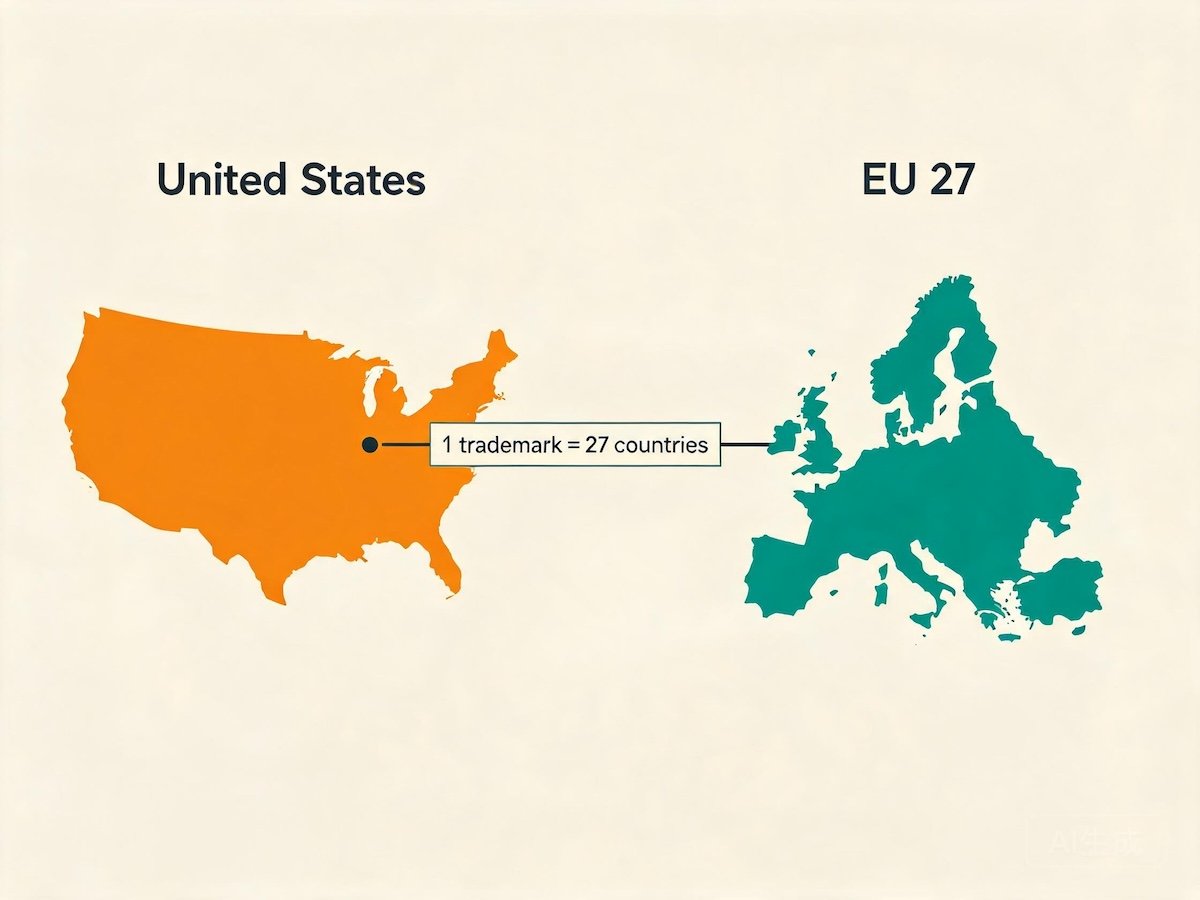
A single EU trademark (EUTM) filed through the EUIPO covers all 27 EU member states for one fee, which makes it the most cost-efficient way for a kidswear brand to protect its name across Europe. After registration you must genuinely use the mark in the EU within five years or it becomes vulnerable to cancellation.
For a small brand, the EU’s single-market trademark system is unusually good value. Instead of filing in Germany, France, Spain and the rest separately, one EUTM application gives you protection across all 27 member states at once. Kidswear brands file in Class 25, exactly as in the US.
Two EU-specific realities are worth knowing. First, use it or lose it: if you do not put the mark to genuine use in the EU within five years of registration, a third party can apply to revoke it. Selling through an EU fulfilment channel, marketplace listing or distributor all count. Second, the EUTM no longer covers the United Kingdom — since the UK left the EU, a UK filing is separate, and brands selling into both should budget for both.
5. Amazon Brand Registry and Marketplace Protection
Amazon Brand Registry requires a registered trademark and, in exchange, gives you listing control, tools to remove infringing offers, and A+ Content. It does not police the whole internet — it polices Amazon — but for a kidswear brand that sells there, it is the highest-return protection step.
Amazon Brand Registry is the tool that converts a trademark into day-to-day marketplace control. Once enrolled, you can report listings that use your mark without permission, and Amazon’s automated tools become more effective at blocking lookalikes. You also unlock A+ Content, a quiet competitive advantage in a category where every listing looks the same.
What Brand Registry does not do is replace the trademark itself. You cannot enroll with a name you merely use; you need an active registered trademark in a country Amazon accepts — which is why so many kidswear sellers file the moment sales justify it.
Beyond Amazon, the same principle applies on every marketplace you sell. eBay, Etsy, Walmart Marketplace and the regional platforms each have reporting mechanisms, and all respond far faster to a seller who can attach a registration number.
6. Anti-Counterfeiting Strategies for a Small Brand Budget
Effective anti-counterfeiting is layered, not expensive. The highest-return layers are a registered trademark, marketplace reporting, proprietary prints, serialized packaging and complete QC documentation. None of these requires a legal department.
A small brand cannot outspend a counterfeiter, but it can out-document one. The strategy is to make copying your product unprofitable, not impossible. Layers to consider, in order of return on effort:
- Register the mark. Everything else in this list is weaker without a registration number to attach to a takedown.
- Own proprietary prints. A custom print is harder to replicate than a solid-colour basic, and a factory with 3,000+ print designs can help you develop a pattern that is distinctive and yours.
- Add a serialized or coded label. A unique code per unit lets marketplaces and customers verify, and lets you trace grey-market leakage.
- Monitor your listings. Set alerts for your brand name and top SKUs, and report infringements promptly.
- Watermark imagery. Your own product photography is routinely stolen; watermarks and distinctive styling reduce reuse.
- Keep QC records. Full six-stage QC documentation, including needle detection, gives you evidence of what an authentic unit is.
| Layer | What it does | Cost and effort | Best for |
|---|---|---|---|
| Trademark registration | Legal basis for takedowns | Medium, one-time | Every brand |
| Proprietary prints | Makes visual copying harder | Low, at development | Print-led brands |
| Serialized packaging | Verifies individual units | Low to medium | Amazon sellers |
| Listing monitoring | Catches infringements early | Low, recurring | Marketplace sellers |
| Watermarked imagery | Reduces asset theft | Low | DTC brands |
7. Working With Your OEM/ODM Factory on Brand Protection
Your factory is both a potential risk point and one of your best defense assets. Use a written agreement that assigns you the pattern, print and label artwork, ask for exclusivity on custom prints, and choose a partner that keeps full QC documentation.
A factory sees your brand at its most vulnerable: your patterns, print files, label artwork and packing specification all pass through its hands. The right OEM/ODM partner treats those as your property; the wrong one treats them as a reference library for the next client. Three clauses separate the two.
- Ownership of development assets. Confirm in writing that patterns, graded size charts, print artwork and label designs you pay to develop belong to you, not to the factory.
- Exclusivity on custom prints. A proprietary print should not appear on another brand’s garment. Ask for exclusivity in the agreement, and keep a dated record of the artwork you supplied.
- Documentation on demand. A factory that runs a six-stage QC process with needle detection and a defect rate under 0.3% is also a factory that can produce the records you need for CPC back-up, marketplace disputes and customs clearance.
Choose a partner whose scale implies stability, not one whose convenience implies risk. Nuohua Garment, established in 2016, runs an 8,000 sqm facility with 300+ staff and a capacity of 1,000,000+ pieces per month — the kind of operation that keeps your assets and records secure, and has a reputation to protect.
8. A Trademark Protection Checklist for Kidswear Founders
Work the checklist in order: settle the name, search it, file in the US and EU (and the UK if you sell there), enroll in Amazon Brand Registry once registered, add one or two anti-counterfeit layers, and keep your documentation current. Protection is a sequence, not a single event.
- Settle and search the name. Confirm the mark is clear in the US, EU and UK before committing to packaging or production.
- File the trademark. US (USPTO, Class 25) and EU (EUIPO, Class 25), using priority where it applies.
- Line up compliance. CPSIA and CPC for the US, with third-party testing through labs such as SGS, Intertek or TÜV SÜD, and GB 31701 Class A for China-produced goods.
- Enroll in Amazon Brand Registry. Once the registration lands, connect it to your listings.
- Add anti-counterfeit layers. Proprietary prints, serialized packaging and watermarked imagery.
- Set up monitoring. Alerts for your brand name and top SKUs.
- Document everything. Patterns, prints, QC reports and testing records in one folder.
Build the brand, then protect it with a production partner that documents everything. Send your brand name, target markets and a short description of your kids’ underwear line to info@nuohuagarment.com or WhatsApp +86 150 1198 5393, and our team will return a compliance and production plan tailored to your brand.