
This guide is part of the Kidswear Brand Building Guide.
Every private-label founder asks the same question before placing a first order: what does a kids clothing brand actually cost to start? The honest answer is that there is no single number — but there is a predictable structure. Fabric, sampling, MOQ, bulk production, packaging and shipping each pull on the budget, and the order in which you lock them in decides whether you launch with a few thousand dollars or several tens of thousands. This breakdown walks through each cost line the way a manufacturer sees it, using Nuohua Garment’s real MOQs and in-stock fabric options, so you can build a kids clothing brand startup cost template of your own instead of guessing.
On this page
- 1. Quick Answer: What It Costs to Start in 2026
- 2. The Seven Cost Lines: Where the Money Goes
- 3. Why MOQ Controls Your Unit Price
- 4. How Much the Sampling Stage Really Costs
- 5. Hidden Costs That Break First Budgets
- 6. A 500-Piece First Order: Worked Budget Example
- 7. How to Cut Startup Cost Without Cutting Quality
- 8. The 12-Week Capital Rhythm for Founders
1. Quick Answer: What It Costs to Start in 2026
A lean kids underwear or sleepwear launch typically needs $3,000–$8,000 for a small first order — one or two styles, a few hundred pieces, plus sampling, testing and freight. A broader multi-style private-label range runs $15,000–$40,000+. The single biggest lever is SKU count × MOQ: every new style and colour multiplies your upfront capital.
When founders ask us for a number, we start with the same two questions we ask every sourcing team. First: how many styles and colours do you actually need for launch? Second: which market are you selling into, because that sets your compliance bill. Those two answers move the total more than anything else on the quote.
A single kids underwear style in three colours is a completely different project from a twelve-SKU capsule across briefs, boxer briefs, triangle styles and sleepwear. The first might cost you a few thousand dollars. The second ties up capital in inventory you have not yet proven you can sell. The pattern we see again and again is founders over-buying variety before they have a single paying customer, then running out of cash for the re-order that actually matters.
For a deeper read on the fabric decisions that sit underneath these numbers, see our guide to shortlisting kids underwear fabric with a manufacturer.
2. The Seven Cost Lines: Where the Money Goes
Every kids clothing brand startup cost can be reduced to seven lines — fabric, sampling, bulk production, SKU count, packaging, logistics and compliance. Fabric and bulk production are the two largest; sampling and compliance are the two that surprise founders most.
Most first-time founders budget off a single FOB unit price and nothing else. That is the mistake that sinks cash-flow plans, because the unit price only covers the goods. Around it sit six other cost lines that each arrive at a different moment in the timeline. Understanding them separately is what lets you move money from the wrong place to the right one.
The table below is the structure we walk new brands through. It is deliberately generic — the percentages are ranges from real kids underwear and sleepwear projects, not exacts.
| Cost line | What it covers | Typical share of a first order | What moves the number |
|---|---|---|---|
| Fabric | Knitted fabric, per piece or per metre | 30–40% | GSM, fiber blend, fabric mill MOQ |
| Sampling & development | Tech pack, lab dips, strike-offs, fit samples | 5–10% | Number of colours, revisions, courier |
| Bulk production (CMT) | Cutting, sewing, finishing labour | 25–35% | Style complexity, order volume |
| SKU count × MOQ | Units you must buy per style and colour | Sets total volume | Number of styles, colours and sizes |
| Packaging & trims | Hang tags, care labels, polybags, cartons | 5–10% | Printed vs sewn-in labels, box spec |
| Logistics & shipping | Freight, customs broker, duties | 10–20% | Air vs sea, destination, Incoterms |
| Compliance & audit | Third-party testing, inspection | 3–8% | Target market, number of test cycles |
Notice that two of these lines — sampling and compliance — are invisible in a unit-price quote. A factory can quote you $1.10 FOB per piece for 500 pieces and still leave you with a testing bill and a sampling bill that are not part of that number. When you compare quotes, ask explicitly what is and is not included, or you will be comparing different baskets.
3. Why MOQ Controls Your Unit Price
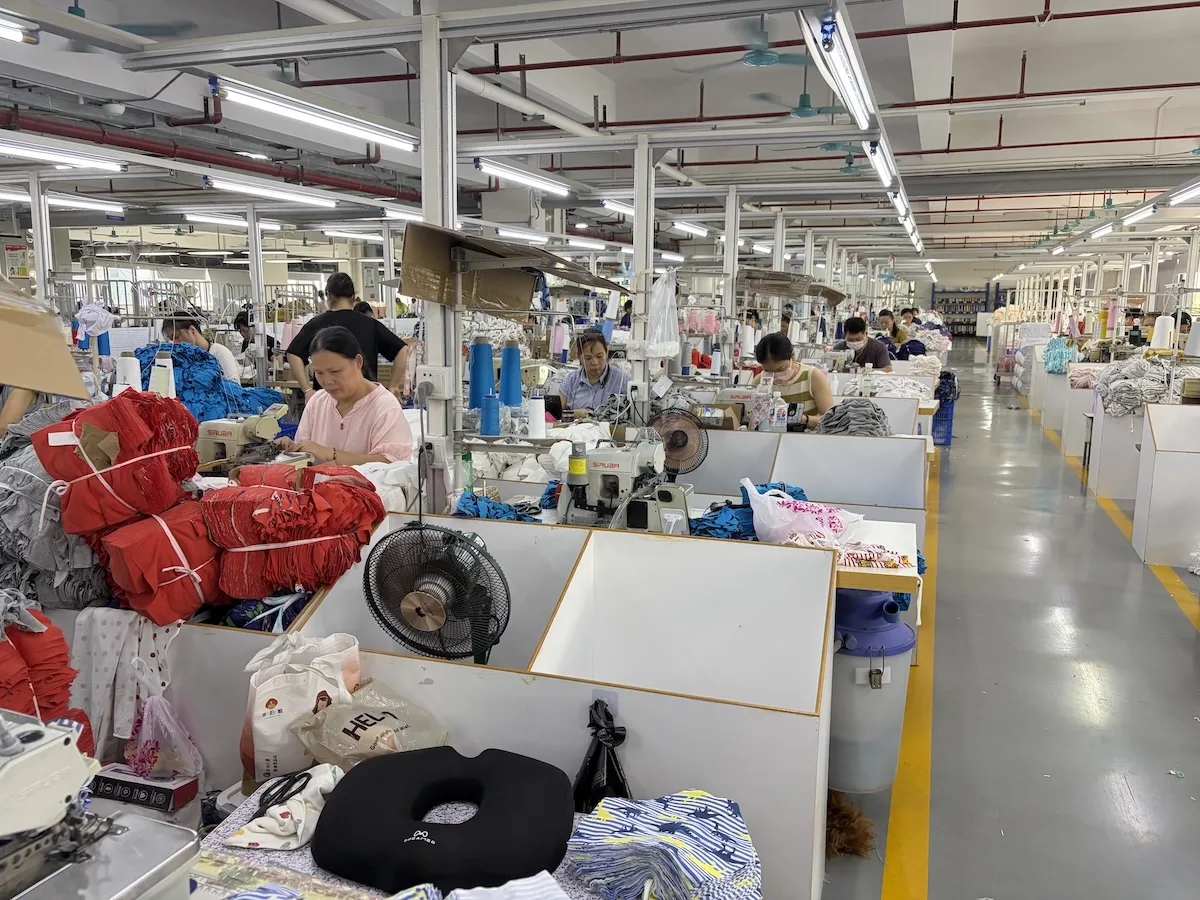
MOQ sets the floor for your order size, and order size sets your unit price. At 2 pcs on selected in-stock styles, colors and sizes you pay noticeably more per piece than at 1,000, because the factory’s fixed costs — setup, cutting, line changeover — are spread over fewer units.
MOQ is not an arbitrary rule a factory invented to be difficult. It exists because a production run has fixed costs that do not shrink when the order does. The cutting team still sets up the lay. The sewing line still changes thread, needles and machine settings. The finishing station still runs the same inspection sequence. Those steps cost roughly the same whether they produce 100 pieces or 1,000, so on a smaller order they are divided across far fewer units.
That is why the same style gets cheaper per piece as volume rises, and why the first thing we advise founders to do is shrink the number of styles and colours rather than negotiate the MOQ itself. Buying 500 pieces across one style and five colours is cheaper per piece than buying 500 pieces across five styles and one colour each — even though the total piece count is identical.
| Order scenario | Total pieces | Relative unit price | Why |
|---|---|---|---|
| 1 style × 1 colour, at MOQ | 2 pcs on selected in-stock styles, colors and sizes | Highest per piece | All fixed setup cost spread over very few units |
| 1 style × 5 colours | 500 pcs | Mid per piece | One setup, five colour runs |
| 1 style × 1 colour, large run | 1,000 pcs | Lowest per piece | Setup, cutting and changeover amortized |
There is a second MOQ you need to keep separate: the one for sleepwear. Kids underwear at Nuohua Garment is 2 pcs on selected in-stock styles, colors and sizes, which is deliberately low so new brands can test the market. Sleepwear and pajama sets are 1,000 sets per design, because a full pyjama set involves more fabric, more trims and a longer finishing sequence. Mixing these two up in a budget is a common and costly error — a “first order” of 1,000 sleepwear sets is a very different capital commitment from 1,000 pieces of underwear.
4. How Much the Sampling Stage Really Costs
A realistic sampling stage for a simple kids underwear style costs $150–$500 all-in — tech pack work, lab dips, a fit sample and courier fees. Many factories refund or deduct part of it against the bulk order, so it is not lost money if you proceed.
Sampling is the cheapest stage of the whole project and the one founders most often under-plan for. It is also the stage that protects you from the most expensive mistake of all: committing thousands of dollars to a bulk order based on a colour or a fit you have never physically held.
The cost breaks into a handful of small items. If you bring a finished tech pack and use an existing factory pattern, the development charge can be close to zero. If you need a new pattern, a new print or several rounds of colour approval, the total climbs. The table below shows the typical items and their usual ranges.
| Sampling item | Typical range (USD) | Notes |
|---|---|---|
| Tech pack & pattern development | $0–$300 | Often $0 if using an existing factory pattern |
| Lab dips (per colour) | $20–$50 | Confirms shade before bulk cutting |
| Print strike-off (per print) | $30–$80 | Only for printed designs |
| Fit / pre-production sample | $100–$200 | One size or a full size set |
| Courier / sample shipping | $30–$80 | Depends on your region |
| Total, simple style | ~$150–$500 | Often partly refunded against bulk |
Ask a factory upfront how sampling charges are handled against a confirmed bulk order. Many — including us — will credit part or all of the sampling cost toward the production invoice once the PO is placed. That changes the maths: sampling becomes a small holding cost rather than a permanent line item. For the full sequence of how a lab dip and strike-off turn into an approved bulk standard, read our guide to swatch, lab dip and bulk approval for kids apparel.
5. Hidden Costs That Break First Budgets
Third-party testing, fit revisions, pre-shipment inspection and import duties are the four hidden costs that push real first orders 10–25% above the quoted FOB unit price. Budget for them as line items, not as surprises.
The unit price a factory quotes you is the cost of making and finishing the garment. It is not the cost of proving it is safe, checking it before it ships, or getting it through customs. Those costs live outside the FOB number, and first-time importers discover them at exactly the wrong moment — when the goods are ready and the money is already committed.
Compliance is the one we want every founder to understand before they sign anything. For children’s apparel sold into China, the relevant safety standard is GB 31701 Class A (China children’s A-class safety standard), which governs the strictest category for infant and toddler clothing. For the US market, a Children’s Product Certificate (CPC) is required, backed by third-party laboratory testing for lead, phthalates and small parts under CPSIA. That testing is performed by independent labs such as SGS, TÜV SÜD or Intertek — they are third-party test bodies, not something a factory “holds” as its own certificate. Separately, OEKO-TEX Standard 100 is currently in progress at our facility; it has not been granted yet, and no honest manufacturer will represent it as an achieved status while it is still pending.
Beyond compliance, three other hidden costs deserve a line in your spreadsheet. Revision costs come from changing a fit, a colour or a print after sampling is approved — each change re-starts part of the process. Pre-shipment inspection (an AQL-based check before release) typically runs a few hundred dollars per inspection day. And import duties and customs brokerage are destination-side costs that air-freight and sea-freight quotes often exclude until the goods arrive.
| Hidden cost | Typical range (USD) | When it hits |
|---|---|---|
| Third-party testing (CPC via SGS / TÜV SÜD / Intertek) | $200–$500 per cycle | Before US export / customs |
| Fit or colour revision after approval | $100–$400 per change | During sampling or pre-production |
| Pre-shipment inspection (AQL) | $200–$350 per day | Before balance payment |
| Customs broker & import duties | Varies by destination | At arrival |
6. A 500-Piece First Order: Worked Budget Example
A single kids underwear style in five colours (2 pcs on selected in-stock styles, colors and sizes per colour, 500 pieces total) typically lands around $1,300–$2,900 for production plus shipping. Marketing, website and working capital sit on top of that, which is why the full launch range is higher.
Let us put the structure to work with a concrete example. Imagine a founder launching with one kids underwear style — a brief, in a soft modal-blend fabric from stock — in five colours, 2 pcs on selected in-stock styles, colors and sizes per colour. That is a 500-piece first order that respects the ready-stock minimum of 2 pcs, keeps the fixed setup cost on a single style, and still gives the founder enough colour variety to test the market.
The table below is the production-and-shipping slice of that launch. It deliberately excludes website, photography, samples for influencers and the working capital you hold for a re-order, because those vary too widely to be useful in a generic table. Add them on top when you build your own plan.
| Line item | Basis | Indicative cost (USD) |
|---|---|---|
| Bulk goods, FOB (fabric + CMT + trims + packaging) | 500 pcs @ $0.90–$1.30 | $450–$650 |
| Sampling & development | 1 style, 5 colours | $150–$500 |
| Third-party testing (CPC) | 1 cycle | $200–$500 |
| Pre-shipment inspection (AQL) | 1 day | $200–$350 |
| Freight, customs broker, duties | 1 shipment | $300–$900 |
| Total, production + shipping | ~$1,300–$2,900 |
This is why the full-launch figure in section one is higher than the table total: a real brand also needs a Shopify store, product photography, packaging design, a few hundred dollars for paid testing of the first batch, and enough cash to place the second order before the first has fully sold through. The production slice is the part you can control precisely; the rest is where founders usually overspend.
7. How to Cut Startup Cost Without Cutting Quality
The three fastest ways to lower a kids clothing brand startup cost are using in-stock fabric with no setup fee, launching with fewer SKUs, and combining colours or styles into one order. None of these require sacrificing safety or fabric quality.
Cutting cost in children’s apparel is never about finding a cheaper, thinner fabric or skipping a safety step. It is about removing the friction that drives cost up without adding any value: custom fabric minimums, development fees, and over-diversified SKU lists. The savings below are structural, which means they survive the first order and keep paying off on every re-order.
The biggest single lever is in-stock fabric. Developing a custom fabric means paying the mill’s minimum, waiting for a dedicated run, and often absorbing a setup fee before a single garment is cut. Using fabric the factory already holds in stock removes that fee and that wait entirely. At Nuohua Garment, two kidswear fabrics are kept in stock with no setup fee: a 91.9% Lenzing™ Modal + 8.1% Spandex interlock at 220–240 GSM (no cotton), and a 49.9% Lenzing™ Modal + 43.3% Cotton + 6.8% Spandex interlock at around 220 GSM. Cotton-only or other cotton blends are available, but they run through our custom fabric development line rather than stock.
Reducing the number of styles does more for your budget than negotiating a few cents off the unit price. Five styles at 100 pieces each spreads five setups, five patterns and five sets of labels across the same 500 pieces. One style in five colours spreads one setup across five colour runs. The total piece count is identical; the per-piece cost is not. The same logic applies to choosing printed versus sewn-in care labels and deciding how many size runs you really need at launch — read our comparison of printed vs sewn-in labels for kids clothing if label cost matters to your margin.
8. The 12-Week Capital Rhythm for Founders
Plan your cash around a 12-week rhythm: weeks 1–2 sampling deposit, weeks 3–5 approval, week 6 bulk deposit, weeks 7–10 production, week 11 balance and inspection, week 12 shipping. Deposits are staged, not all paid upfront.
One of the most useful things a founder can do is stop thinking of the startup cost as a single lump sum and start thinking of it as a schedule of smaller payments. Factories stage payments for a reason: the deposit funds materials and commits the production slot, while the balance is due when the goods pass inspection and are ready to release. Understanding that rhythm lets you plan cash flow instead of scrambling.
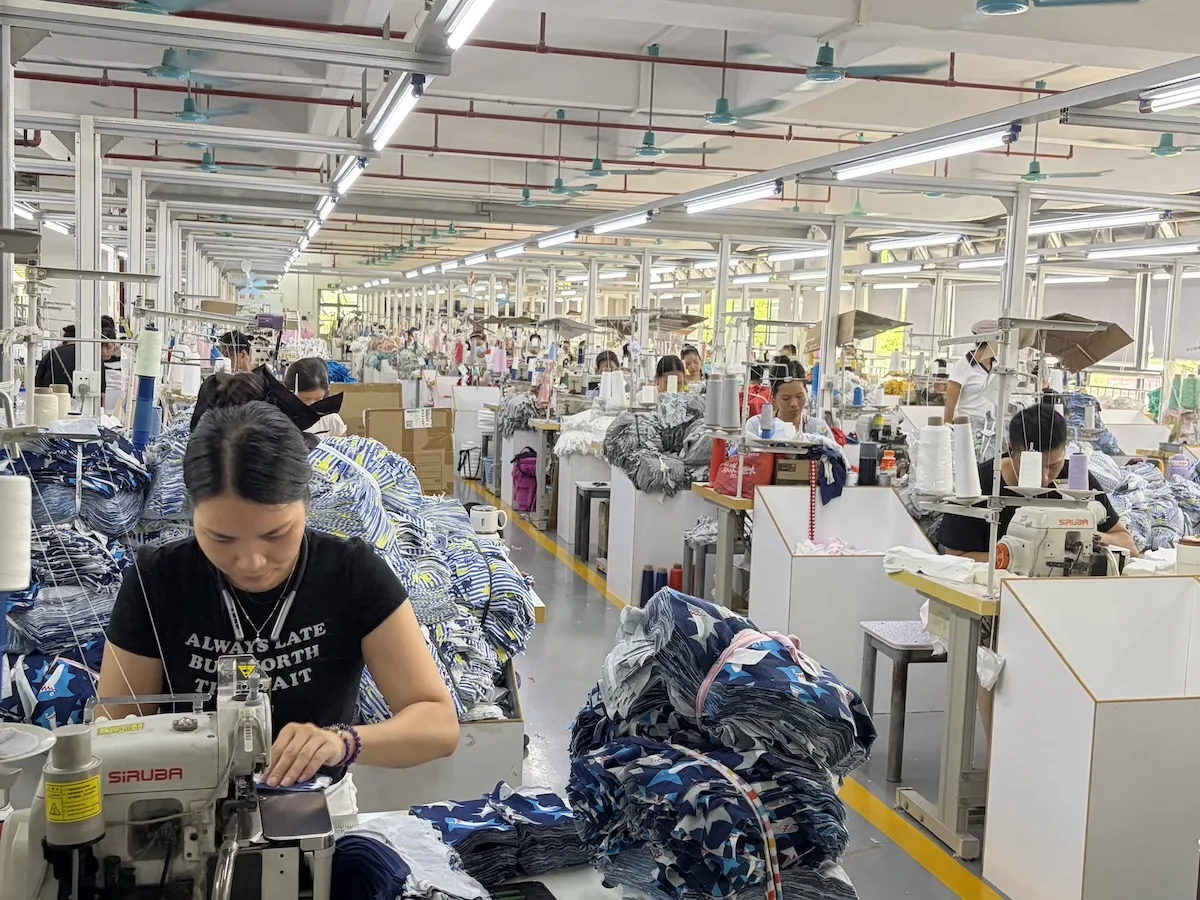
The timeline below is based on our own production lead time for kids underwear — roughly 30 days for bulk production, plus or minus five days, after sampling is approved. Sleepwear runs longer because of the additional finishing steps. Use it as a skeleton and adjust for your own market and shipping method.
| Weeks | What happens | Money moving |
|---|---|---|
| 1–2 | Confirm tech pack, colours, place sampling order | Small sampling deposit |
| 3–5 | Lab dips, fit samples, approval; prepare GB 31701 Class A / CPC | Sampling balance; book third-party testing |
| 6 | Approve bulk, sign PO, pay deposit | 30% bulk deposit (typical) |
| 7–10 | Bulk production (30±5 days), inline QC | — |
| 11 | Pre-shipment inspection, pay balance | 70% balance before release |
| 12 | Ship, customs clearance, receive | Freight, duties, broker |
The reason we spell this out is that most budget failures are not “the order cost too much” — they are “the payments arrived faster than the sales did.” Staging your capital against this rhythm, keeping a reserve for freight and duties at the end, and holding back working capital for the re-order is the difference between a launch that survives its first season and one that runs dry at week ten.
Want a real quotation built around your style count, fabric choice and target market?