
Low MOQ Kids Underwear Manufacturing: how 2 pcs on selected in-stock styles, colors and sizes works
This guide is part of the Kids Underwear & Sleepwear Sourcing Guide.
Launching a kids’ underwear brand is exciting — but the traditional manufacturing model asks you to bet thousands of dollars and thousands of units on a product you have never sold. For a new brand, that single order can be the difference between a confident market entry and a warehouse of dead stock. Low minimum order quantity (MOQ) changes that math entirely. In this guide we explain what low MOQ means for a children’s underwear brand, how Nuohua’s standard program of 2 pcs on selected in-stock styles, colors and sizes de-risks launching and testing, what low MOQ can and cannot do, and how to use it as a deliberate growth strategy rather than a one-off tactic.
What “Low MOQ” Actually Means in Kids’ Underwear Manufacturing
Minimum order quantity, defined
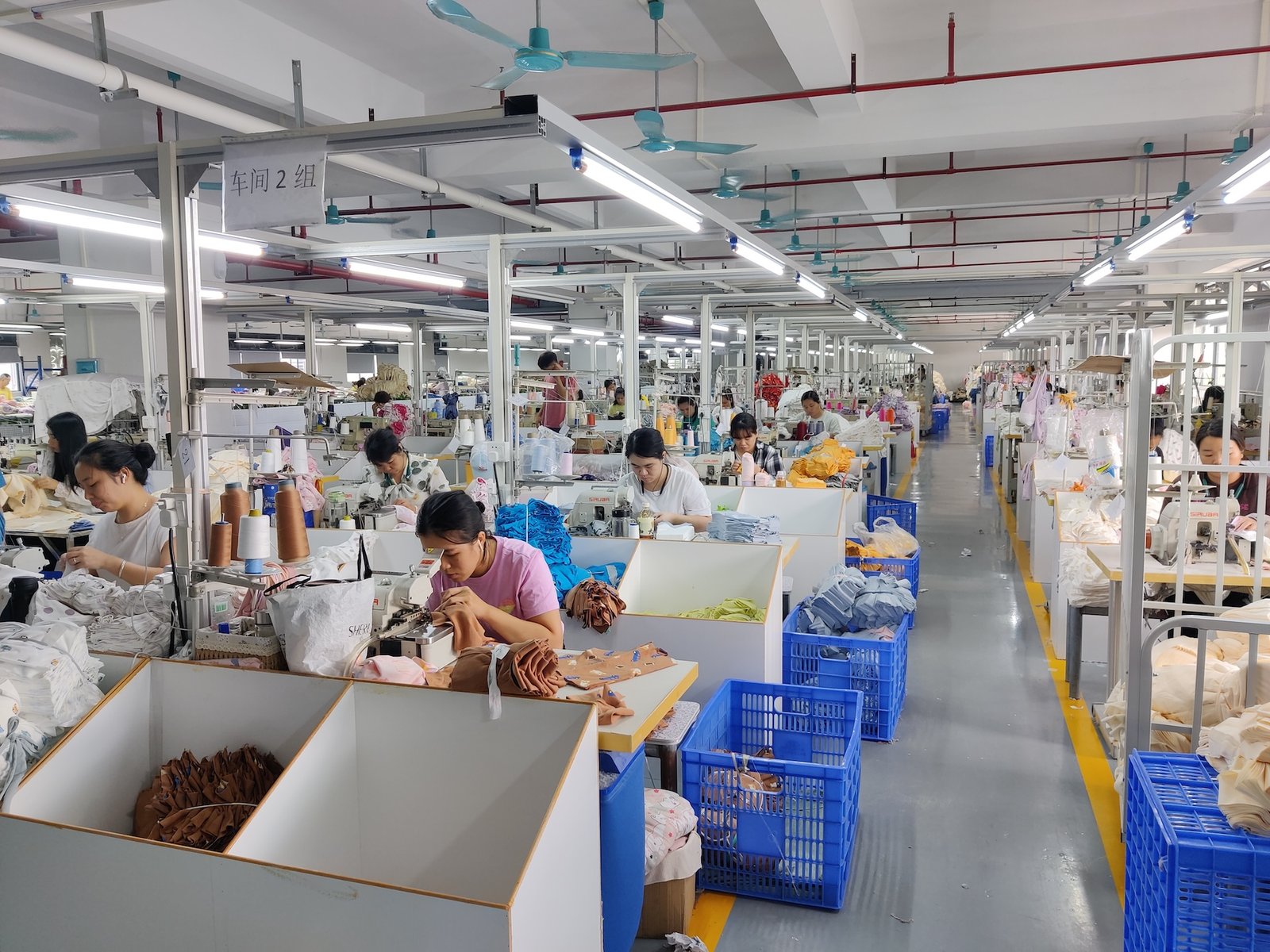
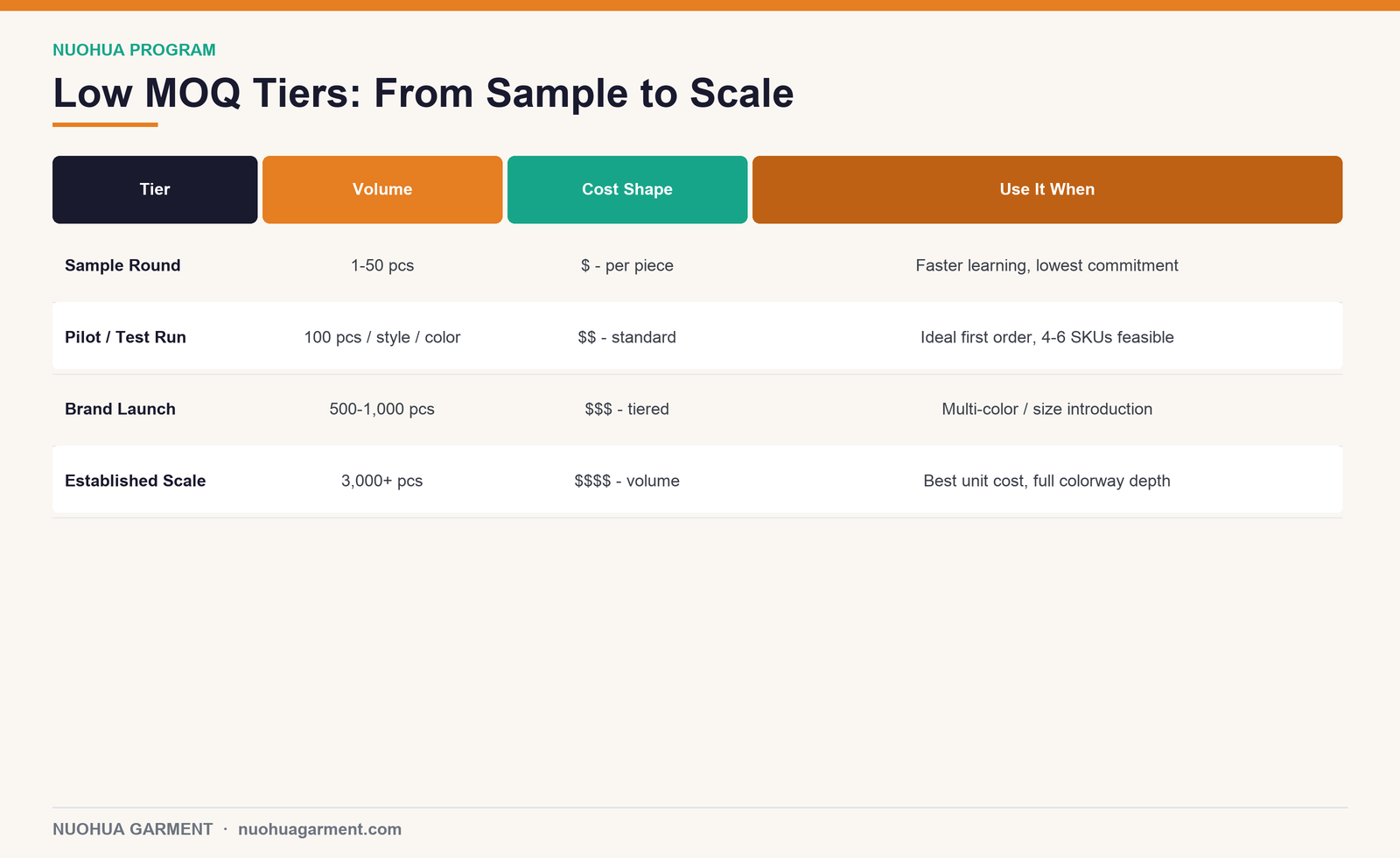
Minimum order quantity (MOQ) is the smallest number of units a factory will produce in a single production run for a given item. Most large-scale knitting and sewing mills set MOQs in the range of 500 to 3,000 pieces per style — sometimes higher for custom-milled fabrics. A “low MOQ” program, by contrast, brings that floor down dramatically, allowing a brand to place a credible first order without committing to a full container.
Why kids’ underwear behaves differently from adult apparel
Children’s underwear is a special case. It is skin-contact apparel for a population with sensitive skin, and it spans a wide size curve (infant, toddler, little-kid, big-kid) that adult basics do not. A brand cannot simply order one size and call it done. You need a size run, and you need fiber choices that hold up to frequent washing and parental scrutiny. That makes the MOQ floor especially painful — until low MOQ removes it.
When you compare custom vs off-the-shelf kids’ underwear manufacturing, the MOQ is usually the first dividing line. Off-the-shelf stock lets you buy a few dozen units but locks you into someone else’s label and spec. Custom manufacturing gives you your own brand, your own fabric, and your own fit — and with a low MOQ program, it finally becomes accessible at boutique volumes.
Nuohua’s 2 pcs on selected in-stock styles, colors and sizes / Style / Color Program
What 2 pcs on selected in-stock styles, colors and sizes actually unlocks
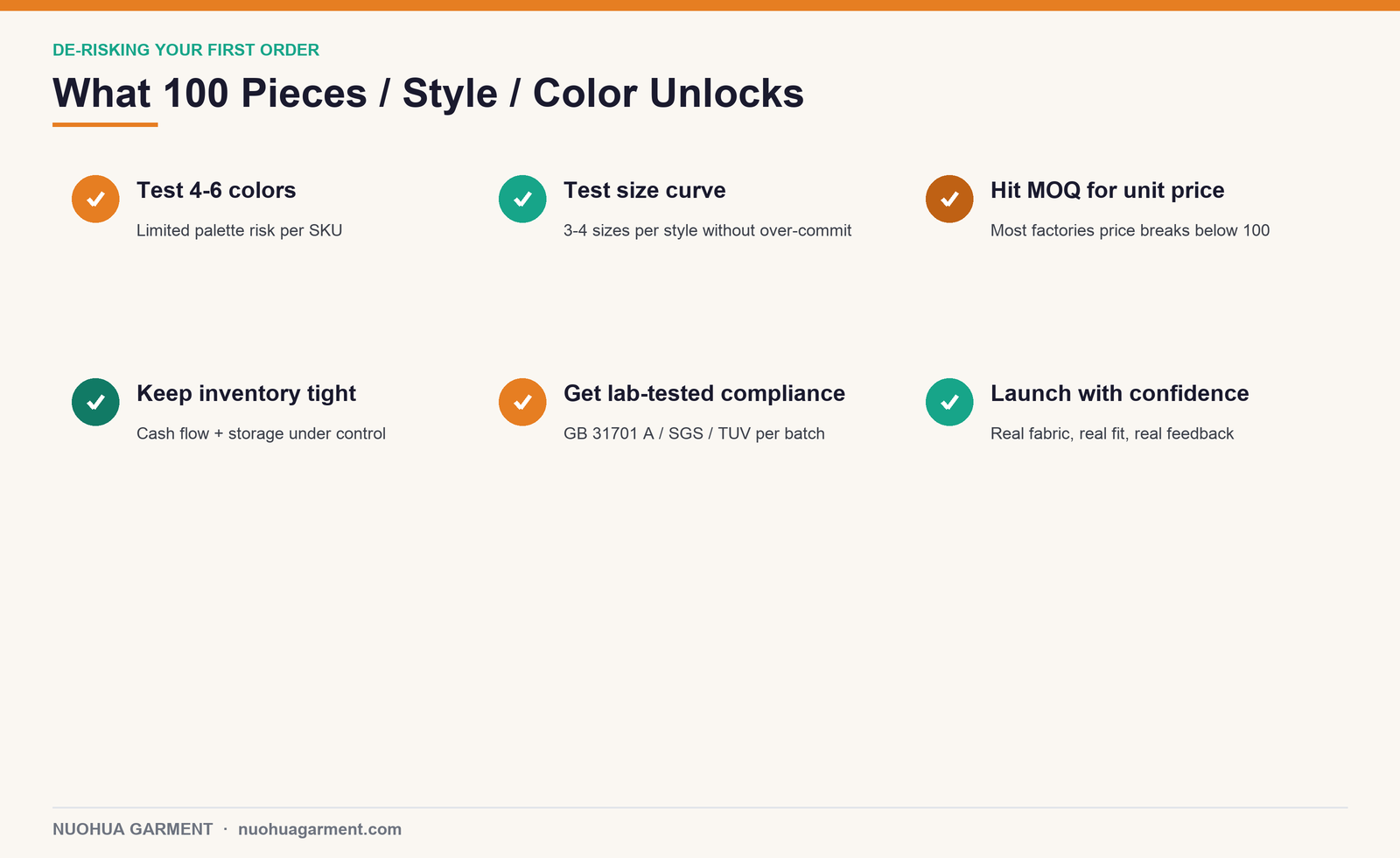
At Nuohua, our standard MOQ is 2 pcs on selected in-stock styles, colors and sizes. Read that carefully: it is per style and per color. That means a single brief — one silhouette, one fiber — can be split across several colorways at 100 pieces each, so a brand can launch a small but believable collection without a single 1,000-unit bet. We set the floor at 100 rather than 50 because below that, fabric lots, cutting efficiency, and per-unit QC overhead make a custom run economically fragile — 100 is the sweet spot where a branded line becomes genuinely viable.
Key point: “2 pcs on selected in-stock styles, colors and sizes” is Nuohua’s standard MOQ. It is the entry floor for a custom, branded production run — not a promotional one-time exception. It applies to our OEM/ODM private-label kids’ underwear, training bras, and sleepwear lines.
How it de-risks launching a new brand
A full-scale MOQ forces a founder to forecast demand before a single customer exists. Low MOQ inverts that: you launch, observe real sales, and then reorder what actually moves. The downsides of guessing wrong shrink from “thousands of unsold units” to “a hundred units of one slow color” — a difference that can keep a small brand alive through its first year.
Speed compounds the benefit. With a fast-turnaround private-label kids’ clothing workflow, a low-MOQ first run can go from approved sample to sellable inventory in weeks, letting you test the market while the season is still current rather than arriving after it has ended.
How Low MOQ Lets You Test Fibers, Sizes, and Markets
Testing fibers before you scale
Parents care about what touches their child’s skin. Combed cotton, cotton-spandex, bamboo-derived viscose, and EcoCosy® modal each feel and perform differently — and each carries a different cost and care profile. With a 100-piece floor, you can run two or three fiber variants side by side, put them in front of real customers, and let returns, reviews, and repeat purchases tell you which one deserves a larger run.
EcoCosy® is one fiber we can speak about concretely: Nuohua holds EcoCosy® fiber authorization, a licensed, traceable, wood-based fiber that is biodegradable. It is a strong differentiator for premium positioning, and low MOQ lets you validate that premium story with a small, targeted drop before committing mill capacity.
Testing the size curve
Kids’ sizing is notoriously regional. A US 4T is not an EU 104 is not a UK 3–4. Instead of printing your entire size run at volume, you can launch a trimmed curve — say sizes 2T through 6 — and watch which sizes sell through fastest. That data directly informs your first re-order and protects you from over-producing the sizes nobody buys. Our kids’ underwear size chart (US/EU/UK/AU) is a practical reference when you plan that first trimmed run.
Testing markets and channels
Low MOQ also lets you run quiet experiments across channels. A 100-piece run can feed an Amazon test listing, a pop-up, or a crowdfunding pre-launch without touching your main inventory plan. If a market responds, you scale; if it does not, the loss is contained. For brands weighing where to manufacture, understanding China’s kids’ underwear manufacturing regions helps explain why a Guangdong-based partner like Nuohua can offer both low MOQ and mature supply chains.
What Low MOQ Cannot Do (Managing Expectations)
It does not mean instant production
Low MOQ lowers the order floor; it does not erase the production timeline. Fabric still has to be sourced or knitted, the line still has to be set up, and QC still has to happen. A 100-piece run is faster and cheaper to stage than a 2,000-piece run, but it is not same-day. Realistic sampling and first-production lead times still apply, and we are upfront about them in every quote.
It does not mean zero setup
Custom manufacturing always carries setup: tech pack review, pattern making, grading across sizes, and often a physical sample for fit and quality sign-off. Those one-time steps exist regardless of order size, and they are part of why your kids’ underwear OEM production readiness checklist matters even for a tiny first run. Low MOQ reduces inventory risk, not development work.
It does not mean the lowest possible unit cost
Unit economics shift with volume. A 100-piece run carries a higher per-unit price than a 1,000-piece run because fabric setup, cutting, and line changeovers are spread over fewer pieces. That is the reasonable exchange for flexibility: you pay a small premium for optionality. Smart brands accept the higher early unit cost as a market-research expense, then capture volume pricing only on the styles that earned it. Budget accordingly, and let the tiered plan above guide when the math favors scaling.
It does not mean free or skipped compliance
Children’s skin-contact apparel carries real compliance obligations. Nuohua manufactures to GB 31701 Class A, China’s strictest standard for infant and children’s textile skin-contact wear, and we coordinate third-party testing through partners such as SGS, TÜV SÜD, and Intertek. For the US market, the importer issues the Children’s Product Certificate (CPC) using test data — Nuohua supplies that data; we do not issue the CPC ourselves. And while we are advancing OEKO-TEX Standard 100 certification (in progress), we will not claim to be OEKO-TEX certified until that process completes. None of this disappears at low volume — it simply scales to the batch.
Using Low MOQ Strategically: Tiered Scaling and Multiple Colorways
The tiered scaling plan
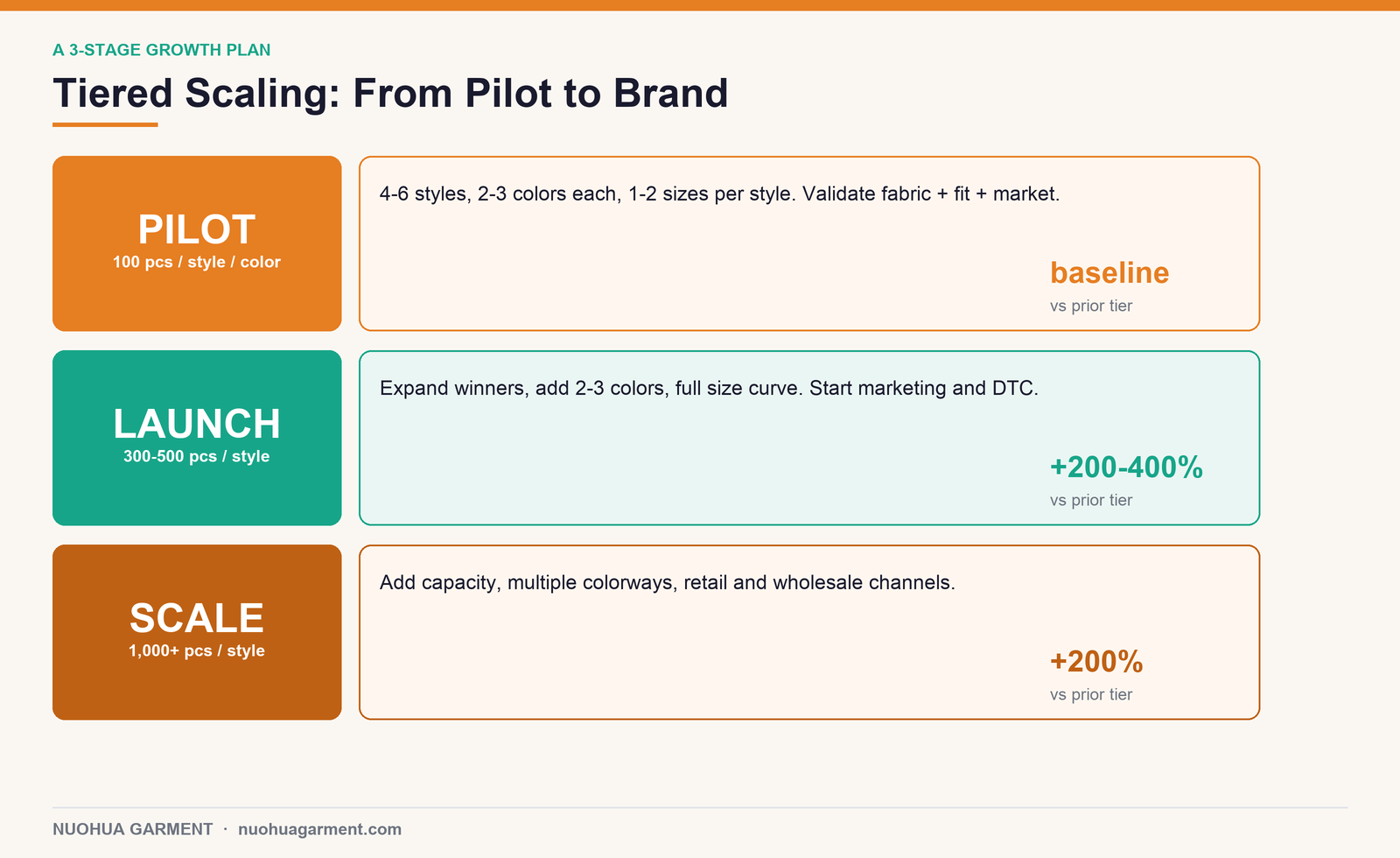
The smartest way to use low MOQ is not to stay small forever — it is to treat the first run as a funded experiment and scale the winners. A typical arc looks like this:
| Stage | Order size | Goal | Decision after |
|---|---|---|---|
| 1. Validate | 2 pcs on selected in-stock styles, colors and sizes | Prove fit, fiber, and appeal | Reorder winners only |
| 2. Confirm | 300–500 pcs / style / color | Build sell-through data | Expand colorways |
| 3. Scale | 1,000+ pcs / style / color | Lower unit cost at volume | Lock bestsellers |
Multiple colorways as a low-risk assortment
Because the MOQ is per color, a founder can assemble a “collection” feel from several 100-piece color runs instead of one giant monochrome bet. This lets a new brand look assortment-rich on a shelf or listing while keeping total exposure modest. If one print underperforms, it is 100 units, not 1,000.
Strategy tip: Launch 3 colorways at 100 pcs each (300 units total) rather than 1 color at 300 pcs. You learn which color the market wants and you present a fuller brand — same inventory risk, more signal.
Before you price that first run, work through our kids’ underwear manufacturer quote checklist so the 11 details that drive cost — fabric, trim, packing, labeling, and more — are pinned down up front. A clean quote at 100 pieces prevents surprises when you scale to 1,000.
Frequently Asked Questions
What is a low MOQ for kids’ underwear manufacturing?
A low MOQ is a small minimum order quantity that lets a brand produce custom, branded children’s underwear without a large commitment. At Nuohua, the standard floor is 2 pcs on selected in-stock styles, colors and sizes, which is low enough for boutique brands yet high enough to run a real production line with proper QC.
Is ready stock from 2 pcs Nuohua’s real MOQ or a promotion?
It is our standard MOQ for OEM/ODM private-label kids’ underwear, training bras, and sleepwear — not a limited-time offer. It reflects how we have structured sampling and small-batch production so new brands can enter the market credibly.
Can I split a ready-stock order from 2 pcs across multiple sizes?
Yes. The ready-stock minimum of 2 pcs is per style per color; within that run you grade across the size curve you need (for example, sizes 2T–6). Many brands launch a trimmed size run first, then expand the curve on reorder once they see which sizes sell through.
Does low MOQ mean I can skip sampling?
No. Sampling and fit sign-off are separate from order volume. We still recommend a physical sample for quality and fit approval before any production run, because low MOQ reduces inventory risk, not development risk.
Will my small order still meet compliance standards?
Yes. Nuohua produces to GB 31701 Class A for skin-contact children’s wear and coordinates third-party testing through SGS, TÜV SÜD, and Intertek. For the US, the importer issues the CPC using our test data. Compliance scales to the batch — it is not waived at low volume.
How fast can a 100-piece run ship?
Faster than a full container, but not instant. Timelines depend on fabric sourcing, sample approval, and line scheduling. Our fast-turnaround private-label process is designed to compress this, but realistic lead times are always confirmed in your quote.
Can I test different fabrics at low MOQ?
Absolutely — that is one of the best uses of low MOQ. Running combed cotton, cotton-spandex, or EcoCosy® modal as separate 100-piece color or style runs lets real customer feedback decide which fiber you scale. EcoCosy® in particular is a strong premium differentiator we can support from the first small batch.
Start Your Low-MOQ Run With Nuohua
Low MOQ is not about staying small — it is about de-risking the leap from idea to shelf. With Nuohua’s standard 2 pcs on selected in-stock styles, colors and sizes program, you can launch a real, branded kids’ underwear line, test fibers and sizes with live customers, and scale only what proves itself. When you are ready to scope your first run, use our quote checklist to get the details right, then get a quote and we will map a tiered plan from 2 pcs on selected in-stock styles, colors and sizes to your first full-scale reorder.