
When you brief a kids’ underwear line, one of the first fabric decisions is deceptively simple: pure cotton, or cotton with a little spandex? Both are safe, both are breathable, and both can carry your brand. The difference shows up in how the garment fits, moves, and ages — not in whether it is “good” or “bad.”
This guide gives private-label buyers a practical framework for choosing between 100% combed cotton and a 95% cotton / 5% spandex blend, matched to product type, skin sensitivity, and the kind of fit your customer expects.
Quick Answer
Choose 100% combed cotton for toddlers, sleepwear, and sensitive skin where maximum breathability and a hypoallergenic hand-feel matter most. Choose a 95% cotton / 5% spandex blend for training bras, active boys’ briefs, and any style that needs stretch, recovery, and shape retention. Both are kid-safe; the trade-off is fit and movement, not safety.
In this guide
- Why “Combed Cotton” Is Not the Same as “Cotton”
- What “95% Cotton / 5% Spandex” Actually Means
- Breathability & Skin Safety: Where Pure Cotton Wins
- Fit, Stretch & Recovery: Where the Blend Wins
- Side-by-Side: Combed Cotton vs Cotton-Spandex
- Which to Choose by Product Type
- GSM, Care & Skin-Contact Standards
- How Nuohua Helps You Specify the Right Blend
1. Why “Combed Cotton” Is Not the Same as “Cotton”
“Cotton” on a care label tells you the fiber origin. “Combed cotton” tells you how the fiber was prepared before it became yarn — and for children’s skin, that preparation matters.
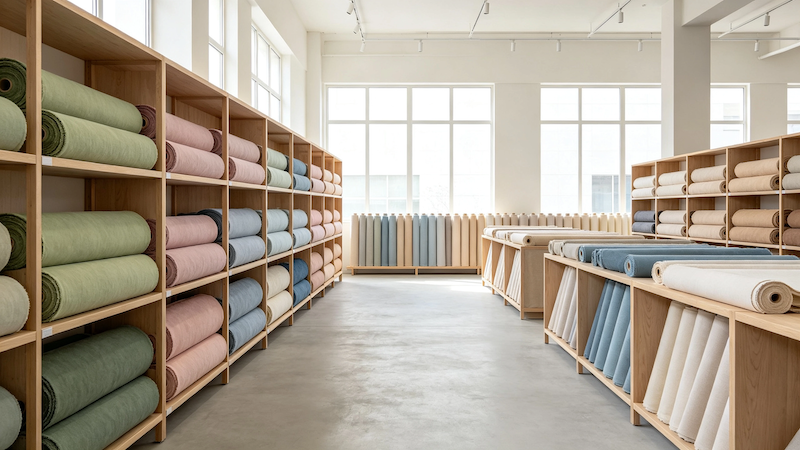
After ginning, raw cotton still contains short fibers (noils) and impurities. Combing is an extra step that passes the fibers through a fine comb to remove those short staples. The result is a smoother, stronger, more uniform yarn with fewer loose ends poking toward the skin.
- Softer hand-feel — fewer protruding fiber ends means less surface roughness against delicate skin.
- Lower pilling — short fibers are the ones that ball up; removing them keeps fabric looking new.
- Better dye uptake — a cleaner yarn takes color more evenly, which matters when you match a Pantone target.
Combed cotton typically costs a bit more than carded (un-combed) cotton, but for kids’ underwear — the garment worn closest to the skin for the longest part of the day — most private-label brands treat combed as the baseline, not an upgrade. At Nuohua, our standard kids’ basics start from combed cotton rather than carded.
2. What “95% Cotton / 5% Spandex” Actually Means
A 95% cotton / 5% spandex (also called elastane or Lycra® when branded) fabric is still overwhelmingly cotton. The 5% elastane is knit into the structure as a tiny elastic core, giving the whole cloth “memory.”
That 5% is deliberately small. It is enough to:
- Let a waistband or leg opening stretch and snap back instead of permanently relaxing.
- Help a garment hold its shape through dozens of washes.
- Give a closer, no-gap fit for active kids without going up a size.
What it does not do: it does not turn the fabric into a synthetic. The wearer still gets cotton next to the skin; the elastane simply lives inside the knit. For buyers worried about “is spandex safe for children” — at 5% and fully encapsulated in the yarn, it is a standard, widely used, kid-appropriate component. (Branded elastane such as Lycra® is available on request with proper brand authorization.)
3. Breathability & Skin Safety: Where Pure Cotton Wins
If breathability is the priority — and for underwear it usually is — 100% combed cotton is the ceiling. With zero synthetic content, the fabric is the most open and moisture-absorbing option, which is why pediatric and infant guidelines consistently favour pure natural fibers for the youngest wearers.
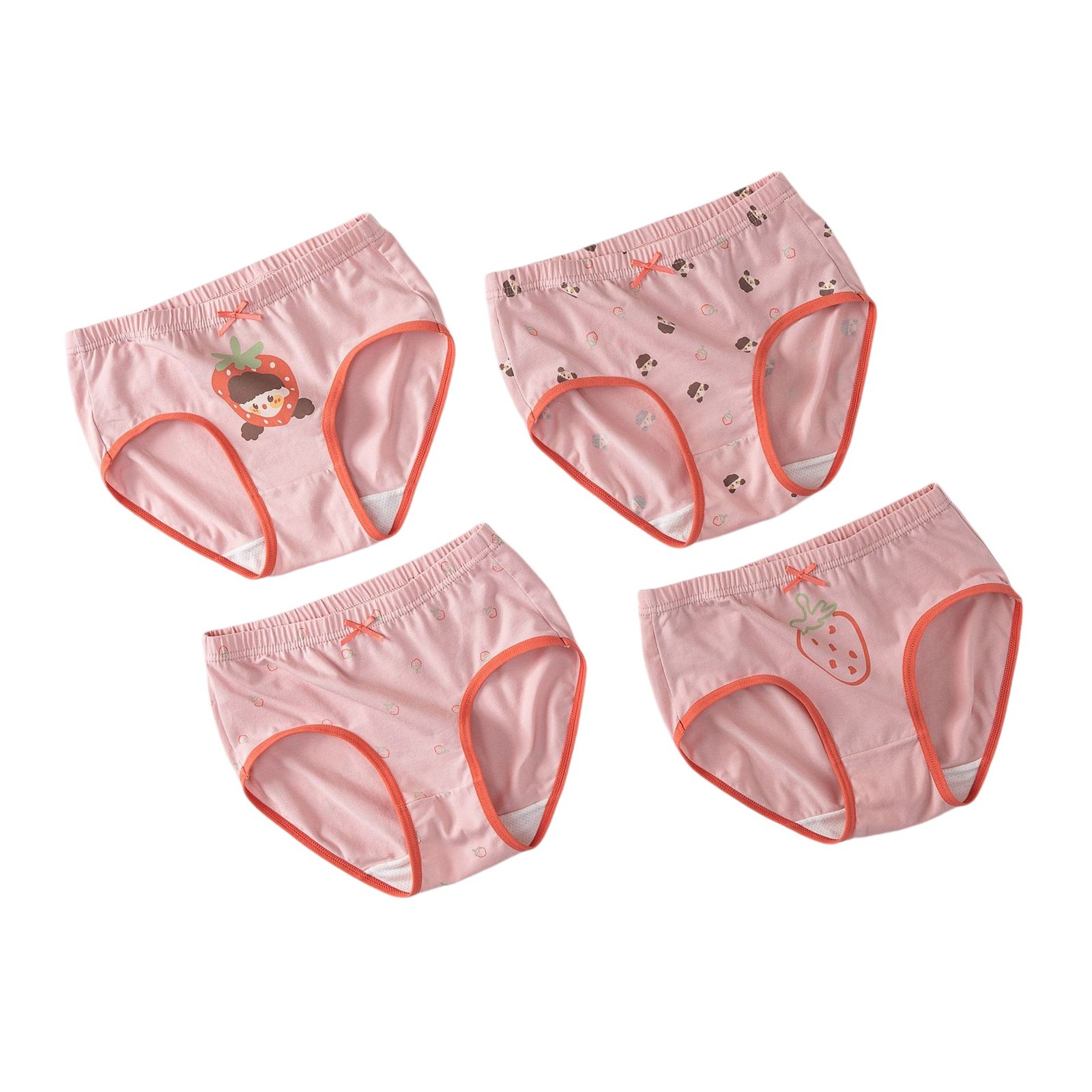
This is also where pure cotton earns its place in sleepwear and infant basics. Loose, pure-cotton knits maximize airflow, and for snug-fit children’s sleepwear the breathability of cotton is part of the safety story (regulators in the US, for example, steer flammable-risk sleepwear toward snug pure-cotton fits rather than loose, loose-weave garments).
4. Fit, Stretch & Recovery: Where the Blend Wins
Pure cotton is soft but it has no memory. After a few wears and washes, a 100% cotton waistband relaxes and a leg opening can gap. That is fine for a loose sleep set; it is frustrating for a training bra or a boy’s brief that needs to stay put through a school day.
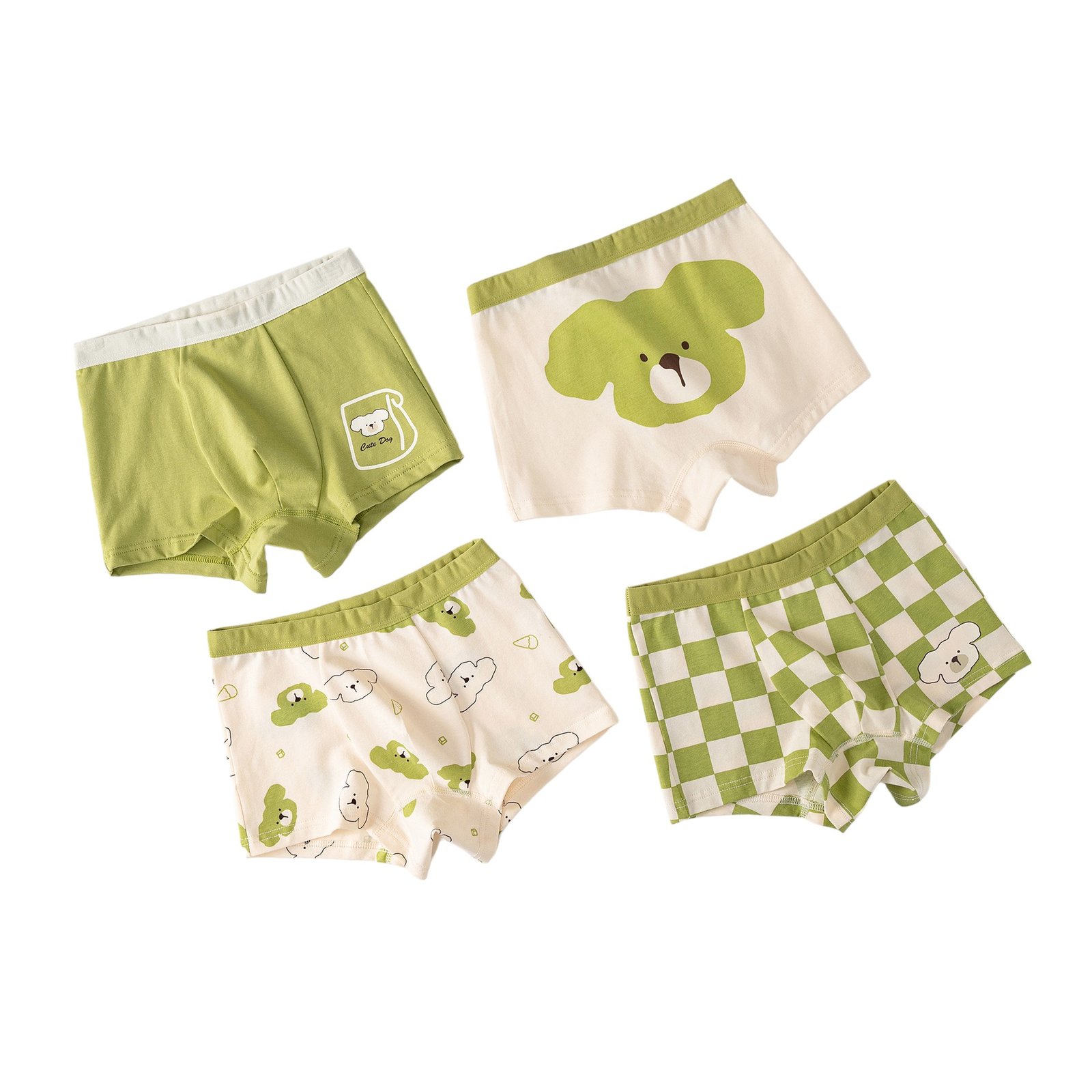
The 5% spandex changes the behaviour:
- Training bras need gentle, consistent support that moves with a growing body — a blend is the natural choice.
- Active boys’ briefs and trunk styles benefit from recovery so the garment does not ride or gap during play.
- Any form-fitting style (bikini, hipster, second-skin cami) looks and feels better in a fabric that returns to shape.
5. Side-by-Side: Combed Cotton vs Cotton-Spandex
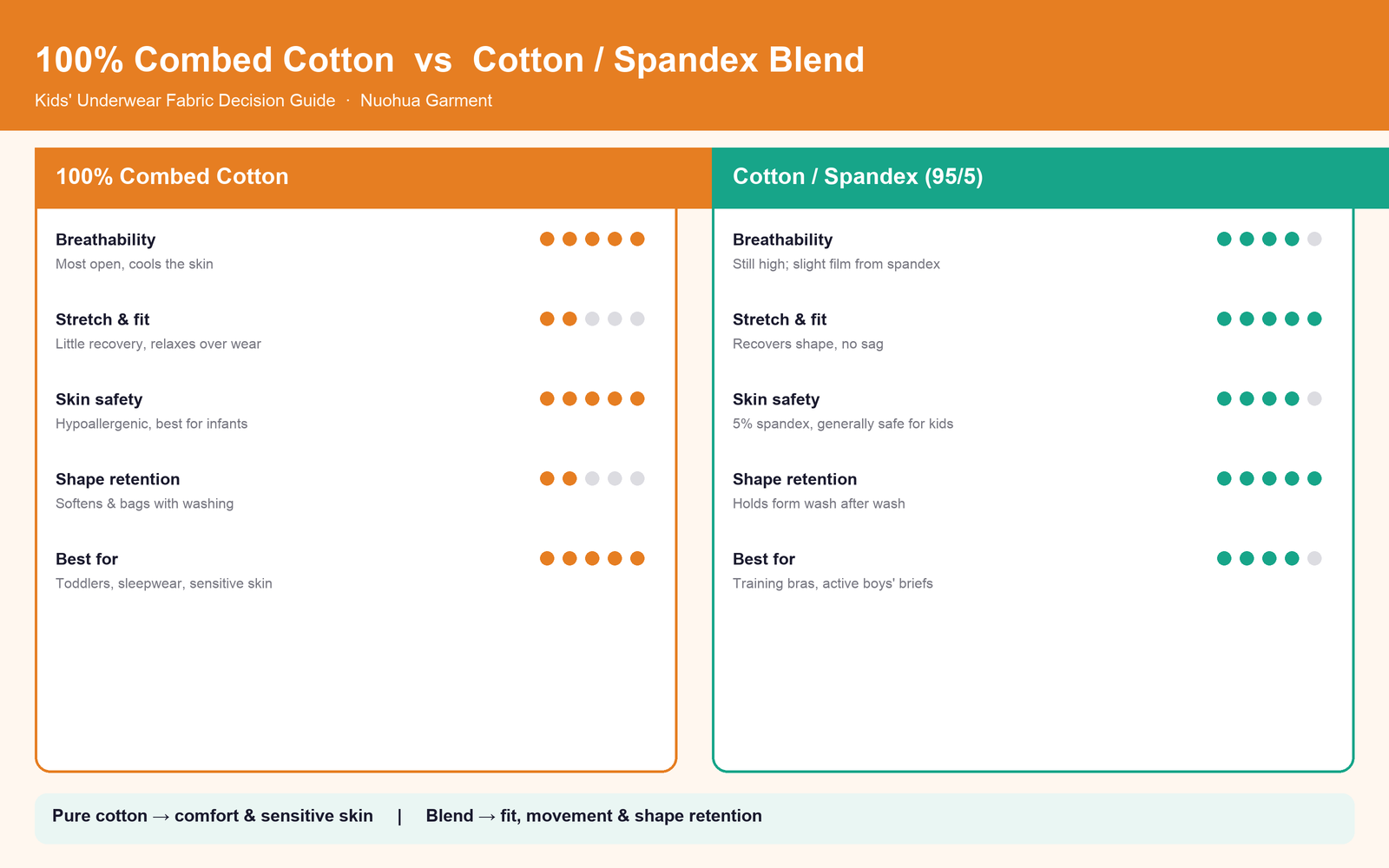
The table below summarizes the trade-off. Neither column is “better” — they serve different products.
| Dimension | 100% Combed Cotton | 95% Cotton / 5% Spandex |
|---|---|---|
| Breathability | Highest — fully open knit | Very high — cotton dominates |
| Stretch & recovery | Low — relaxes over wear | High — snaps back to shape |
| Skin safety | Hypoallergenic, ideal for infants | Kid-safe at 5% encapsulated elastane |
| Shape retention | Softens & may bag with washing | Holds form wash after wash |
| Best product types | Toddler briefs, sleepwear, sensitive skin | Training bras, active briefs, form-fit |
| Cost position | Baseline (no elastane) | Slightly higher (elastane + recovery knit) |
6. Which to Choose by Product Type
Use this as a starting brief, then adjust by your customer:
- Toddler & baby briefs → 100% combed cotton. Maximum breathability, lowest irritation risk, easy care.
- Girls’ training / first bras → 95/5 cotton-spandex. Gentle support that moves and recovers.
- Boys’ boxer briefs & trunks → 95/5 cotton-spandex for active wear; pure cotton for relaxed/lounge versions.
- Snug-fit sleepwear → 100% combed cotton (breathability + compliance fit logic).
- Sensitive-skin / eczema-prone lines → 100% combed cotton, optionally with a tag-free print label.
Many brands run both: a pure-cotton “comfort” tier and a cotton-spandex “active” tier under one label.
7. GSM, Care & Skin-Contact Standards
Fiber is only half the story — GSM (grams per square metre) decides hand-feel and durability. For kids’ underwear:
- Lightweight basics: ~150–170 GSM (soft, airy).
- Everyday briefs/trunks: ~170–190 GSM (balanced).
- Supportive training bras: ~180–210 GSM (with the blend for recovery).
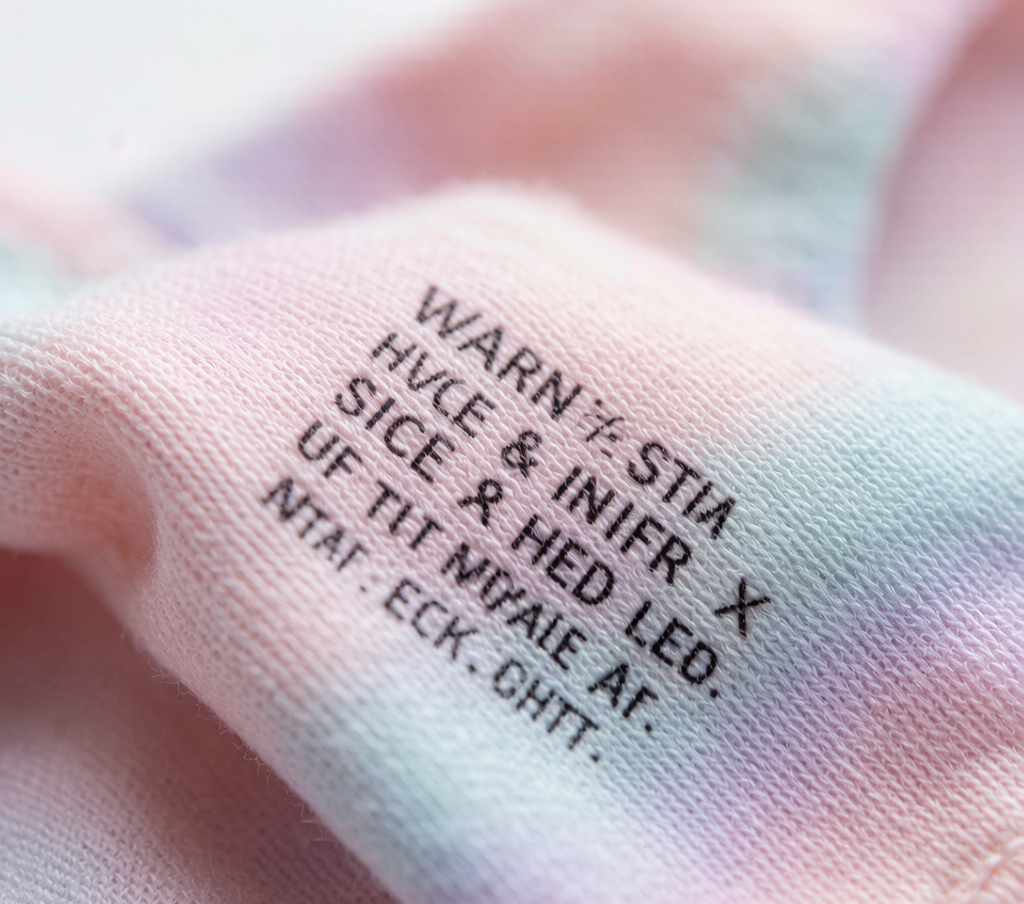
Care-wise, pure cotton loves heat (boil-wash safe at item level) but shrinks if not pre-shrunk; the blend tolerates tumble drying better and wrinkles less. Either way, we recommend tag-free printed care labels to remove the scratchiest point of contact with skin.
On compliance: beyond GB 31701 Class A, items for the US market can be supported with CPC (Children’s Product Certificate) documentation, and our OEKO-TEX Standard 100 work is in progress. We match the safety class to your destination market — tell us US CPSIA, EU EN 14682, or other requirements and we build to them.
8. How Nuohua Helps You Specify the Right Blend
You do not have to land the fiber call alone. Our development process walks from your brief to a locked sample:
- Brief & target market — share age range, product type, and destination compliance.
- Fabric recommendation — we propose combed cotton vs blend (and GSM) per your use case.
- Tech pack & lab dips — document the exact fiber composition and match colour to Pantone references.
- Sample (physical or 3D virtual) — confirm hand-feel and recovery before bulk.
For the wider material picture — knit vs woven construction, or how cotton compares to bamboo and modal — see our knit vs woven guide and the bamboo kids’ sleepwear playbook.
Frequently Asked Questions
Is spandex safe in kids’ underwear?
At ~5% and fully encapsulated inside the yarn, elastane is a standard, widely used, kid-appropriate component. The cotton still sits next to the skin. Branded elastane (e.g., Lycra®) is available on request with brand authorization.
Does combed cotton shrink?
It can, if not pre-shrunk. We pre-shrink and test cotton programs so the delivered size holds after the first wash.
Can I mix pure cotton and blend in one collection?
Yes — many brands run a pure-cotton comfort tier and a cotton-spandex active tier under one label. We support both in the same production run.
Which is more expensive?
The blend is marginally higher (elastane cost + recovery knit), but the gap is small versus the total landed cost. We break it down in the BOM-to-sample workflow.