
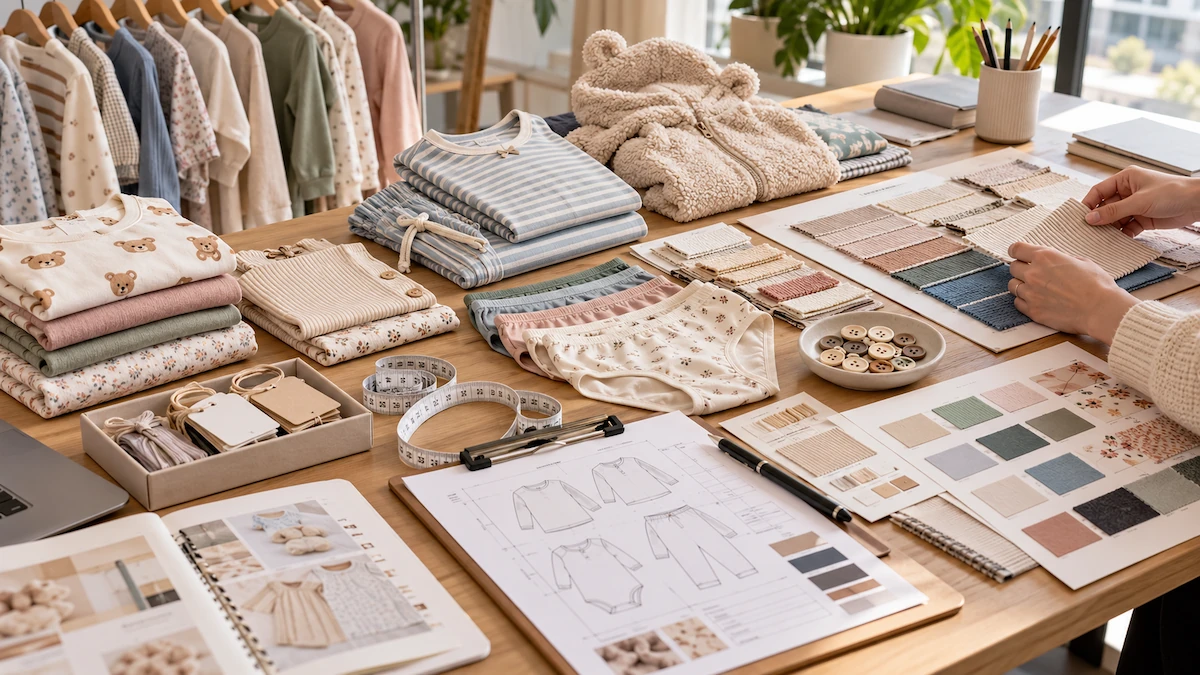
Kidswear Sourcing Checklist 2027: Safety, Fabric, Fit, MOQ & QC
A kidswear bulk order can fail long before the sewing line starts.
The wrong sleepwear silhouette can create a different compliance path in the US. A drawstring detail can turn into a safety issue. A fabric that feels perfect during sampling can shrink differently after production washing. A low MOQ can look attractive until the buyer discovers that it applies per colour or per print rather than per style.
For brands sourcing children’s apparel in 2027, the buying decision is no longer just about price, design and lead time. Safety requirements, fabric performance, size grading, production minimums, sample approval, traceability and quality-control standards increasingly need to be decided as one system — before bulk production begins.
This guide provides a practical kidswear sourcing checklist for brands, retailers, wholesalers and buying teams sourcing underwear, sleepwear, baby apparel and other children’s clothing.
On this page
- Quick answer: what to check before a kidswear bulk order
- Why kidswear sourcing is different in 2027
- Checks 1–2: destination market first, safety as a design input
- Check 3: never approve fabric by hand feel alone
- Check 4: review size grading, not just the sample size
- Check 5: test prints, embroidery and trims on production fabric
- Check 6: understand what the MOQ actually applies to
- Checks 7–8: PP sample approval and QC defined before production
- Checks 9–10: traceability and sustainability claims
- The 2027 kidswear bulk order checklist
1. Quick Answer: What to Check Before a Kidswear Bulk Order
Before placing a kidswear bulk order, confirm the destination market and its applicable safety requirements, approve production fabric after performance testing, review the complete size grading rather than one sample size, test prints and trims on the actual fabric, understand what the MOQ applies to, approve a final pre-production (PP) sample, define QC tolerances in advance, and confirm labelling and traceability documentation. The objective is not the lowest unit price — it is a product that can be produced consistently, documented correctly and sold in its intended market.
The ten checks in this article follow the order in which decisions actually harden during a sourcing project. Market and safety decisions come first because they change construction. Fabric and grading come next because they change fit. MOQ, samples and QC come last because they depend on everything above them.
Each check includes what to confirm, why it matters at bulk scale, and what usually goes wrong when it is skipped.
2. Why Kidswear Sourcing Is Different in 2027
Three shifts have changed how childrenswear should be sourced: safety and documentation requirements in major markets are being enforced more systematically, digital import filing is reducing the room for paperwork errors, and material claims are increasingly expected to be verifiable. Buyers who plan these as design inputs — not final paperwork — avoid the expensive redesigns and customs delays that follow when they are discovered late.
Safety requirements are design inputs. In the United States, children’s products that are subject to an applicable children’s product safety rule generally require third-party testing by a CPSC-accepted laboratory and a Children’s Product Certificate (CPC), which is issued by the domestic manufacturer or the importer rather than by the testing laboratory. Children’s sleepwear in scope of 16 CFR Parts 1615 (sizes 0–6X) and 1616 (sizes 7–14) must meet the applicable flammability requirements, including FPU and GPU testing — while underwear, infant garments and qualifying tight-fitting sleepwear are excepted from Parts 1615/1616 and instead fall under 16 CFR Part 1610. Hood and neck drawstrings on children’s upper outerwear in sizes 2T–12 are treated as a substantial product hazard, and waist or bottom drawstrings on sizes 2T–16 must meet specific length and construction limits. A silhouette that looks commercial on a mood board can therefore change the compliance path before a single pattern is cut.
Where a regulation is mentioned, the summary in this article is directional rather than exhaustive; always verify the latest legal text, scope and testing path for the exact product under development. Our dedicated kids underwear and sleepwear compliance checklist walks through this category by category.
Import paperwork is tightening. Beginning July 8, 2026, importers of consumer products subject to CPSC certification requirements generally must electronically file certificate data with U.S. Customs and Border Protection (CBP) under CPSC’s eFiling framework. Products entered for consumption or warehousing from a U.S. Foreign Trade Zone have a separate effective date of January 8, 2027. In practice, this raises the value of clean product identification, batch records and traceability from the first order onward.
The EU General Product Safety Regulation (Regulation (EU) 2023/988) applies from 13 December 2024. Under Article 19 of the GPSR, distance-sale offers must clearly and visibly display the manufacturer’s identity and contact details; where the manufacturer is established outside the EU, the EU responsible person’s details must also be shown, together with product identification and any applicable warnings or safety information. These belong on the listing itself, not only in the carton.
Material claims are moving toward evidence. Textile Exchange reported that participating companies in its Materials Benchmark increased their sourcing of cotton, polyester, nylon, viscose and wool from recognized preferred-production programs from 68% in 2024 to 72% in 2025. This statistic reflects reporting participants, not the entire industry, but it shows the direction among brands that already measure their material strategy.
The practical conclusion: kidswear sourcing is no longer a price-and-style decision. Market, safety, materials, fit, MOQ and documentation now need to be planned together before bulk production begins. The ten checks below are how experienced buying teams do that.
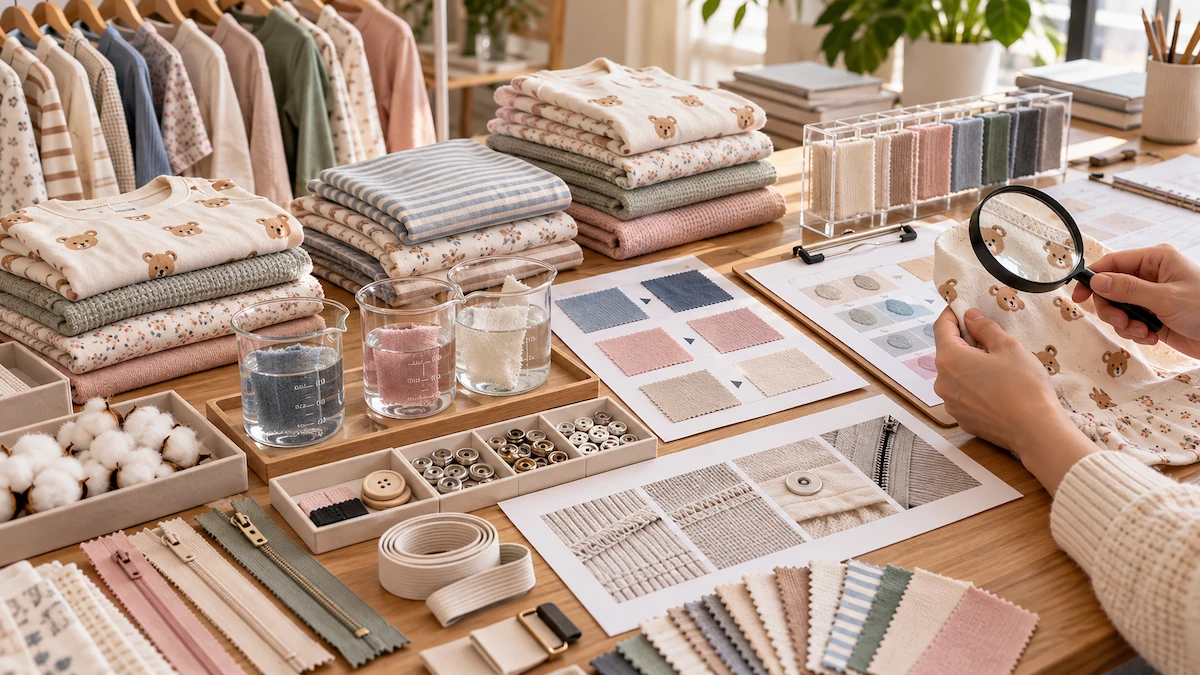
3. Checks 1–2: Destination Market First, Safety as a Design Input
Decide the destination market before finalising fabric, construction or labels, because requirements differ by market and product category. Then treat safety as a design input: sleepwear construction, drawstrings, small trims and fastenings can each change what is permitted or how a product is classified, and changing them after sampling means re-sampling.
Check 1 — Decide the destination market before finalising the product
The same style sold in the US, EU and UK may need different construction, labelling and documentation. Deciding the market late is one of the most expensive sequencing mistakes in kidswear sourcing, because market requirements flow backwards into fabric choice, garment construction, label content and testing scope.
| Decision | Why it must come before the product is finalised |
|---|---|
| Destination market (US / EU / UK / other) | Determines which safety framework, labelling content and documentation apply to the shipment. |
| Product classification (sleepwear, underwear, baby apparel, outerwear) | Requirements vary by intended use and construction — sleepwear and baby sizes are treated differently from general children’s apparel. |
| Selling channel (DTC, retail, marketplace) | Marketplace and distance-selling rules add product-identification and safety-information expectations on the listing itself. |
| Age range and size span | Baby sizes sit under stricter expectations than older kids’ sizes; the span you choose drives the pattern and grading work. |
Check 2 — Treat safety as a design input, not final paperwork
Three design areas create the most re-work when they are discovered late:
- Sleepwear construction. In the US, children’s sleepwear within the scope of 16 CFR Parts 1615 and 1616 must meet the applicable flammability requirements, while underwear, infant garments and qualifying tight-fitting sleepwear are excepted and instead fall under 16 CFR Part 1610. The intended use, fit and construction of a garment determine which path applies — which is why sleepwear should be engineered with the compliance route in mind from the first tech pack. For category-level guidance, see our kids sleepwear manufacturing page.
- Drawstrings and cords. In the US, hood and neck drawstrings on children’s upper outerwear in sizes 2T–12 are treated as a substantial product hazard, and waist or bottom drawstrings on sizes 2T–16 must meet specific length and construction limits. Other markets apply their own restrictions by garment area and age group — so a hood drawstring that is fine on an adult hoodie can be a problem on a child’s jacket. The design fix is easy at the sketch stage and disruptive at the PP-sample stage.
- Small trims and fastenings. Buttons, snaps and decorative trims should be reviewed for secure attachment and for any chemical or material restrictions that apply to the destination market. In the U.S., functional clothing attachments such as buttons are excluded from the 16 CFR Part 1501 small-parts ban, although the CPSC recommends voluntary attachment and use-and-abuse testing on garments through size 2. Reinforced attachment and clear trim specifications in the tech pack remain the practical way to prevent failures found at final inspection.
4. Check 3: Never Approve Fabric by Hand Feel Alone
Confirm composition, fabric weight (GSM), shrinkage, colourfastness and wash performance in writing before approving bulk fabric. Two fabrics can feel nearly identical at the sampling table and behave very differently after repeated washing, which is where returns and reviews actually happen.
Hand feel is real information — it is how buyers detect the difference between a soft single jersey and a harsh one. But hand feel cannot tell you how a fabric will behave across a production dye lot, across washes, or across a child’s actual week of wear. Those properties are specified and tested, not felt.
| Property | What to confirm | Why it matters at bulk scale |
|---|---|---|
| Composition | Fibre percentages in writing (e.g. 95% cotton / 5% spandex), plus accurate naming where relevant (e.g. “viscose from bamboo”) | Drives stretch recovery, labelling content and testing scope; composition errors surface at customs and on labels. |
| Fabric weight (GSM) | Target GSM with an acceptable tolerance band | Weight drift changes opacity, warmth and drape — and a garment can pass a single sample while failing across the roll. |
| Shrinkage | Shrinkage tested on the production fabric, with patterns graded to compensate | A fabric that shrinks more than the pattern assumes turns a passed sample into a returned size range. |
| Colourfastness | Wash, rub and light fastness appropriate to the colour and print | Deep solids and contrast trims are where bleeding and staining show up first. |
| Stretch recovery | Recovery after repeated stretch, not just stretch percentage | Waistbands and cuffs that bag out are a top complaint in underwear and sleepwear reviews. |
| Wash performance | Pilling and surface appearance after repeated domestic washing | This is what the end customer actually experiences; it cannot be judged on a fresh swatch. |
For baby programmes, fabric decisions also interact with construction expectations — flat seams, covered seam allowances and tagless labelling are standard practice precisely because baby garments sit against sensitive skin. Our baby clothing manufacturing page sets out how we build these into bodysuits, sleepsuits and rompers.
Factory-floor reality: most fabric disputes we see are not about whether the fabric is “good”. They are about a property that was never written down — shrinkage, recovery, GSM tolerance — being assumed differently by the buyer and the mill. Write the property, test it on the production fabric, and most fabric disputes disappear.
5. Check 4: Review Size Grading, Not Just the Sample Size
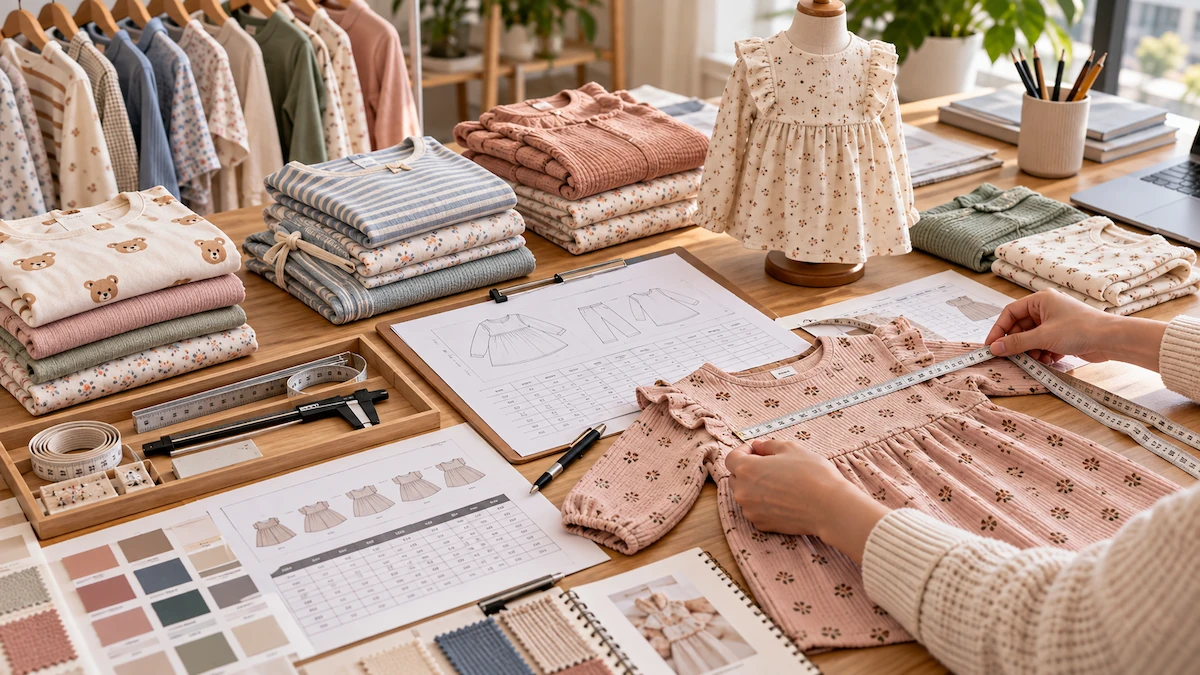
A perfect sample in one size does not validate the full size range. Review the graded measurement chart — chest, body length, waist, rise, sleeve and neck opening — and approve a size set, or at minimum the smallest and largest sizes, before bulk production. Grading errors are invisible until the extreme sizes are actually worn.
Kidswear spans an unusually wide body range, from baby sizes around 50–90 cm through toddler and grade-school sizes up to 150–160 cm. Proportionally, a child is not a scaled-up baby: head-to-body ratio, waist definition and limb length all change. A grade rule copied from a women’s or unisex block produces a range where the middle sizes pass and the extremes fail — and reviews come from the extremes.
What a buying team should actually review before approving the size range:
- Chest and waist ease at every size, not just the sample size — ease that works at 110 cm can be tight at 90 cm.
- Body length and sleeve length increments — length that grows faster than girth makes larger sizes look and fit wrong.
- Rise and leg opening for bottoms — the measurement most often mis-graded across toddler sizes.
- Neck opening and shoulder width — especially for envelope necklines and pullover styles, where dressing ease is part of the product’s function.
- Elastic and cuff dimensions per size — a fixed waistband width across a wide size span is a classic bulk-order defect.
The professional standard is to approve a size set — one garment per size, or at minimum the smallest, one middle and the largest size — against the graded chart. The cost of a size set is trivial next to the cost of a bulk order that fits only in the middle of the range.
6. Check 5: Test Prints, Embroidery and Trims on Production Fabric
Print quality, embroidery, heat transfers and applied trims behave differently on different fabrics. Test them on the actual production fabric — especially where stretch, repeated washing or baby-size wear is involved — and approve a decorated strike-off before bulk production.
Decoration is where a commercially attractive design meets manufacturing physics. The failure modes are predictable, which makes them preventable:
- Print cracking across high-stretch zones when ink flexibility does not match the fabric’s stretch percentage.
- Colour migration between contrast panels and prints during washing when dye systems are incompatible.
- Distortion of placement prints over elastic or ribbed zones, where the print is applied flat but worn stretched.
- Embroidery puckering on lightweight knits, where stitch density pulls the fabric or shows through to the inside.
- Heat-transfer adhesion loss after repeated washing on high-cotton or brushed surfaces.
- Snap and button attachment strength below requirement on baby sizes, where hardware is safety-critical.
The fix is procedural: a decorated sample made on the production fabric, washed several times, then approved as the bulk standard. Buyers who approve decoration on a swatch or on a different fabric roll routinely rediscover these failures at final inspection — the most expensive possible moment.
7. Check 6: Understand What the MOQ Actually Applies To
MOQ is not one number. Ask whether it applies per style, per colour, per print, per fabric or per dye lot — the answer changes inventory risk and cash flow more than the unit price does. In kidswear, custom colour and custom fabric routes carry higher minimums than stock-fabric routes because each colour is a separate dye commitment.
“What is your MOQ?” is the most common first question in kidswear sourcing, and the least informative without a second clause: per what? A 30-piece MOQ per style with free colour mixing is a very different commercial proposition from a 30-piece MOQ per colourway across ten colours.
| Route | Typical MOQ basis | What it means for the buyer |
|---|---|---|
| Stock fabric + stock colours | From 2 pcs on selected in-stock styles, colors and sizes; styles and colours can be mixed within one order | Lowest inventory risk; best for testing a market or launching a first collection. |
| Custom dyeing (Pantone / lab dip) | Reviewed based on the fabric and colour selected | Mid-range minimums; the colour itself — not the style — drives the commitment. |
| Custom underwear lines (including bamboo) | Quoted separately, per fabric and colour | Suited to established programmes; justify through repeat orders rather than a first launch. |
| Baby sizes 50–90 | From 150–300 pcs per color on selected styles | Baby programmes carry stricter construction expectations; plan the size span deliberately. |
| Sleepwear / homewear sets | From 1,000 sets per design | Two-piece sets are counted as sets; print-driven designs concentrate volume per print. |
These figures describe Nuohua’s routes; every factory’s structure differs, and exact requirements are confirmed per project. The durable principle is route-based: the more customisation you introduce, the more the MOQ attaches to the customised element — colour, print or fabric — rather than to the style.
For buyers who need to test demand with low commitment, the low MOQ kids underwear manufacturing route exists precisely for this: stock fabric, stock colours, mixed styles and colours in one order. When the product itself must be custom — own pattern, own waistband, own print — the custom kids underwear development route is the right entry point, with MOQ agreed against the specification rather than a single headline number.
The question that prevents most MOQ surprises: “If I order this style in three colours and two prints, which element is the MOQ measured against?” Ask it before the quotation, not after the deposit.
8. Checks 7–8: PP Sample Approval and QC Defined Before Production
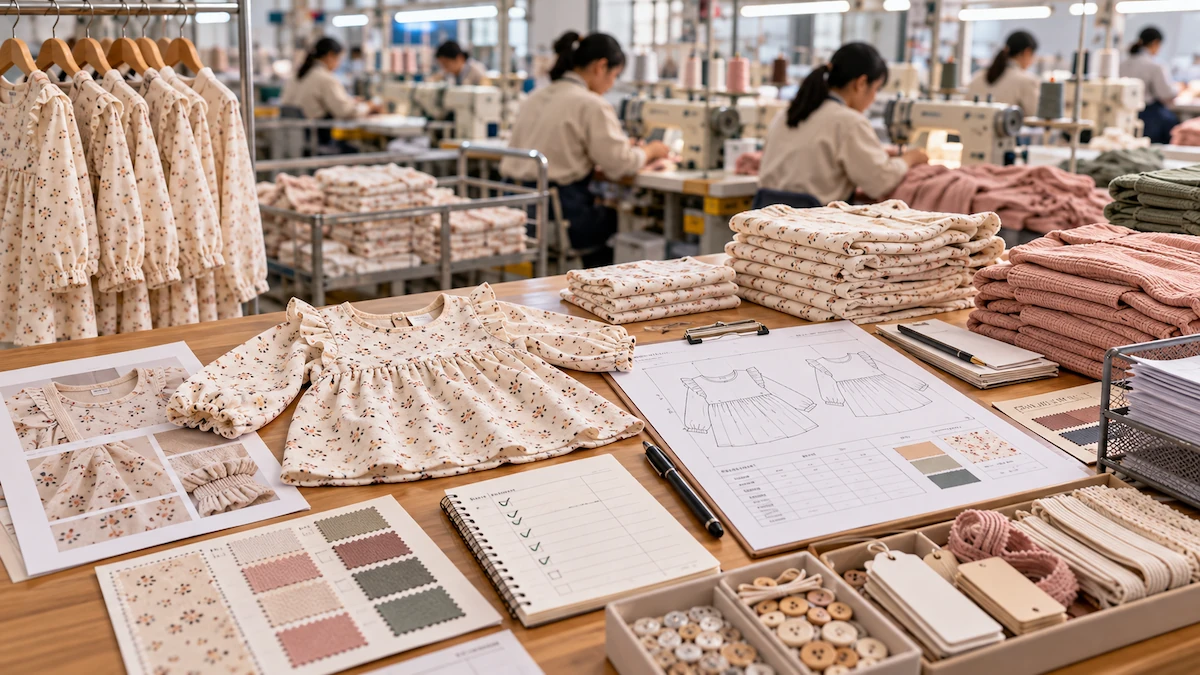
Approve a pre-production (PP) sample made from production fabric — not a courier sample from earlier development — because the PP sample is the single reference that locks fabric, colour, measurements, construction, trims, labels and packing for bulk. And define inspection criteria — tolerances, workmanship standards and inspection points — before the line starts, because the cheapest time to solve a production problem is before thousands of pieces exist.
Check 7 — Approve a real PP sample
A PP sample is not a nicer-looking prototype. It is the contract garment: made on production fabric, with production trims and labels, sewn on the intended machines. When a bulk order is later disputed, the PP sample is what both sides measure against. Approving a sample made from sampling-yard fabric defeats the purpose — production fabric can differ in dye lot, finish and hand feel.
A complete PP-sample approval covers: fabric (composition, weight, hand feel), colour (against the approved lab dip or standard), measurements (against the graded chart), construction (seam types, stitch density, elastic application), print and trims (position, colour, attachment), labels (content, position, required information) and packing (fold, polybag, carton markings).
Check 8 — Define QC before production starts
“Strict quality control” is not a specification. A QC standard is a written agreement on what will be checked and what passes. These items should be agreed before bulk production, not negotiated after inspection:
| Checkpoint | What is agreed in advance |
|---|---|
| Measurement tolerance | Permitted deviation per measurement point and size, so inspection is objective rather than arguable. |
| Seam and stitch standards | Stitch density per seam type; acceptable seam appearance on both face and inside. |
| Print and trim placement | Position tolerances for prints, embroidery, labels and hardware. |
| Workmanship classification | What counts as a minor vs. critical defect — agreed before anyone inspects. |
| Inspection sampling | Sampling level and acceptance limits for inline and final inspection. |
| Needle detection | Broken-needle control and metal detection procedure, with records kept per batch. |
| Packing specification | Fold method, polybag, carton quantity and shipping marks confirmed on the PP sample. |
Our manufacturing facility page documents how incoming material inspection, inline checks, final inspection and needle detection are organised across the production run — the structure behind these checkpoints.
9. Checks 9–10: Traceability and Sustainability Claims
Design traceability into the tech pack, labelling and order records from the first order: product identification, manufacturer or responsible-party information, and batch or production-date details. And when a material is described as sustainable, ask what the claim means precisely — which fibre, which certification or programme, and whether the documentation covers this specific order.
Check 9 — Build traceability into the order
Traceability is usually discussed after a problem appears. In practice it has to be designed in at the start, because the information sits on the product, on the packaging and in the order records at three different moments:
- On the product (U.S. children’s products): tracking information should identify the manufacturer, importer or private labeler, the production location and production date, and the batch or run, with permanent distinguishing marks on the product and packaging to the extent practicable — applied so they survive washing and remain readable.
- On the packaging and listing (EU sales): the manufacturer’s identity and contact details and, where the manufacturer is established outside the EU, the EU responsible person’s details, together with product identification and any applicable warnings or safety information — planned alongside the product, the packaging and the distance-sale listing requirements.
- In the order records: dye lot and fabric batch references, test report numbers, QC records and packing lists held together per order, so a query from an importer or retailer can be answered with documents instead of reconstruction.
Check 10 — Ask what a sustainability claim actually means
Textile Exchange’s Materials Benchmark reporting indicates that participating brands and retailers moved from 68% to 72% of key fibres sourced through recognised preferred-production programmes between 2024 and 2025. That is a signal about companies already measuring their materials — not a description of the whole market. The useful response for a buyer is not to adopt the claim but to interrogate it.
| Question | Why it matters |
|---|---|
| What exactly is the fibre? | “Bamboo” on a label usually means viscose made from bamboo — the accurate description is “viscose from bamboo”. |
| Which certification or programme supports the claim? | A claim without an identified scheme is marketing, not evidence. |
| Does the documentation cover this material and this order? | Certificates are scoped — by facility, fibre or article — and the scope is what gets challenged at customs or by a retailer. |
| Is the fabric commercially realistic for this product? | A premium fibre in a price-sensitive category raises unit cost without necessarily raising sell-through. |
Our own status, stated plainly: Nuohua develops children’s apparel with applicable safety and compliance requirements in mind, and third-party testing can be arranged through qualified laboratories. OEKO-TEX® STANDARD 100 certification is currently in progress — we do not present it as held. Do not rely on a supplier claim unless the supporting documentation can be matched to the relevant facility, material, product or certification scope and, where applicable, to the specific order or batch.
10. The 2027 Kidswear Bulk Order Checklist
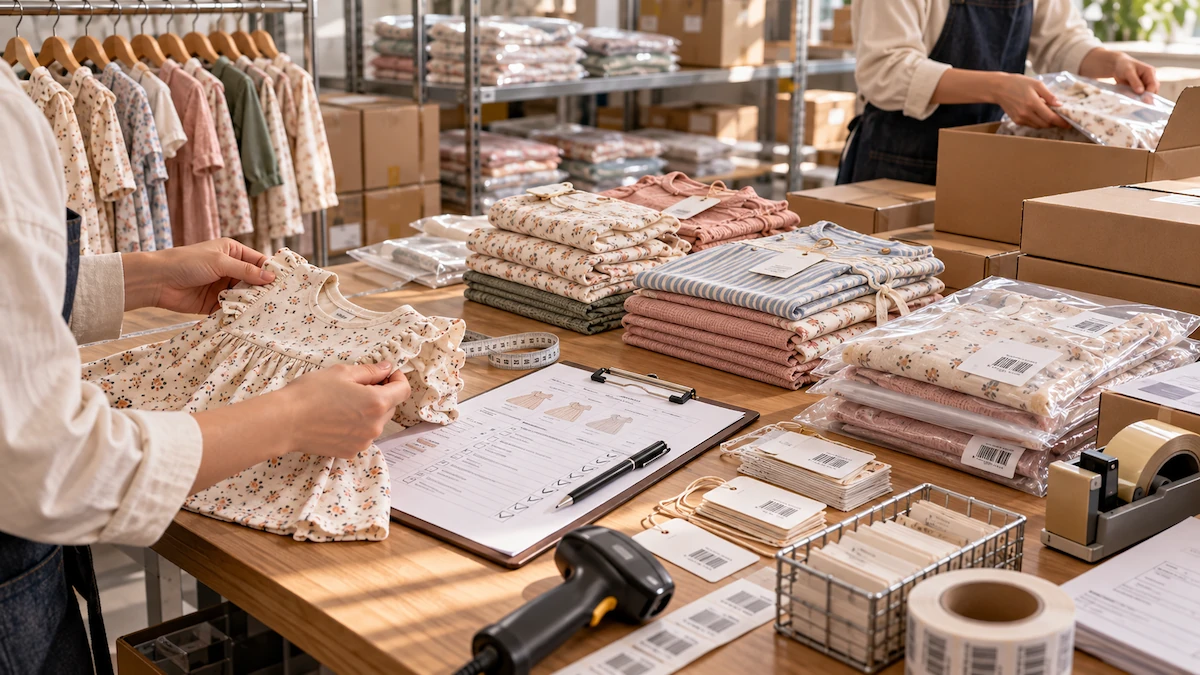
The checklist below consolidates all ten checks into a single pre-bulk review. Use it as a working document: send it to the factory with the tech pack, or review it line by line at the PP-sample stage. It belongs next to the quotation, not in an inbox archive.
| Before bulk production | Buyer should confirm | Why it matters |
|---|---|---|
| Destination market | US, EU, UK or other — fixed before development | Determines the applicable safety and documentation requirements |
| Product classification | Sleepwear, underwear, baby apparel or outerwear | Requirements and routes vary by intended use and construction |
| Safety-related design details | Drawstrings, trims, fastenings, sleepwear fit and construction | Design changes after sampling mean re-sampling and re-testing |
| Fabric | Composition, GSM, shrinkage, colourfastness, wash performance | Controls fit, quality consistency and repeatability |
| Size set | Graded measurements across the full size range | One approved size does not validate all sizes |
| Prints and trims | Tested on the production fabric, washed and re-checked | Prevents cracking, migration, distortion and attachment failure |
| MOQ basis | Per style, per colour, per print or per fabric | Controls inventory risk and cash flow more than unit price does |
| PP sample | Fabric, colour, measurements, construction, trim, label and packing locked | The single reference for the entire bulk order |
| QC standard | Tolerances, defect classification and inspection criteria | Prevents subjective disputes at final inspection |
| Labels and documentation | Market information, traceability data, test reports and certificates | Supports importer, retailer and marketplace requirements |
Nuohua’s manufacturing view
We have been manufacturing children’s underwear, sleepwear and baby apparel since 2016, with more than 20 years of team experience in children’s apparel. Three observations from the production side:
- Most expensive problems are specification problems. A shrinkage figure, a GSM tolerance or an elastic width that nobody wrote down costs more than any unit-price negotiation saves.
- The middle size always passes first. Buyers approve the sample size; customers wear the smallest and largest. Review the extremes.
- Ask “when must the factory receive the brief” rather than “how fast can you ship”. Launch timing is decided by when the brief arrives, not by how quickly the line runs.
Related products
Explore manufacturing solutions
Planning a 2027 kidswear bulk order?
Send your tech pack, reference sample or product brief with your target market, quantity and size range. We will come back with the fabric options, construction notes and MOQ route that fit the project.
More sourcing guides: Kids Underwear & Sleepwear Sourcing Guide · Compliance Checklist
Regulatory note: This article is provided for general informational purposes and does not constitute legal, regulatory, compliance or product-testing advice. Regulatory requirements vary by market, product category, age range, construction, labelling and intended use. The regulatory sources referenced in this article were reviewed as of September 2026, but laws, standards, enforcement practice and filing requirements can change. Before sampling or placing a bulk order, confirm the current requirements, applicable clauses, labelling rules and required test methods for your specific product with your testing laboratory, importer, legal adviser or compliance specialist.
Nuohua route note: Any MOQ ranges, production-route examples, feasibility comments and buyer-side planning frameworks in this article are based on Nuohua’s own operating routes and project experience. They are provided as practical sourcing guidance only and should not be treated as industry-wide standards or legal requirements. Final feasibility always depends on product category, fabric, trim, construction, testing scope and order structure.