
2027 Kidswear Trends in the UK: From Trend Forecast to Production
The UK is a small market with an unusually high standard of scrutiny. Ranges are bought by teams who have seen a lot of product, sold to parents who compare quality against a strong domestic benchmark, and held to a safety framework that is now separate from the European Union’s — which is where most first-time UK ranges quietly go wrong.
This is a production-side reading of 2027 UK kidswear trends. It follows the same structure as the wider 2027 cluster and treats the UK angle as two questions: which direction lands with British buyers, and what has to change in the tech pack now that the GB market is regulated separately from the EU. It is written for brand founders, designers and buying teams sourcing from overseas who need their first UK range to clear labelling and safety scrutiny without a reprint.
On this page
- What is the UK trend direction?
- Why does it matter in the UK?
- Which products should UK buyers produce differently?
- What should buyers change in the tech pack?
- Production feasibility
- Fabric & construction
- MOQ, cost and lead time
- UK market & compliance considerations
- Nuohua’s 20-year manufacturing view
- Buyer checklist
- Related manufacturing guides
- Turn the trend into a production plan
Back to the 2027 kidswear trends overview — the UK reading is one of four market lenses in this cluster.
1. What is the UK trend direction?
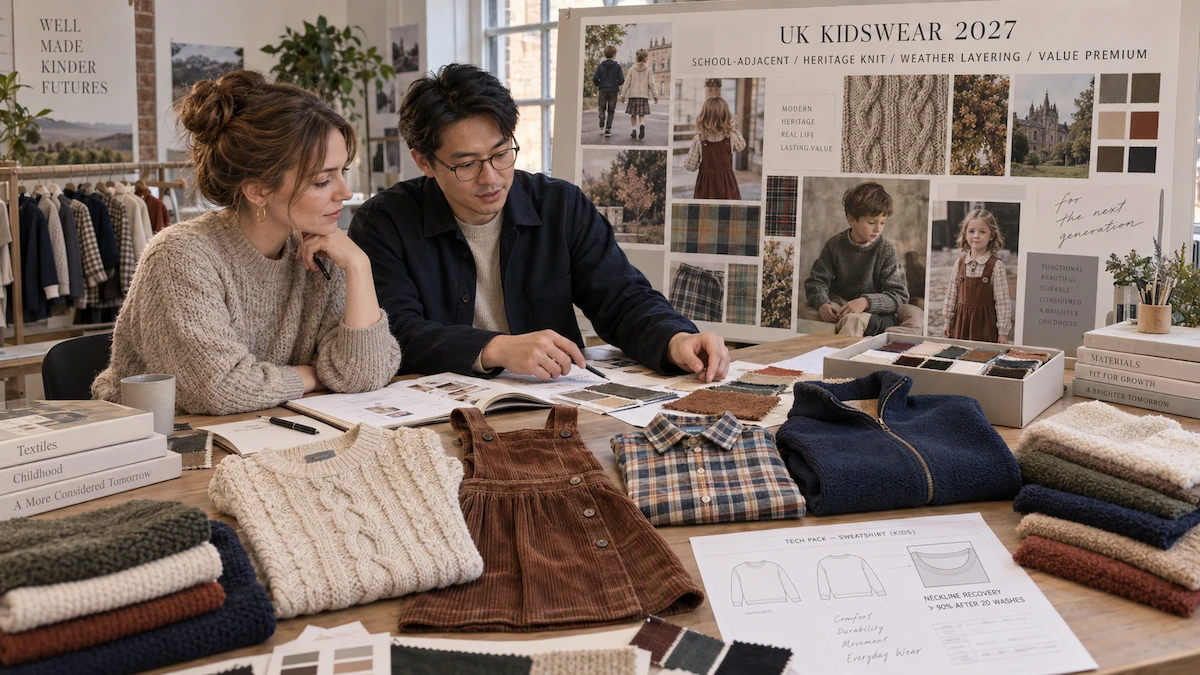
Four directions are landing in the UK for 2027: school-adjacent everydaywear built on durable knit and woven separates; heritage-influenced pieces such as knitwear, corduroy and checked wovens; weather-driven layering, where outer layers and brushed-back mid-layers do the commercial work; and value-premium basics, where the whole proposition rests on construction quality rather than print. The UK-specific twist is that all four are judged against a strong domestic quality benchmark, so fabric behaviour and finishing carry more weight than novelty.
What separates the UK from its neighbours is not the styling — it is the expectation of finish. British parents and buying teams read quality from the inside of a garment: seam finish, neckline recovery, the way a hem sits after a wash. A range that photographs well and finishes loosely does not hold a mid-market price in the UK for long.
| Direction | What it looks like in a garment | What UK production demands |
|---|---|---|
| School-adjacent everydaywear | Knit tops, pull-on bottoms, pinafores and simple woven separates in repeatable colourways | Construction that survives frequent washing and repeated wear, with a stable size run |
| Heritage-influenced pieces | Knitwear, corduroy, checked wovens, cable and rib textures, contrast trims | Texture consistency and pattern matching on checks — both are visible quality signals |
| Weather-driven layering | Brushed-back mid-layers, zip-front styles, lightweight outer layers, hooded pieces | Hardware selection and cord-rule awareness, decided by garment category and age band |
| Value-premium basics | Few styles, deep colour and size coverage, high repeat potential | Neckline recovery, waistband consistency and colour consistency across restocks |
The commercially strongest position for a first UK range is depth rather than breadth: a small number of styles carried properly across colour and size, on one or two fabric platforms. UK wholesale and DTC both reward a range that can be restocked identically, and both punish a range whose colour drifts between production runs.
2. Why does it matter in the UK?
Four forces: the GB market is now regulated separately from the EU, so UK and EU versions of the same range are no longer interchangeable products; British buyers apply a high domestic quality benchmark and read construction rather than print; the climate makes layering and outer layers commercially significant rather than seasonal extras; and school-adjacent demand gives the UK a dependable volume base that rewards restock consistency over novelty.
Market signalWe read the UK direction from the same four source types we use across this cluster: colour and material forecasting services, UK retail and wholesale assortments, sector trade media and seasonal buying briefings, and Nuohua’s own sampling and production data on UK-bound orders. No single source is a conclusion — and none of them tells you whether a direction is producible at your price point.
Nuohua manufacturing viewA UK range only becomes a plan once it answers the second question: can it be produced repeatedly, in the full size run, at a quantity that makes commercial sense, and does it carry the safety and labelling position the GB market requires — separately from whatever the same style needs for the EU?
- Regulatory separation is now a product decision. Placing the same range in GB and the EU means two labelling positions, two safety regimes and, for nightwear, two different standards frameworks. That has to be designed into the label component, not added at the warehouse.
- Quality is read from the inside. The UK benchmark for mid-market childrenswear is set by long-established domestic and high-street brands. Seam finish, neckline recovery and the behaviour of a hem after washing are the visible tells, and they are all decided in the specification.
- The climate carries the assortment. Layering and outer layers are not a seasonal add-on in the UK, they are the commercial core for a large part of the year. That makes hardware and cord-rule awareness a routine part of UK range planning.
- School-adjacent demand rewards dependability. A significant share of UK kidswear volume sits around the school year and everyday uniform-adjacent wear. Restock colour consistency matters more here than in markets driven by a trend cycle.
3. Which products should UK buyers produce differently?
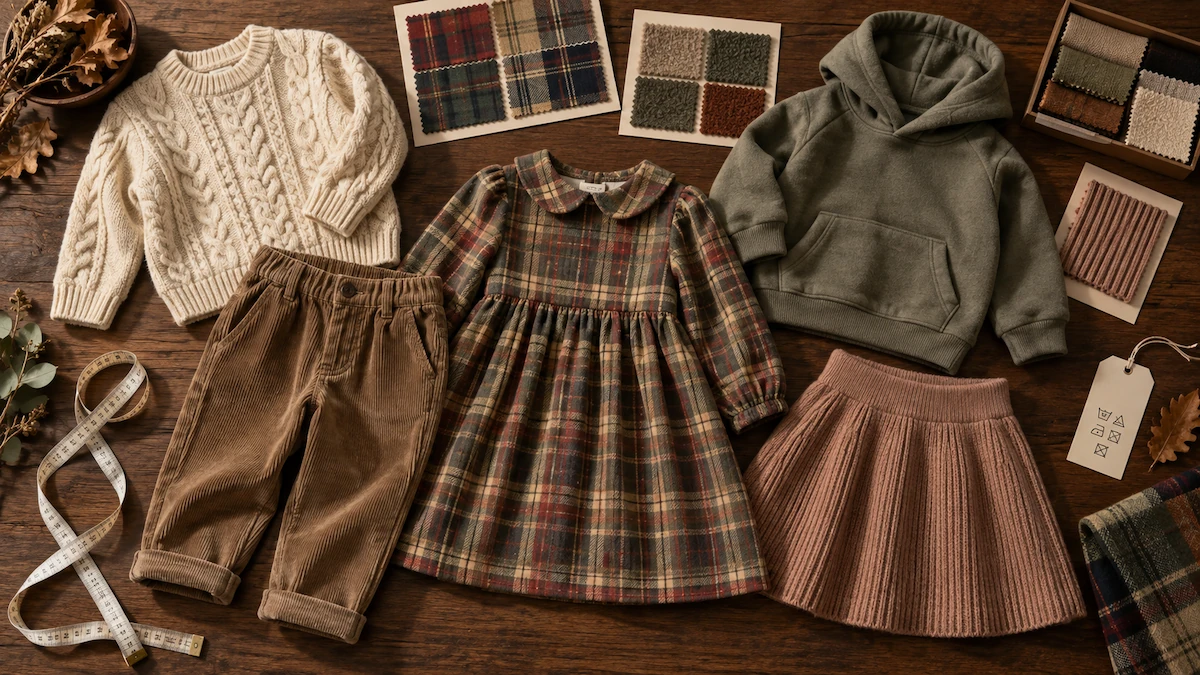
Produce: knit tops and dresses with specified neckline recovery, pull-on bottoms with a defined waistband, brushed-back mid-layers, zip-front styles with defined hardware, and heritage knits with texture specified by reference swatch. Review carefully before producing: any cord or tie on a hood or neckline, checks and stripes that cannot be pattern-matched at the seam, ranges whose colour must be identical across restocks, and nightwear without the UK-specific framework being confirmed.
| Produce this | Review before producing | Why |
|---|---|---|
| Knit tops and dresses with a specified neckline recovery target | Ribbed necklines specified only as “rib” | An unsupported neckline opens after a few wears and reads as poor quality in a market that checks for it |
| Pull-on bottoms with a defined finished waistband width | Elastic specified by type without a finished width | Waistband behaviour is the most common fit complaint in children’s bottoms |
| Zip-front and hooded layering with age-appropriate hardware | Cord and drawstring specified without reference to garment category | Cord rules apply by garment category and age band, not as a single blanket rule |
| Heritage checks and stripes with a pattern-matching requirement | Checks and stripes cut without a matching instruction | Visible pattern break at the seam is read immediately as a quality failure |
| Texture specified by reference swatch and a named standard | Texture described only as “chunky” or “soft” | Without a reference, the same style arrives with a different hand feel on the next order |
| Colour standardised for restock repeatability | Colour matched loosely because “it’s a basic” | Restock shade drift is a returns issue in a market that buys the same basic repeatedly |
| Nightwear with the UK nightwear framework confirmed first | Nightwear labelled on the assumption that the EU route applies | The UK has its own nightwear safety regulations and standard, separate from the EU approach |
The most common UK range mistake we see is assuming an EU-ready range is also GB-ready. The product can be identical — but the label position, the nightwear framework and the conformity route are not. Ranges that plan for both markets at the label stage pay one setup cost; ranges that plan for the EU and discover GB afterwards pay for a second label print and, in nightwear, potentially a second test scope.
4. What should buyers change in the tech pack?
Five changes: state whether the garment is for GB, the EU or both, because the labelling and conformity position differs; specify neckline recovery and waistband width as measurable values; set the care instruction before fabric approval and treat it as the wash-test condition; confirm the nightwear framework before the style is graded; and require a reference swatch for any texture or hand-feel claim.
| Change | Current practice | Change to | Why |
|---|---|---|---|
| Market of sale | “EU” assumed to cover the UK | Stated explicitly: GB, EU, or both — and the label designed for each | The GB market is regulated separately; the same garment can need a different labelling position |
| Neckline and waistband | Specified by component name only | Specified with a recovery target and a finished width | These are the two most visible quality signals in the UK mid-market |
| Care instruction | Decided after fabric approval | Fixed before fabric approval and used as the wash-test condition | Shrinkage, colourfastness and trim behaviour are only meaningful against a defined condition |
| Nightwear | Patterned before the framework is confirmed | Framework confirmed on the tech pack, before grading | Nightwear has its own regulations and fabric standard, and the route is not identical to the EU approach |
| Texture and hand feel | “Chunky knit”, “soft fleece” | A reference swatch plus a named construction or weight | A description is interpreted differently at sampling and at bulk, producing two different products |
Of these, the market-of-sale statement is the one that saves the most money. It costs one line on a document and determines the label component, the conformity route and, for nightwear, the applicable standard. Our apparel compliance checklist sets out the wider set of items to confirm before production.
5. Production feasibility
Feasibility is high for cotton and cotton-rich knits, brushed-back sweatshirting and simple woven separates, and medium-high for zip-front layering once hardware is specified by age band. It drops for checks and stripes that must be pattern-matched at every seam, for texture-heavy knits without a reference swatch, and for nightwear where the framework was not confirmed before grading. The recurring UK risks are neckline recovery, waistband consistency, pattern matching and restock shade drift.
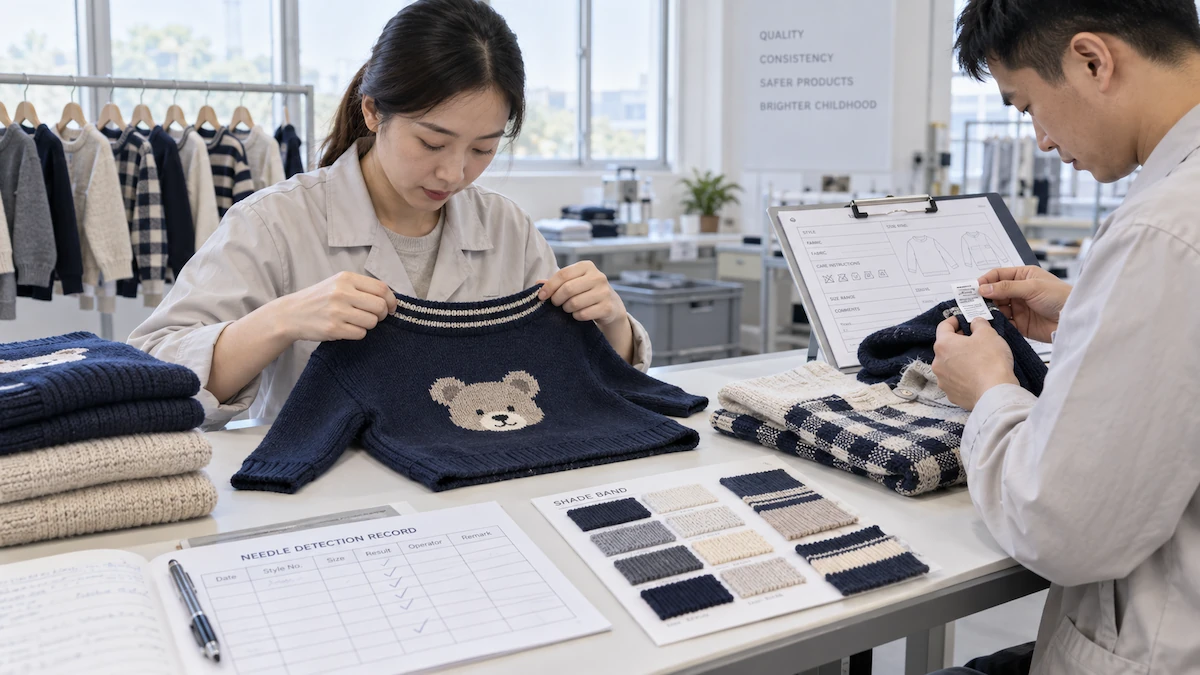
Seven checks we run before sampling on a UK-bound range:
- Market position. Is this range for GB, the EU or both — and does the label component reflect that?
- Neckline recovery. Is there a measurable recovery target, or only a ribbed construction?
- Waistband definition. Is the finished width specified rather than the elastic type alone?
- Pattern matching. For checks, stripes and engineered prints, is a match requirement written at every visible seam?
- Texture reference. For any hand-feel claim, is there a reference swatch and a named construction or weight?
- Cords and hardware. For any cord, tie or functional string, has the applicable rule been confirmed for the specific garment category and age band?
- Restock repeatability. Can the same colour and hand feel be reproduced on a second order, and against what standard?
| Element | Feasibility | Note |
|---|---|---|
| Cotton and cotton-rich knit tops and dresses | High | Standard production; neckline recovery specification is the main control point |
| Brushed-back mid-layers and sweatshirting | High | Brushing depth must be specified by reference to avoid drift between orders |
| Pull-on bottoms with a defined waistband | High | Predictable once finished width and stretch target are stated |
| Zip-front layering with specified hardware | Medium-High | Hardware retention and age-band selection are the risks, not the sewing |
| Textured and cable knits | Medium | Requires a reference swatch and a named construction; hand feel drifts without one |
| Checks and stripes requiring seam matching | Medium | Fabric consumption rises and every seam becomes a control point |
| Nightwear without the framework confirmed before grading | Not recommended | Fit and fabric selection follow from the applicable standard; retrofitting them is a re-do |
6. Fabric & construction
The 2027 UK base is built on cotton single jersey and interlock for everyday knitwear, 1×1 and 2×2 rib for necklines, cuffs and trims, brushed-back fleece and loopback terry for layering, and corduroy and plain-weave wovens for heritage-influenced pieces. Cotton-rich blends dominate because they wash predictably and hold the mid-market hand feel. The failure modes are neckline recovery, waistband collapse, pattern-match break at seams, texture drift between orders and shade drift on restock.
Fabric direction. Cotton interlock gives a stable, smooth surface that holds a print and a neckline well, which makes it the safest base for a first UK range. Single jersey is lighter and cheaper and less forgiving at the neckline unless the rib is specified with recovery in mind. 2×2 rib carries the heritage texture direction and is the base where hand feel is most easily lost between orders without a reference swatch. Loopback terry is more durable than brushed fleece and slightly less soft; brushed fleece is softer and needs a defined brushing depth. Corduroy carries the heritage story well but adds a nap direction that affects cutting efficiency and shading. We cover base behaviour in our fabric weight guide and knit comparisons in our interlock versus jersey guide; this article only states which base fits which UK direction.
Construction and failure modes
- Neckline recovery. The most visible UK quality signal and the cheapest to control. A ribbed neckline must be specified with a recovery target and a finished width; without them the same style arrives with a neckline that opens after two wears.
- Waistband collapse and roll. Caused by a finished width that was never stated, or by a channel narrower than the elastic after the seam allowance. Specify the finished width, not the elastic width.
- Pattern-match break. On checks and stripes, an unmatched seam is read immediately. The requirement has to be written at every visible seam and priced into fabric consumption, because matching increases the cut requirement.
- Texture drift between orders. Brushed and ribbed surfaces are specified by feel. A reference swatch and a named construction turn a subjective property into a repeatable one.
- Shade drift on restock. UK basics are bought repeatedly, so a small shade difference between production runs becomes a returns problem. A shade band tolerance agreed before bulk is the control.
- Hardware and cords. Zip pulls, toggles and any cord on a garment for younger children need a defined attachment strength — and any cord needs the applicable rule confirmed by garment category. Our elastic waistband guide and bound versus flatlock seam guide cover two of the components most often under-specified.
7. MOQ, cost and lead time
UK-facing ranges are usually built on From 150–300 pcs per color on selected styles, depending on fabric, size range and customization requirements, mixable across styles and colours. Custom dyeing is reviewed case by case; MOQ is confirmed after reviewing fabric composition, GSM, yarn count, size range, artwork, print method, construction and other customization requirements. Cost is driven by pattern matching, fabric platform count, texture specification and hardware; lead time is driven by lab-dip approval, label artwork and the seasonal window the range is aimed at.
| Route | MOQ |
|---|---|
| Stock fabric + existing colour | From 2 pcs on selected in-stock styles, colors and sizes (styles, colors and sizes mixable) |
| Custom dye (Pantone / lab dip) | Reviewed based on fabric and colour |
| Custom fabric development | Quoted separately, per fabric and colour |
| Sleepwear and loungewear sets | From 1,000 sets per design |
| Baby sizes 50–90 (set programmes) | From 150–300 pcs per color on selected styles |
Five cost levers, in the order they usually move a UK price:
- Pattern matching. A check or stripe that must match at every visible seam increases fabric consumption and cut time. It is a real cost line and it should be quoted, not discovered.
- Fabric platform count. Two platforms instead of five reduces testing, approval and minimum-quantity exposure at once.
- Texture specification. A reference swatch costs nothing to provide and prevents a second sample round, which is the most expensive form of ambiguity.
- Hardware specification. Defined, age-appropriate hardware costs marginally more per unit and removes a category risk worth considerably more than the difference.
- Colour coverage. Depth across fewer colours is cheaper to approve and easier to restock consistently than breadth across many.
Lead-time chain: fabric sourcing → lab dip (if custom colour) → prototype → fit and construction approval → label artwork → pre-production sample → bulk → QC → freight. For a UK range, the two steps that most often move a launch date are colour approval for a restock-critical basic and label artwork where the range serves both GB and the EU. Working backwards from the retail window is the only reliable way to set the brief date. Our production timeline case study walks through the sequence, and our Incoterms guide covers the shipping terms side.
8. UK market & compliance considerations
Four points decide most UK kidswear questions. General product safety in Great Britain sits under the General Product Safety Regulations 2005. Children’s nightwear is covered by the Nightwear (Safety) Regulations 1985, with BS 5722 setting the flammability performance requirement for the fabrics used. Textile fibre composition labelling continues to apply in the UK under the retained labelling rules. And the GB market is regulated separately from the EU, which means the EU route cannot be assumed to cover it.
General product safety. In Great Britain, the general safety obligation for consumer products sits under the General Product Safety Regulations 2005, which places duties on producers and distributors to supply safe products and to provide relevant information and documentation. For a brand sourcing from an overseas manufacturer, the practical consequence is that the information trail — what the product is, what it is made of, and who placed it on the market — has to be assemblable. That is a documentation discipline that runs alongside the product itself, not a certificate attached to a fabric.
Children’s nightwear. The UK has its own nightwear framework rather than adopting the EU approach. The Nightwear (Safety) Regulations 1985 govern children’s nightwear placed on the UK market, and BS 5722 sets the flammability performance requirement for the fabrics used in that context. Both the applicable standard and the labelling position should be confirmed for the specific garment and age band before the style is graded — because fit and fabric selection follow from them. Our pajama and sleepwear trends guide covers the construction and fit implications of getting that decision right, and best fabrics for kids’ pajamas covers the fabric side.
Textile labelling. Fibre composition labelling continues to apply in the UK under the retained textile products labelling rules, which derive from the same framework the EU still applies. In practice this means the composition statement, the fibre names and the durability and legibility requirements of the label remain part of placing a garment on the UK market. Where a range sells in both GB and the EU, the sensible approach is a single label component designed to satisfy both positions rather than two separate print runs. Our guide to fibre label checks covers the checks buyers run, and our printed versus sewn-in label guide covers the construction side.
Standards designations. Many of the harmonised European standards used in apparel work are published in the UK as BS EN versions, which is why the same technical content often appears under two designations: an EN number in EU documentation and a BS EN number in UK documentation. The content is aligned; the designation and the citation are not interchangeable, and a certificate citing one designation should not be assumed to satisfy a request written against the other. The same applies to chemical restrictions: the UK operates its own regime, and a restricted-substance request written against EU REACH should be read against the regime it was written for rather than assumed to carry across. Restricted-substance testing of dyed and printed components is examined in our azo dyes and heavy metal testing guide.
9. Nuohua’s 20-year manufacturing view
Two decades in children’s apparel tell us that UK ranges fail on finish and repeatability, not on styling. Specify neckline recovery and waistband width numerically, confirm the GB market position on the tech pack, and treat restock colour as a specification — then the range holds the price it was priced at.
- Neckline recovery is the cheapest quality signal there is. A recovery target and a finished rib width take two lines in a tech pack. Without them, the same style will pass sampling and fail after four wears — and the customer will not describe it as a neckline problem, they will describe it as a cheap garment.
- Texture without a reference will drift. Brushed fleece, 2×2 rib and corduroy are specified by feel, and feel is subjective across mills and seasons. We now require a reference swatch on every order where hand feel is part of the selling proposition, because it is the only way a second order arrives looking like the first.
- Pattern matching is a cost, so quote it. Buyers sometimes assume a check will match because a competitor’s does. Matching consumes extra fabric and extra cut time; the honest approach is to price the matching requirement into the brief rather than to promise it and absorb the shortfall.
- The GB and EU positions are two products on paper. The garment can be identical. The label component, the conformity route and the nightwear framework are not. Ranges that plan both at the label stage pay one setup cost; ranges that plan the EU first and discover GB afterwards pay for a reprint.
One question we would reframe. “Which 2027 direction sells in the UK?” is the wrong first question. The right first question is “which direction can this range carry at this price, in this size run, at this finished quality — and on which market’s labelling and safety position?” — because a garment that finishes well but is labelled for the wrong market is still not shippable.
10. Buyer checklist
Eleven checks before briefing a 2027 UK range: market position stated as GB, EU or both; neckline recovery specified as a target; waistband specified by finished width; care instruction fixed before fabric approval; pattern matching quoted and required; texture backed by a reference swatch; cord and hardware rules confirmed by garment category; nightwear framework confirmed before grading; restock colour standard agreed; label component designed for both markets; and lead time mapped backwards from the retail window.
- Is the market position stated explicitly — Great Britain, the EU, or both — with a label component designed for each?
- Is there a measurable neckline recovery target, not just a ribbed construction?
- Is the waistband specified as a finished width with a stretch target?
- Is the care instruction fixed before fabric approval, and is the wash test run at that exact condition?
- For checks, stripes or engineered prints, is a pattern-match requirement written at every visible seam — and has the extra fabric consumption been quoted?
- Does every texture or hand-feel claim have a reference swatch and a named construction or weight?
- For any cord, tie or functional string, has the applicable rule been confirmed for the specific garment category and age band?
- If the style is nightwear, has the UK nightwear framework been confirmed before the pattern was graded?
- Is a shade band tolerance agreed so a restock matches the first production run?
- Has the label component been designed once to satisfy both the GB and EU positions where both are needed?
- Is the lead-time chain mapped backwards from the retail window, including colour approval and label artwork?
11. Related manufacturing guides
12. Turn the trend into a production plan
Turn the 2027 UK direction into a range that finishes as well as it photographs.
Send us your reference images, the market you are selling into and your target price point. We will return a feasibility read on construction, neckline and waistband specification, texture control and pattern matching, plus the labelling questions that need answering before sampling.
Or reply with your tech pack — see our tech pack guide.
Standards verified as of 2026-09; regulations change — confirm with a qualified laboratory or qualified counsel before ordering. This article is a Nuohua buyer-side assessment, not compliance advice or an industry standard. Nuohua Garment — kidswear OEM & ODM manufacturer since 2016.