
The Safe Kids’ Underwear Buyer’s Guide: What to Look For (and What to Avoid)
When you source kids’ underwear as a brand owner, Amazon seller, or boutique buyer, “safe” is not a marketing word — it is a sourcing specification. Children wear underwear against the most sensitive skin on their body for ten to fourteen hours a day. A fiber, dye, or trim that is harmless on an adult’s outerwear can cause irritation, rashes, or allergic reactions when it sits directly against a toddler’s skin. This guide gives you a practical checklist for choosing skin-safe, non-toxic kids’ underwear and for spotting the red flags that quietly put children (and your brand reputation) at risk.
Why Skin-Contact Safety Matters for Kids’ Underwear
A child’s skin is not just “smaller adult skin”
Children’s skin is thinner, more permeable, and still developing its barrier function. Pediatric dermatology references consistently note that infant and toddler skin absorbs substances more readily and loses moisture faster than adult skin. That is exactly why regulations around the world treat “products in direct contact with skin” — especially children’s underwear, sleepwear, and baby basics — as a higher-risk category than a hoodie or a tote bag.
For a brand, the practical takeaway is simple: the closer a garment sits to the skin and the longer it stays there, the stricter your fiber, dye, and trim standards must be. Underwear is the single most demanding category you can put your label on.
The cost of getting it wrong
A safety miss on kids’ underwear is not just a return. It can trigger a marketplace removal, a compliance inquiry, or a reputational hit that is hard to undo. The good news: most problems are predictable and preventable at the sourcing stage. If you know which fibers are safest, which labels actually mean something, and which red flags to reject at the sample stage, you remove the overwhelming majority of risk before a single unit reaches a customer.
The Safest Fibers for Kids’ Underwear
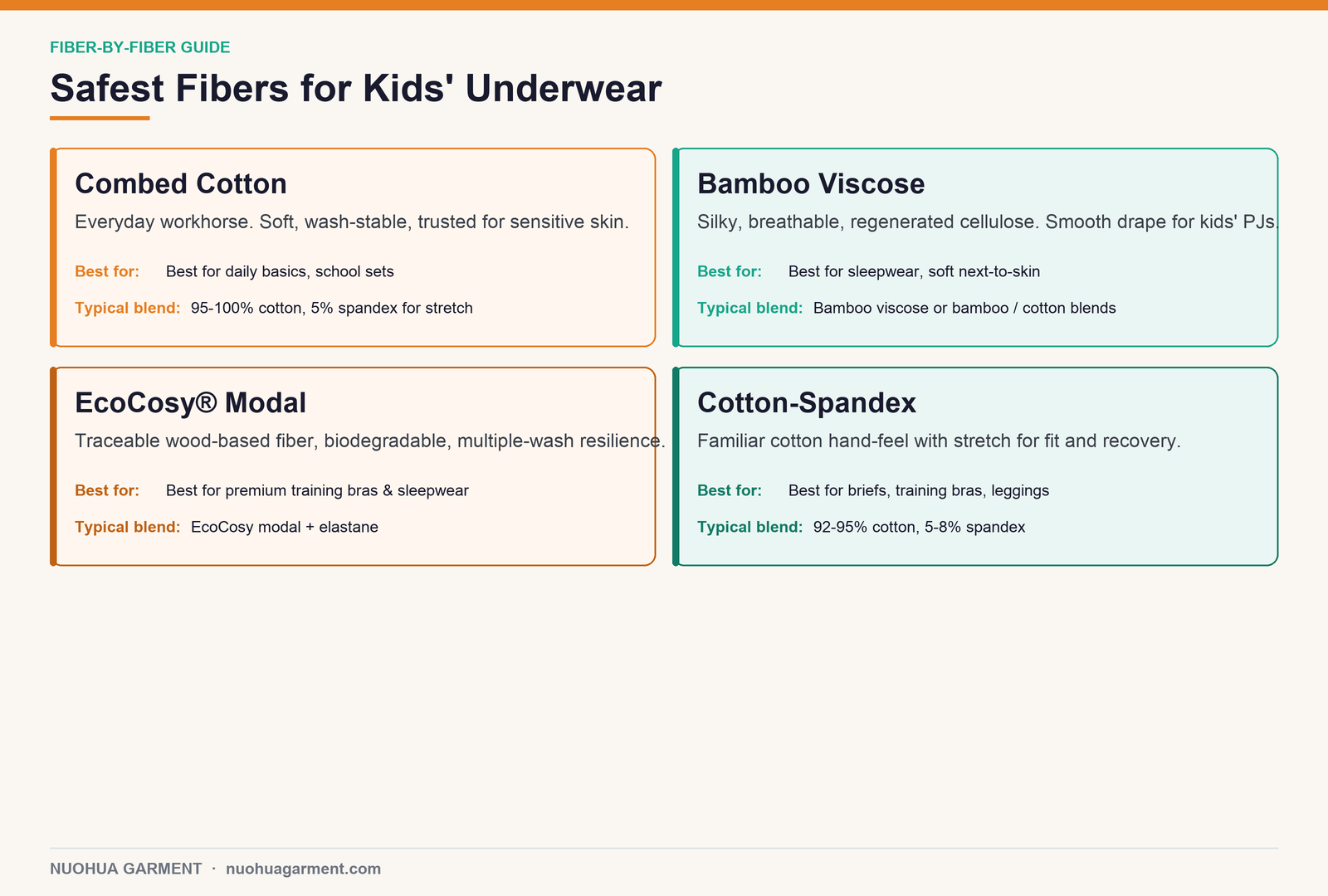
Fiber choice drives everything else. Below are the four fiber families we recommend most often for children’s skin-contact wear, with the honest trade-offs of each.
Combed cotton — the everyday workhorse
Combed cotton is regular cotton that goes through an extra combing step before spinning. Fine brushes pull out the shortest, weakest fibers and any remaining impurities, leaving only the longest, strongest strands. Industry sources estimate combing removes roughly 15–20% of the raw material. The result is a smoother, stronger, more pill-resistant yarn that feels soft from the first touch and stays that way wash after wash.
For underwear, that matters twice over: fewer short fibers means less surface fuzz that can rub sensitive skin, and the stronger yarn holds its shape better through repeated laundering. When a mill offers “100% cotton,” ask whether it is combed or merely carded — the difference is felt by the wearer on day one.
See our fiber-by-fiber comparison in Combed Cotton vs Cotton–Spandex Kids’ Underwear for a deeper look at how the two perform in real production.
Bamboo viscose — soft, breathable, regenerated cellulose
Bamboo viscose (often labeled “bamboo rayon” or “bamboo viscose”) is a regenerated cellulosic fiber. The bamboo plant is processed into a pulp, dissolved, and spun into smooth, rounded filaments. Its hand-feel is silky and cool, and it typically has strong moisture-wicking behavior — useful for active kids and warmer climates.
Two honest notes. First, “bamboo” on a label describes the plant source, not the process; the fiber is technically a viscose/rayon, so the environmental story depends entirely on the mill’s chemistry and wastewater controls. Second, bamboo viscose is usually weaker when wet than cotton, so it is often blended or used in knits rather than as a standalone structural fabric. We cover knit vs woven trade-offs in Knit vs Woven Fabric for Kids’ Underwear.
EcoCosy® modal — traceable, biodegradable wood-based fiber
EcoCosy® is a licensed, wood-based regenerated-cellulose fiber (a modal/lyocell-type fiber) made from responsibly sourced, FSC/PEFC/CFCC-certified plantation wood pulp. It is fully biodegradable, carries USDA bio-based certification, and is built around a traceable, closed-loop supply chain. For brands that want a premium, silky, highly breathable fiber with documentation behind the sustainability claim, EcoCosy® is one of the strongest options we offer — and Nuohua holds EcoCosy® fiber authorization, so we can supply it with the proper licensing and traceability records.
Its rounded cross-section makes it gentle against skin, and it keeps its softness through repeated washing better than generic viscose. For a deeper technical dive, see What Is Modal Fabric? EcoCosy® for Kids’ Clothing.
Cotton–spandex blends — stretch without compromise
Underwear needs recovery — it has to stretch with movement and snap back without riding up or bagging out. A small percentage of spandex (typically 5–8%) added to combed cotton delivers that recovery while keeping the skin-contact surface mostly natural fiber. The safety question is not the spandex itself but the quality and coverage of the elastane: thin, poorly cured elastic breaks down faster and can expose skin to degraded polymers and dyes.
Our rule of thumb: keep the spandex content low, source elastane from a named, tested supplier, and confirm it survives the wash-cycle count your size chart promises. The cotton–spandex article linked above breaks down exact blend ratios we use by age group.
| Fiber | Why it’s skin-safe | Best use | Watch-outs |
|---|---|---|---|
| Combed cotton | Long, smooth fibers; low fuzz; strong, pill-resistant | Everyday briefs, boxers, bodysuits | Confirm “combed,” not just “cotton” |
| Bamboo viscose | Silky, cool, wicks moisture; regenerated cellulose | Warm climates, sensitive skin, sleep-adjacent knits | Weaker when wet; mill chemistry matters |
| EcoCosy® modal | Traceable wood pulp; biodegradable; soft, durable | Premium lines, training bras, seamless knits | Licensed fiber — confirm authorization |
| Cotton–spandex | Natural fiber face + low elastane for recovery | Any style needing stretch and shape retention | Keep spandex low; test elastic durability |
What Certifications and Labels Actually Mean for Safety
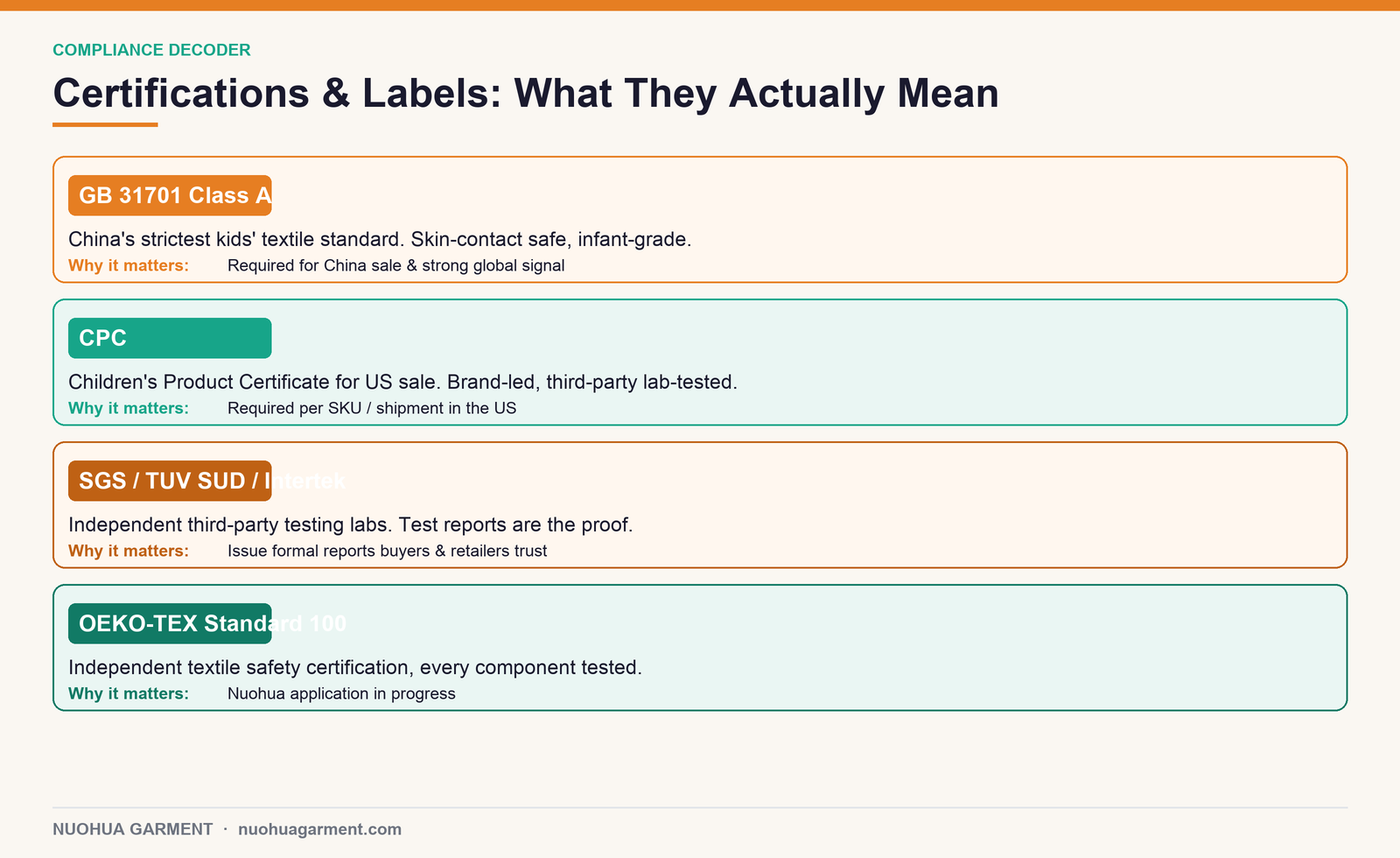
Certification labels are only useful if you know what each one proves — and what it does not. Here is the honest reading for the marks that matter on children’s underwear.
GB 31701 Class A — China’s strictest kids’ textile standard
GB 31701 is China’s mandatory national standard for textile safety technical codes for infants and children. It sorts products into Classes A, B, and C, where Class A is the strictest tier and applies to infant/children’s products in direct contact with skin. It sets limits on harmful substances, including certain azo dyes, formaldehyde, pH, and color fastness. Nuohua holds GB 31701 Class A compliance for skin-contact children’s wear, which means the base construction, dyes, and finishing we use are validated against that stricter threshold rather than the looser Class B/C limits.
CPC — the US Children’s Product Certificate context
In the US, children’s apparel generally falls under the Consumer Product Safety Commission framework, and a Children’s Product Certificate (CPC) is required for items sold to kids. It is important to get the roles right: Nuohua supplies the third-party test data and a compliant garment; the importer or brand issues the CPC based on that testing. We do not issue the CPC ourselves — we arm you with the SGS/TÜV/Intertek reports that make issuing one straightforward. For the full picture, see our Children’s Product Certificate (CPC) Guide for Kids’ Underwear.
Third-party testing through SGS, TÜV SÜD, and Intertek
The most reliable safety signal is not a logo on a hangtag — it is a test report from a recognized third-party laboratory. Nuohua coordinates testing through partners including SGS, TÜV SÜD, and Intertek for parameters such as color fastness, pH, formaldehyde, and restricted substances. A real report names the standard (e.g., GB 31701 Class A, 16 CFR references), the tested sample, and the lot. Treat any “tested for safety” claim without a named lab and a retrievable report as unverified.
OEKO-TEX Standard 100 — in progress at Nuohua
We are advancing OEKO-TEX Standard 100 certification (in progress) and are building our processes toward it; we are not yet certified, and we will not claim to be until the certification is granted. Where you see EcoCosy® fabric referenced, note that the fiber itself carries its own upstream certification — but that is the fiber’s status, not a claim that a finished Nuohua garment is OEKO-TEX certified today. We will update the market the moment our own certification is confirmed.
Red Flags to Avoid When Sourcing Kids’ Underwear
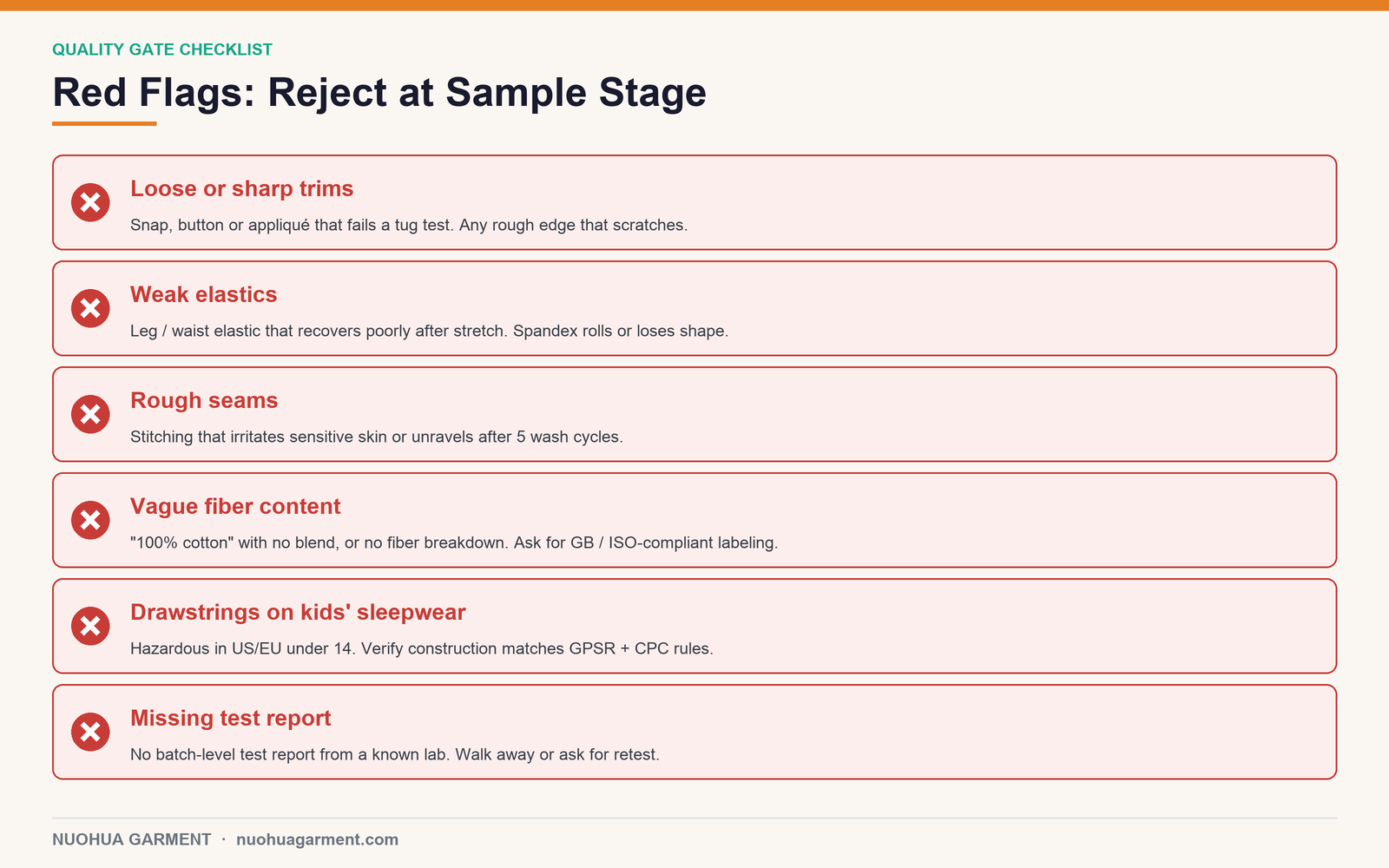
These are the issues we reject at the sample and bulk stage — and that you should reject too.
Loose trims, weak elastics, and rough seams
Any trim that can detach is a choking and irritation hazard for small children, and a rough or poorly finished seam is a direct rub point against skin worn all day. Check that waistband elastics are encased (not exposed against skin), that labels are printed or soft-backed rather than scratchy woven tags, and that flatlock or covered seams sit away from high-friction zones. If a sample’s elastic already looks stretched or the stitching already puckers, the bulk will be worse.
Mislabeled or vague fiber content
A fiber-content label that reads “mixed,” “cotton-rich,” or omits percentages is a compliance problem in most markets and a trust problem for your customers. The label must state each fiber by percentage, in descending order. Mislabeling is also how restricted-substance risks hide: if a mill will not commit to exact fiber composition, it is unlikely to commit to the dye and finishing chemistry either. Hold your manufacturer to exact, contract-matched fiber claims.
Drawstrings and hazardous details on kids’ sleepwear
Drawstrings at the waist or neck of children’s sleepwear and some apparel categories are a recognized hazard and are restricted in several major markets. Even when a style is “underwear-adjacent,” avoid adding functional drawstrings to kids’ nightwear or loose sleep sets. Our Kids’ Underwear & Sleepwear Compliance Checklist walks through the details by market so you do not ship a non-compliant feature by accident.
How to Read a Care and Fiber Label
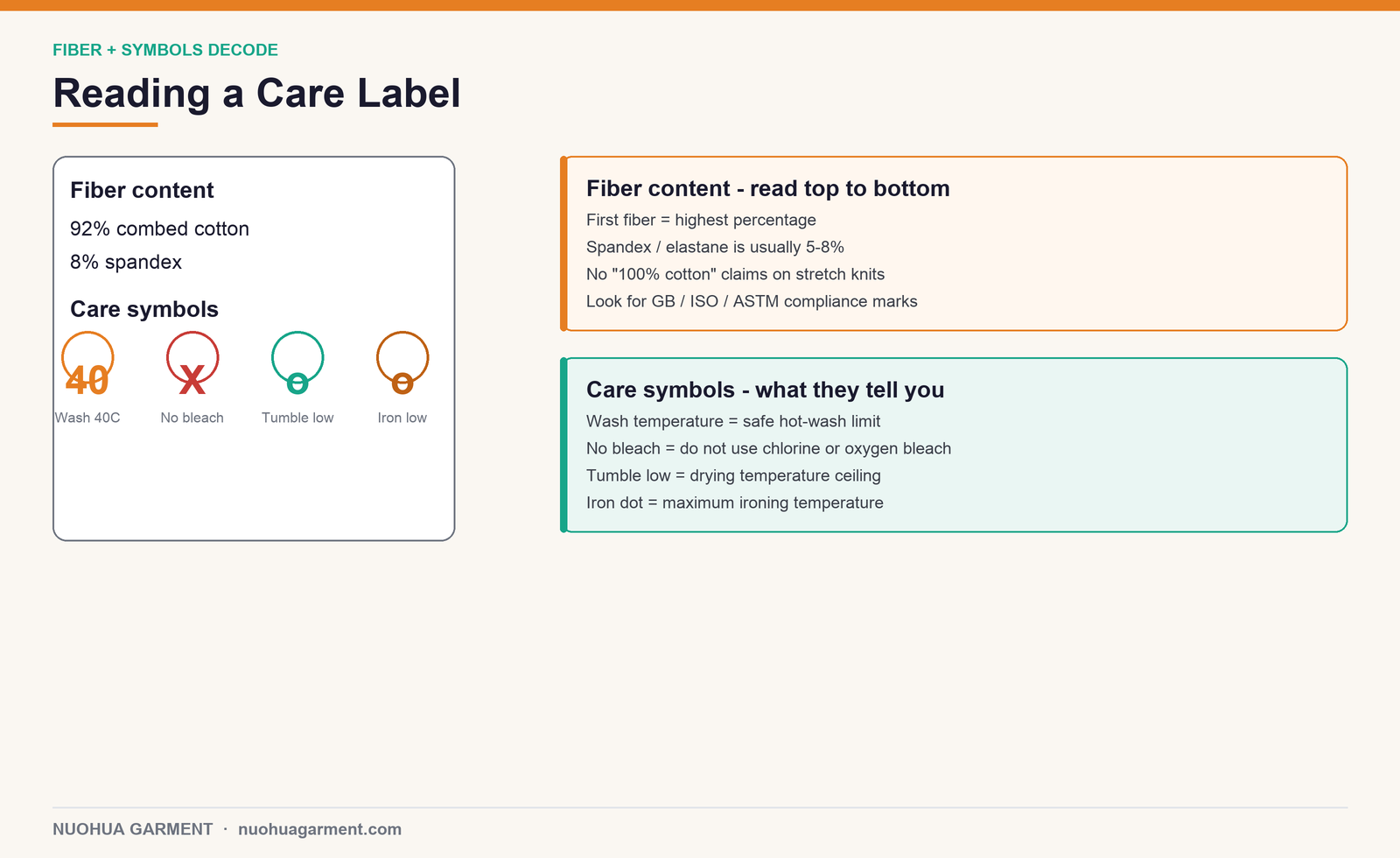
Fiber content — read it top to bottom
The fiber line is the single most important piece of safety information on the garment. Read it as a specification:
- Order matters. Fibers are listed by descending weight percentage. The first fiber is the majority content.
- Percentages must sum to ~100%. If they do not, the label is wrong or incomplete.
- Named fibers only. “Combed cotton,” “bamboo viscose,” “modal (EcoCosy®),” and “spandex” are specific. “Other fibers” or blank spaces are not acceptable for skin-contact kids’ wear.
- Match the contract. The bulk label should match the fiber claim in your tech pack and the tested sample exactly.
Care symbols and what they tell you
Care symbols are a safety proxy, not just laundry advice. A low recommended wash temperature, a “do not bleach” mark, and a gentle-tumble instruction usually signal dyes and finishes chosen to stay stable — which also means fewer substances migrating onto skin. If a garment is labeled for harsh industrial wash but is sold as daily kids’ underwear, question whether the dye chemistry was selected for skin safety or just for speed.
Washing for Safety: From Factory to First Wear
Pre-wash before first wear
Even compliant garments can carry trace finishing residues from cutting, sewing, and packing. A gentle wash before first wear removes surface processing chemicals and any loose dye. For sensitive-skin children, this single step removes a meaningful share of first-wear irritation complaints. We recommend a plain, fragrance-free cycle at the temperature the care label allows.
Detergent and temperature choices
Choose a free-and-clear detergent with no added fragrance or dyes, and avoid fabric softeners — they deposit residues precisely on the fabric layer touching skin. Warm (not hot) washes clean effectively while protecting elastane recovery. Overly hot cycles accelerate elastic breakdown, which is how degraded polymer and trapped dye eventually reach skin. Dry away from direct high heat to preserve both the fiber and the elastic.
Frequently Asked Questions
What is the safest fiber for kids’ underwear?
For most children, combed cotton is the safest everyday choice: long, smooth fibers with low surface fuzz and strong, pill-resistant construction. Bamboo viscose and EcoCosy® modal are excellent softer, more breathable alternatives, and a low-spandex cotton blend adds needed recovery. The “safest” fiber is the one that is correctly processed, correctly labeled, and third-party tested.
Is “bamboo” underwear actually natural?
Bamboo describes the plant source, but most bamboo underwear uses bamboo viscose — a regenerated cellulosic fiber made by dissolving bamboo pulp and spinning it. It is plant-derived and biodegradable, but it is a manufactured fiber, not a raw plant fiber like linen. Judge it by the mill’s chemistry and the test report, not by the word “bamboo” alone.
What does GB 31701 Class A mean on a label?
It means the product meets China’s strictest textile safety tier for infant/children’s items in direct skin contact, with tighter limits on harmful substances, pH, formaldehyde, and color fastness than Class B or C. Nuohua holds GB 31701 Class A for skin-contact children’s wear, which is a strong baseline signal for daily underwear.
Who actually issues the CPC for US sales?
The importer or brand issues the Children’s Product Certificate; the manufacturer supplies the underlying third-party test data. Nuohua provides SGS/TÜV/Intertek test reports so you can issue a defensible CPC — but we do not issue the CPC ourselves.
Is Nuohua OEKO-TEX certified?
Not yet. We are advancing OEKO-TEX Standard 100 certification (in progress) and will announce it once granted. We will not describe a finished Nuohua garment as OEKO-TEX certified until that certification is in hand.
What label red flags should I reject at the sample stage?
Reject vague fiber content (“cotton-rich,” missing percentages), exposed or weak elastics, scratchy woven tags on skin, detached or loosely attached trims, and any drawstrings on kids’ sleepwear. Each of these is either a compliance gap or a direct skin-safety risk.
How should I wash kids’ underwear for safety?
Pre-wash once before first wear with a free-and-clear detergent, wash at the labeled temperature (warm, not hot), skip fabric softeners and fragrance, and dry away from intense heat to protect the elastic. This keeps both the fiber and the skin-contact finish stable over the garment’s life.
Can I get custom safe kids’ underwear made to my spec?
Yes. We build to your fiber, dye, and trim specification, coordinate third-party testing, and hold GB 31701 Class A for skin-contact wear. Start with a tech pack and a compliant sample before scaling to bulk — our compliance checklist is a good reference point.
Build a Safer Kids’ Underwear Line with Nuohua
Skin-safe kids’ underwear is the result of deliberate choices: the right fiber, a tested dye and finish, clean trims, honest labels, and verifiable third-party testing. At Nuohua we hold GB 31701 Class A for skin-contact children’s wear, coordinate testing through SGS, TÜV SÜD, and Intertek, and offer licensed EcoCosy® modal with full traceability. Whether you are developing seamless training bras or a first underwear program, our process is built around safety you can document.
Explore how we manufacture seamless training bras, review our full Trust Center for certifications and testing, or get a quote to start your safe, compliant kids’ underwear line today.