
What Is Bamboo Fabric for Kids’ Clothing? (And Why It’s Not What Most Brands Assume)
“Bamboo fabric” has become one of the most marketed phrases in children’s apparel — especially in sleepwear, underwear, and baby basics. Walk any trade show floor and you’ll hear “it’s natural bamboo,” “it’s antibacterial,” and “it’s the eco choice.” As a B2B manufacturer that produces bamboo-blend kids’ sleepwear for Amazon sellers and boutique brands, we think the honest version is more useful than the slogan. In this guide we explain what bamboo fabric really is, how it is made, how it compares to cotton and modal, where the sustainability story holds up (and where it doesn’t), and why it remains a strong pick for kids’ sleepwear when specified correctly.
What “Bamboo Fabric” Actually Is (It’s Not a Leaf Fiber)
Regenerated cellulose, not a raw plant fiber
The single most important fact: the “bamboo” in most bamboo clothing is a regenerated cellulosic fiber made from bamboo pulp. It is not spun directly from bamboo leaves or stalks the way flax becomes linen. The bamboo plant supplies the cellulose feedstock, but that cellulose is broken down chemically and re-formed into entirely new fibers. The finished material is structurally a type of viscose (rayon), not a natural fiber in the cotton-or-linen sense.
This matters for labeling and for truthful marketing. In the United States, the Federal Trade Commission (FTC) requires that fabric made this way be identified as “viscose from bamboo” or “rayon from bamboo” — not simply “bamboo.” A compliant care label reads “100% viscose from bamboo,” which names the fiber (viscose) and discloses the source (bamboo).
Why the distinction protects your brand
For a Western brand owner or Amazon seller, the distinction is not academic. The FTC has taken enforcement action against retailers and marketplace sellers for marketing bamboo viscose as if it were a raw natural fiber. Getting the fiber name right keeps your listings compliant and keeps claim-substantiation questions off your desk. If you are building a kids’ sleepwear program, our bamboo kids’ sleepwear manufacturer guide for Amazon sellers covers the labeling and compliance angles in more depth.
How Bamboo Viscose Is Made (The Viscose Process)
From bamboo stalk to spinnable fiber
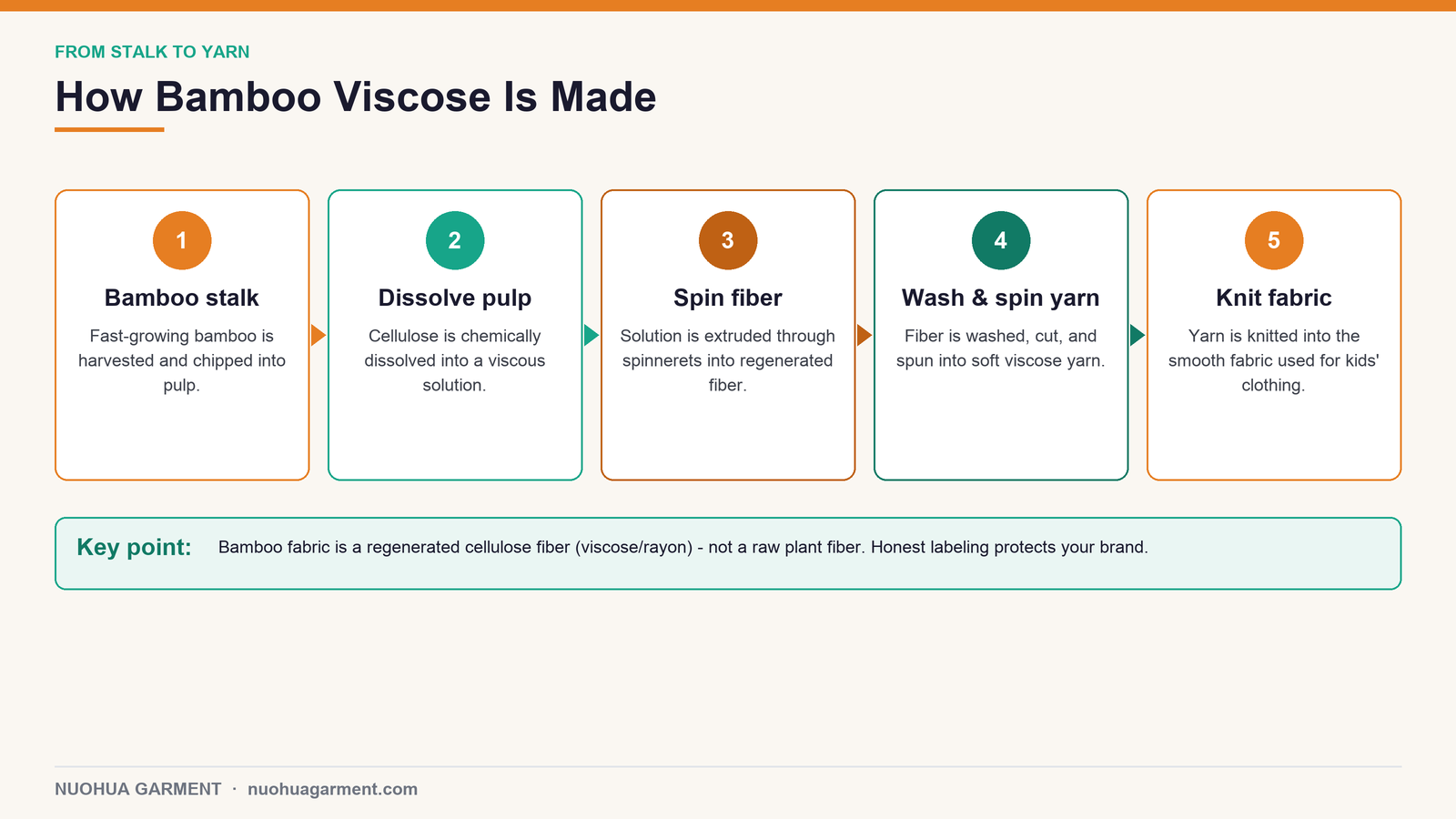
Nearly all commercial bamboo fabric follows the viscose process, a chemical regeneration route developed in the late 19th century. The broad steps are consistent across mills:
- Pulping: Harvested bamboo is chipped and processed to remove lignin, hemicellulose, and waxes, leaving refined cellulose pulp.
- Steeping: The pulp is soaked in sodium hydroxide (caustic soda), swelling the cellulose into alkali cellulose.
- Aging: The alkali cellulose is shredded and ripened to control the polymer chain length.
- Xanthation: It reacts with carbon disulfide to form cellulose xanthate — the “viscose” stage.
- Dissolution: The xanthate is dissolved in dilute sodium hydroxide into a thick, honey-like spinning solution.
- Spinning: The solution is forced through a spinneret (a plate with thousands of fine holes) into a dilute acid bath, which regenerates the cellulose into solid filaments.
- Finishing: Filaments are washed, desulfurized, dried, and spun into yarn for knitting or weaving.
The chemicals — particularly carbon disulfide and sodium hydroxide — are potent industrial reagents. Responsible mills manage them in closed-loop or partially closed systems to limit emissions and wastewater. Finished-fabric safety is independently verified by standards such as OEKO-TEX Standard 100 certification (in progress at Nuohua), which tests the final textile for harmful residues.
The lyocell alternative (closed-loop)
Not every regenerated bamboo fiber uses the viscose route. Bamboo lyocell dissolves cellulose in an organic solvent (NMMO) in a closed-loop system where the solvent is captured and reused. That process generally carries a lower environmental footprint, though it is produced in far smaller volumes and costs more. When a “bamboo” claim is central to your sustainability story, ask your supplier which process they actually use — viscose or lyocell — because the answer changes the footprint conversation completely.
Key Properties That Matter for Kids’ Clothing
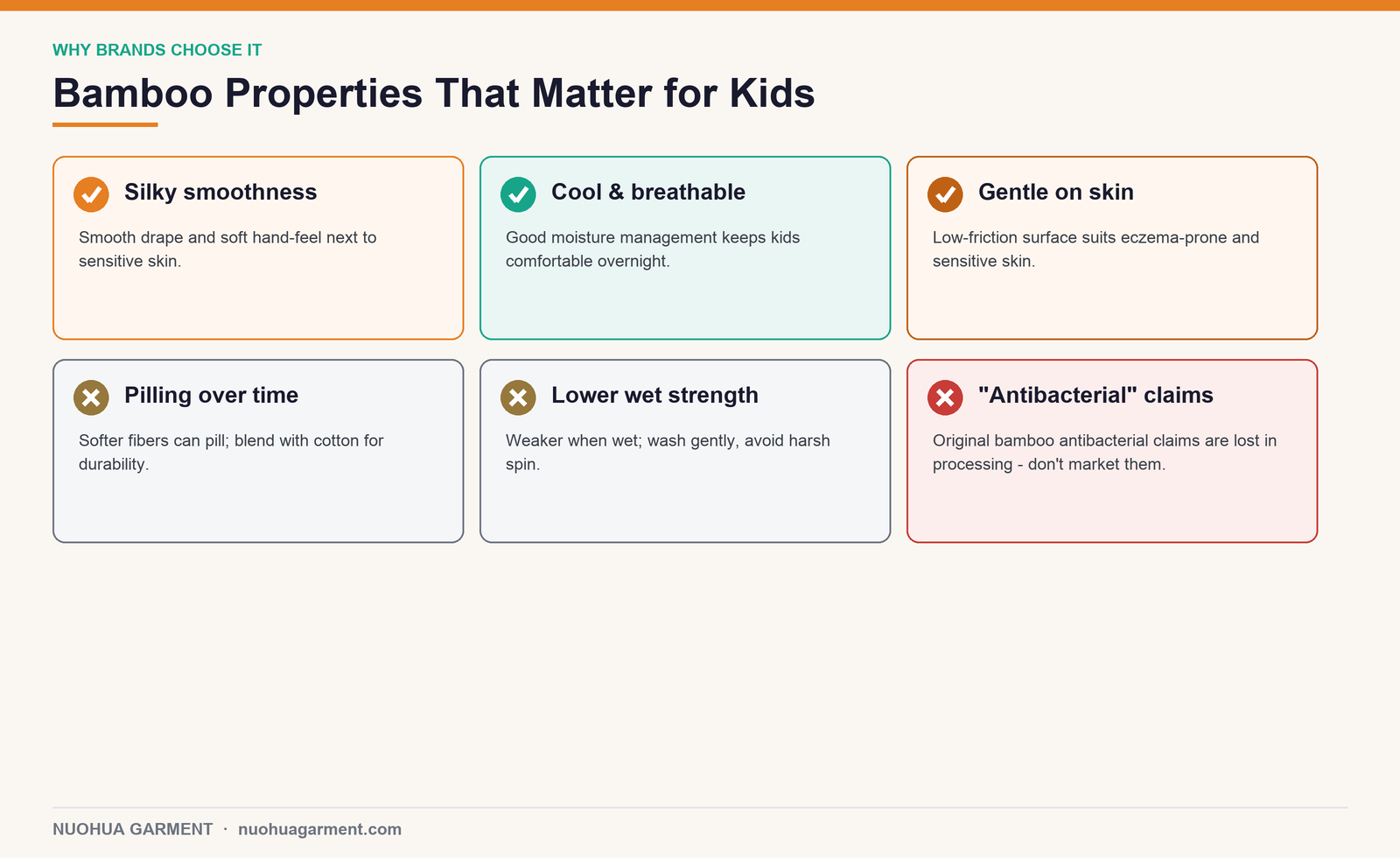
Silky smoothness and drape
Bamboo viscose filaments have a smooth, near-cylindrical cross-section with few surface irregularities. Under magnification the fiber is markedly smoother than cotton’s twisted, ribbon-like structure. That smoothness is why bamboo viscose feels closer to silk than to cotton, and why it drapes so well against the body — a real advantage for next-to-skin categories like underwear and sleepwear.
Cool, breathable, moisture-managing
Bamboo viscose is highly hygroscopic. Its moisture regain (how much moisture it absorbs relative to dry weight) sits around 11–13%, versus roughly 6–9% for cotton. In practice this means it pulls perspiration away from the skin and releases it back to the air efficiently, so the wearer stays drier and feels cooler. The fine filament diameter and micro-capillary structure of the spun yarn add to that cooling sensation — useful for warm-night sleepwear.
Gentle on sensitive skin
Smooth fibers mean less mechanical friction against delicate skin, and bamboo viscose’s breathability helps reduce the damp, clammy conditions that aggravate irritation. For children with sensitive skin, a well-finished bamboo jersey is often a comfortable option. (Note we say “often” — every child is different, and fiber choice is one factor among many, including fit and laundering.)
Honest limits: pilling, wet strength, and “antibacterial” claims
Bamboo viscose is not a miracle fiber, and over-claiming it invites trouble:
- Pilling: Many viscose jerseys can pill in high-friction zones (waistbands, inner thighs) if the yarn and knit aren’t specified well.
- Wet strength: Like most rayons, bamboo viscose is weaker when wet, so gentle washing and careful finishing matter for garment life.
- “Antibacterial” claims: The raw bamboo plant has natural antimicrobial compounds, but those are destroyed during viscose processing. The FTC has ruled that “antibacterial bamboo” claims are not permissible for bamboo viscose. Do not repeat them in your marketing.
Bamboo vs. Cotton vs. Modal — An Honest Comparison
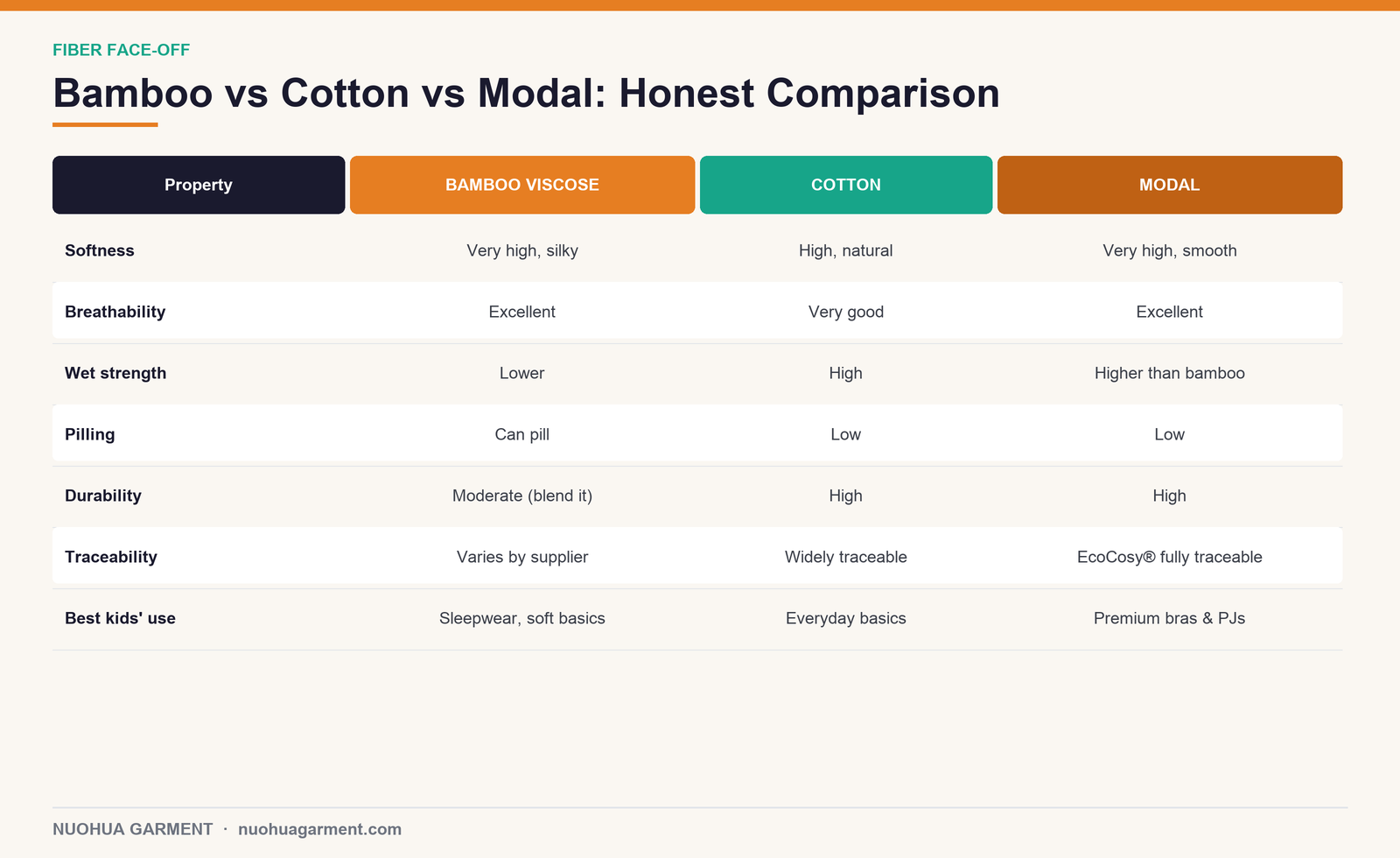
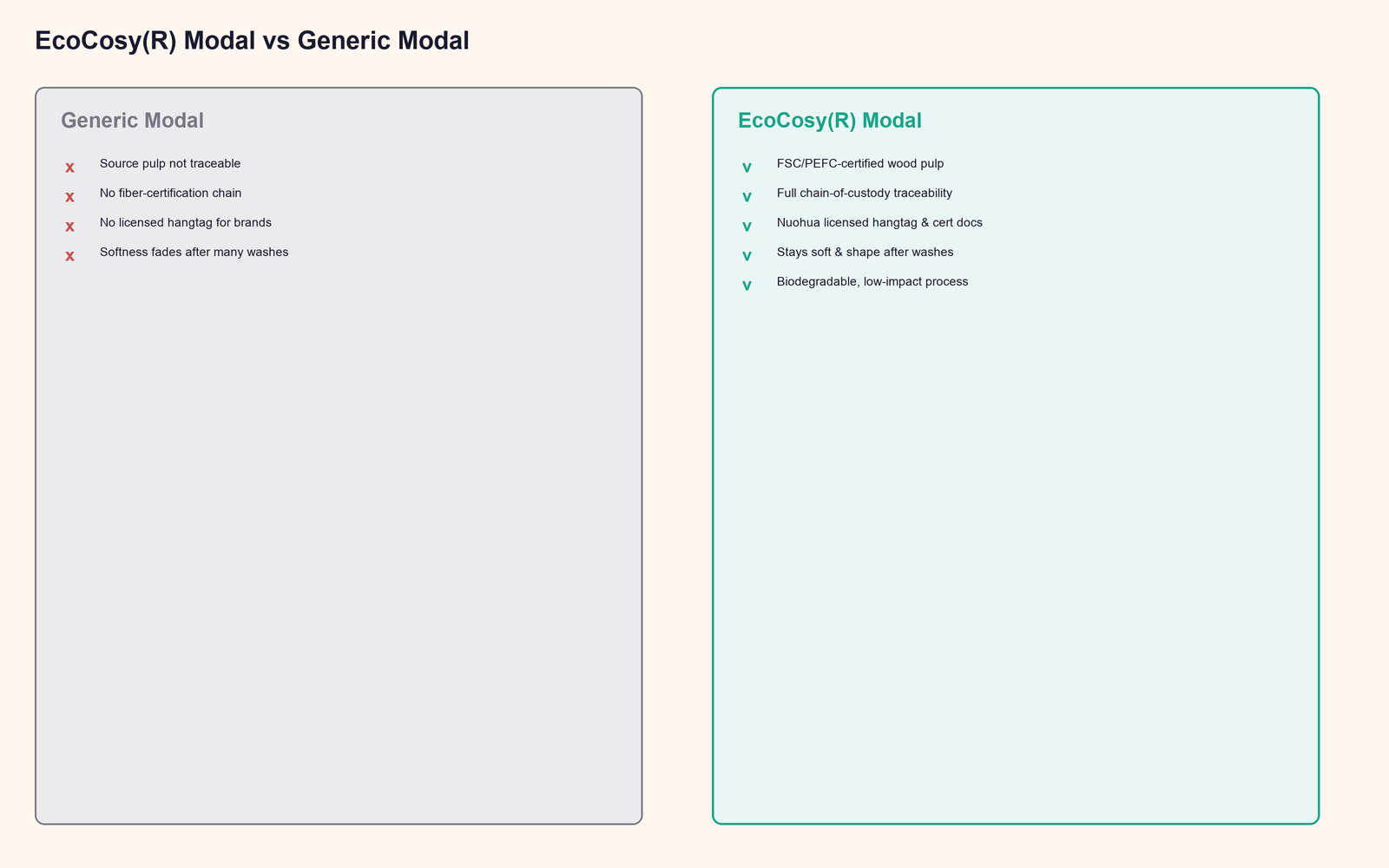
Modal deserves a place in this comparison because it is also a regenerated cellulosic fiber — a modified viscose originally made from beech pulp, and available from bamboo cellulose too. We cover it in detail in our guide to modal fabric for kids’ clothing (including EcoCosy®). Here is the side-by-side:
| Property | Bamboo Viscose / Rayon | Cotton (combed) | Modal |
|---|---|---|---|
| Fiber type | Regenerated cellulose (bamboo pulp) | Natural seed fiber | Regenerated cellulose (modified viscose) |
| Hand-feel | Silky, drapes like silk | Soft, matte, structured | Very soft, smooth, stable |
| Moisture regain | ~11–13% | ~6–9% | ~11–13% (similar to bamboo) |
| Breathability | High | High | High |
| Shrink / shape retention | Moderate; needs pre-shrink testing | Can shrink 5–10% untreated | Excellent dimensional stability |
| Wet strength | Lower (rayon-typical) | Strong | Stronger than bamboo viscose |
| Pilling risk | Moderate in friction zones | Low–moderate | Low (with quality yarn) |
| Typical use in kidswear | Sleepwear, underwear, baby basics | Everyday underwear, bodysuits | Premium underwear, base layers |
| Relative cost | Mid | Low–mid (cotton-spandex blends vary) | Mid–high |
For cotton specifics, our combed cotton vs. cotton-spandex comparison for kids’ underwear breaks down when a stretch blend beats pure combed cotton.
The Sustainability Nuance: Bamboo Is Renewable, but the Process Decides
What’s genuinely green about bamboo
The plant itself is a strong sustainability story. Bamboo is a fast-growing grass that regenerates from its own root system without replanting, reaches harvest in months rather than years, and typically needs little or no pesticide. At the cultivation stage it uses far less water than conventional cotton. Those are real, defensible advantages.
Where the “eco” story gets complicated
The catch is the processing route. Conventional viscose production relies on carbon disulfide and sodium hydroxide, and not every facility recovers those chemicals efficiently. Independent life-cycle assessments have found that the utility and treatment stages — not the farm — drive most of viscose’s carbon impact. So a “bamboo” label tells you about the crop, not about the mill. Bamboo lyocell (closed-loop) and responsibly managed viscose are a different conversation from generic, poorly controlled viscose.
“Bamboo” is a fiber source, not a certification
This is the point most brand decks get wrong. There is no “bamboo certification” that automatically makes a garment organic or fair-trade. Brands sometimes conflate “bamboo” with standards they don’t actually hold. Be precise: you can offer bamboo as a fiber option, and you can offer organic cotton as a fiber option, but neither is a substitute for a named, verified certification. We are advancing OEKO-TEX Standard 100 (in progress) and hold EcoCosy® fiber authorization; we coordinate third-party testing through partners such as SGS, TÜV SÜD, and Intertek, and our skin-contact wear meets China’s GB 31701 Class A standard.
Caring for Bamboo Kids’ Clothing (Washing Guide)
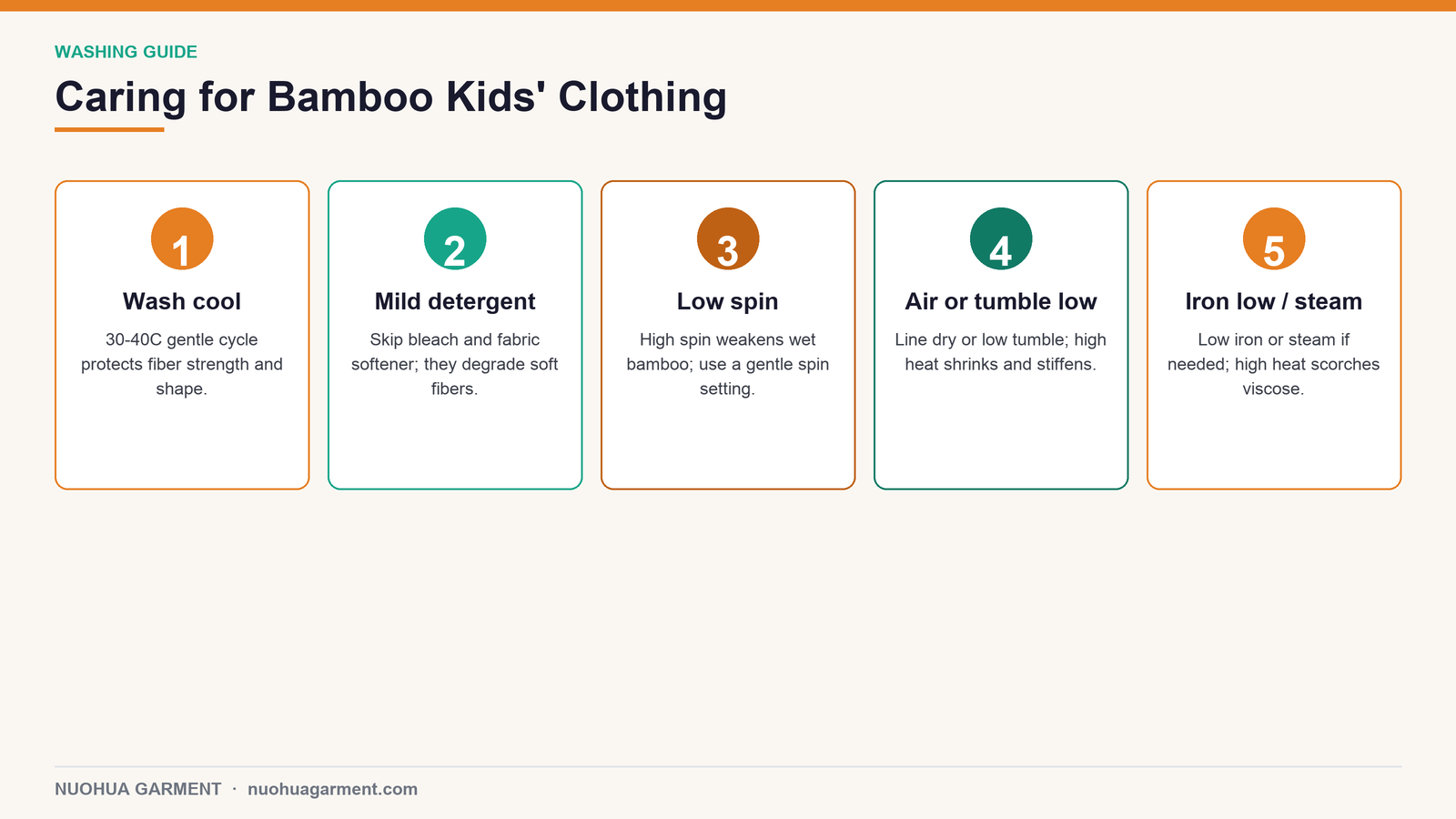
Good care preserves the softness and extends garment life, which matters for both returns and brand reputation. Recommended practice for bamboo viscose kidswear:
- Wash in cold to warm water (about 30–40°C / 86–104°F) on a gentle cycle.
- Turn garments inside out to reduce surface friction and pilling.
- Use a mild detergent; avoid bleach and harsh optical brighteners.
- Skip fabric softeners — bamboo viscose is already soft, and softeners can coat fibers.
- Line dry where possible, or tumble dry on low; high heat weakens rayon and causes shrinkage.
- Wash with similar colors and avoid rough items (zippers, towels) in the same load.
Why Bamboo Works So Well for Kids’ Sleepwear
Sleepwear is where bamboo viscose’s profile pays off most directly. Children sleep warm and move constantly; a fabric that is silky, breathable, and quick to move moisture away from the skin helps maintain a comfortable microclimate through the night. The smooth hand reduces friction against sensitive skin, and the natural drape suits relaxed sleepwear cuts.
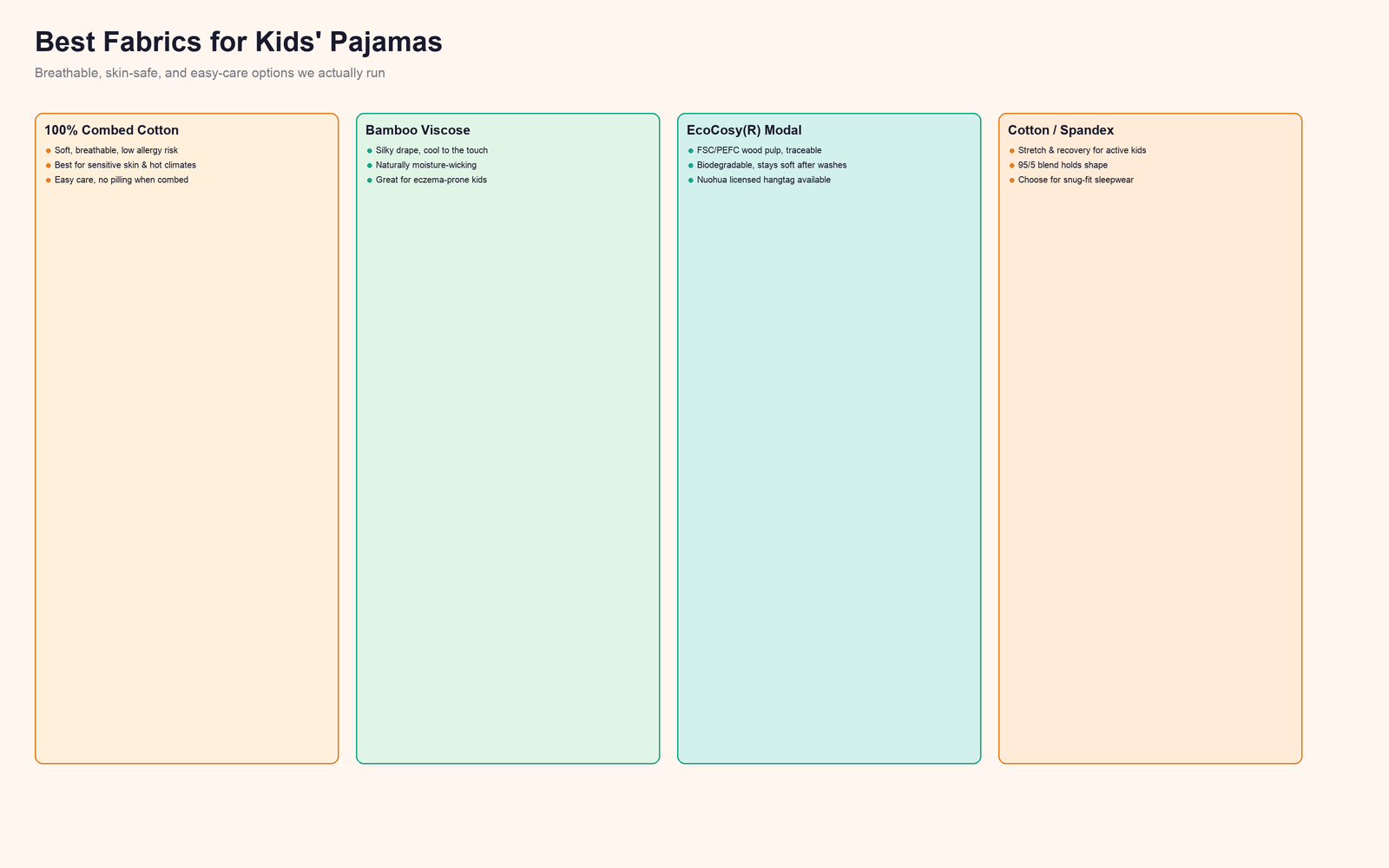
Two cautions for the spec sheet. First, in many markets kids’ sleepwear faces flammability rules that bamboo (a cellulose fiber) must meet through construction or finishing — this is a compliance, not a fiber, question. Our guide to the best kids’ pajama fabrics and flame resistance walks through the options. Second, keep claims honest: soft, breathable, and comfortable are supportable; “antibacterial” and “natural bamboo fiber” are not, for viscose. For the full regulatory picture, see our kids’ underwear and sleepwear compliance checklist.
Frequently Asked Questions
Is bamboo fabric a natural fiber?
Not in the finished form. Most “bamboo fabric” is bamboo viscose (rayon), a regenerated cellulosic fiber made by dissolving bamboo pulp and re-forming it. The source is natural; the fiber is chemically regenerated. Honest labels say “viscose from bamboo.”
Is bamboo viscose the same as bamboo rayon?
Yes. “Bamboo viscose” and “bamboo rayon” describe the same material and the same production route. “Rayon” is more common in US labeling; “viscose” is more common in Europe.
Is bamboo fabric better than cotton for kids?
It depends on the job. Bamboo viscose feels silkier and manages moisture better; cotton is stronger when wet and more familiar to buyers. For sleepwear and next-to-skin basics, bamboo’s drape and cool hand are appealing. For structured everyday wear, cotton or a cotton-spandex blend may fit better. Neither is universally “better.”
Is bamboo more sustainable than modal?
At the farm level bamboo is excellent — fast-renewing and low-input. But modal (a modified viscose) is often processed with tighter controls and better dimensional stability, and bamboo lyocell is the most closed-loop option. Sustainability is decided by the processing route and certification, not by the word “bamboo” alone.
Does bamboo fabric kill bacteria?
No. Any antimicrobial compounds in the raw plant are destroyed during viscose processing. The FTC has ruled that “antibacterial bamboo” claims are not permissible for bamboo viscose. Avoid that claim entirely.
How should I wash bamboo kids’ clothing?
Cold-to-warm gentle cycle (30–40°C), mild detergent, inside out, no bleach or fabric softener, line dry or low tumble. Pre-test for shrinkage at sampling.
Can Nuohua produce bamboo kids’ sleepwear for my brand?
Yes. We manufacture bamboo-blend kids’ sleepwear and underwear as OEM/ODM and private label, with ready-stock minimums from 2 pcs on selected in-stock styles, colors and sizes, and we coordinate testing through SGS, TÜV SÜD, and Intertek. Reach out via our quote request page to start a tech pack.
Ready to Spec Bamboo for Your Line?
If you are weighing bamboo viscose against cotton or modal for a kids’ sleepwear or underwear program, the right answer is almost always “it depends on the spec.” We help brands choose the fiber, set the GSM and construction, run pre-shrink and color-fastness testing, and build a compliant tech pack. Start with our compliance checklist and then request a quote — we will map the fabric choice to your market’s labeling and flammability rules.