
OEM vs ODM vs Private Label for Kids’ Underwear: Which Model Fits Your Brand?
This guide is part of the Kids Underwear & Sleepwear Sourcing Guide.
When you set out to launch or scale a children’s underwear line, one of the first — and most consequential — decisions you will make is how to manufacture it. The sourcing conversation quickly collapses into three acronyms: OEM, ODM, and Private Label. They are frequently used interchangeably by suppliers and resellers, but they describe three distinct production relationships, each with very different implications for your budget, your timeline, your intellectual property, and how much design control you actually hold.
This guide does three things. First, it gives you a precise, working definition of each model as it applies specifically to kids’ underwear, training bras, and sleepwear — not generic apparel. Second, it walks through a practical decision framework: which model to choose based on your brand stage, your budget, and how much you need to protect a proprietary design. Third, it covers the IP and NDA realities that catch first-time founders off guard. If you are still weighing custom development against buying off-the-shelf stock, our guide on custom vs off-the-shelf kids’ underwear manufacturing covers that broader debate in depth — this article assumes you have made that call and now need to pick a build model.
What Is OEM for Kids’ Underwear?
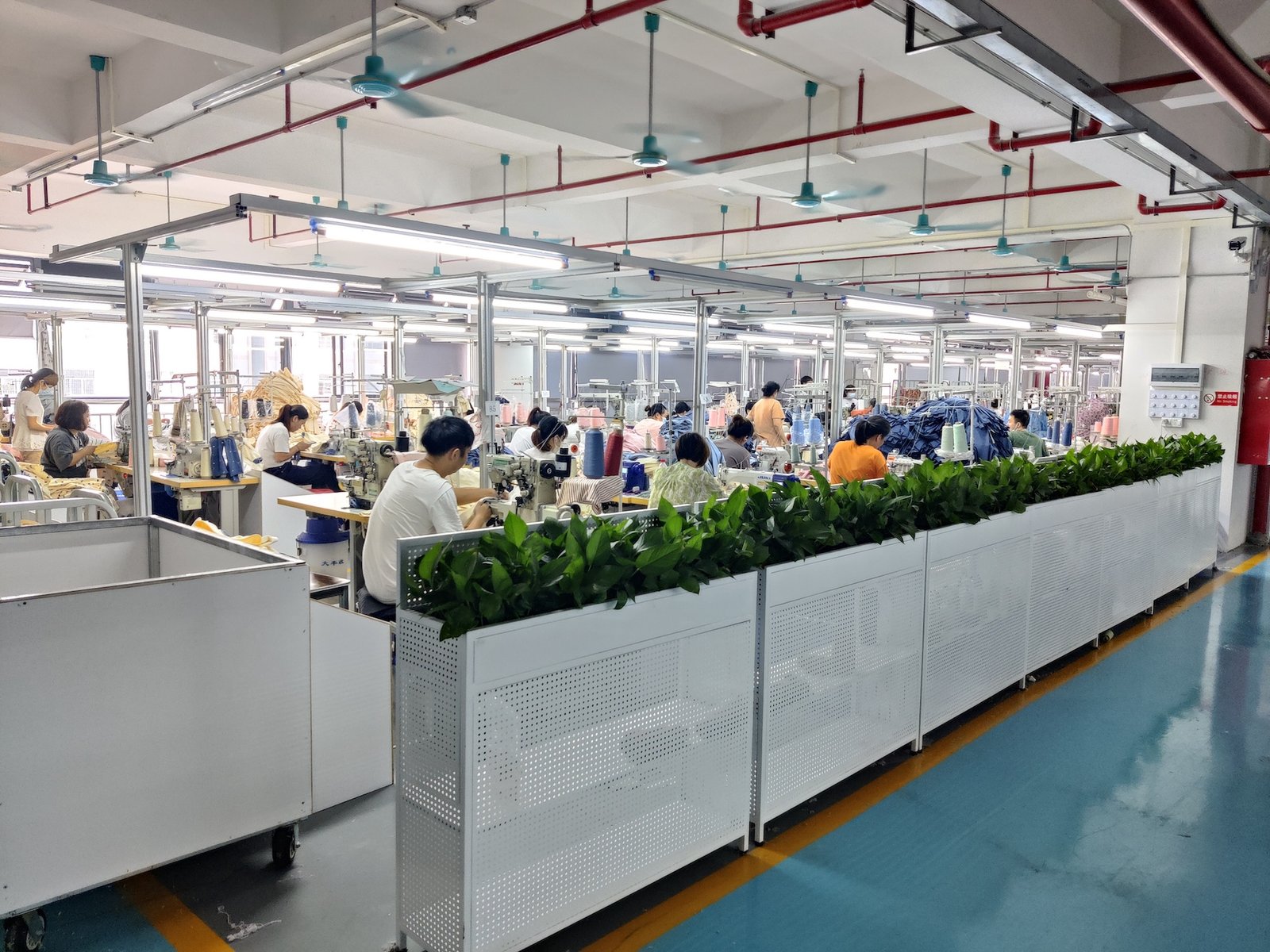
OEM stands for Original Equipment Manufacturer. In apparel sourcing, “OEM” means the factory builds a product to your specification. You own the design — the tech pack, the fabric choices, the fit, the print, the trims — and the manufacturer’s job is to execute it faithfully at scale. The factory supplies the machines, the sewing lines, the quality system, and the labor; you supply the “what” and the “how it should look and feel.”
For kids’ underwear, an OEM engagement typically starts with a detailed tech pack: nominated fabrics (for example combed cotton, cotton-spandex, or EcoCosy® modal), GSM (grams per square meter) targets, waistband construction, label placement, size grading across your target age range, and any compliance requirements such as GB 31701 Class A for skin-contact children’s wear. The manufacturer then sources or receives your nominated materials, develops the pattern, sews prototypes, and runs bulk production once you have approved the pre-production (PP) sample.
How OEM Works, Step by Step
The typical OEM flow for a children’s underwear program looks like this:
- You develop or commission a tech pack. This is the master document: every panel, measurement, stitch type, and tolerance.
- The factory quotes against your bill of materials (BOM). Pricing depends on fabric weight, trim complexity, and order volume, not on a generic catalog price.
- Sampling begins. A development (proto) sample confirms construction; a PP sample locks the bulk standard. Expect one to three rounds before approval.
- Bulk production runs. Typical lead times from PP approval run roughly four to eight weeks depending on fabric availability and order size.
- Testing and compliance. For the US market, the importer issues the Children’s Product Certificate (CPC); Nuohua coordinates the underlying third-party testing through partners such as SGS, TÜV SÜD, or Intertek and supplies the test data.
What the Brand Must Provide
The single most important deliverable from your side is the tech pack. If you do not have one yet, our guide to creating a tech pack for kids’ underwear and sleepwear walks through every panel, measurement, and tolerance you will need. Without a complete tech pack, an OEM quote is little more than a guess, and sampling will stretch out as details get clarified late in the process.
Beyond the tech pack, you should arrive with nominated fabric and trim suppliers (or be willing to accept the factory’s recommended equivalents), a clear size chart, and your branding artwork. In short: OEM rewards brands that know exactly what they want.
When OEM Wins
OEM is the right model when your design is your differentiator. If you have a proprietary fit, a signature waistband, a custom-developed print, or a fabric story that no competitor can copy, building to spec protects that advantage. It is also the correct choice when you must meet a precise compliance or performance brief — for example a specific GSM for breathability, or a fiber like EcoCosy® modal that carries its own traceability story. OEM carries the highest development effort and usually the longest timeline, but it gives you the strongest ownership and the clearest path to a defensible product.
What Is ODM for Kids’ Underwear?
ODM stands for Original Design Manufacturer. Here, the factory already owns a catalog of developed styles — patterns, fits, and often fabrications that it has engineered and produced for other clients. You select from (or near) that existing library and customize it lightly: change the print, swap the waistband color, adjust the size curve, or pick a different fiber. You are not starting from a blank tech pack; you are starting from a proven, production-ready design and putting your brand on a tuned version of it.
This is a common and efficient route for kids’ underwear because the category has a relatively stable set of silhouettes — briefs, boxer briefs, training bras, camisoles, sleep sets — where incremental customization (a custom woven label, a softer hand-feel, a seasonal colorway) delivers most of the perceived differentiation a young brand needs without the cost of full development.
How ODM Works
The ODM flow is shorter than OEM because the hard development work is already done:
- You review the factory’s existing style catalog. These are real, sampled, and factory-proven designs.
- You specify light modifications. A new print, a color swap, a label change, or a small fit tweak.
- The factory confirms feasibility and lead time. Minor changes may need no new pattern; bigger ones may need a revised sample.
- You approve a modified sample. Often a single round rather than multiple development cycles.
- Bulk runs against the adjusted spec. Lead times are typically shorter than full OEM because tooling already exists.
What the Brand Must Provide
For ODM, your input is light but not absent. You will typically supply your brand labels and packaging, your chosen prints or colorways, any market-specific compliance notes, and the final size range you want graded. You do not need a full tech pack, but a short specification sheet describing your modifications removes ambiguity. A good factory will also show you its capability page for private-label and ODM kids’ clothing so you can see what is already tooled and ready to customize.
When ODM Wins
ODM is ideal when speed-to-market and lower development cost matter more than owning a fully proprietary silhouette. If your edge is branding, bundling, or retail channel rather than a unique garment shape, ODM lets you launch a credible, quality product in a fraction of the time. It is also a smart middle step: many brands start on ODM, prove demand, and then graduate to OEM once they have the volume and the confidence to invest in a bespoke design. Before committing, it is worth reviewing how to vet an OEM/ODM partner as a boutique kidswear brand so you choose a supplier that can grow with you.
What Is Private Label for Kids’ Underwear?
Private Label is the lightest-touch model of the three. In a private-label arrangement, the manufacturer sells you a finished, stock design that it already produces — often in generic, unbranded form — and you resell it under your own brand name by applying your label, your hangtag, and your packaging. There is little to no modification: you are buying availability and speed, not a custom product.
For many Amazon sellers and first-time boutique owners, private label is the entry point: you choose from in-stock SKUs (say, a five-pack of children’s cotton briefs in neutral colors), add your branding, and list them. Our overview of private-label kids’ clothing explains the broader model and what to expect on minimums and turnaround.
How Private Label Works
- You pick from in-stock or quickly available SKUs. The product already exists; you are selecting, not designing.
- You supply branding assets. Logo, woven label, hangtag, and any retail-ready packaging.
- The factory applies your label or ships blank for you to apply it through your own fulfillment.
- You receive finished, sellable goods. Often within weeks rather than months.
What the Brand Must Provide
Minimal. At most, you provide artwork for your woven label and hangtag, your barcode (UPC/GTIN), and any retail-ready packaging. You are not involved in pattern development, fabric nomination, or fit grading. This is the fastest path but also the one with the least differentiation — your competitors can (and often do) buy the exact same stock garment and brand it differently.
When Private Label Wins
Private label wins when you are validating demand, testing a market, or need inventory in weeks rather than months. It is the lowest-risk way to get your brand name onto a real product and learn what sells. The trade-off is obvious: with no product differentiation, you compete almost entirely on price and marketing. Most sustainable brands treat private label as a starting tactic, not an end state.
OEM vs ODM vs Private Label: A Side-by-Side Comparison
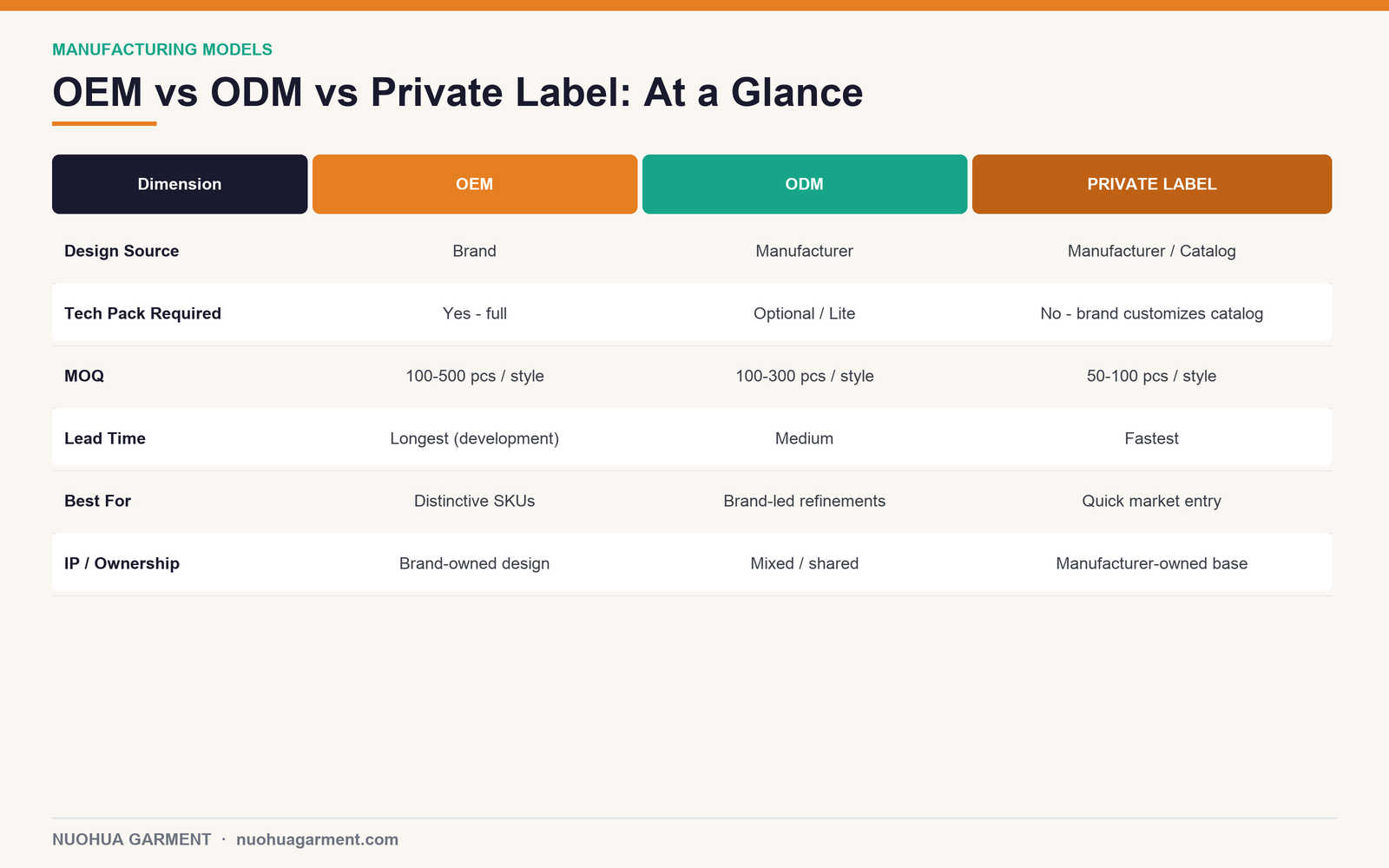
The table below distills the practical differences. Treat it as a quick-reference; the sections that follow explain the nuance behind each column.
| Dimension | OEM (Build to Spec) | ODM (Existing Design, Light Custom) | Private Label (Stock, Your Brand) |
|---|---|---|---|
| Who owns the design | You (your tech pack) | Factory (you license/customize) | Factory (off-the-shelf) |
| What you must supply | Full tech pack, nominated fabrics, size chart | Light mods: print, color, label, size range | Label, hangtag, barcode, packaging |
| Typical development effort | High (multiple sample rounds) | Low to medium (1 sample round often) | Minimal (none) |
| Typical MOQ | Confirmed after specification review | Low-to-mid, factory-set per style | Lowest, often small per-SKU packs |
| Typical lead time | ~4–8 weeks from PP approval | Shorter than OEM (tooling exists) | Weeks (stock available) |
| Differentiation | Maximum (bespoke) | Medium (tuned from proven base) | Minimal (commodity) |
| IP protection need | Highest (protect your tech pack) | Medium (confirm design licensing) | Low (no unique design) |
| Best for | Brands with a proprietary product | Brands optimizing speed + cost | Demand testing / fast entry |
A Decision Framework for Kids’ Underwear Brands
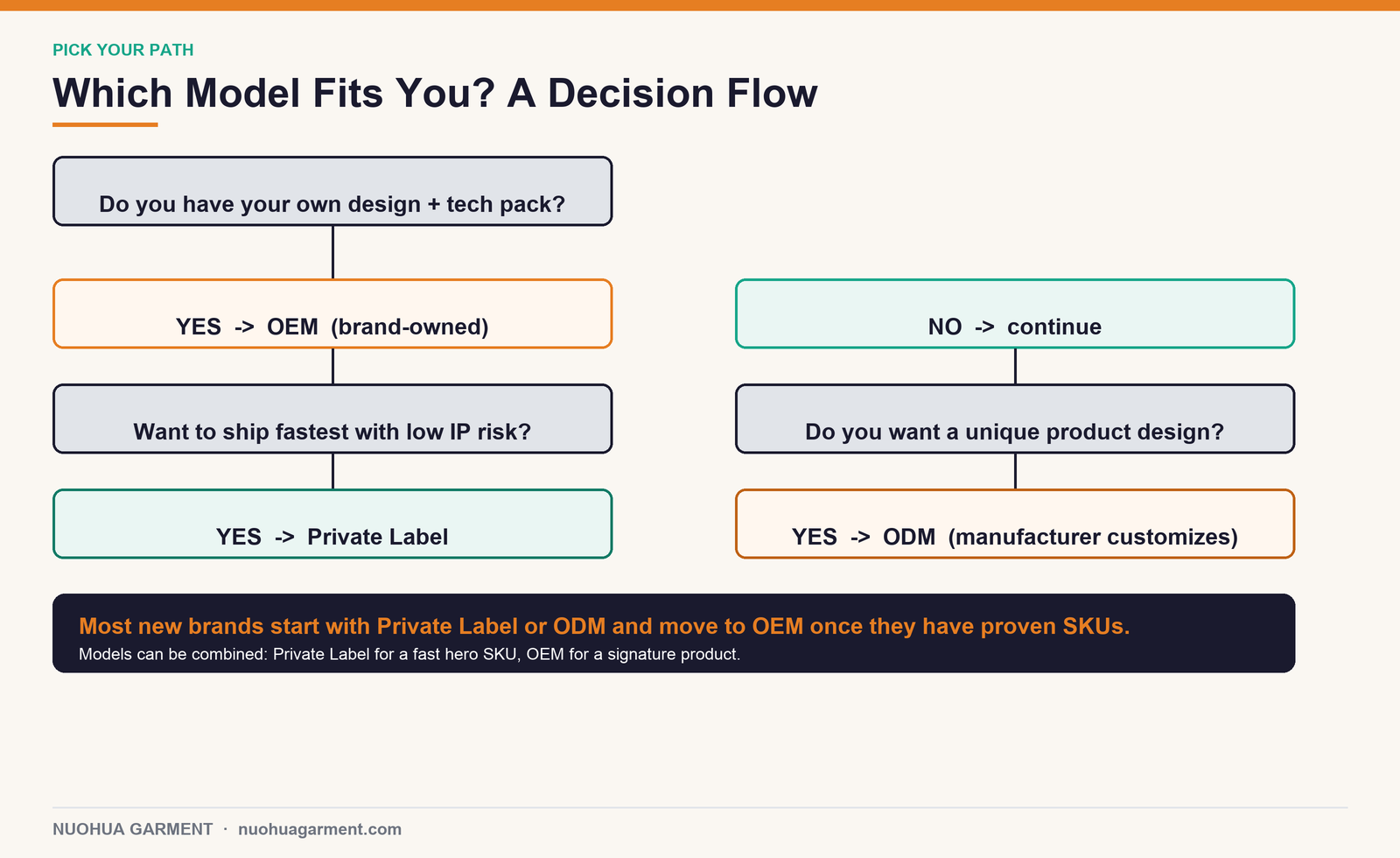
Definitions are useful, but the real question is: which model should your brand pick right now? Use the three filters below — stage, budget, and IP need — and then confirm what each model requires of you.
Choose by Brand Stage
Pre-launch / validating: If you have no sales history and need to prove the category is worth pursuing, private label gets you to market fastest with the least capital at risk. You learn what prints, sizes, and price points move before you commit to development.
Early growth: Once you have signal, ODM lets you professionalize quickly — a credible, customized product without a full tech-pack investment. This is where many boutique brands spend their first 12–24 months.
Scaling / established: When volume justifies it and your design is central to your brand, OEM protects margin and differentiation. At this stage you can afford the sampling lead time and the development discipline a tech pack demands.
Choose by Budget and MOQ
Development cost is the hidden variable. OEM asks you to fund pattern development, sampling, and often nominated-material minimums; ODM amortizes that cost across the factory’s existing library; private label asks for almost nothing upfront beyond branding. If your first order is small, the per-unit premium of ODM or private label is usually cheaper than the fixed development cost of OEM spread thin. As volume climbs, OEM’s lower unit cost and bespoke efficiency typically win. Note that even OEM can start at approachable minimums — our OEM production readiness checklist lays out the practical minimums and what to prepare before you request a quote.
Choose by IP Need
If you have invested in a unique fit, a custom print, or a proprietary fabric story, your choice is effectively made: OEM keeps that IP in your hands. ODM requires you to confirm, in writing, whether the modified design is licensed to you exclusively or shared with other brands — a point we return to in the IP section. Private label offers no IP protection at all; the design is the factory’s, available to anyone. For kids’ underwear specifically, where silhouettes are hard to patent but prints and trims are not, OEM’s control over the tech pack is often the only durable moat.
What Each Model Requires From You
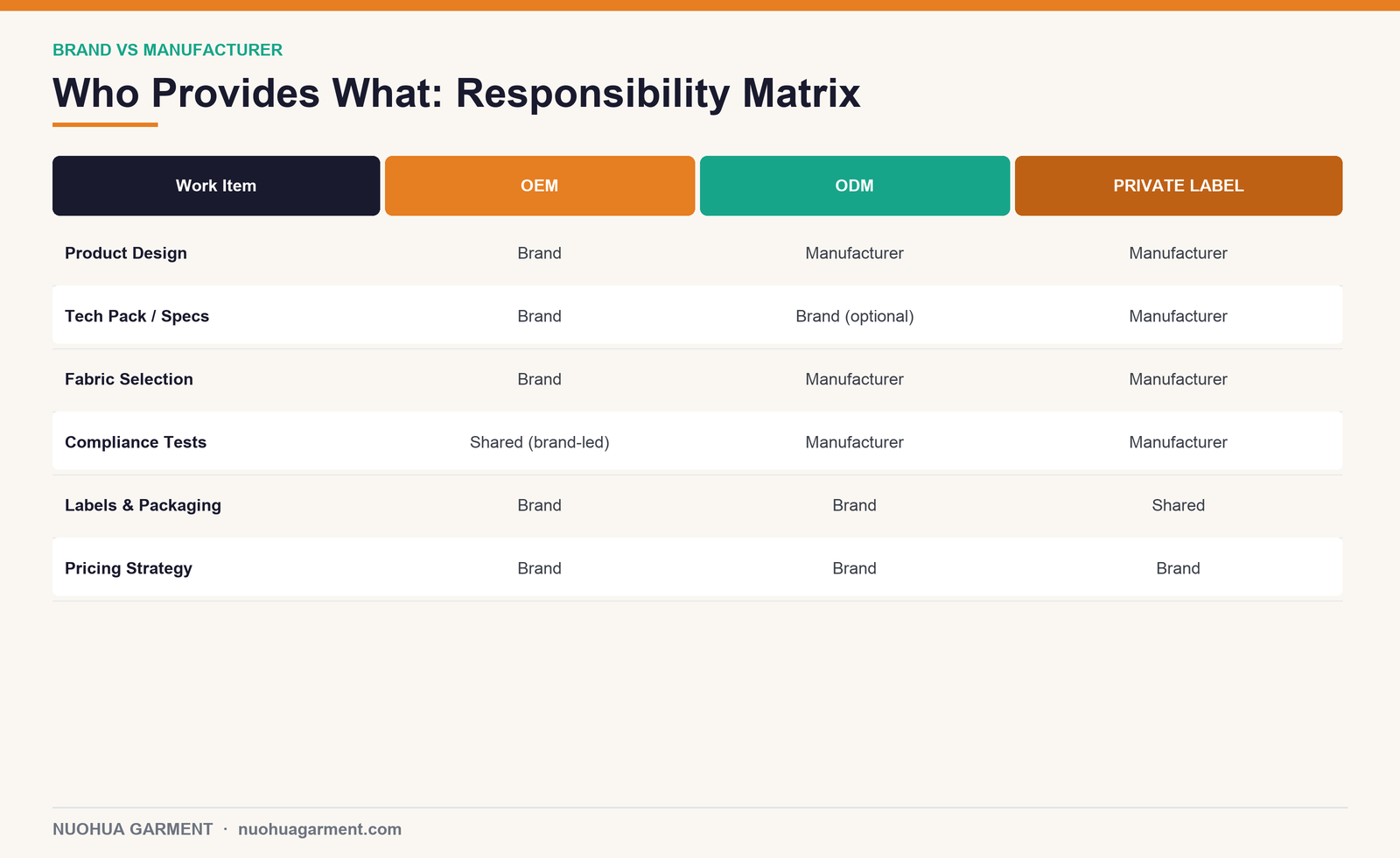
- OEM: A complete tech pack, nominated materials or approval of equivalents, a size chart, and the patience for sampling. You lead; the factory executes.
- ODM: A clear modification brief, your branding assets, and a confirmation of design licensing. You guide; the factory adapts.
- Private Label: Label and packaging artwork plus a barcode. You brand; the factory supplies.
IP, NDA, and Ownership Considerations
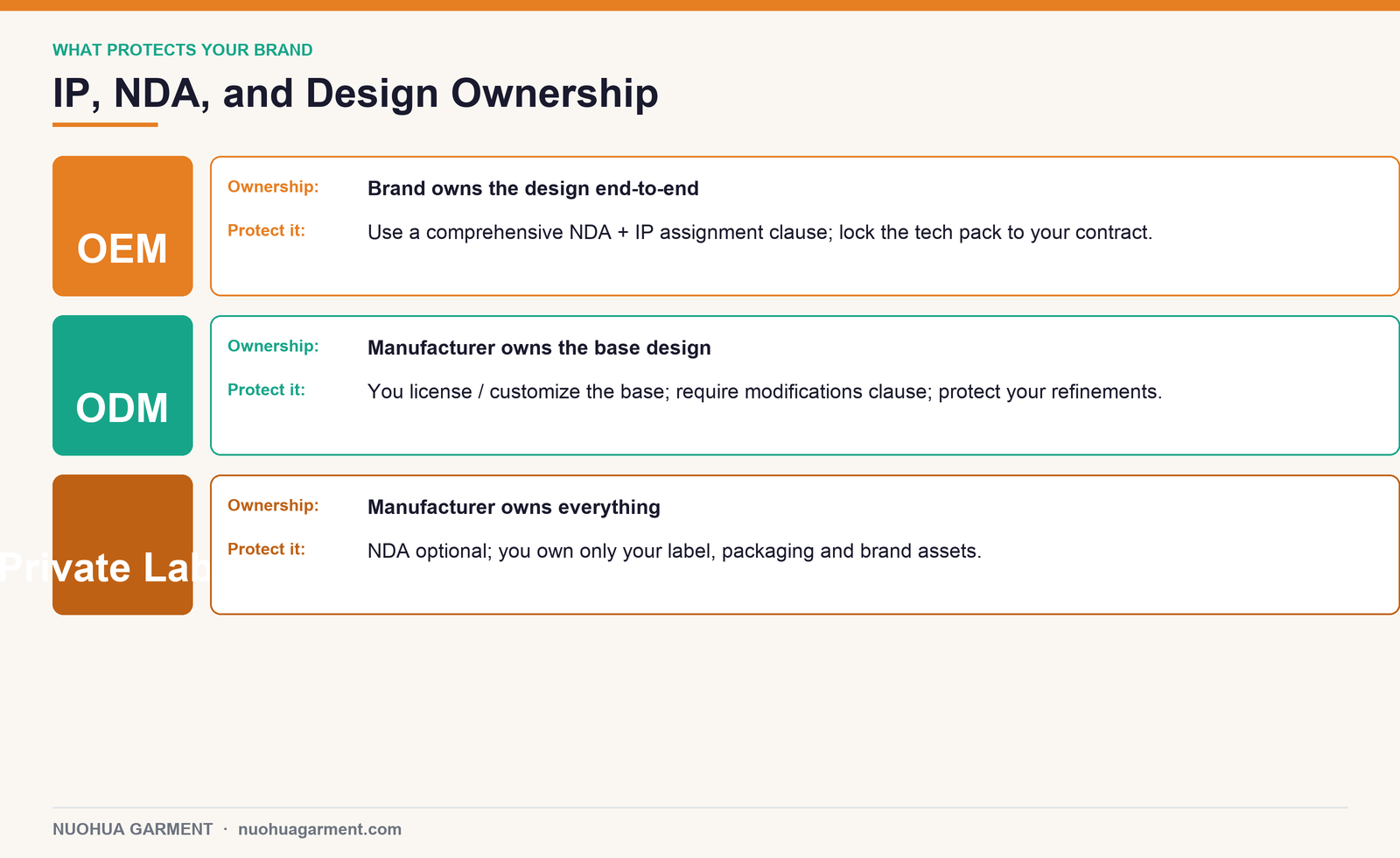
The manufacturing model you choose changes who can claim the design — and that has real consequences if your product takes off.
Who Owns the Design?
Under OEM, ownership is clearest: the design originates with your tech pack, so the factory is building your intellectual property. Under ODM, ownership is shared or licensed — the base design belongs to the factory, and your customization may or may not be exclusive depending on your contract. Always confirm in writing whether your modified version is reserved for you or can be sold to others. Under private label, the factory retains full ownership of the design; you are licensing the right to resell it under your brand for that production run.
NDAs and Tech-Pack Protection
Before you send a tech pack to any supplier, have a non-disclosure agreement (NDA) in place, especially for OEM. Your tech pack contains your competitive advantage — measurements, constructions, and material specs that a competitor could exploit. A signed NDA does not guarantee enforcement across borders, but it is a necessary baseline and signals seriousness. For ODM, ask the factory to confirm in the agreement that your specific modifications will not be reproduced for other clients without consent. And regardless of model, insist that compliance documentation — such as GB 31701 Class A records or third-party test reports from SGS, TÜV SÜD, or Intertek — is handled through a defined, confidential process so your batch records are not loosely shared.
Frequently Asked Questions
What is the difference between OEM and ODM in simple terms?
OEM means the factory builds a product to your own design and tech pack; you own the spec. ODM means the factory already has a developed design and you customize it lightly — the factory owns the base design, you tune and brand it. OEM maximizes control, ODM maximizes speed-to-market.
Is private label the same as ODM?
No. In private label you resell a stock, unmodified (or near-unmodified) product under your brand — the factory’s design, your label. ODM involves meaningful customization of an existing factory design. Private label is the lowest-effort, lowest-differentiation end of the spectrum; ODM sits between private label and full OEM.
Which model is cheapest for a new kids’ underwear brand?
Private label has the lowest upfront cost because there is no development. ODM is typically the cheapest path to a customized product. OEM carries the highest development cost but can deliver the lowest per-unit cost at scale. For a first small order, the fixed cost of OEM usually makes ODM or private label more economical.
Do I need a tech pack for ODM or private label?
Not a full one. Private label needs only label and packaging artwork plus a barcode. ODM needs a short modification brief describing your changes (print, color, size range, label). A complete tech pack is really an OEM requirement — and if you are heading there, our tech-pack guide is the place to start.
Who owns the design under each model?
OEM: you own it via your tech pack. ODM: the factory owns the base design; your modifications may be licensed exclusively or non-exclusively depending on contract. Private label: the factory owns the design entirely; you license the right to resell it under your brand.
Can I start with private label and move to OEM later?
Yes, and many brands do exactly that. Private label validates demand with minimal risk; ODM professionalizes the offer; OEM locks in a proprietary, defensible product once volume justifies the development investment. The same factory relationship can often carry you through all three stages if you choose a partner with the right capabilities.
What MOQ should I expect for kids’ underwear OEM?
It depends on the route: ready stock starts from 2 pcs on selected in-stock styles, colors and sizes, while existing styles and print programs typically run from 1,000 pcs per style and color, with mixed sizes available. Fabric and trim minimums can push effective minimums higher, which is why a readiness checklist — and a candid conversation with your supplier — matters before you request a quote.
Ready to Choose Your Manufacturing Model?
The right model is the one that fits your brand’s stage, budget, and IP needs today — not the one that sounds most impressive. If you are still uncertain which path suits you, the fastest next step is a conversation with a partner who can run all three. Review how to vet an OEM/ODM partner, check your readiness with our OEM production readiness checklist, and when you are ready, request a quote with your target model, volumes, and timeline. We will help you match the build approach to your brand — and get your kids’ underwear program into production with the right balance of speed, cost, and control.