This guide is the manufacturer-selection playbook we wish existed when our first GCC clients started asking us about Saudi compliance. It is written from the factory side, so the perspective is honest about what a manufacturer can and cannot do for you: where to hold a Saudi-bound supplier to the highest standard, where to accept “good enough for the pilot,” and how to read a quote without being misled by a headline FOB price. By the end, you will have a 7-step vetting process, a realistic 15-16 week timeline, a red-flag checklist, and a shortlist of the only certifications that actually clear SABER.
1. Why Saudi Brands Are Sourcing Kids’ Clothing Differently in 2026
Three forces have reshaped how Saudi children’s wear brands pick a manufacturing partner, and ignoring any one of them is the most common mistake we see from new Saudi founders.
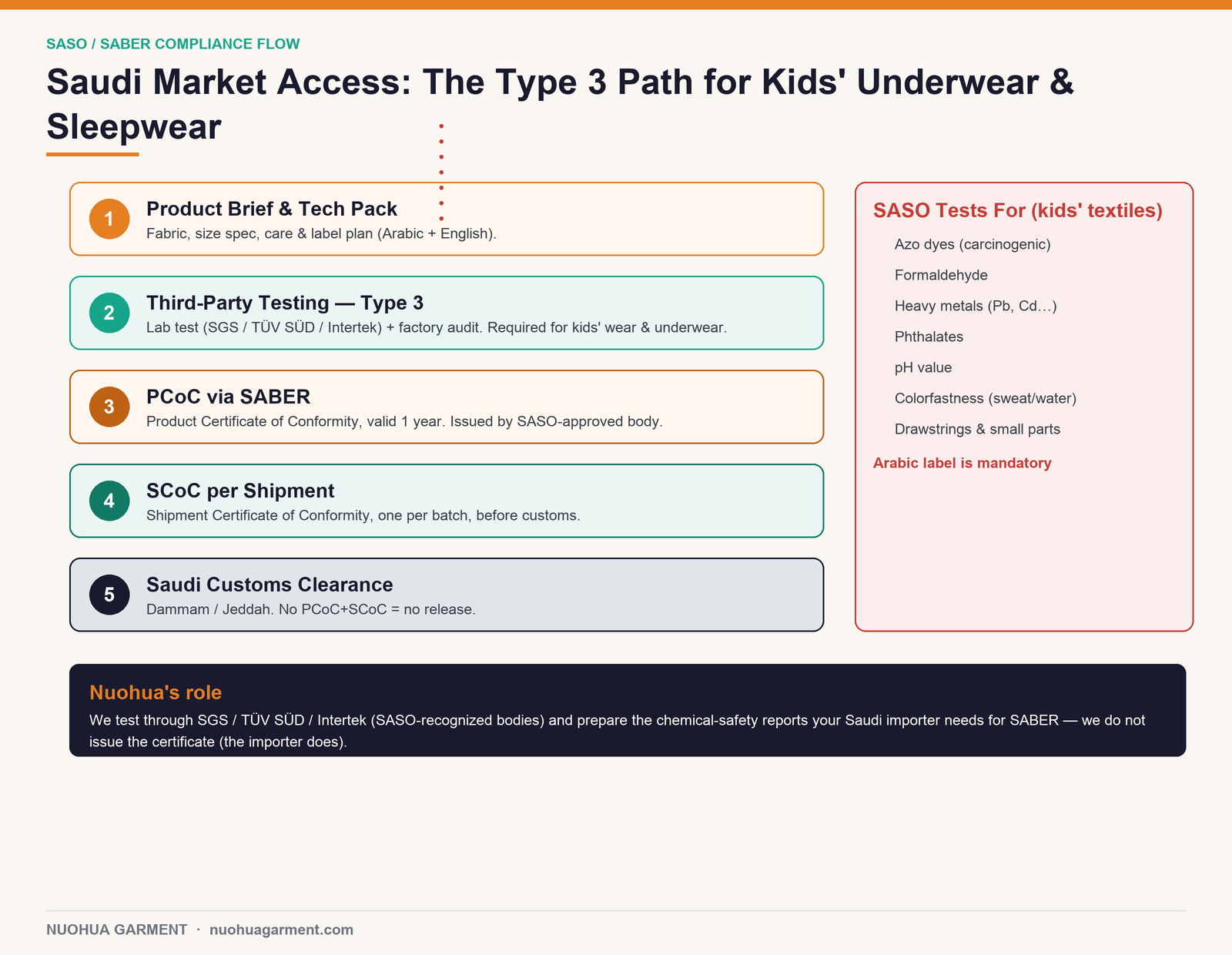
- Regulators got stricter. The SASO Technical Regulation for Textile Products (second edition, published January 12, 2024) brought underwear and children’s textiles into Type 3 certification scope – testing plus a physical factory audit. SABER now issues a PCoC (Product Certificate of Conformity, valid one year) and an SCoC (Shipment Certificate of Conformity, one per shipment). No PCoC + SCoC, no release at Saudi customs.
- Buyers got more sophisticated. Saudi parents compare fabric composition, pH and chemical-safety claims the way European parents do. The trust-first posture that already defines US and EU private label has arrived in KSA.
- The supply chain bifurcated. Some brands want the fastest possible replenishment and lean on GCC-local cut-and-sew shops. Others want the maturity of a specialist kids’ knit cluster and source from Asia. Both models work – but they solve different problems, and mixing them carelessly is the most expensive mistake a new Saudi brand can make.
To ground this guide in real demand, the local brand scene is no longer small. Ein Ghein stocks heritage kaftans and thobes for children at Homegrown Market in Jeddah and Pattern Concept Store in Riyadh. MAMNON Co. Ltd. was founded in Riyadh in 1998 and is widely cited as the first Saudi company manufacturing children’s wear. Koflah is a Jeddah-based online children’s boutique working with local Saudi designers since 2016. International and GCC retailers – Mothercare, Carter’s, H&M, Zara, Chicco – compete for the same Riyadh, Jeddah and Dammam parents. The question is no longer whether to source internationally; it is how to do it without your shipment getting stuck at Jeddah Islamic Port.
2. What Saudi Market Access Actually Requires
Before you evaluate any factory, understand the gate you have to pass. For kids’ underwear and sleepwear – the two categories we focus on at Nuohua – the path through Saudi customs runs through SABER Type 3 testing plus a factory audit, an Arabic-language care label, and a one-time PCoC plus per-shipment SCoC filing.
Three details that surprise first-time importers:
- Type 3 is non-negotiable for kids’ and underwear. General apparel (Type 1a) is testing only; children’s wear and intimate apparel require testing plus a factory audit. Plan for a 4-6 week certification timeline before your first commercial shipment.
- The Arabic label is part of the certificate, not an afterthought. Fiber composition, country of origin, supplier name and commercial register number, and care symbols must be present and accurate in Arabic.
- The SASO banned-substance list is long and specific. Azo dyes, formaldehyde, pentachlorophenol, heavy metals, phthalates, organotin compounds, flame retardants, and pH all have defined limits. Children’s wear also passes colorfastness (sweat, water, rubbing).
What a manufacturer can do for you: prepare the tech pack with the right fiber and care specifications, source fabrics that pass the banned-substance panel, and coordinate third-party testing through labs SASO recognizes. What a manufacturer cannot do for you: issue the SABER certificate on your behalf – the importer (you or your local partner) is the legal applicant. Be wary of any factory that promises to “handle all the paperwork.” For the compliance stack most Saudi buyers also run alongside SASO – CPC for the US, GB 31701 Class A for China, OEKO-TEX – see our kids’ underwear & sleepwear compliance checklist.
3. The 5 Things That Decide a Good Manufacturing Partner for KSA
Five factory-side criteria separate a safe bet from a costly mistake.
3.1 Testing depth, not just certificates on a wall
Ask which third-party labs the factory works with for the SASO chemical panel. Names like SGS, TÜV SÜD and Intertek matter because they are SASO-recognized conformity assessment bodies; a test report from an unrecognised lab will not clear SABER. Ask to see a recent dated PDF, not a marketing badge.
3.2 Fabric engineered for hot-climate skin
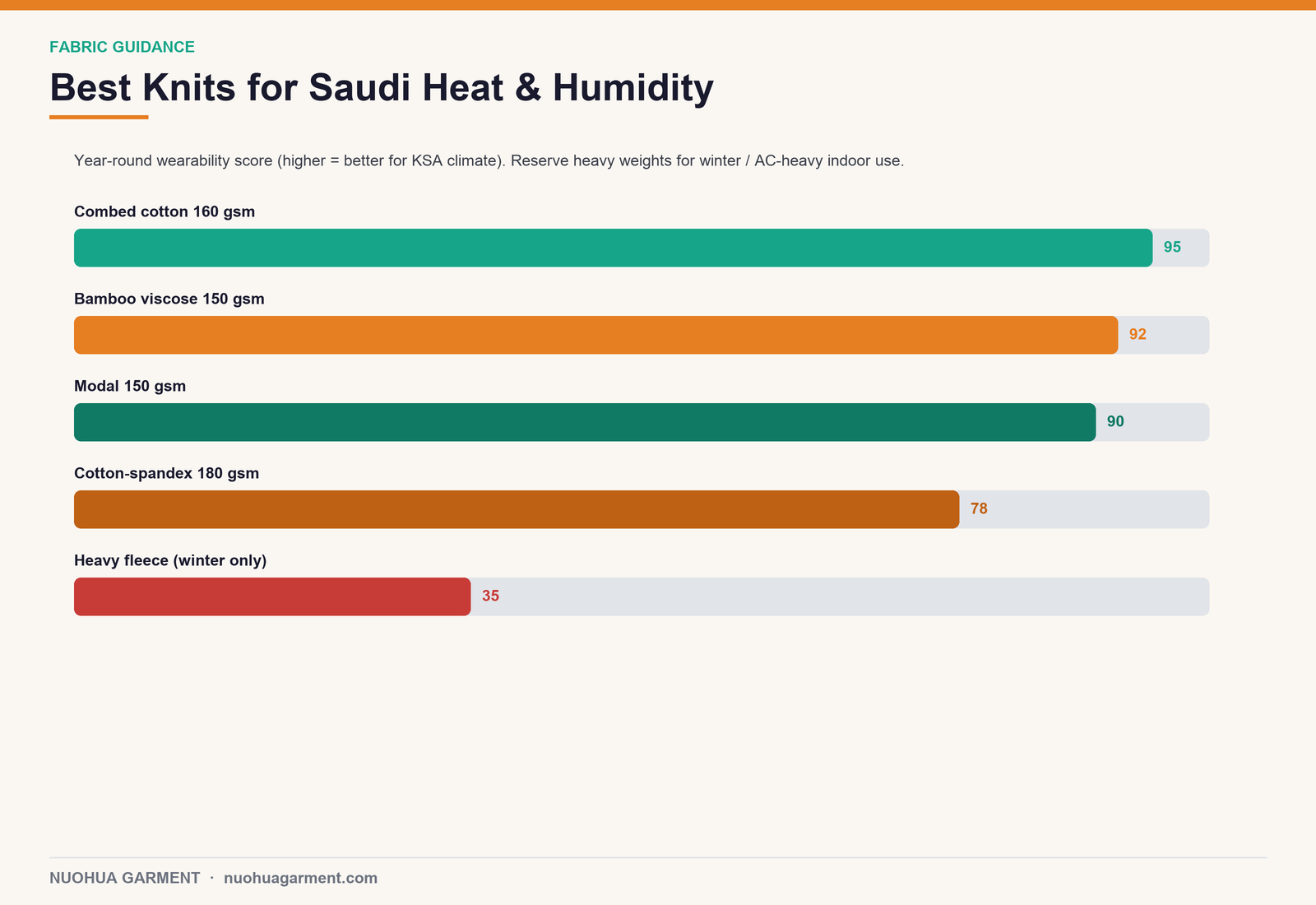
Saudi Arabia’s climate is among the harshest for children’s wear – long hot seasons, high humidity on the coast, AC-driven dry air indoors. Breathable, moisture-managing knits outperform heavy synthetics. Ask whether the factory runs lightweight jersey (140-180 GSM) specifically for kids’ underwear and sleepwear, and whether they can source fabrics tested against the OEKO-TEX restricted-substance list. (Note on OEKO-TEX: we are advancing our OEKO-TEX Standard 100 application at our facility; in the meantime every production batch is tested through SGS, TÜV SÜD and Intertek. We do not market OEKO-TEX as held.) For the skin-safety logic, see our combed cotton vs cotton-spandex guide.
3.3 MOQ that matches a Saudi brand’s pilot curve
Most GCC founders we meet want to test 2-3 styles in 2-3 colors before scaling. A factory that demands 1,000 pieces per style will kill your pilot. At Nuohua we run 2 pcs on selected in-stock styles, colors and sizes as standard for sampling and pilot runs, with flexible sampling terms. For an honest read on why “low MOQ” is sometimes a marketing trick, see our low-MOQ explainer.
3.4 Private label and labeling capability
Saudi retail demands bilingual (Arabic + English) care labels, RN/CR numbers, barcodes, and private-label packaging. The factory must be able to print or source compliant care labels in Arabic and to attach tracking labels for shipments heading to the US in parallel. Ask whether they have run Arabic-labeled production before – right-to-left typesetting and placement rules are easy to get wrong.
3.5 Communication cadence and documentation
For cross-border GCC sourcing, you want weekly written updates with photos, signed sample approval sheets, and a clear change-control process. If a factory only communicates over voice calls, expect surprises at pre-shipment inspection.
4. Sourcing Options for Saudi Brands: An Honest Comparison
No single region is best for every Saudi brand. Here is how the main sourcing options stack up against the KSA-specific criteria above.
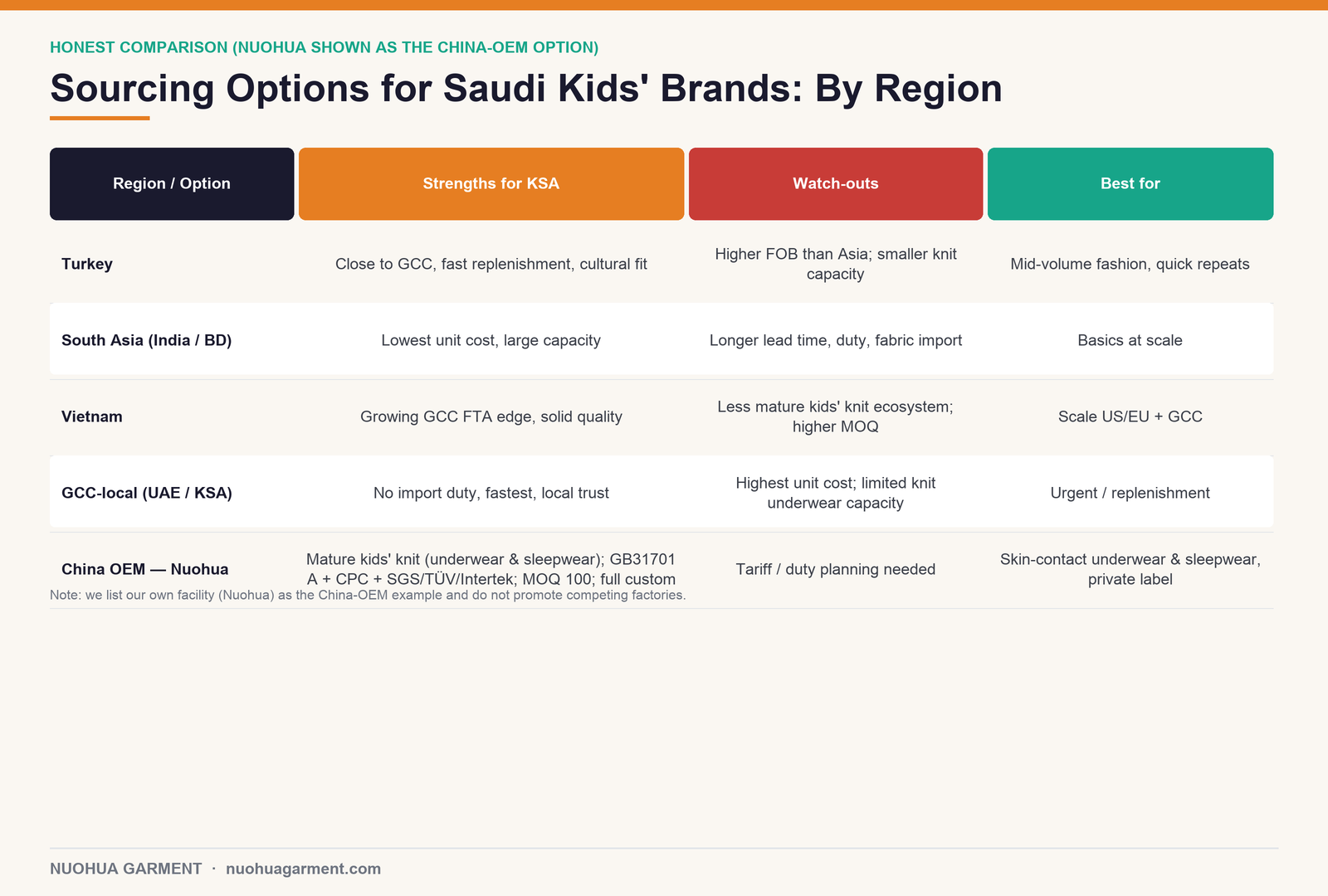
Two honest notes. First, Turkey is the strongest option if speed and cultural proximity dominate your decision; it is rarely the strongest option on unit cost. Second, if you choose a China OEM partner, the question is not whether China can make kids’ underwear to a Saudi-standard chemical panel – it can, and the major labs in Guangdong and Fujian run the panel weekly. The question is whether your specific factory has the documentation discipline, the bilingual labeling capability, and the willingness to coordinate the SABER audit when SABER’s body shows up. That is the gap we built Nuohua to close.
5. A Closer Look: Nuohua Garment’s Fit for Saudi Kids’ Brands
Full disclosure: this is where we talk about our own factory, because you asked for an honest list and we would rather be transparent than hide behind a generic roundup.
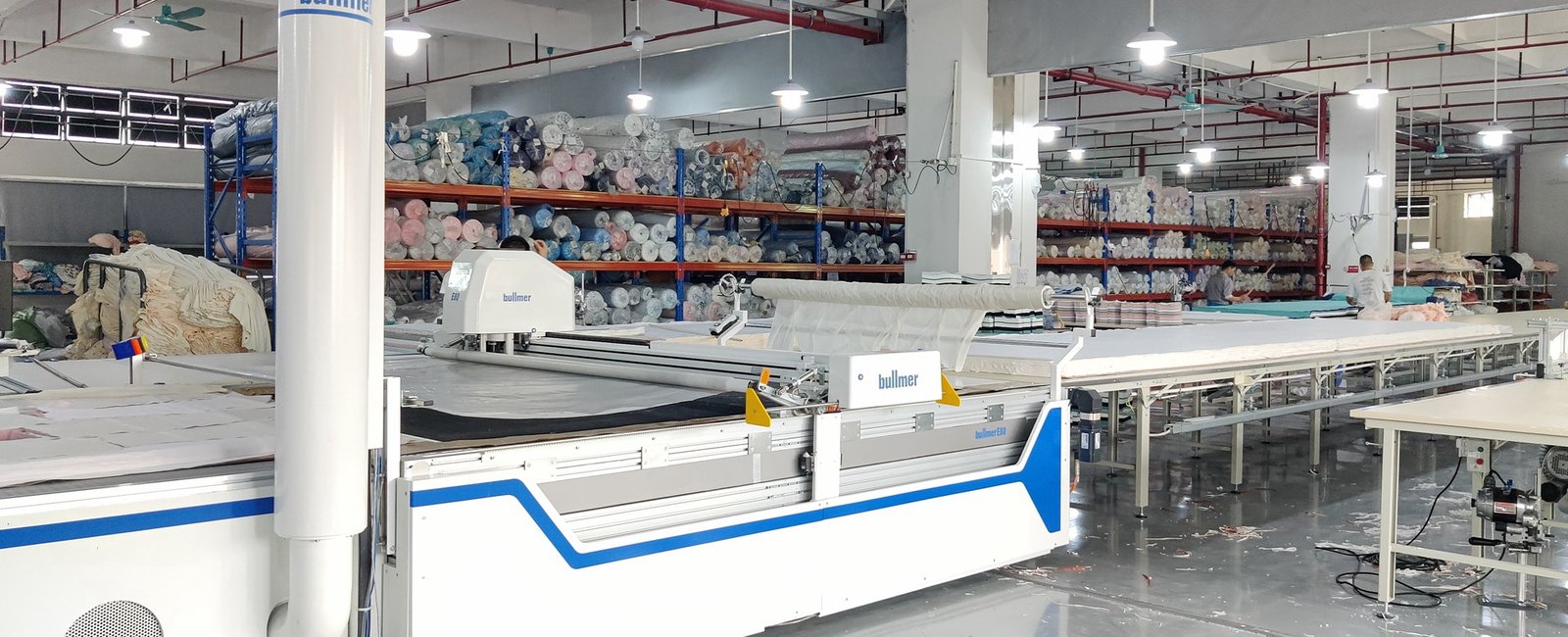
What we make. Nuohua Garment is a China-based OEM/ODM manufacturer specializing in kids’ underwear and sleepwear – training bras, panties, briefs, pajama sets, and related knit basics. We have shipped children’s knit apparel for over 14 years, primarily to US, EU and GCC importers, with a current capacity profile that supports Saudi-bound private label.
Compliance backbone. Our kids’ underwear and sleepwear program is built on:
- GB 31701 Class A – the Chinese national standard for infant and children’s textile safety, the strictest class.
- CPC (Children’s Product Certificate) support – test reports aligned with US CPSIA requirements, ready for your US-side filing if you sell cross-border.
- Third-party testing through SGS, TÜV SÜD, and Intertek – all three are SASO-recognized conformity assessment bodies, so a test report from any of them uploads cleanly into your SABER application.
- OEKO-TEX Standard 100 (in progress) – we are advancing our application; every production batch is tested against the OEKO-TEX restricted-substance list through the labs above. We do not market OEKO-TEX as held.
- EcoCosy® fiber authorization – we are an authorized user of EcoCosy® fibers (100% cellulose from certified forests, biodegradable), giving us a credible sustainability story for the bamboo and modal segment.
Commercial model. MOQ 2 pcs on selected in-stock styles, colors and sizes for sampling and pilot runs, with flexible sampling terms for Saudi founders testing the market. Full custom on fabric, color (Pantone-dyed), sizing (EU / US / Asian standards), labels (Arabic + English care labels), and packaging. We structure sampling to a fixed-fee model so the first three styles do not eat your runway. For the step-by-step on the custom model, see our OEM vs ODM vs private label explainer.
What we will not do. We will not issue a SABER PCoC for you (the importer files it), and we will not sign a compliance attestation we cannot back with a third-party test report. If a factory is willing to do those things, treat it as a red flag.
6. How Saudi Brands Vet a Manufacturer: Step by Step
A 7-step process that has worked for the Saudi and GCC founders we serve. The full visual playbook is below.
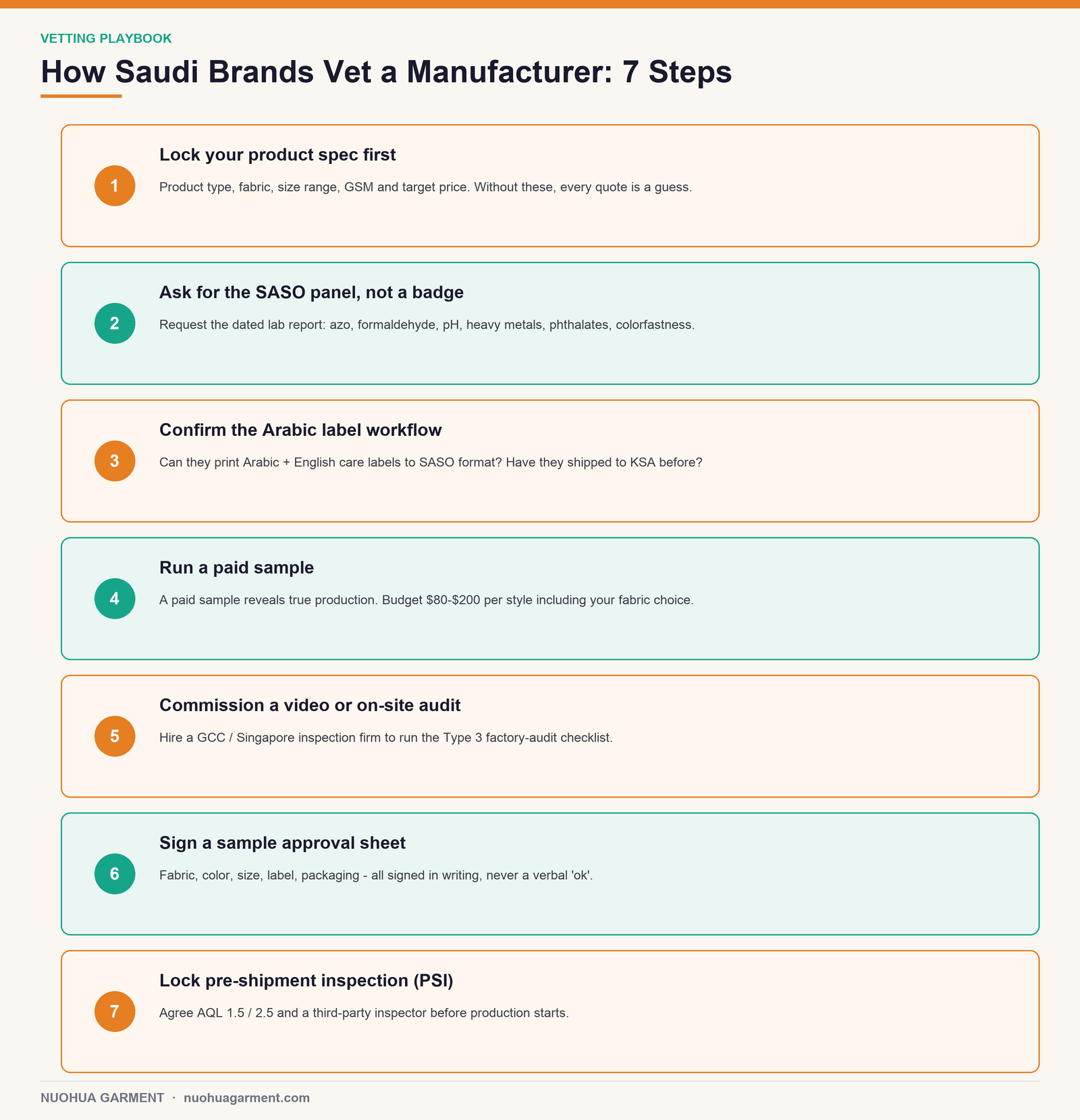
Two details that often get missed. Step 4: a paid sample (USD 80-200 per style) reveals what production will actually look like; a free sample reveals what the factory wants you to see. Step 7: agree on an AQL level (we use 1.5 / 2.5 for kids’ apparel as a starting point) and a third-party inspector before production starts. The OEM production-readiness checklist covers what we need from you before the line starts.
7. From Brief to First Shipment to Dammam: A Realistic Timeline
For a 1,000-piece pilot of two pajama styles in three colors, sourced through a China OEM partner with SABER Type 3 testing, plan on 15-16 weeks door-to-door. The realistic schedule:
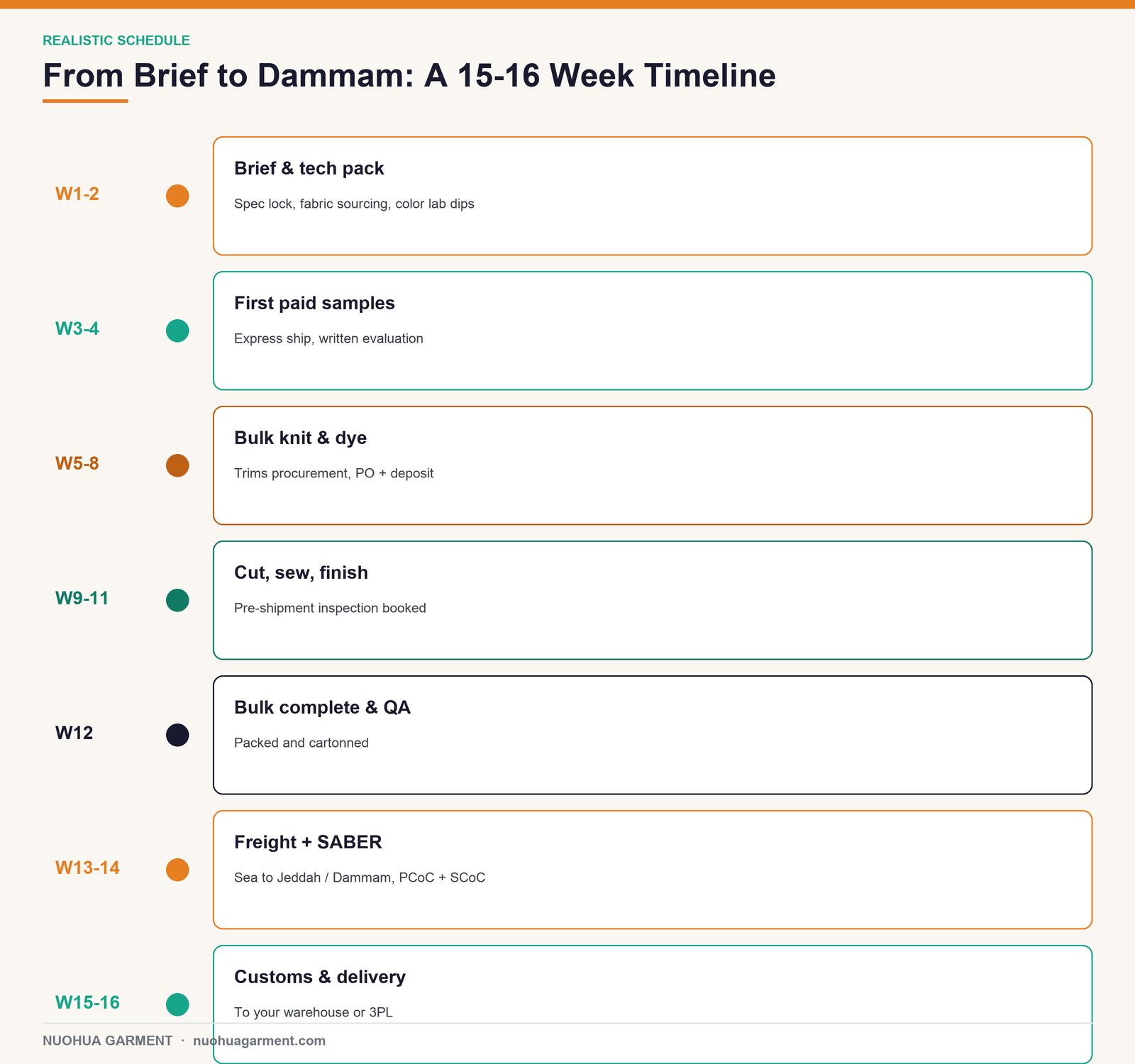
Faster is possible by air-freighting samples and finished goods, but at a meaningful cost premium. Slower is common if you are running first-time SABER certification in parallel – the first audit can add 4-6 weeks.
8. Mistakes Saudi Brands Make When Sourcing Kids’ Clothing
From the side of the factory, here are the patterns we see most often.
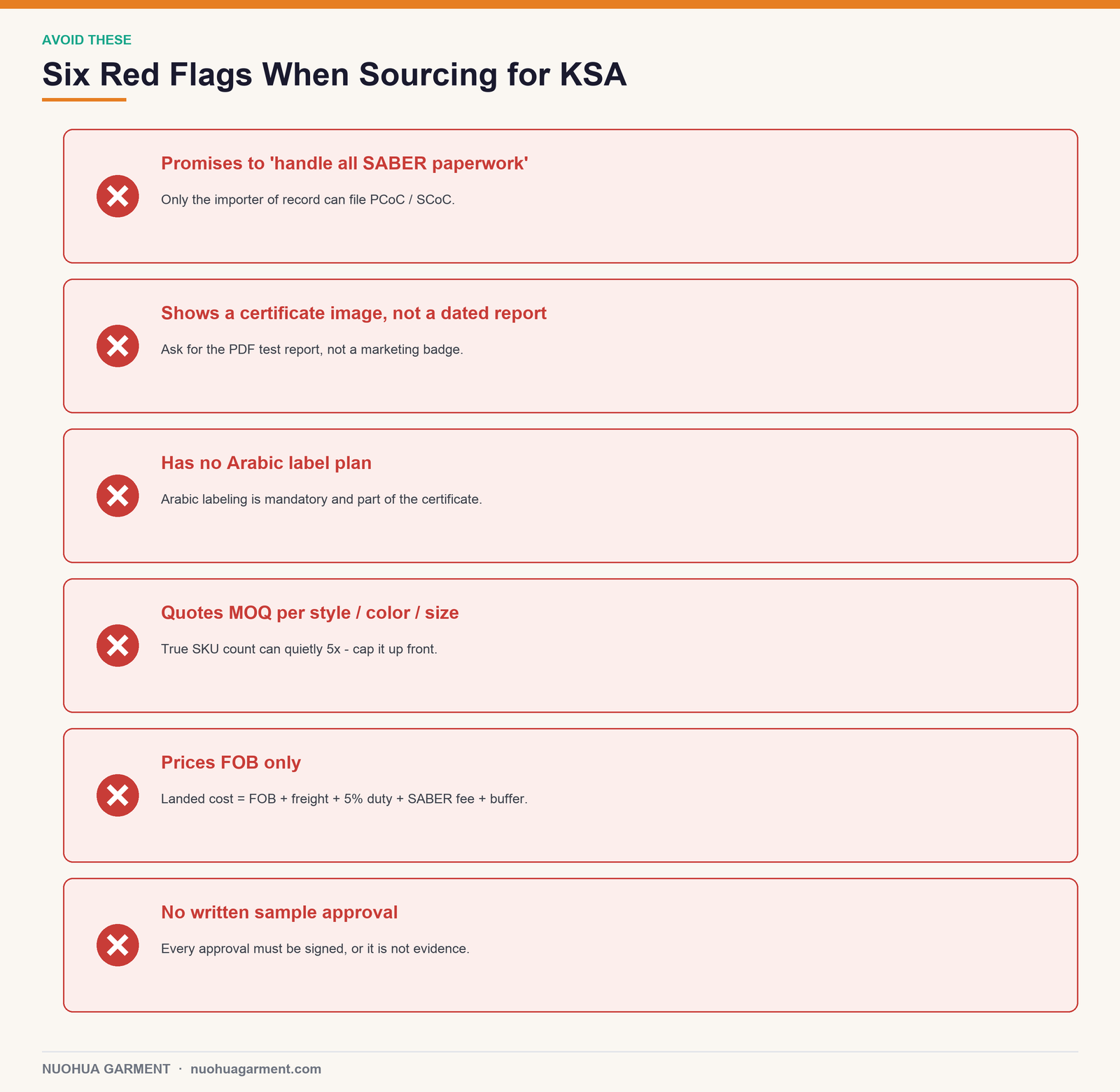
Treat SASO as a sticker on the box. Type 3 is testing plus factory audit, not a paperwork formality. Order the wrong fabric for the climate. Heavy fleece-lined pajamas do not sell in Riyadh summers. Source lightweight knits (140-180 GSM) for year-round basics. Skip the Arabic label until the container is loaded. Reworking labels at destination is a customs hold. Underestimate true MOQ. A 6-style, 4-color, 5-size line can quietly become 120 SKU combinations – negotiate SKU-count caps upfront. Optimize only on FOB price. Landed cost = FOB + freight + 5% GCC duty + SABER fees + buffer. Skip the contingency plan for the first audit. Expect one or two non-conformities and have a corrective-action process agreed in writing before the audit.
9. Your Pre-Production Checklist for KSA
Before you issue a purchase order to any kids’ underwear or sleepwear factory for the Saudi market, confirm every line on the checklist below.
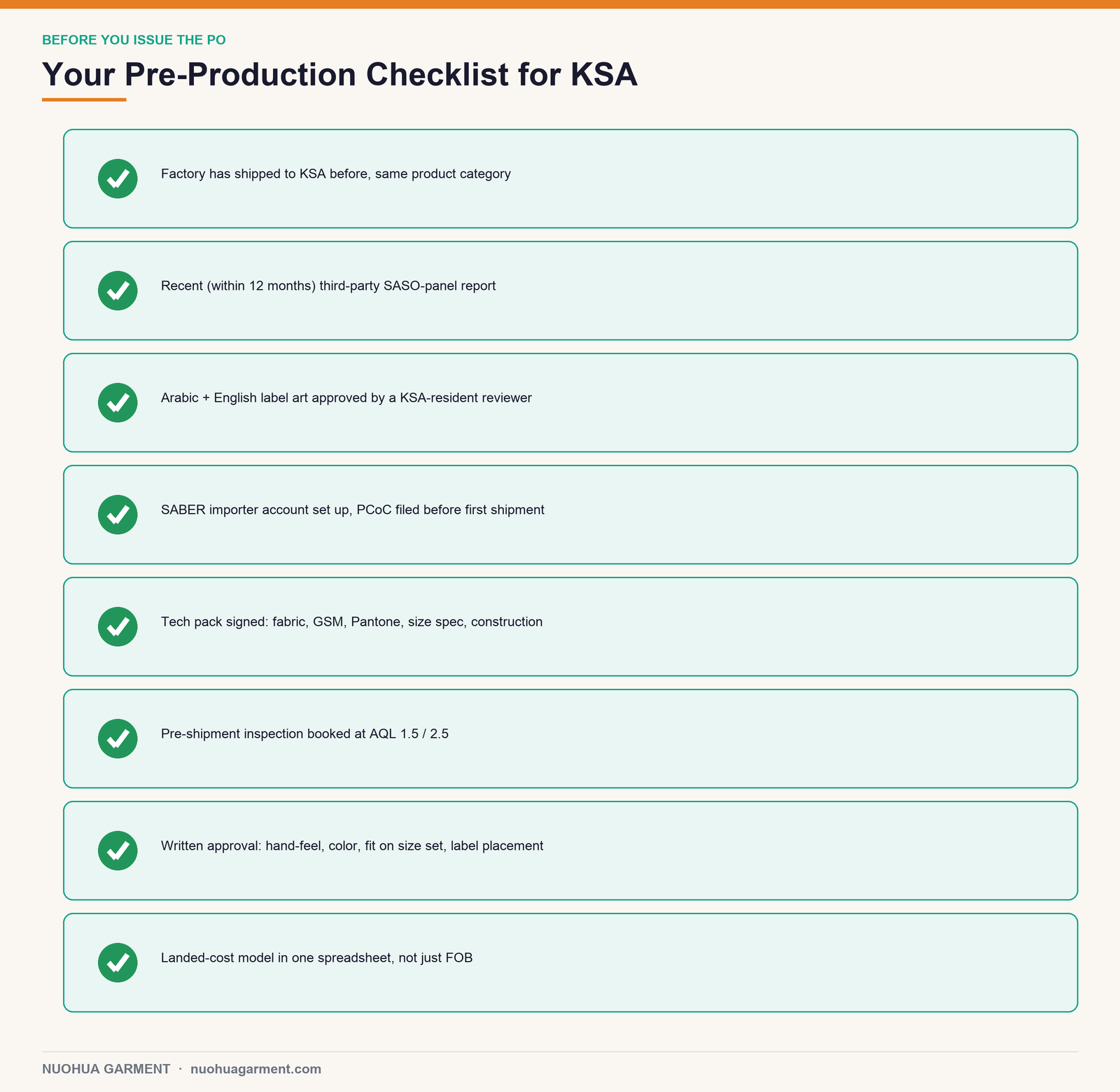
For the full production-readiness list, including what the factory will need from you before the line starts, see our OEM production-readiness checklist and our 11-detail quote checklist.
Frequently Asked Questions
Do I really need Type 3 certification for kids’ underwear imported into Saudi Arabia?
Yes. Under the SASO Technical Regulation for Textile Products (second edition, effective mid-2024), children’s wear and underwear require Type 3 certification – laboratory testing against the chemical-safety panel plus a factory audit. Type 1a (testing only) is not sufficient.
Can my factory in China issue the SABER certificate for me?
No. The SABER PCoC and SCoC are issued to the importer of record (you or your local partner). Your factory’s role is to provide compliant test reports, bilingual labeling, and cooperation with the factory audit. Be skeptical of any factory that promises to “handle all the paperwork.”
How long does the first SABER certification take?
Plan 4-6 weeks for first-time certification including the factory audit. If you run it in parallel with sampling, you can land the first commercial shipment inside the 15-16 week timeline above. Repeat shipments under the same PCoC are faster – only a new SCoC is needed per shipment.
What is the Arabic label requirement exactly?
The 2024 SASO update made Arabic labeling mandatory. The label must include fiber composition, weight or size, supplier name and commercial register number, country of origin, and care instructions – all legible in Arabic. English may accompany but cannot replace Arabic.
Is a factory in China really cheaper than Turkey for kids’ knit basics once you add duty?
For 1,000-5,000 pieces per style with 12-week lead time tolerance, a China OEM usually wins on FOB by 15-25% even after the 5% GCC duty and SABER fees. For 200-500 pieces per style with a 4-week tolerance, Turkey or GCC-local usually wins because air freight and duty erode the China FOB advantage.
How do I verify a factory’s OEKO-TEX or EcoCosy claim?
Ask for the certificate number, then verify it on the issuing body’s public database. For OEKO-TEX, the oeko-tex.com Label Check confirms whether a supplier’s certificate is current. For EcoCosy®, the Sateri / EcoCosy licensee list is the authoritative source. We list our own facility’s certifications on the Nuohua Trust Center.
What is the difference between SASO certification and Gulf G-Mark?
SASO is the Saudi national scheme; G-Mark is the GCC-wide conformity mark. For kids’ underwear and sleepwear sold in Saudi Arabia specifically, SASO Type 3 via SABER is the path. G-Mark becomes relevant if you also sell into UAE, Bahrain, Kuwait, Qatar, and Oman under a unified GCC program.
Where do I start if I’m a first-time Saudi importer without a local partner?
Get your local setup right first (CR number, Saudi importer account, ZATCA registration), then engage a Saudi customs broker familiar with SABER filings. Shortlist two or three factories with documented SASO-panel test reports and run paid samples in parallel. Our how-to-start-a-kids-underwear-brand guide walks through the founder-side setup in detail.
Saudi Arabia’s kidswear market is one of the most exciting categories we serve – a young, growing consumer base, sophisticated parents, and a regulator that is pushing the whole industry toward safer, more transparent supply chains. If you are building a Saudi-bound private-label line and want a manufacturer that takes Type 3, bilingual labeling, and pilot MOQ as seriously as you do, request a quote or talk to our team. We will send a current factory audit summary, a sample of recent third-party test reports, and a sample Arabic + English care label draft within one business day.
This article is part of our private-label kids’ clothing sourcing library.