
AZO Dyes & Heavy Metal Lead Testing: Chemical Safety Guide for Kids’ Underwear
Chemical safety is the part of kids’ underwear sourcing that no brand wants to think about until a lab report comes back red. The dyes that colour the fabric, the pigments in the print, and the metal residues left in the finish are all invisible to the eye — but they are exactly what a customs hold, a CPSC recall or a retailer audit is looking for. This guide is a technical walk-through of azo dyes, lead testing and phthalates in kids’ underwear: the exact limits, the test methods behind them, how print chemistry changes your risk, and how to read a third-party lab report without a chemistry degree. Whether you are preparing for an azo dyes lead testing kids underwear audit or building a compliance program from scratch, the limits and methods below are the ones that matter.
On this page
- Quick answer: what chemical tests kids underwear must pass
- AZO dyes: the REACH Annex XVII restriction (30 mg/kg)
- Lead in kids underwear: CPSIA limits explained (100 ppm / 90 ppm)
- Phthalates: the 0.1% limit on flexible prints
- Print chemistry: water-based vs plastisol inks and testing impact
- How to read a third-party lab report (SGS / Intertek)
- OEKO-TEX Class I: what “in progress” means for our facility
- A pre-shipment chemical test checklist for brands
1. Quick Answer: What Chemical Tests Kids’ Underwear Must Pass
Chemical safety for kids’ underwear revolves around three families of substances: azo dyes, restricted under EU REACH Annex XVII at 30 mg/kg for carcinogenic aromatic amines (tested to EN 14362-1); lead, limited under CPSIA to 100 ppm in the substrate and 90 ppm in surface coatings (tested to CPSC-CH-E1002-08); and phthalates, with the eight restricted compounds capped at 0.1% each in accessible parts.
These three do not come from a single regulation. They come from a patchwork of US, EU and Chinese standards that overlap only partially, which is why a garment can pass one market’s test and fail another’s. A brand selling into the US cares most about CPSIA lead and phthalate limits; a brand selling into the EU cares most about the REACH azo and heavy-metal restrictions. A brand selling into both must satisfy both, and a responsible factory tests against the strictest applicable limit rather than the loosest.
| Substance | Governing standard | Limit | Test method |
|---|---|---|---|
| Azo dyes (carcinogenic amines) | EU REACH Annex XVII | 30 mg/kg | EN 14362-1 |
| Lead (substrate) | US CPSIA | 100 ppm | CPSC-CH-E1002-08 |
| Lead (surface coating) | US CPSIA | 90 ppm | CPSC-CH-E1002-08 |
| Phthalates (8 restricted) | US CPSIA / EU REACH | 0.1% each | CPSC-CH-C1001-09 / EN 14372 |
Note the distinction already visible in that table: azo dyes are a concentration limit measured in milligrams per kilogram of the dyed material, while lead is a parts-per-million limit on the total content, and phthalates are a percentage of the plasticised component. They are different units, different tests, and different risk profiles — which is exactly why a single “chemical test passed” claim without the specific method behind it is meaningless.
2. AZO Dyes: The REACH Annex XVII Restriction (30 mg/kg)
Azo dyes are a broad class of synthetic colourants, most of which are perfectly safe — but a specific subset can break down under certain conditions into aromatic amines classified as carcinogenic. EU REACH Annex XVII restricts those amines to 30 mg/kg in textile articles that come into prolonged contact with skin, and the reference test is EN 14362-1.
The first thing to understand about azo dyes is that the chemistry is not the problem; the decomposition is. An azo dye molecule contains an azo group (a nitrogen double bond) linking two aromatic rings. When a garment made with a restricted azo dye is exposed to the body’s warmth, sweat and friction over time, the dye can cleave and release aromatic amines — compounds that several are classified as carcinogenic. That release, not the dye itself, is the hazard REACH is regulating.
REACH Annex XVII sets the limit at 30 mg/kg for each of the listed aromatic amines — a deliberately low threshold that reflects the principle that carcinogenic amines should not be present in skin-contact clothing at meaningful levels. The reference test method, EN 14362-1, extracts the amines from the textile and quantifies them. It is the standard you will see named on almost every EU-facing lab report for dyed textiles.
For a manufacturer, the practical control is in the dye selection. The restricted azo dyes are almost entirely avoidable: the colour can usually be achieved with alternative dyestuffs that do not carry the restriction. A responsible mill specifies dyes that are demonstrably free of the restricted amines, and confirms that choice with testing rather than trusting a supplier’s word.
3. Lead in Kids’ Underwear: CPSIA Limits Explained (100 ppm / 90 ppm)
Under the US CPSIA, lead in children’s products is limited to 100 ppm in the accessible substrate (the fabric and trim) and 90 ppm in surface coatings such as prints and paints. The reference test method is CPSC-CH-E1002-08. Lead is a cumulative neurotoxin, and the limits are set low because there is no safe exposure level for a developing child.
Lead in a children’s garment sounds like an industrial-age problem, but it is a live compliance issue in modern sourcing. Lead can enter a kids’ underwear product through several quiet routes: a pigment in a print, a metal button or snap with a lead-bearing alloy, a bright-coloured trim, or a dye or finish that carries lead as an impurity. Because lead accumulates in the body over time, the US CPSIA sets its limits with the assumption that no level is safe for a developing child — hence the low thresholds.
The two limits are easy to confuse but have different targets. The 100 ppm limit applies to the accessible substrate — the fabric body of the underwear, the elastic, the trims — essentially everything the child touches that is not a coating. The 90 ppm limit applies to surface coatings, which in underwear most often means the printed design on the front panel. Coatings get a tighter limit because they sit directly on the surface and can flake or transfer.
The reference method, CPSC-CH-E1002-08, is the CPSC’s standard operating procedure for determining total lead content in children’s products. It digests the sample and measures lead by instrumental analysis. When a lab reports a lead result for a substrate, this is the method behind the number.
| Part of the garment | Lead limit | What it covers in kids underwear |
|---|---|---|
| Accessible substrate | 100 ppm | Fabric body, elastic, waistband, trims, snaps |
| Surface coating | 90 ppm | Printed designs, painted details, coated trims |
For a manufacturer, lead control is a matter of supply-chain discipline: the pigments used in prints, the alloys used in trims, and the dyes and finishes used on the fabric must all be sourced from suppliers who can document low-lead formulations. The factory’s own testing — third-party tested by SGS or an equivalent laboratory — then confirms the finished garment meets the limits before it ships.
4. Phthalates: The 0.1% Limit on Flexible Prints
Phthalates are plasticisers used to make plastics and some inks soft and flexible. In children’s products, eight specific phthalates are restricted to 0.1% (1,000 ppm) each in accessible components. For kids’ underwear, the practical risk sits in thick, rubbery prints — which is why the print chemistry choice in the next section matters so much.
Phthalates do not belong in a well-made kids’ underwear product, but they can enter through a specific route: the flexible, rubbery print. A thick plastisol or rubberised ink can contain phthalates as softeners, and because a printed design is an accessible component, it falls within the scope of the restriction. The eight phthalates restricted under US CPSIA — and echoed in EU REACH — are each capped at 0.1%.
For a brand, the phthalate question almost always reduces to one practical choice: what print ink is being used, and is it a phthalate-free formulation? This is the subject of the next section, because print chemistry is the single biggest lever a brand has over its phthalate — and often its lead — exposure.
5. Print Chemistry: Water-Based vs Plastisol Inks and Testing Impact
Water-based and reactive prints carry far lower phthalate and lead risk than plastisol prints, because they do not rely on phthalate plasticisers or heavy-metal pigments for their colour. Plastisol — a PVC-based ink — is the formulation where phthalate risk concentrates, and it is the first thing a chemical audit should question.
Every printed kids’ underwear design is a chemical decision wearing a picture. The two broad families of print you will encounter are water-based (including reactive printing) and plastisol, and they carry very different chemical risk profiles.
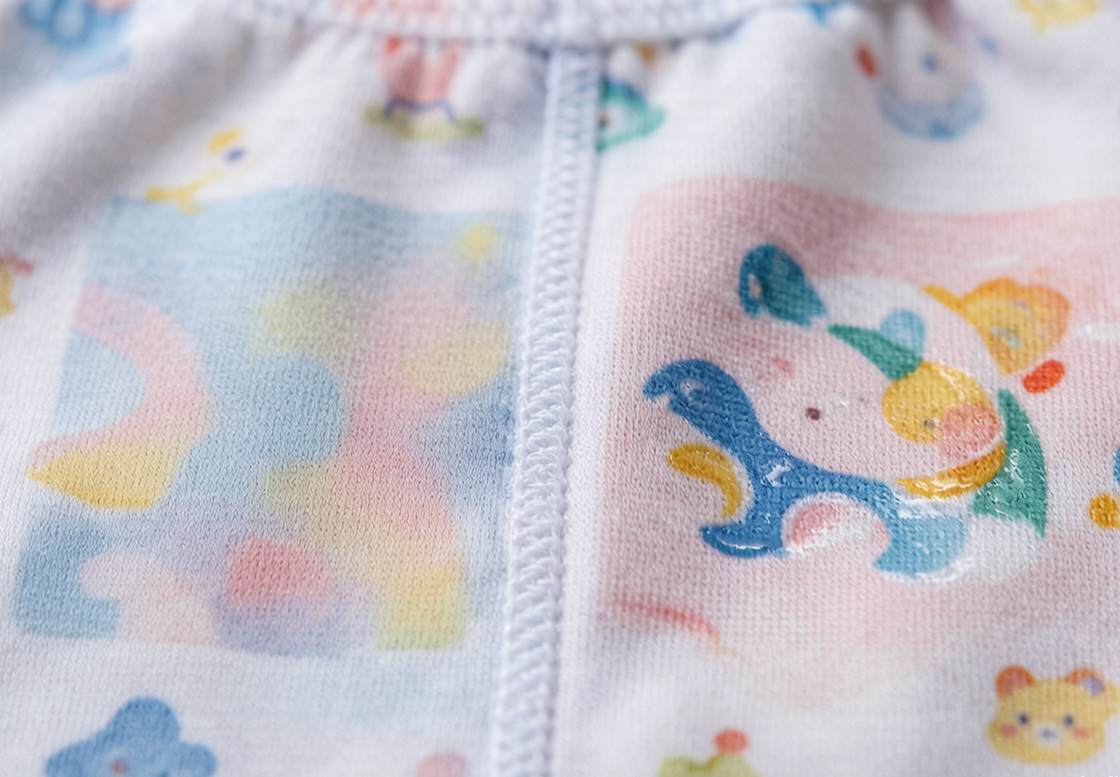
Water-based and reactive prints use the fabric’s own chemistry to carry the colour. A reactive print bonds the dye to the fibre, producing a print that is part of the fabric rather than a layer sitting on top of it. Because these systems do not require plasticisers, they do not introduce phthalates, and their pigment load can be selected to keep heavy metals low. This is the family a children’s brand should default to.
Plastisol is a PVC-based ink that sits on the surface of the fabric as a flexible film. It is popular because it is opaque, durable and cheap — but the PVC base is exactly where phthalate plasticisers live, and the pigments used for opacity can carry lead. A plastisol print is not automatically a violation — compliant phthalate-free plastisols exist — but it is the formulation where the risk concentrates, and it is the first thing an auditor questions on a kids’ product.
| Print type | How it works | Phthalate risk | Lead risk | Hand feel |
|---|---|---|---|---|
| Water-based / reactive | Dye bonds into the fibre | Very low | Low (pigment-dependent) | Soft, part of fabric |
| Plastisol | PVC film sits on the surface | Higher (plasticiser) | Higher (opacity pigments) | Thick, rubbery film |
6. How to Read a Third-Party Lab Report (SGS / Intertek)
A useful lab report names three things: the test method, the limit, and the result — and the result must be stated against the limit, not just as a raw number. For azo dyes you want EN 14362-1 against 30 mg/kg; for lead you want CPSC-CH-E1002-08 against 100 ppm (substrate) or 90 ppm (coating). If any of those three elements is missing, the report is not complete.
A lab report from SGS, Intertek or an equivalent third-party body is only as good as your ability to read it. Most brands glance at the “PASS” line and move on, but a pass with no method and no limit is a pass you cannot defend. Here is the discipline for reading a chemical report on kids’ underwear.
| Element | What to look for | Why it matters |
|---|---|---|
| Test method | EN 14362-1, CPSC-CH-E1002-08, etc. | The method defines what was actually measured |
| Limit | 30 mg/kg, 100 ppm, 90 ppm, 0.1% | A result is meaningless without the threshold |
| Result | Measured value vs the limit | Pass/fail is a comparison, not a raw number |
| Sample ID | Which garment, colour and component was tested | Confirms the tested item is the shipped item |
| Lab & date | Third-party name and report date | Verifiable, current, independent |
Three common report problems are worth naming. The first is a method-less result — a number with no test method attached, which could have been produced by any procedure. The second is a limit-less pass — “PASS” with no stated threshold, which tells you nothing about what standard was applied. The third is a mismatched sample — a report on a raw fabric swatch being presented as if it covered the finished, printed, trimmed garment. A fabric swatch report does not cover the print, and a print is often where the risk is.
When we commission testing for a kids’ underwear program, the garment is third-party tested by SGS or an equivalent laboratory against the relevant methods, and the report is shared with the buyer rather than summarised. That transparency is the point: a report you can read and verify is worth more than a certificate you are asked to take on faith.
7. OEKO-TEX Class I: What “In Progress” Means for Our Facility
OEKO-TEX Standard 100 is the most recognised textile chemical-safety label, and Class I is its strictest level, intended for infants and toddlers. At Nuohua Garment, OEKO-TEX Standard 100 is currently in progress — we are transparent that it is not yet granted, and in the meantime we rely on third-party testing to the specific substance limits covered in this article.
A brand should never be given a false impression about certifications, and this section exists to be precise. OEKO-TEX Standard 100 is currently in progress at our facility — which means exactly that: the certification process is underway, but we do not claim to hold the certificate, and we will not imply otherwise.
Why Class I specifically? OEKO-TEX Standard 100 divides textiles into four product classes by the age of the end user, and Class I is the strictest, covering products for babies and children up to three years old. Because kids’ underwear often spans the Class I and Class II boundary, the tightest applicable limits are the right target, and that is the standard against which our material and process choices are being aligned.
In the meantime, the substance-level safety that OEKO-TEX would certify is achieved through the testing described in the rest of this article: third-party verification against EN 14362-1 for azo amines, CPSC-CH-E1002-08 for lead, and the phthalate limits. A certification is a convenient shorthand, but the underlying limits are testable with or without it — and a buyer who understands the limits is never dependent on a label alone.
8. A Pre-Shipment Chemical Test Checklist for Brands
Before a kids’ underwear order ships, confirm six things: the target market, the applicable limits, the test methods, the component coverage, the lab, and the approval chain. A checklist converts chemical safety from a vague “we test” into a set of verifiable, named items.
Close with the discipline, not the theory. This is the checklist to run before you accept a shipment — or before you commission the testing for one.
- Target market confirmed. US (CPSIA lead and phthalates), EU (REACH azo and heavy metals), or both — this determines the test panel.
- Limits named. 100 ppm substrate / 90 ppm coating for lead, 30 mg/kg for azo amines, 0.1% for each restricted phthalate.
- Methods named. EN 14362-1 for azo, CPSC-CH-E1002-08 for lead — not just “tested for chemicals.”
- Component coverage. The test covers the finished, printed, trimmed garment, not a raw fabric swatch.
- Lab identified. A third-party body such as SGS or Intertek, with a report you can read.
- Approval chain clear. You have approved the report against the standard before goods ship.
Need a kids’ underwear program built around verifiable chemical safety? Tell us your target market and print requirements, and our team will map the applicable limits and test methods before you commit.