
From Tech Pack to Bulk Delivery: A 42-Day Custom Kids’ Underwear Case Study
Every brand asks the same question in a different way: “how long until I can sell it?” A kids underwear production timeline is not a single number — it is a sequence of hand-offs, each with its own rhythm and its own failure points. This article walks through a real 42-day custom production run from a manufacturer’s perspective: what happens each week, where time is actually spent, what went wrong in the middle and how it was caught, and where a less-disciplined program would have slipped. No names, no invented heroics — just the mechanics of taking a tech pack to a delivered carton.
On this page
- Quick answer: the 42-day timeline at a glance
- Phase 1: tech pack review and lab-dips (Day 1–7)
- Phase 2: PP sample confirmation (Day 8–18)
- Phase 3: bulk fabric knitting, dyeing and cutting (Day 19–32)
- Phase 4: sewing and inline QC (Day 33–38)
- Phase 5: final inspection, packing and shipping (Day 39–42)
- Where timelines slip: the honest delay points
- How to protect your timeline as a brand
1. Quick Answer: The 42-Day Timeline at a Glance
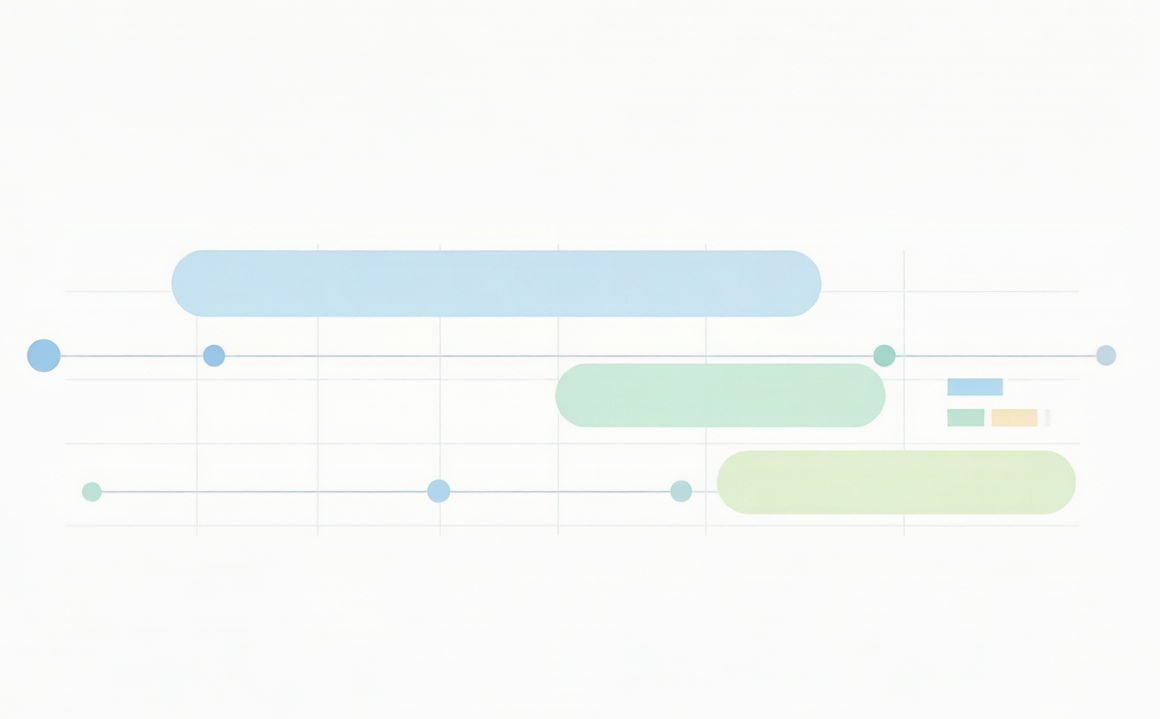
A custom kids underwear production timeline of 42 days breaks into five phases: tech pack review and lab-dips (Days 1–7), pre-production sample confirmation (Days 8–18), bulk fabric knitting, dyeing and cutting (Days 19–32), sewing with inline QC (Days 33–38), and final AQL 2.5 inspection, packing and shipping (Days 39–42). The 42 days are production days, not calendar days — and that distinction is where most brand-side planning goes wrong.
The single most important number to internalise is not 42 — it is the difference between production days and calendar days. A factory counts the days the work is actually moving. It does not count weekends, public holidays, the days a courier sits in customs, or the days a sample waits on your desk for approval. When a brand hears “six weeks” and books a launch eight weeks out, the mismatch is rarely the factory being slow; it is the brand forgetting that its own approval time lives inside the same calendar.
| Phase | Days | What happens | Who is on the critical path |
|---|---|---|---|
| 1. Tech pack review & lab-dips | 1–7 | Spec review, colour lab-dips, fabric lock | Factory + you (approvals) |
| 2. PP sample confirmation | 8–18 | Pre-production sample, fit check, sealing | Factory + you (sign-off) |
| 3. Bulk fabric, dye & cut | 19–32 | Bulk knitting, dyeing, inspection, spreading, cutting | Factory + mill |
| 4. Sewing & inline QC | 33–38 | Line assembly, inline checks, end-of-line audit | Factory |
| 5. Final inspection & ship | 39–42 | AQL 2.5 inspection, packing, carton, dispatch | Factory + inspector |
Notice that two of the five phases contain a “you” in the critical-path column. Your approval speed is part of the production timeline, not separate from it. The fastest factory in the world cannot shorten a timeline you are holding up. That is the theme of the rest of this article.
2. Phase 1: Tech Pack Review and Lab-Dips (Day 1–7)
The first week is not sewing — it is reading. The factory reviews your tech pack line by line, checks the measurements against the fabric’s stretch, and produces colour lab-dips so the exact shade is approved before a single metre of bulk fabric is dyed. Getting this week right prevents most of the delays that appear later.
A tech pack arriving at the factory is the moment the clock starts, but only if the pack is complete. The review step is where the factory’s pattern and technical team reads every field — rise, waistband width, leg elastic specification, seam types, label placement — and cross-checks it against what the chosen fabric can actually do. A spec that asks for a waistband stretch a given fabric cannot deliver is caught here, in week one, where the fix is a conversation rather than a re-cut of thousands of units.
In parallel, colour work begins. The fabric is not dyed blind: the mill produces lab-dips — small dyed swatches of the exact fabric in your requested shade — which you approve against your Pantone reference or physical swatch. Lab-dips are cheap and fast compared to re-dyeing bulk fabric, which is why this step exists as a gate. You should expect to review the dips, and possibly request an adjustment to the shade before signing off.
3. Phase 2: PP Sample Confirmation (Day 8–18)
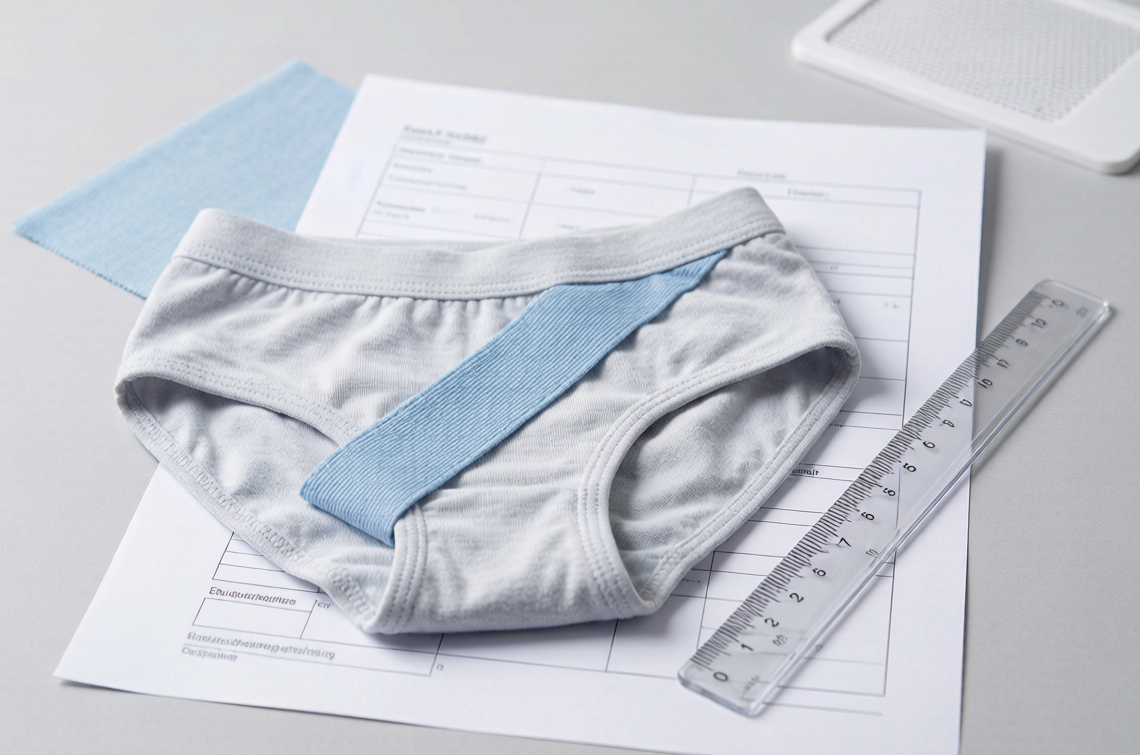
Days 8 to 18 belong to the pre-production sample. The factory cuts and sews one or two pieces in the actual bulk fabric, to the locked spec, and you fit-test and approve them. The PP sample is the reference the entire bulk line will be set up to reproduce — approving it is approving the bulk run itself.
The pre-production sample is the most important physical object in the entire timeline, because it converts your tech pack from a document into a decision. The PP sample is made from the actual bulk fabric, with the actual trims and the approved colour, to the sealed specification. When you hold it, you are holding what the line will produce thousands of.
This is where the case study’s one real production problem surfaced — and where the factory’s controls are worth describing honestly. On Day 12, during the standard pre-production checks, the team found that the waistband elastic’s stretch recovery was reading below the target. The elastic stretched far enough, but it did not snap back fully, which would have shown up in the finished garment as a waistband that bags out after a few hours of wear.
The fix was a process adjustment, not a panic: the elastic was pre-treated and the waistband attachment tension was re-tuned, then the sample was re-checked the next day and the recovery came back within tolerance. The point of telling this story is not the specific numbers — it is that the problem was found at Day 12, on a sample, where a correction costs one piece, rather than at Day 35, on a bulk line, where the same problem costs a production run. That is the entire argument for a PP stage.
4. Phase 3: Bulk Fabric Knitting, Dyeing and Cutting (Day 19–32)
Days 19 to 32 are the industrial core: the fabric is knitted and dyed in bulk to the approved lab-dip, inspected for shade and defects, relaxed, spread, and cut. This is the longest single phase because knitting and dyeing are batch processes that cannot be meaningfully rushed without risking shade inconsistency.
Once the PP sample is sealed, the factory releases the bulk fabric order. For an in-stock base such as the 91.9% Lenzing™ Modal / 8.1% Spandex interlock at 220–240 GSM, the fabric may already be available or knit to order; for a custom development, this phase is where the knitting and dyeing lead time lives. Dyeing is done against the lab-dip you approved in week one, and the dyed fabric is checked against the shade band to ensure the whole roll matches the standard within tolerance.
| Step | What happens | What it protects against |
|---|---|---|
| Bulk knitting & dyeing | Fabric produced to the approved lab-dip | Shade drift from the standard |
| Shade band check | Roll matched to the colour standard | Visible colour mismatch between rolls |
| Fabric inspection | Defects marked and graded | Holes, stains, and knit faults reaching the line |
| Spreading & marker | Fabric stacked and pattern laid for cutting | Waste and mismatched plies |
| Cutting & bundling | Pieces cut and bundled by size and colour | Mixed sizes and lost pieces on the line |
The honest thing to say about this phase is that it is the least forgiving of last-minute changes. Once the bulk fabric is dyed, a colour change means re-dyeing. Once the fabric is cut, a pattern change means re-cutting. Both are delays measured in days and costs measured in fabric. This is why the approval gates in the first two phases exist — they are what make this phase safe to run at speed.
5. Phase 4: Sewing and Inline QC (Day 33–38)
Days 33 to 38 are the assembly window: the cut pieces move onto the sewing lines, are assembled with the specified seam construction, and pass through inline quality checks at each station. Inline QC — checking quality during production rather than only at the end — is what keeps a defect from travelling through a hundred garments before anyone notices.
Sewing is where the timeline finally becomes visible as finished garments. The cut pieces, bundled by size and colour, are loaded onto the lines in the sequence the operation breakdown specifies. For kids’ underwear, the seam construction matters as much as the fit: flatlock seams lie flat against the skin and are the standard choice for the side and gusset seams, while bound and overlock constructions are used where a specific finish is required. These are engineering decisions, made in the tech pack, and the line simply executes them.
The quality system is the part a brand never sees but always benefits from. Rather than sewing everything and checking at the end, inline QC places checks at each stage: the elastic attachment is checked, the seam quality is checked, the label placement is checked. A defect caught at station two is corrected before it propagates through stations three through ten. This is a six-stage QC process with needle detection at the end — the needle check matters because a broken needle fragment in a children’s garment is a safety event, not a cosmetic one.
At our facility this phase runs on the INA hanging production system, which moves the garments between stations on hangers rather than in bundles. The practical effect is a smoother flow and fewer handling defects, because the pieces are not being repeatedly picked up and dropped. The capacity that backs it — 1,000,000+ pieces per month across 300+ staff — means a single brand’s run is scheduled into a line, not scrambling for one.
6. Phase 5: Final Inspection, Packing and Shipping (Day 39–42)
The final days are inspection, packing and dispatch. The finished goods are checked against an AQL 2.5 sampling standard, the approved garments are folded and packed into polybags and cartons, and the shipment is dispatched. This phase is short only because the previous phases did their jobs.
Final inspection is a sampling discipline, not a count of every piece. Under the AQL 2.5 standard, a statistically determined sample is pulled from the finished lot and checked against the sealed specification — measurements, seam quality, labels, colour, and the absence of the defects that inline QC should already have caught. AQL 2.5 means the plan tolerates a small, defined proportion of minor defects while rejecting the lot if major defects exceed the threshold.
Why AQL 2.5 and not something looser? For children’s underwear, a brand’s real risk is not a slightly crooked label — it is a safety or fit failure that generates returns and, in the worst case, a compliance problem. A tighter inspection plan costs a little time at the end but buys back far more in avoided returns. The factory’s own sub-0.3% defect rate is the internal target that makes the AQL inspection a formality rather than a confrontation.
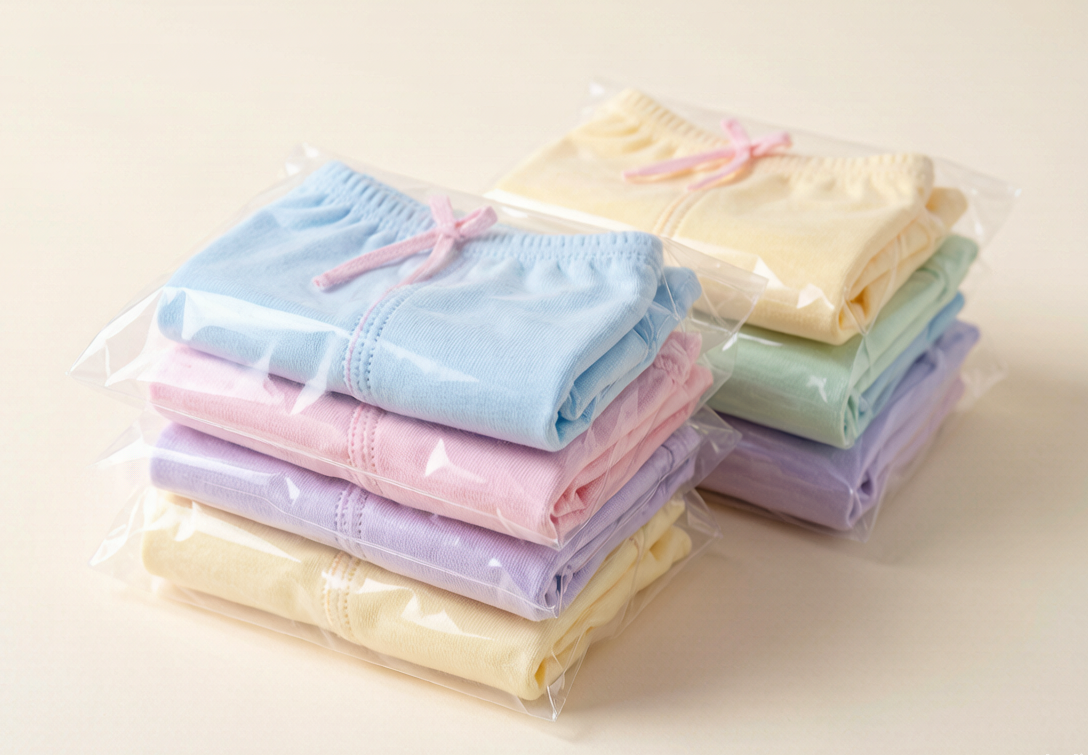
Packing is its own quality step. The garments are folded to the agreed standard, inserted into polybags, and packed into export cartons with the sizes and colours distributed as specified. A carton that arrives with mixed sizes or crushed packaging turns a successful production run into a customer-service problem, so packing follows the same discipline as sewing.
| Step | What happens | Common failure if skipped |
|---|---|---|
| AQL 2.5 inspection | Sampled check against the sealed spec | Defective lot ships to your customer |
| Needle detection | Every piece scanned for metal fragments | Safety hazard in a children’s garment |
| Folding & bagging | Garments folded and polybagged to spec | Crushed, unsellable presentation |
| Carton packing | Sizes and colours distributed correctly | Mixed cartons, warehouse chaos |
| Dispatch | Cartons leave the factory | Production and logistics conflated |
7. Where Timelines Slip: The Honest Delay Points
Timelines slip at four predictable points: an incomplete tech pack, a slow sample approval, a last-minute change after the fabric is dyed or cut, and a failed final inspection. The factory controls only some of these — the first two are usually on the brand’s side of the table.
A production timeline is only as honest as its delay points are named. The factory that tells you “42 days, guaranteed” without explaining where the 42 can break is not doing you a favour. Here are the four places a kids underwear production timeline actually slips, in rough order of frequency.
| Delay point | Where it sits | How it shows up | Who owns it |
|---|---|---|---|
| Incomplete tech pack | Week 1 | Review stops for clarification | Brand |
| Slow approval | Weeks 2–3 | Lab-dip or PP sample sits unapproved | Brand |
| Late change | Weeks 4–5 | Colour or pattern changed after dye/cut | Brand (usually) |
| Failed inspection | Week 6 | Rework required before dispatch | Factory |
The pattern is uncomfortable but true: three of the four most common delays originate with the buyer, not the factory. The factory is not blameless — a mill delay or a quality failure is real — but the brand-controlled delays are more frequent and easier to fix. An incomplete tech pack and a slow approval are both solved by preparation and responsiveness, not by finding a faster factory.
8. How to Protect Your Timeline as a Brand
You protect the timeline by doing your side of the table fast and completely: submit a complete tech pack on day one, approve lab-dips and the PP sample within hours rather than days, and freeze all decisions before the fabric is dyed. The factory runs the line; you run the approvals, and the approvals are where the calendar leaks.
Most timeline advice is aimed at the factory — “find a faster one.” The higher-leverage move is to make your own side of the schedule airtight, because your side is where the avoidable delays live. Here is the short discipline that keeps a 42-day run at 42 days.
- Submit a complete tech pack first. Every missing field is a pause. Rise, waistband, leg elastic, seam types, labels — get them all in the first submission.
- Approve within hours, not days. A lab-dip or PP sample that sits on your desk for a week is a week you added, not the factory.
- Freeze before the dye. Treat the lab-dip approval as the point of no return for colour, and the PP seal as the point of no return for the pattern. After those, do not change.
- Plan logistics separately. Production is 42 days; freight is not part of that number. Book your shipping and customs on its own timeline so one does not masquerade as the other.
- Ask for the delay points up front. If you know where a schedule breaks, you can watch those points specifically instead of being surprised.
The 42 days in this case study are achievable precisely because the discipline above was held. The tech pack was complete, the lab-dips were approved quickly, the Day 12 recovery issue was caught and fixed within 24 hours because the PP stage existed, and nothing was changed after the fabric was dyed. That is not luck — it is the process working as designed.
If there is one sentence to take away, it is this: the factory owns the line, but you own the approvals, and the approvals are where a 42-day timeline becomes a 60-day calendar. Run your side fast, and the factory’s 42 days will hold.
Planning a custom kids’ underwear launch? Send your tech pack and target quantity, and our team will return a phased production timeline with the approval gates and delay points spelled out.