
DTC Pricing Margin Kids Basics is the unit economics problem that decides whether a kids’ underwear brand survives its first year or quietly runs out of cash. The product is cheap to make, the customer is price-sensitive, and the return-and-acquisition costs are real — which means the margin has to be engineered deliberately, not discovered after launch. This guide walks through the cost stack, the gross and contribution margin calculation, realistic price ranges, and the multi-pack bundle strategies that lift average order value. It is written from the factory side of the table, where we watch brands win or lose on these numbers every season.
On this page
- Why kids basics have different margin math
- The cost stack: what goes into landed cost
- Calculating gross margin and contribution margin
- Setting price ranges: what parents will actually pay
- Multi-pack bundles: the margin lever that works
- The trap of discounting your way to volume
- A unit economics worksheet for kids basics
1. Why Kids Basics Have Different Margin Math
Kids basics carry a lower ticket price than adult apparel but a higher repurchase frequency, so the margin math rewards order frequency and bundle size over single-unit margin. A brand that optimises for a fat per-unit margin on a US$6 pair of briefs is optimising the wrong number.
Kids’ underwear is a replenishment category. A parent buys it repeatedly, in multi-packs, across multiple children, for years — which is precisely the behaviour DTC brands want. But the unit price is low, which means the fixed costs of acquiring a customer and shipping an order hit a small base, and the margin must be structured around that reality.
Three structural facts shape the math. First, the product is light and inexpensive to ship, which is an advantage — small parcels keep fulfilment costs manageable. Second, the customer is highly price-aware and compares against mass-market brands, which caps how far above the market you can price. Third, returns and exchanges are driven by sizing, not defects, so sizing accuracy is itself a margin lever.
The implication is that kids’ basics margin is a system, not a single percentage. The levers that matter are landed cost per unit, the bundle size you sell, the return rate you prevent and the repurchase frequency you earn. Fix those four, and a modest per-unit margin becomes a healthy business.
2. The Cost Stack: What Goes into Landed Cost
Landed cost is not just the factory unit price. It is the factory price plus freight, duties, and any per-unit share of sampling and development — divided by the number of units that actually arrive saleable. Most founders undercount the last two parts.
The unit price a factory quotes is the starting point, not the destination. Between the factory and the warehouse shelf sit freight, import duties, and the cost of any units lost or rejected. For a small parcel or a shared container, freight per unit can move the landed cost meaningfully, which is why sourcing decisions and logistics decisions are the same decision.
The full cost stack for a kids’ underwear unit looks like this:
- Factory unit price — the price per piece quoted by the manufacturer for a given quantity and colour.
- Freight — sea or air, spread across the shipment, plus any inland delivery to the warehouse.
- Duties and taxes — the import duty rate for the destination market on the garment classification.
- Development amortisation — sampling fees and pattern work spread over the first production run.
- Defect and loss allowance — a small percentage reserved for units that arrive unsaleable.
The MOQ also shapes landed cost, because it determines how efficiently the run spreads fixed costs. For custom kids’ underwear, the realistic minimum is 3,000–5,000 pieces per single colour; sleepwear and pajama sets run 1,000 sets per design, and baby sizes 150–300 pcs per color on selected styles. Order below those thresholds and the per-unit economics degrade quickly, because setup and development costs concentrate on fewer units.
3. Calculating Gross Margin and Contribution Margin
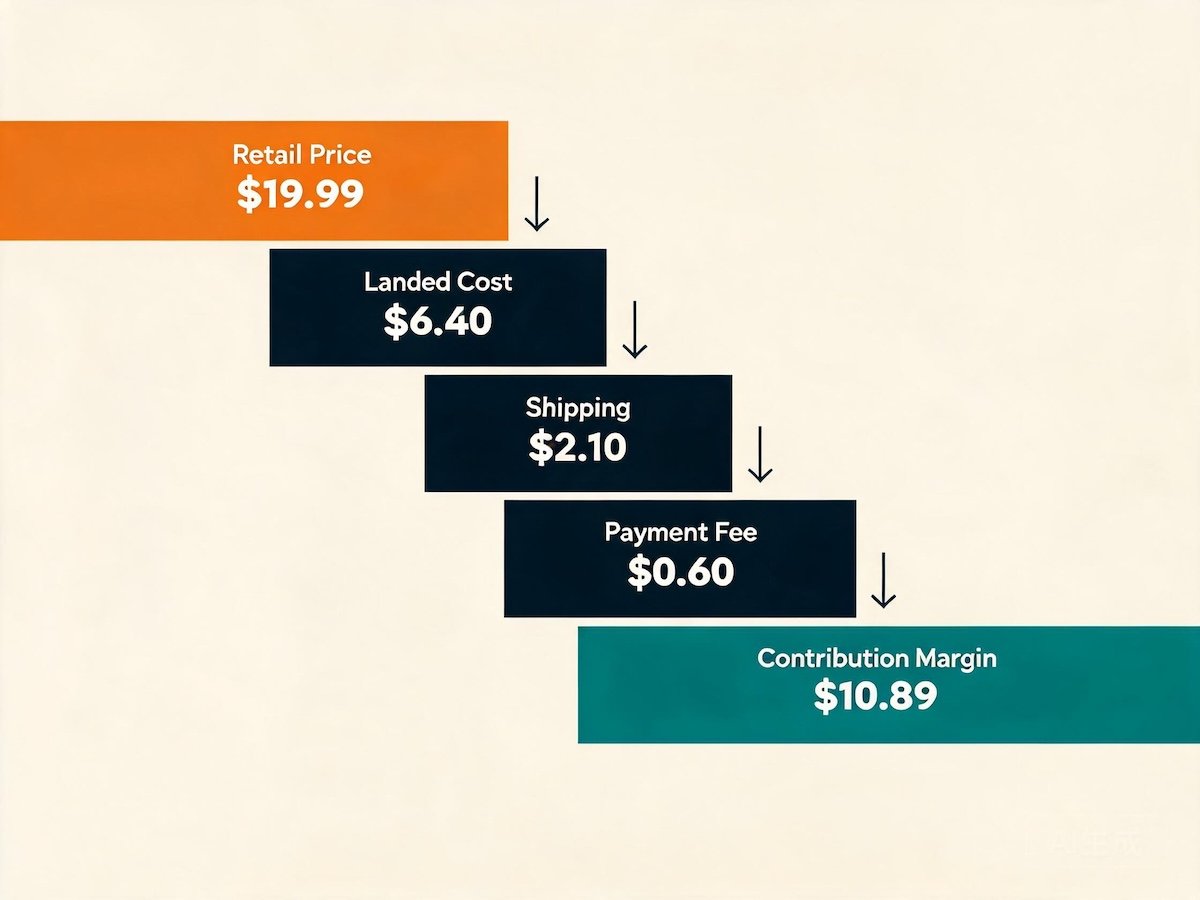
Gross margin is revenue minus landed cost, divided by revenue. Contribution margin subtracts the variable costs of selling — shipping, payment fees, packaging — and is the number that tells you whether a sale actually makes money. Track both, but run the business on contribution margin.
The two margins answer different questions. Gross margin answers “is the product itself profitable?” Contribution margin answers “is this sale profitable after I actually deliver it?” For a DTC kids’ basics brand, the second question is the one that matters, because shipping and payment fees on a low-ticket order can consume the entire gross margin if they are not controlled.
The calculations are simple:
- Gross margin = (selling price minus landed cost) divided by selling price.
- Contribution margin = selling price minus landed cost minus shipping minus payment fees minus packaging, all divided by selling price.
| Line | Low end | High end | Notes |
|---|---|---|---|
| Retail price (multi-pack) | US$14 | US$28 | Varies by fabric, pack size and positioning |
| Landed cost per pack | US$4 | US$9 | Depends on fabric, print count and order size |
| Gross margin | ~55% | ~70% | Healthy DTC range for basics |
| Shipping, fees, packaging | US$3 | US$6 | Small parcel, market-dependent |
| Contribution margin | ~30% | ~55% | The number to run the business on |
The table is illustrative — real numbers vary by fabric, print complexity, order quantity and market — but the shape is consistent across the category: a gross margin that looks healthy can shrink fast once shipping and fees enter the picture. That is why bundle size is the single most powerful margin lever, as Section 5 explains.
4. Setting Price Ranges: What Parents Will Actually Pay
Kids’ underwear multi-packs typically retail in a US$14–US$28 range, with the position inside that range set by fabric, brand story and pack size. Pricing below the range reads as cheap; pricing far above it demands a premium story most new basics brands do not yet have.
Pricing is a positioning decision before it is a math decision. The number on the page tells a parent what kind of brand you are — value, mainstream or premium — and once you choose a position, every other decision follows. For a new kids’ basics brand, the most defensible position is the upper-middle of the mass market: premium enough to justify a margin, accessible enough to win the comparison shopper.
The variables that justify a higher price are concrete:
- Fabric — a cotton-modal blend or a long-staple cotton commands more than a generic open-market cotton.
- Print originality — a distinctive print library reads as design, not commodity.
- Compliance story — GB 31701 Class A and CPSIA/CPC documentation, backed by SGS, Intertek or TÜV SÜD lab reports, supports a safety premium.
- Pack size and presentation — a well-presented multi-pack earns a higher price than loose single pairs.
The mistake to avoid is pricing on a cost-plus formula alone. Cost-plus tells you the floor, not the price. The ceiling is set by the market and by the story you can tell; the right price is the highest one your story can hold without converting the shopper into a comparison.
5. Multi-Pack Bundles: The Margin Lever That Works
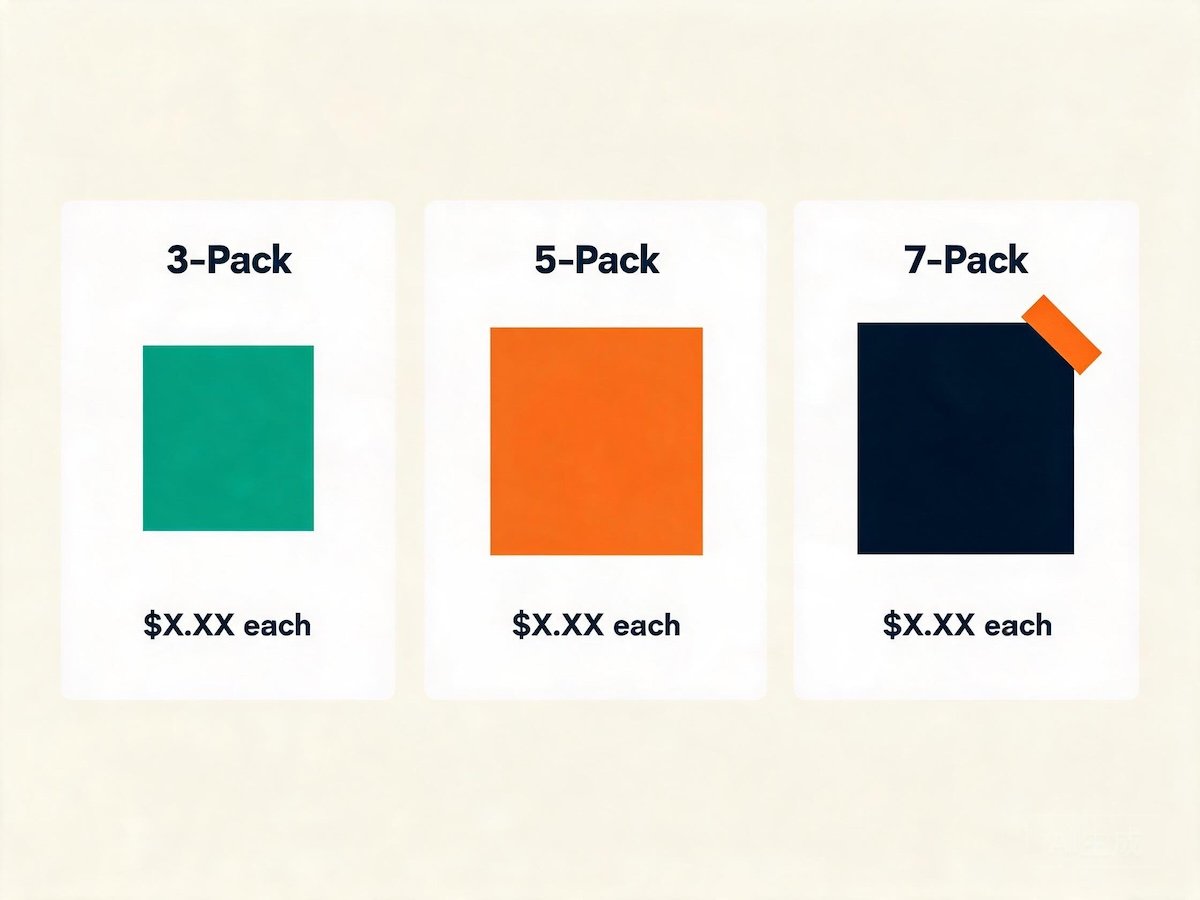
Multi-pack bundles are the highest-leverage margin move in kids’ basics, because they spread the fixed costs of shipping and acquisition across more units and raise the average order value. Sell in 3-packs, 5-packs and 7-packs, and make the larger pack the obvious value.
The economics of the bundle are the economics of the category. A single pair of kids’ underwear is a low-ticket item that struggles to absorb shipping and acquisition costs; a 5-pack is a meaningful order that spreads those same fixed costs across five units. The bundle does not just raise revenue — it changes the margin structure of the sale.
Three bundle mechanics do the heavy lifting:
- Per-unit price anchoring — show the per-pair price on the larger pack so the value is legible at a glance.
- Stepped packs — a 3-pack entry, a 5-pack core and a 7-pack value tier, with the 5-pack priced as the obvious middle choice.
- Mix-and-match — let parents build a pack across colours or prints, which increases perceived value without increasing your cost.
The bundle also improves the return economics. A sizing error in a single-pair order produces a full return; the same error in a 5-pack is more likely to become an exchange or a partial resolution, because the customer has more at stake in keeping the order. Bundle size and return rate move in opposite directions.
6. The Trap of Discounting Your Way to Volume
Discounting to buy volume is the fastest way to destroy a kids’ basics margin, because the discount comes straight out of contribution margin and trains the customer to wait for the sale. Use bundles and value-adds to move units instead of cutting the price.
Every founder feels the pull of the sale. Traffic is soft, the warehouse is full, and a 30% discount looks like the fastest way to move product. But for a low-ticket, replenishment category, the discount is a trap: it converts a contribution margin into a near-zero one, and it conditions the customer to delay purchase until the next sale.
The damage compounds in three ways:
- Margin erosion — a 30% discount on a 45% contribution margin leaves almost nothing after shipping and fees.
- Expectation training — customers learn the real price is the sale price, so full-price sales collapse.
- Brand damage — a basics brand that is always on sale reads as a brand that cannot sell at its stated price.
The exception is a genuine end-of-line clearance on discontinued colours, which is a legitimate inventory tool. The distinction is intent: clearing a dead colour is healthy; discounting the core line to hit a revenue target is a slow margin leak that most brands only notice when the cash runs out.
7. A Unit Economics Worksheet for Kids Basics
Build a simple worksheet with one row per product: retail price, landed cost, gross margin, variable selling costs and contribution margin, plus a separate line for the bundle sizes you sell. Revisit it monthly, because freight, duties and packaging costs drift.
None of this matters if it lives only in an article. The discipline is a simple worksheet that forces every pricing and bundling decision through the same numbers. It does not need to be elaborate — a spreadsheet with one row per product is enough, provided it is actually maintained.
The minimum fields per product:
- Retail price — the price on the page, per pack.
- Landed cost — factory price plus freight, duties, development amortisation and defect allowance.
- Gross margin — computed, and checked against the healthy DTC range.
- Variable selling costs — shipping, payment fees and packaging.
- Contribution margin — the number you run the business on.
- Bundle sizes — the 3-pack, 5-pack and 7-pack variants, each with its own row.
The worksheet is also where the factory relationship shows up. A manufacturer that holds its unit price, its colour shade and its quality steady across repeat orders makes the worksheet predictable; a manufacturer that drifts on any of them forces you to reprice or absorb the loss. Capacity and consistency — such as the 8,000 sqm facility, 300+ staff and 1,000,000+ pieces per month that Nuohua Garment operates — are margin inputs, not just sourcing trivia.
Run the numbers before you order, not after. A brand that knows its contribution margin on every pack size can price confidently, bundle deliberately and discount rarely — and in kids’ basics, that discipline is the difference between a brand and a liquidation.
Healthy margins start with a predictable landed cost and a factory that holds its quality steady. Email info@nuohuagarment.com or WhatsApp +86 150 1198 5393 with your target fabrics, pack sizes and quantities, and our team will return a cost structure and MOQ breakdown so you can price with confidence.