
How to Start a Kids’ Underwear Brand in 2026: A Step-by-Step Roadmap
Launching a children’s underwear brand sounds deceptively simple. The garments are small, the unit economics look friendly, and every parent on the planet is a repeat customer. But the category is also one of the most regulated, quality-sensitive, and trust-dependent segments in apparel. A single itchy seam, a mislabeled size, or a missed safety test can turn a five-star launch into a recall.
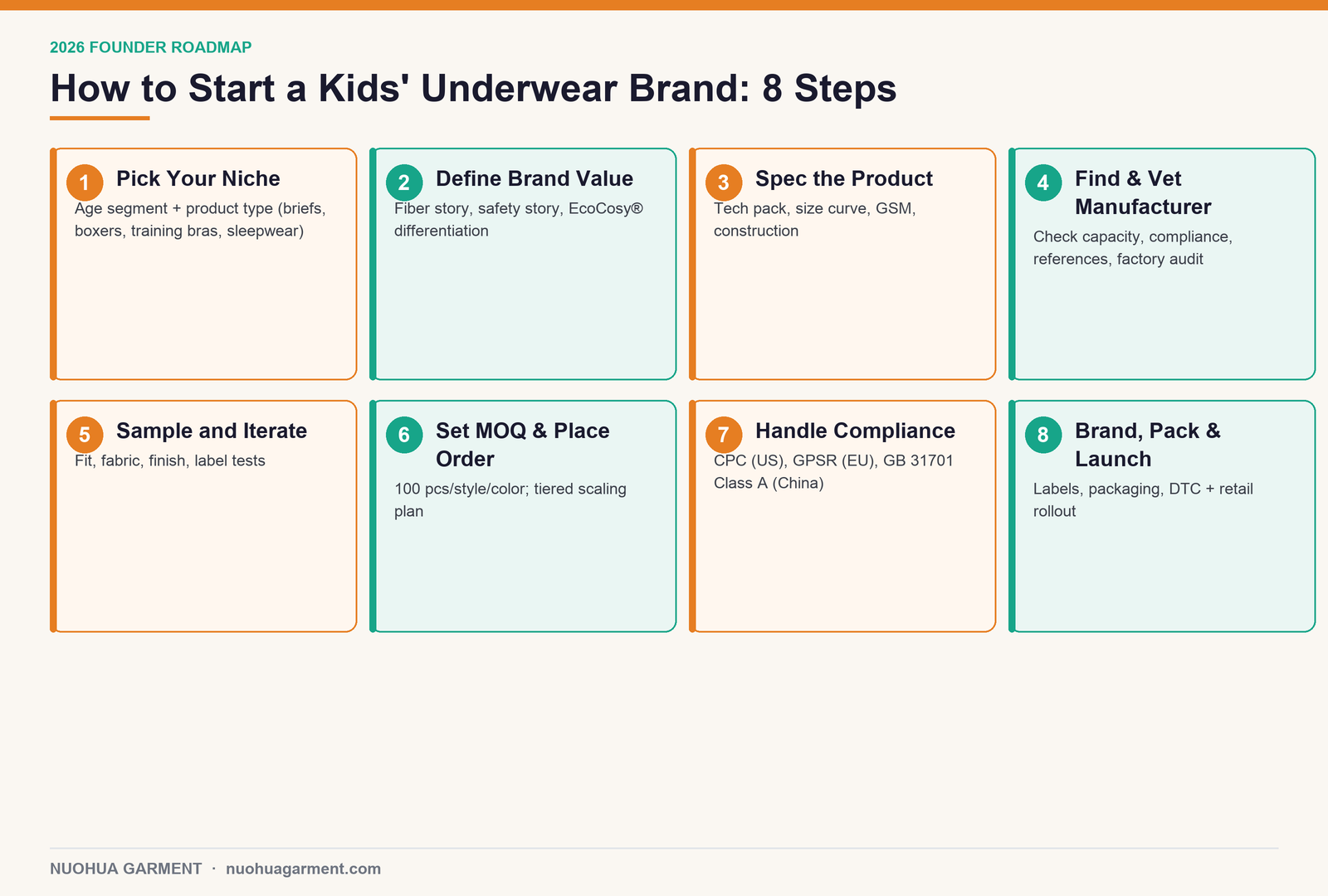
This roadmap is written for the first-time founder: the Amazon seller expanding into a private label, the boutique owner ready to launch their own line, or the entrepreneur who spotted a gap in the market and wants to fill it with a real, sellable product. We will walk through the eight moves that separate a brand that ships from a brand that stalls — from picking a niche to clearing compliance and going to market.
If you already know you want to manufacture and just need the operational detail, our ultimate guide to custom children’s underwear and pajama production covers the factory floor in depth. This article is the business blueprint that sits one level above it.
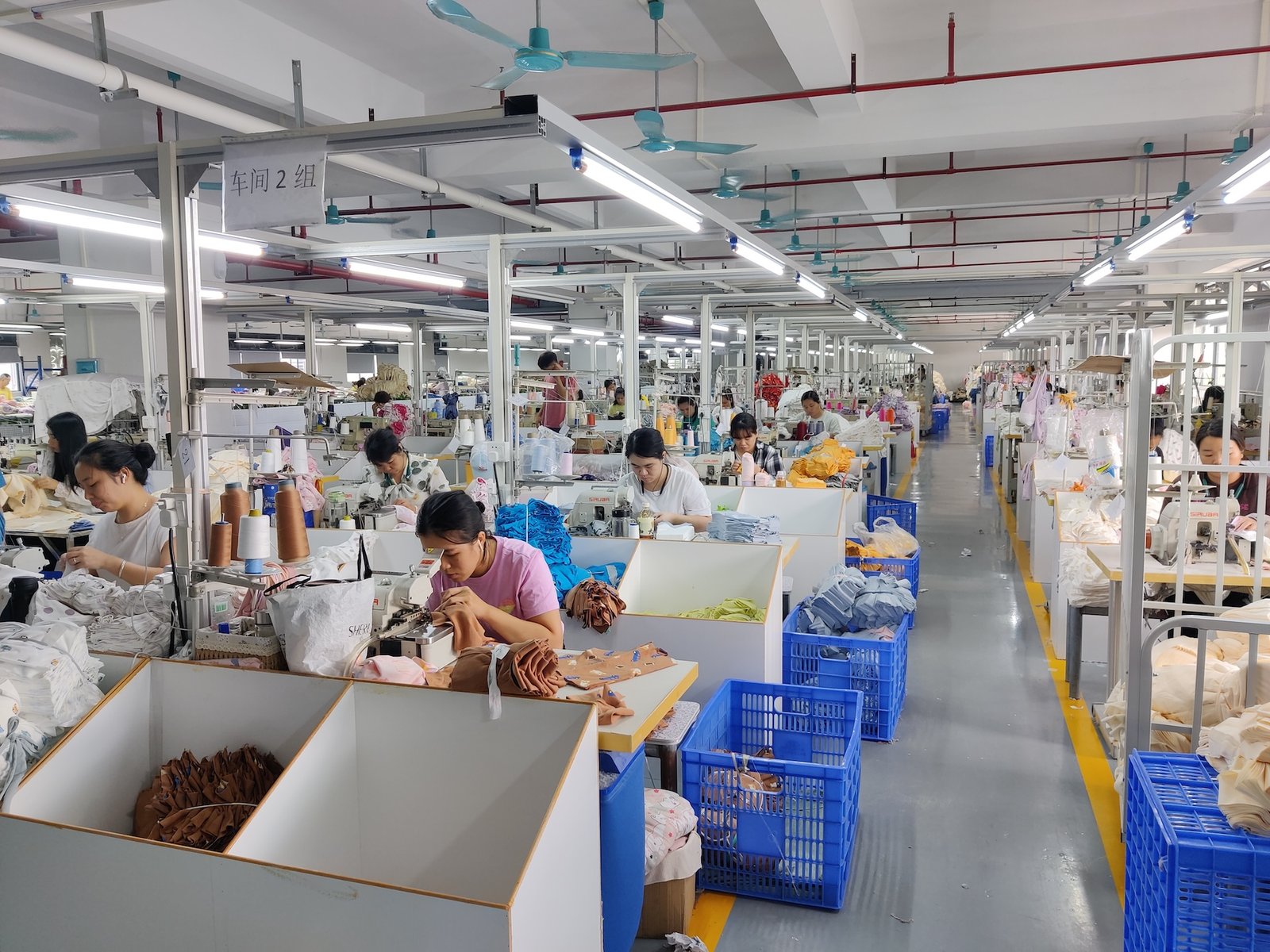
Why 2026 Is a Good Time to Launch a Kids’ Underwear Brand
Three forces are converging in favor of new entrants. First, parents are trading up: they will pay more for softer fibers, certified-safe dyes, and brands that explain what touches their child’s skin. Second, the supply base for small-batch kids’ underwear has matured. Manufacturers that once demanded container-scale orders now support low minimums, which de-risks a first launch. Third, the channel mix has widened — Shopify, Amazon, TikTok Shop, and specialty boutiques all give a new brand a storefront without a wholesale network.
Step 1 — Pick Your Niche (Age Range + Product Type)
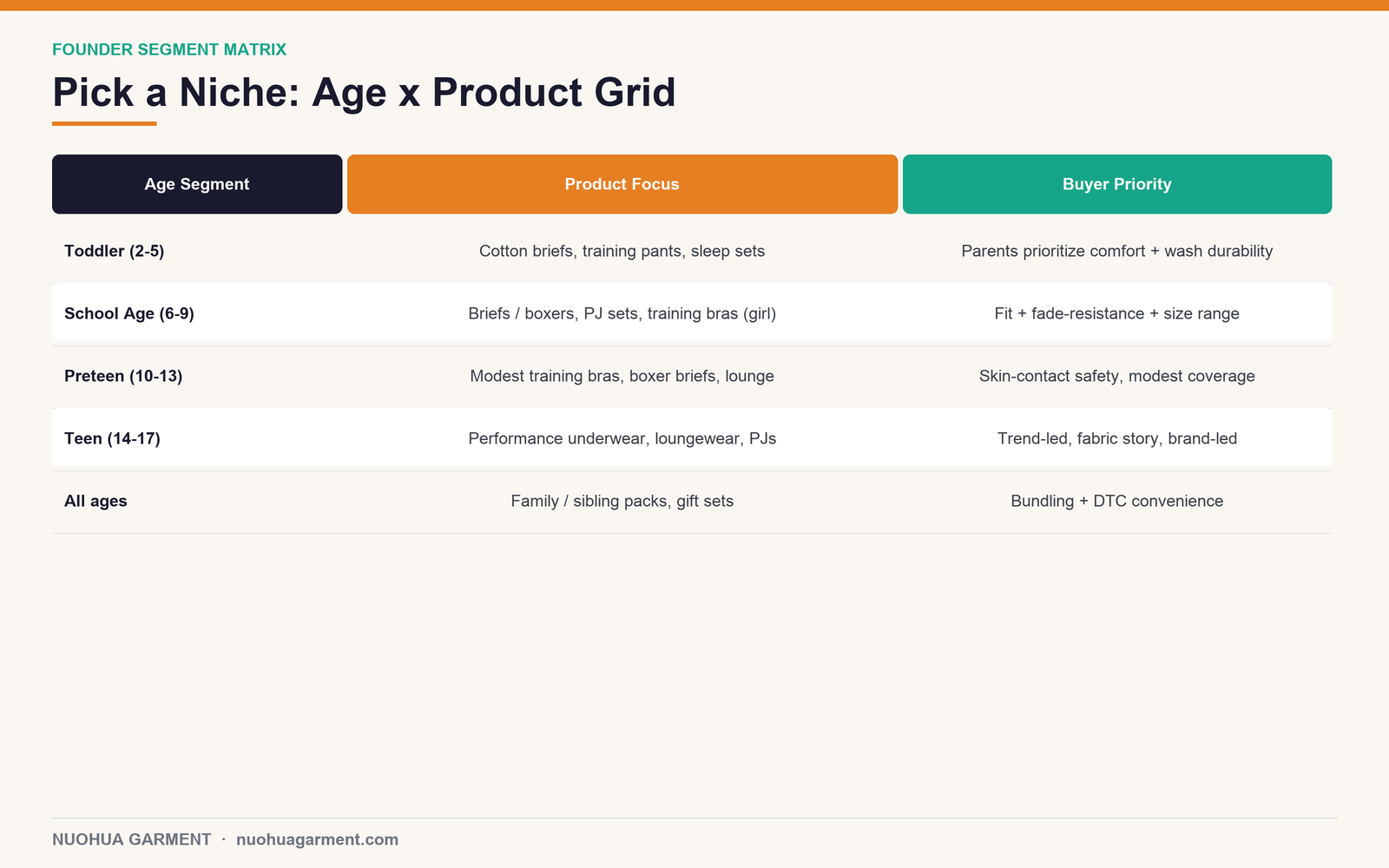
The biggest mistake first-time founders make is trying to serve “all kids, ages 2 to 14” on day one. That spreads your design, sizing, and marketing thin and forces you to carry inventory across a size curve you have not yet validated. Narrow the focus.
Choose an Age Segment
Age segments behave differently:
- Infant / toddler (0–3): highest skin-sensitivity expectations, pull-on waistbands, minimal trims, and the strictest standards (more on GB 31701 Class A below).
- Little kids (4–7): the classic brief and boxer-brief sweet spot, where fun prints and tagless comfort sell.
- Big kids / tweens (8–14): where training bras and seamless styles enter the mix and where brand identity starts to matter more than cartoon prints.
Choose a Product Type: Briefs, Boxers, Training Bras, Sleepwear
Each product type has a different development path:
| Product type | Core development focus | Typical first-line complexity |
|---|---|---|
| Briefs | Waistband comfort, leg elastic, flatlock seams | Low–medium |
| Boxers / boxer-briefs | Panel fit, no-roll waistband, breathability | Medium |
| Training bras | Soft-cup support, adjustable straps, seamless knitting | Medium–high |
| Sleepwear | Fabric hand-feel, thermal comfort, flame-resistance rules in some markets | Medium (higher compliance load) |
Pick one hero product type and one age segment for version 1.0. You can expand the line once you have validated fit and demand.
Step 2 — Define Your Brand Value
With a niche chosen, you need a reason a stranger should buy from you instead of a department-store multipack. In kids’ underwear, value usually comes from one of three angles — and the strongest brands combine at least two.
Fiber as a Story
The fiber is the single easiest thing for a parent to understand. Combed cotton is the safe, breathable default. Cotton-spandex blends add stretch and recovery for active kids. Bamboo-based viscose (regenerated cellulose from bamboo) markets on softness and moisture management. Modal — especially traceable EcoCosy® modal — delivers a silky hand-feel with a documented, lower-impact supply chain.
The Safety Story
Parents buy peace of mind. A credible safety story is not a vague “gentle on skin” claim — it is specific: skin-contact Class A compliance, third-party tested dyes, nickel-free elastics, and tagless construction. We coordinate testing through partners such as SGS, TÜV SÜD, and Intertek so that every claim you make can be backed by a report.
The EcoCosy® Option
If sustainability is part of your brand DNA, EcoCosy® is worth leading with. It is a licensed, traceable fiber made from responsibly sourced wood (FSC/PEFC), and it is biodegradable. Because the authorization is held and traceable, you can state it plainly on packaging and listings without overstating anything. It gives a new brand a defensible “better fiber” narrative that larger generic players cannot easily copy.
Step 3 — Spec the Product (Tech Pack, Size Curve, GSM)
A clear specification is what turns a vision into a manufacturable garment. This is where many first launches go wrong: a founder sends a photo and “make it like this,” and receives something that fits nobody.
Build a Tech Pack
A tech pack is the single source of truth for your factory. It should include flat sketches, measurements, fabric and trim specifications, colorways, labels, and packaging. If you have never built one, our tech pack guide for kids’ underwear and sleepwear walks through every field with examples. A complete tech pack is also what lets a factory quote you accurately instead of guessing.
Define Your Size Curve
Kids grow in jumps, so your size curve matters more than in adult apparel. Decide whether you will grade by age, by height/weight, or by both. A tight, well-tested curve reduces returns and builds the fit trust that drives repurchase. If you are unsure where to start, adapt a published reference like our US/EU/UK/AU kids’ underwear size chart as a baseline and adjust after sampling.
Choose the Right GSM
GSM (grams per square meter) is the weight of your fabric and a primary driver of both hand-feel and cost. Lighter jersey (around 150–180 GSM) reads as soft and breathable for everyday briefs; mid-weight interlock (180–220 GSM) adds opacity and durability for boxers and sleepwear. There is no single right number — there is a right number for your price point and promise. Spec it explicitly in the tech pack so the factory does not substitute a cheaper, thinner cloth.
Step 4 — Find and Vet a Manufacturer
Sourcing the right factory is the make-or-break step, and it deserves more than a keyword search. Our dedicated guide on how to vet a kids’ underwear manufacturer in China goes deep; here is the founder-level summary.
What to Check Before You Commit
- Kids-specific experience: Making adult underwear does not qualify a factory to make children’s. Ask for kids’ references and, ideally, examples of skin-contact Class A work.
- Low-MOQ capability: Confirm they actually run small first orders, not just quote them.
- Testing infrastructure: Do they coordinate third-party testing (SGS / TÜV SÜD / Intertek) or leave it entirely to you?
- Communication and sampling discipline: Slow, vague replies at the quote stage predict worse problems at production.
Red Flags
- They refuse to share a sample cost breakdown.
- They cannot explain how they handle children’s compliance documents.
- They push you to skip the tech pack “to save time.”
- Their MOQ claims and their actual practice do not match.
Before you request quotes, arm yourself with the 11-point manufacturer quote checklist so you compare factories on the same terms instead of on vibes.
Step 5 — Sample and Iterate
Sampling is where the product becomes real. Expect two to four rounds: a proto sample to validate the concept, a fit sample on your size curve, a pre-production sample after trim and fabric finalization, and a shipment sample from the actual production lot. Review each against your tech pack, not against your memory.
Use a structured development request so feedback is unambiguous — our guide on writing a kids’ underwear development request and sampling review shows the format. The goal of iteration is not perfection on round one; it is a documented path from “close” to “this is the product.”
Step 6 — Set MOQ and Place Your First Order
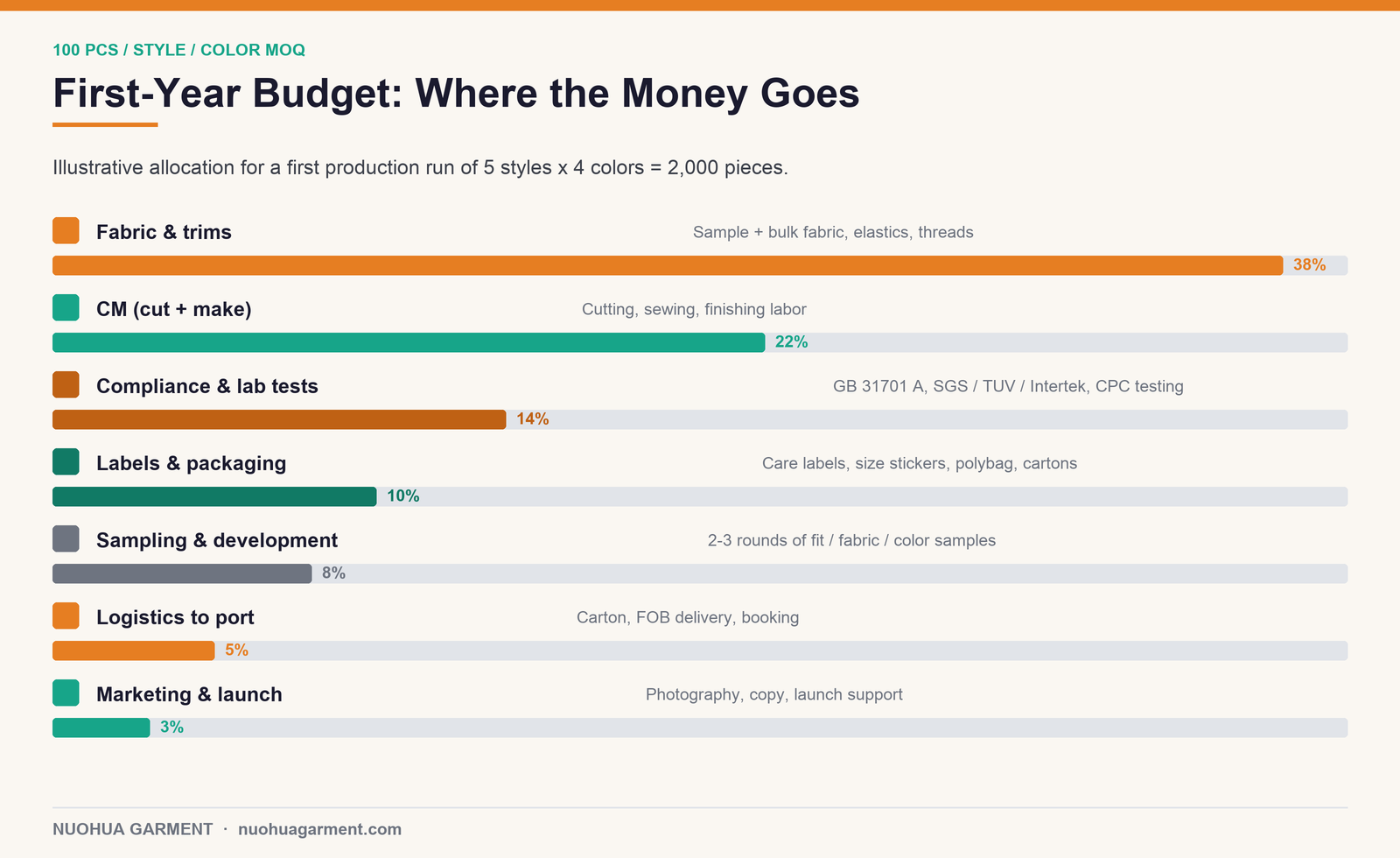
Minimum order quantity is the gate between sampling and selling. For a first order, the industry-standard low entry we support is 2 pcs on selected in-stock styles, colors and sizes. That number is deliberately small: it lets you test three colorways of one brief, or one colorway across a few sizes, without tying up working capital.
Understanding MOQ (2 pcs on selected in-stock styles, colors and sizes)
MOQ is usually expressed per style and per color because the factory sets up machines and trims for each combination. A 100/100 rule means a “3 styles × 2 colors” launch is 600 units — manageable for a first run and enough to populate a real storefront. Larger MOQs lower unit cost but raise risk; for launch one, favor flexibility over the last few cents of margin.
Step 7 — Handle Compliance (CPC, GPSR, GB 31701 Class A)
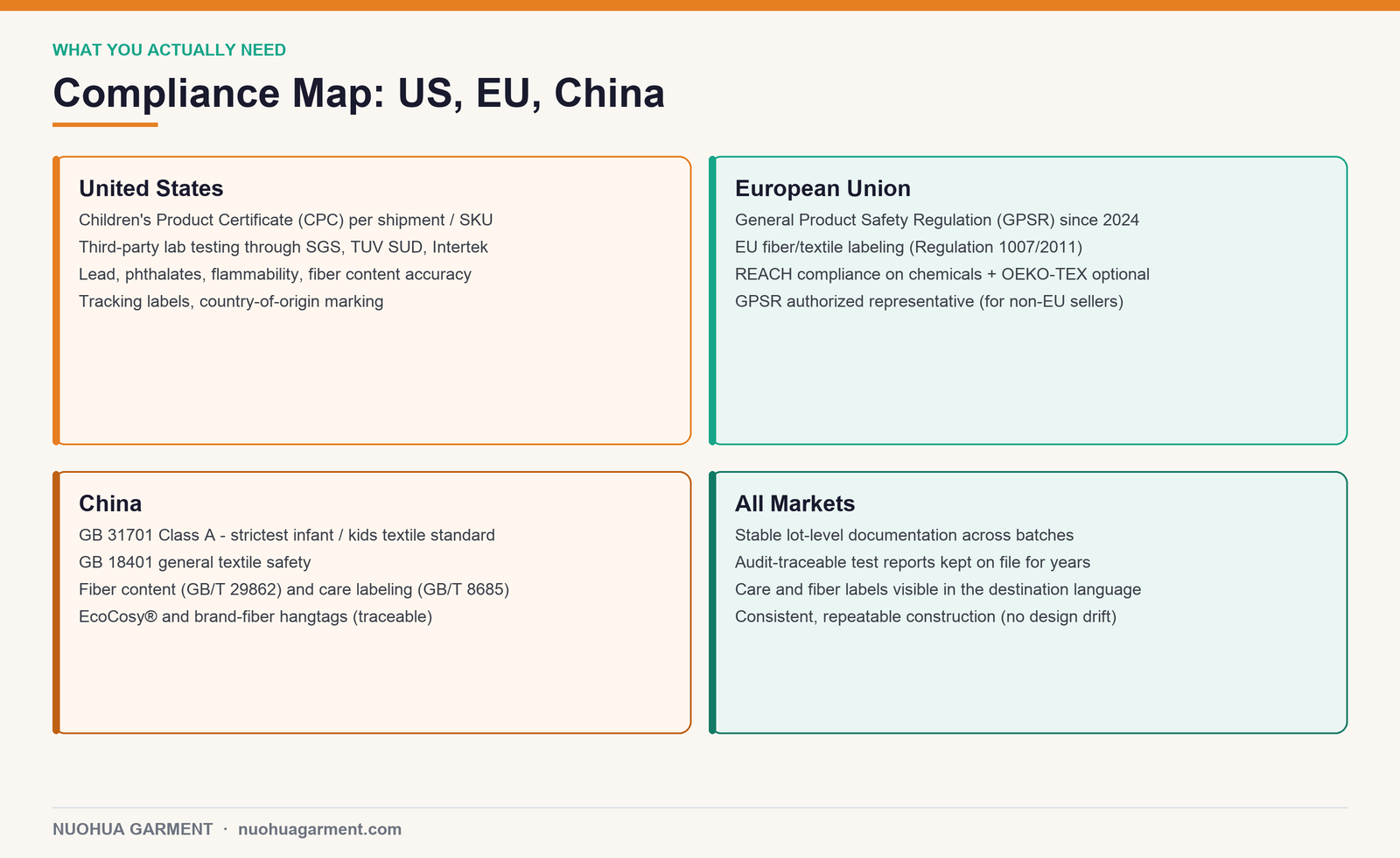
Compliance is non-negotiable in children’s intimates, and the rules differ by market. Do not treat this as paperwork to file later — build it into the spec so the product is born compliant.
US: Children’s Product Certificate (CPC)
In the United States, children’s products require a CPC based on third-party testing to applicable CPSC standards. Important nuance: as the manufacturer we supply the underlying test data and coordinate the testing, but the importer (you, the brand) issues the CPC. We do not issue it on your behalf. Our CPC guide for kids’ underwear and sleepwear details exactly which tests apply and who owns which step.
EU: General Product Safety Regulation (GPSR)
For the European Union, the GPSR sets broad obligations around safety documentation, traceability, and a responsible person based in the EU. Sleepwear in particular can carry additional requirements, so plan labeling and documentation early. Our kids’ underwear and sleepwear compliance checklist is built to keep both US and EU paths on track.
China: GB 31701 Class A
If you source or sell in markets that reference Chinese standards, note that we hold GB 31701 Class A for skin-contact children’s wear — China’s strictest class for items in direct contact with a child’s skin. It is a real, held standard you can reference for the products we produce, and it pairs naturally with the safety story from Step 2.
| Market | Key requirement | Who issues / holds it |
|---|---|---|
| United States | CPC via CPSC-accredited testing | Importer issues; factory supplies test data |
| European Union | GPSR safety file + EU responsible person | Brand / EU representative |
| China (skin-contact) | GB 31701 Class A | Held by Nuohua for produced goods |
Step 8 — Brand, Package, and Launch
With a compliant, sampled, manufactured product in hand, the final step is presentation and go-to-market. Package for the unboxing a parent actually experiences: recyclable or minimal plastic, a clear size label, a fiber-content callout, and care instructions. Your safety and fiber story from Step 2 should appear right on the pack and the listing — that is what justifies a premium over a generic multipack.
For launch, resist the urge to be everywhere at once. Pick one channel where your niche congregates, prove the product and the messaging, then expand. A focused first launch also generates the reviews and fit data you need before scaling the size curve or adding a second product type.
Common Mistakes First-Time Founders Make
- Skipping the tech pack to “move faster” — it slows everything down later.
- Over-wide niche — serving all ages and all product types at once dilutes fit and budget.
- Treating compliance as a final step instead of a design input.
- Chasing the lowest unit price at the cost of fabric weight, trim quality, and testing rigor.
- Ordering too much too soon before validating real demand and returns.
Frequently Asked Questions
How much money do I need to start a kids’ underwear brand?
There is no single number, but the lean path looks like this: tech pack and sampling (a few hundred to low thousands of dollars depending on rounds), a first order at 2 pcs on selected in-stock styles, colors and sizes, and a modest marketing budget. Many founders validate with under a few thousand dollars of inventory before scaling. The biggest variable is how many styles and colors you launch in version 1.0.
Can I start with just one product type?
Yes — and we recommend it. A single hero product (for example, toddler briefs in three colorways) lets you prove fit, marketing, and fulfillment before broadening into boxers, training bras, or sleepwear. The production master guide explains how a focused first line keeps sampling and compliance manageable.
What does MOQ actually mean for a first order?
MOQ is the minimum the factory will produce for a given style and color combination — commonly 2 pcs on selected in-stock styles, colors and sizes. It exists because setup, trims, and cutting are fixed costs regardless of volume. Lower MOQs de-risk your launch; higher MOQs lower unit cost but raise the capital you tie up.
Do I need a tech pack if I have a clear idea in my head?
Almost certainly yes. A tech pack converts your idea into the exact measurements, fabrics, and trims a factory can build and quote against. Without one, fit drift and substitution are likely. Our tech pack guide gives you the template and every field to fill.
Who is responsible for the CPC in the US?
As the brand and importer, you issue the Children’s Product Certificate. The factory’s role is to supply the underlying test data and coordinate third-party testing through partners such as SGS, TÜV SÜD, and Intertek. We support that process but do not issue the CPC on your behalf.
Is EcoCosy® a real certification I can put on my label?
EcoCosy® is a licensed, traceable fiber authorization we hold, so you can reference it accurately as a fiber choice. It is distinct from broad eco-label certifications; keep the claim specific to the fiber rather than implying a finished-garment eco certification you have not obtained.
What compliance do I need for the EU?
The EU’s GPSR requires a safety file, traceability, and an EU-based responsible person, with sleepwear sometimes carrying added rules. Our compliance checklist tracks both US and EU obligations so nothing is missed before launch.
How long does the whole process take?
From niche decision to first shipment, a typical first launch runs a few months: sampling is often the longest single phase. Building the tech pack up front and vetting the factory early compresses the timeline more than anything else.
Ready to Start Your Kids’ Underwear Brand?
You now have the eight-step blueprint: pick a niche, define your value, spec the product, vet a manufacturer, sample, set a sensible MOQ, clear compliance, and launch. The operational depth — tech packs, sampling discipline, readiness, and compliance paperwork — is covered in our linked guides so you can go as deep as each step requires.
When you are ready to turn the plan into a producible garment, use our OEM production readiness checklist to confirm you have everything a factory needs, then request a quote. We will help you move from roadmap to retail with low-MOQ, compliant, skin-contact-safe children’s underwear.