
This guide is part of the Kids Underwear & Sleepwear Sourcing Guide.
Where this guide sits: this is not a beginner walkthrough on how to find a kids underwear manufacturer — that is covered in How to Find and Shortlist a Kids’ Underwear Manufacturer in China.
This guide is for brands already producing at volume and looking for the channels that never surface in a marketplace search: trade shows and trade fairs, referrals from existing suppliers, sourcing agents and agency networks, direct factory relationships and mill-level relationships.
If you have shipped a few seasons already, the “find a factory” advice written for first-time importers feels thin. You are not looking for any supplier who can sew 100 pieces — you are looking for one who can hold a Grade A standard across reorders, who has the compliance paperwork your retailer asks for, and who will not treat a 5,000-piece order as a favor. This guide walks the channels established brands actually use, the upgrade in vetting that comes with scale, and the negotiation and partnership habits that keep a supply line stable for years.
The kids’ underwear category adds a layer most dress-focused sourcing guides never touch: children’s safety regulation. Every style you import sits under GB 31701 Class A (formaldehyde, pH, odor and AZO amine limits), every US-bound style needs CPC documentation from a CPSC-recognized lab, and fit-and-fabric decisions interact with those rules in ways that change your factory shortlist. A factory that has built those systems once is worth more than a cheaper factory that has never shipped kids’ garments.
Why Established Brands Source Differently
A first-time buyer optimizes for MOQ and price. An established brand optimizes for reliability and compliance — because by season three, the cost of a bad factory is not a bad sample, it is a recalled shipment or a retailer delisting you. The sourcing channels stay similar; the filter becomes much tighter.
There is also an asymmetry of time. A startup can absorb a six-week delay on a test order. An established brand has committed retail slots, pre-sold quantities and a website that must not go dark — a delay is lost revenue, not an inconvenience. That single fact changes how you evaluate every candidate: you are no longer buying a product, you are buying a predictable supply chain.
| Decision driver | Startup (first order) | Established brand (reorder + scale) |
|---|---|---|
| MOQ | Lowest possible (100-300 pcs) | Comfortable at 1,000-5,000 pcs, flexible per style |
| Compliance | Nice to have | Non-negotiable (CPC, GB 31701 Class A, testing) |
| QC process | Hope for the best | Auditable, staged, needle-detected |
| Communication | Replies fast | Engineers and QC who speak your language |
| Track record | References optional | Reorders and retailer approvals required |
| Capacity proof | Photos enough | Floor tour or audit, monthly output verified |
The Five Channels That Actually Work
Established buyers rarely gamble on cold listings. In practice, mature brands find kids’ underwear manufacturers through five channels — in roughly this order of trust:
1. Industry referrals
A brand owner you trust introduces you to the factory that already ships for their line. This is the fastest path to a real shortlist because the referral carries implicit social proof: someone with skin in the game vouches that the factory delivers. Ask the referrer the honest questions — what breaks, what is slow, what surprised them — before you spend a single hour on research.
2. Direct factory research
You already know which mills make what. You research certifications, client lists and production evidence directly, often after spotting a factory in a competitor’s product or on a retailer’s approved-vendor list. Pull the company registration, check the legal entity, look for real floor photos and third-party inspection reports, and — for kids’ garments — confirm the compliance file covers the category, not just “we do export”.
3. Trade shows and directories
Canton Fair, Shanghai Kids Fashion Week and verified directories are where factories show capacity you cannot see in photos. A factory that exhibits ships volume; a factory that prints a decent website may not. At a show you can hold fabrics, check stitch quality in person, and meet the people who will actually run your account — which tells you more than a week of email.
4. Sourcing agents and local networks
An agent in the region pre-vets factories, negotiates and inspects on your behalf — genuinely useful at scale, when you need boots on the ground. The catch: you must verify the agent too. Check their retainer model, ask who pays them (a good agent is transparent that they earn from the factory side), and never let the agent be your only window into the factory. Your own audit is non-negotiable.
5. Marketplace and B2B platforms
Alibaba and similar platforms surface hundreds of suppliers; the work is in filtering. Verified badges, transaction history, inspection reports and real factory photos narrow the list, but the platform does not run your QC — you do. We cover the safe way to source on Alibaba in our dedicated Alibaba sourcing guide, including how to read supplier responses for red flags.
Whichever channel surfaces a candidate, the shortlist stage is where scale changes the game. For the full first-pass filter, our finding and shortlisting guide covers the ground rules; the upgrade below is what established buyers add on top.
The Upgraded Shortlist
Five criteria separate a vendor from a partner at scale:
1. Proven compliance system, not just a certificate
A file of test reports means nothing if every new style re-tests against the same standard. Ask how they handle CPC documentation per style and which labs they use (a CPSC-recognized lab such as EQ-T, CPSC Lab ID 1693), how GB 31701 Class A testing is bundled across colorways, and whether the compliance person sits in the room or is an outsourced consultant. Kids’ garments live or die on this file.
2. Auditable QC, staged and needle-detected
A single final inspection is a gamble. Established buyers look for staged inline QC — checks during cutting, sewing and finishing, not just at the end — plus a dedicated needle-detection step. Needle detection is the safety gate that matters most for children’s clothing: a broken needle in a seam is a recall, and no certificate substitutes for a machine that catches it before the carton is sealed.
3. Capacity you can verify
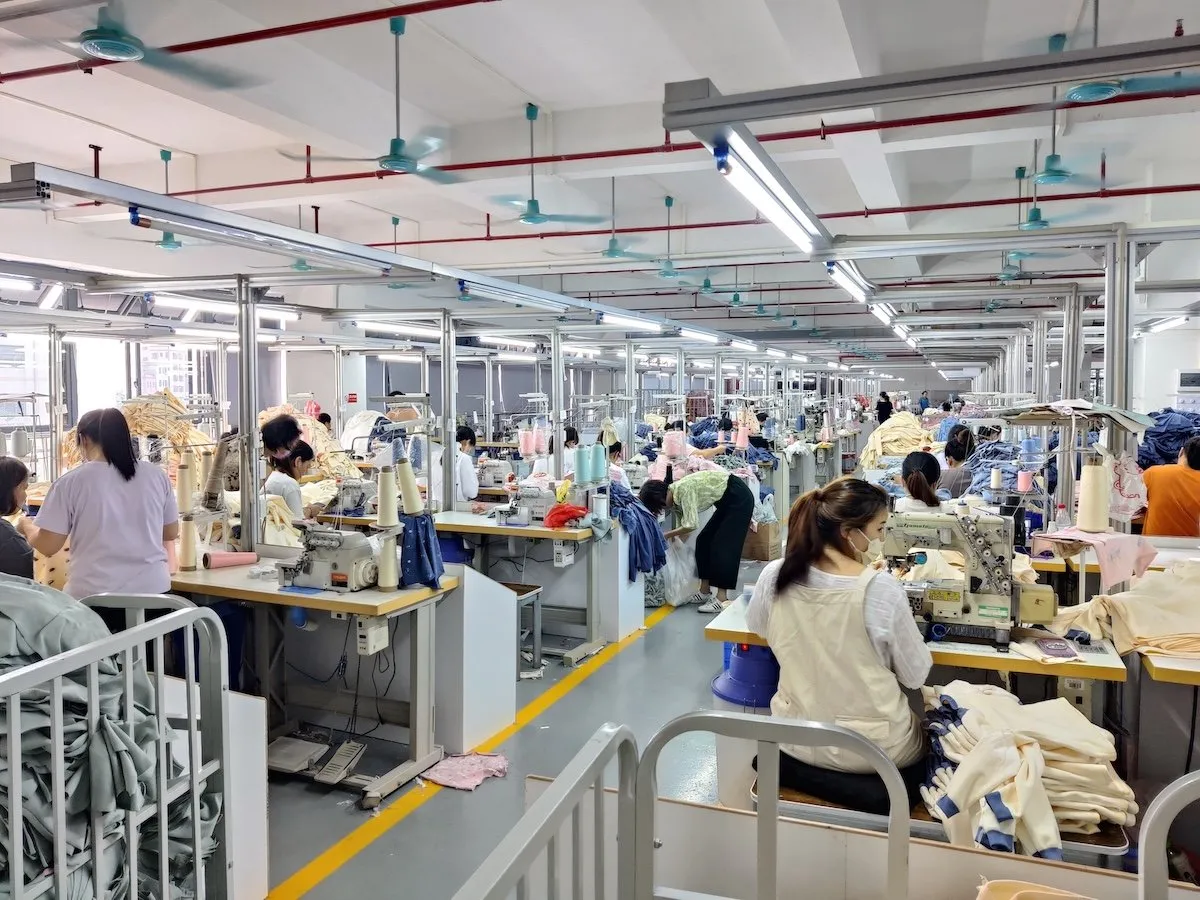
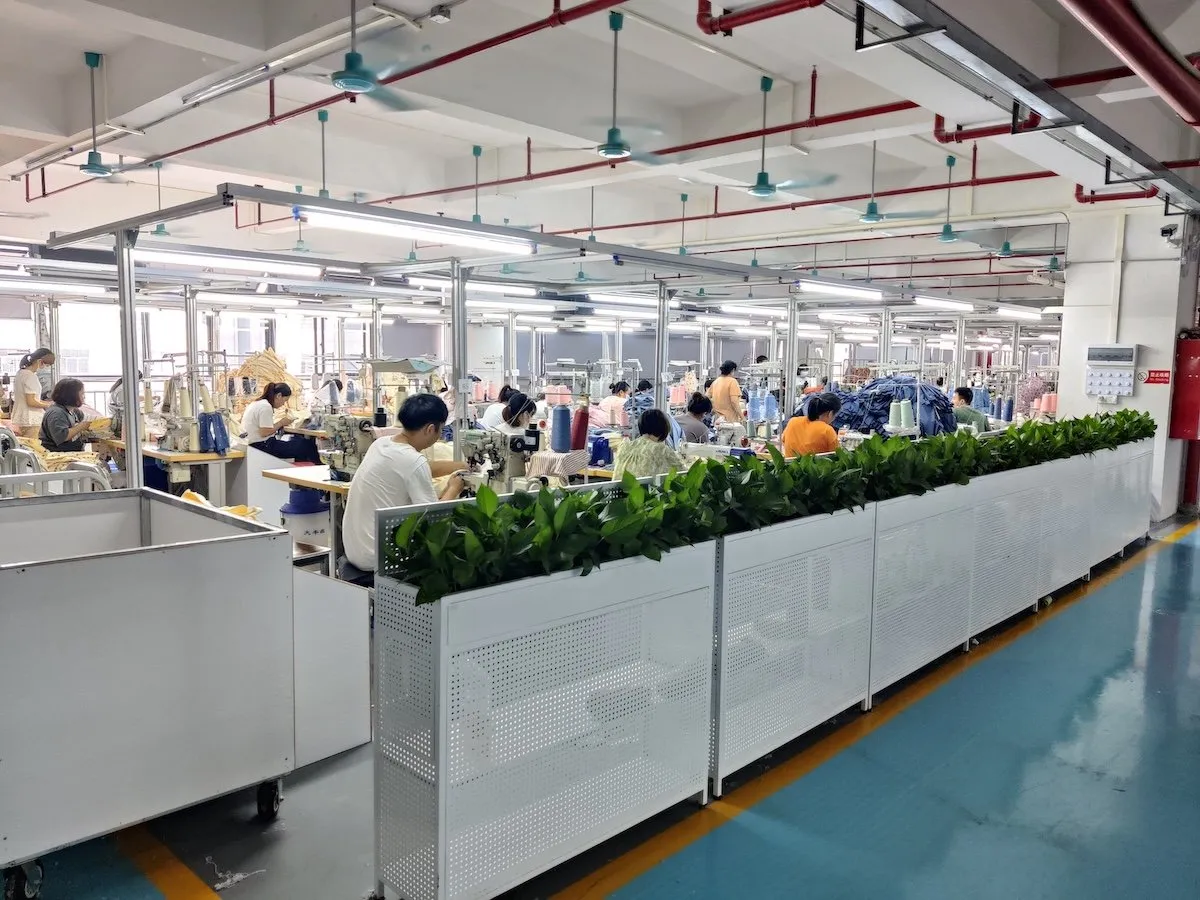
“We can do it” is marketing; a factory with its own sewing floor, cutting and finishing under one roof is verifiable. Ask about floor space, workers and monthly output, then sanity-check against your order size. If your reorder is 5,000 pieces and the factory quotes a three-week turnaround, does the math hold with their stated capacity? An integrated factory — cutting, sewing, finishing, QC under one roof — removes the handoff risk that separate workshops introduce.
4. Reorder discipline
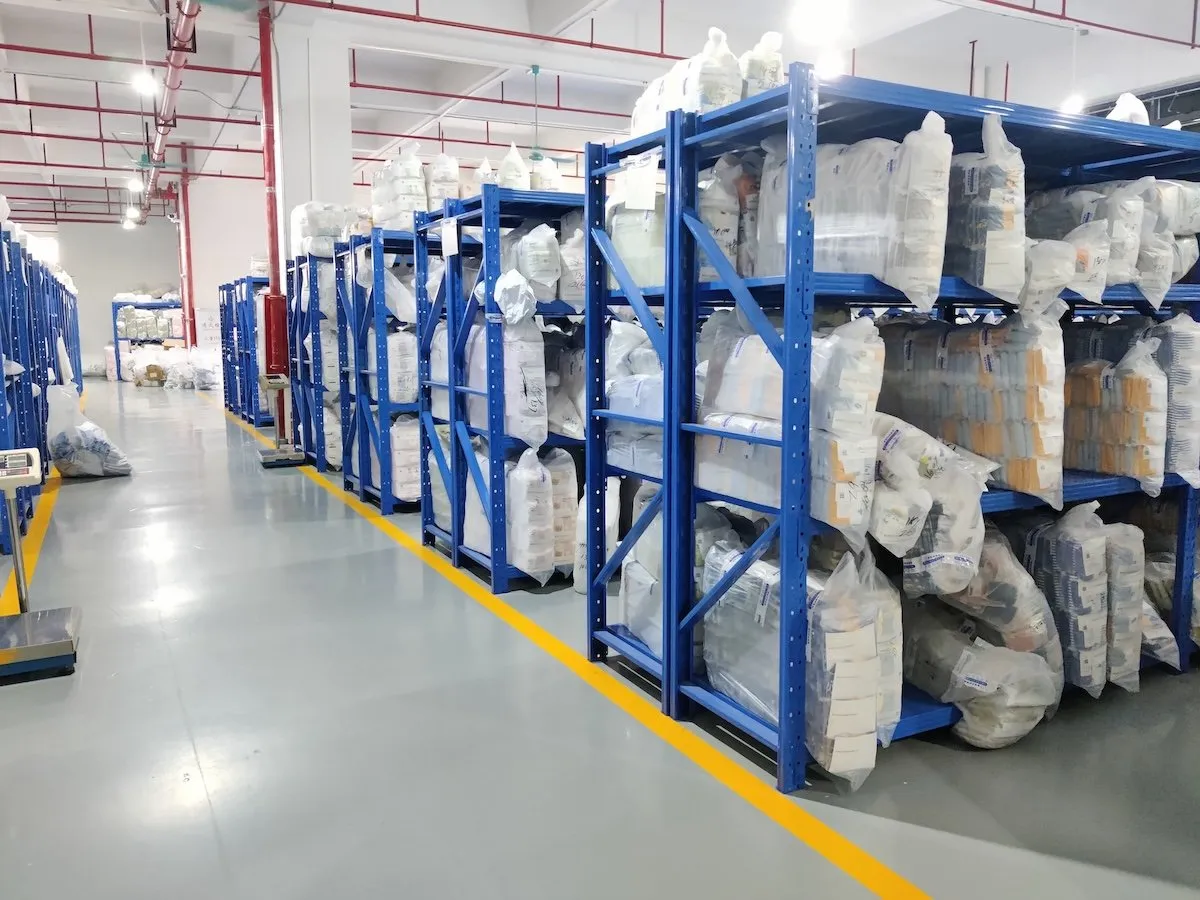
Does the factory keep your spec, prints and label files so a reorder ships without re-developing everything? Reorder discipline is what makes replenishment fast and consistent: the same fabric card, the same print registration, the same label position. Ask how they store your files and how a reorder is priced — a factory that re-quotes from scratch every time is not built for the long game.
5. In-house labeling and packaging
For private label, custom woven labels, hangtags and packaging handled in-house means fewer handoffs and fewer errors. A factory that prints or weaves its own labels controls the brand moment on the garment; one that subcontracts it adds a supplier you will never meet and cannot audit.
How the Factory Reviews Your RFP
The inversion most guides skip: the factory is also filtering you. A serious kids’ underwear manufacturer evaluates your RFP on three things, and being ready for them speeds everything up:
1. Is the spec complete?
A half-finished tech pack means three sample rounds. A complete pack — fabric, construction, trims, sizing, compliance target — means one or two. Our tech pack guide shows what complete looks like, down to the measurement points a factory actually needs.
2. Are the quantities realistic for the construction?
A factory that quotes a 100-piece run on a multi-print style the same as a 5,000-piece run is either padding or misleading you. Realistic quantities let the factory schedule efficiently — which is exactly where the price and the lead time come from.
3. Does the compliance ask match the market?
US CPC snug-fit rules, EU fibre labelling, GB 31701 Class A — the factory needs to know the destination before it can quote testing. Vague asks produce vague quotes. Name the market, name the standard, and the quote comes back with real numbers.
Bring a BOM with real numbers. Our BOM and cost guide breaks down exactly which line items move the price — fabric, trims, labeling, testing — so your RFP reads professional and the quote you get back is comparable across factories.
Verification That Scales
For a startup, one sample and a gut check might do. At scale, verification is a stack of checks, in order:
- Sample evaluation. Fit, fabric hand-feel, print registration and label placement — evaluated against your written spec, not against memory. Keep a sample matrix so every round is judged on the same points.
- Production readiness. The factory’s own checklist before bulk: fabric in, prints approved, QC points mapped, needle detection scheduled. Our readiness checklist is a ready-made version you can hand them.
- Audit or third-party inspection. On-site audit for a new partner; per-shipment AQL inspection once running. An established brand treats inspection as a routine cost, not a punishment — the US$300 you spend on a shipment inspection protects a US$20,000 order.
- Documentation review. CPC per style, test reports and — if you sell into the EU — fibre label checks. Trust, but verify, every season. One season of skipped verification is all it takes to inherit a problem.
| Verification stage | What it catches | When to do it |
|---|---|---|
| Sample evaluation | Fit, fabric, print, label errors | Before every bulk approval |
| Production readiness | Missing materials, unmapped QC | Before bulk starts |
| Inline QC check | Defects early, mid-production drift | Mid-run (staged) |
| Final AQL inspection | Lots that miss the AQL level | Before dispatch |
| Documentation review | Missing certs, label non-compliance | Every shipment |
Negotiating Like a Partner, Not a Buyer
Established brands negotiate differently because they can offer something a startup cannot: continuity. Use it.
- Trade volume for price. Commit to a forecasted annual volume — even without a PO — and ask for tiered pricing. Factories price on utilization; a predictable stream is worth real margin to them.
- Ask where the money actually goes. Fabric is the biggest line item, then labor, then trims, then testing. Negotiate the fabric grade and the trim spec, not the labor rate — that is where a partner factory shows you the real cost and where a bad factory hides margin.
- Put sampling economics on the table. Many factories refund sampling against the first bulk order. Confirm it in writing, and keep the sample count sane — three styles, not fifteen, for a pilot.
- Agree on lead time with a buffer. Negotiate a committed ship date, then plan two weeks of buffer in your calendar. A factory that hits the buffer date every time is better than one that quotes short and ships late.
- Write the partnership into the agreement. Spec of record, version control, reorder pricing, inspection rights, compliance file ownership — the things that feel bureaucratic now are the things that protect you in season six.
Mistake-to-Consequence: What Costs You
| Mistake | Consequence | Typical cost (not guaranteed) |
|---|---|---|
| Choosing on unit price alone | Rework, air-freight panic, late season | 1-2 weeks of lead time lost |
| Skipping staged QC | Defects found at final inspection — or worse, in the store | Up to 3-8% defect rework |
| Vague tech pack | 3-4 sample rounds instead of 1-2 | 2-3 weeks added to sampling |
| No needle-detection step | Safety risk on a kids’ garment — recall territory | Out of proportion to any saving |
| Assuming one cert covers all markets | Shipment held at customs (CPC/GB/EU differences) | Days-to-weeks clearance delay |
| No reorder spec of record | Every reorder re-develops; quality drifts | Lost margin and consistency |
Long-Term Partnership
The brands that run leanest treat the factory as an extension of their supply chain, not a vendor list entry:
- Share forecasts early. Fabrics can be booked ahead; the factory holds print slots for your reorders. A rolling 90-day forecast turns a factory from a supplier into a planning partner.
- Keep one spec of record. Every print, label and trim change goes through a versioned spec, so reorders never drift. One source of truth beats twenty email threads.
- Review quarterly, not post-mortem. On-time rate, defect rate, lead time variance — a short scorecard keeps both sides honest and catches drift before it becomes a crisis.
- Give the good news too. Factories remember the brands that grew with them. When a season lands well, say so — and when you scale, your partner factory scales with you instead of quietly replacing you with a bigger client.
A Realistic Case Timeline
A typical established-brand onboarding with a verified kids’ underwear manufacturer, using conservative, typical numbers:
| Stage | What happens | Typical duration |
|---|---|---|
| Shortlist | Referral + factory research, compliance file reviewed | 1 week |
| RFP + quoting | Complete tech pack sent, BOM-based quote returned | 3-5 days |
| Sampling | 1-2 rounds on a complete spec | 7-15 working days |
| Bulk production | Staged QC, needle detection, inline checks | 20-35 days |
| Inspection + ship | AQL inspection, documentation pack, dispatch | 3-7 days |
That is about 5-8 weeks from RFP to shipped cartons when the spec is complete and the factory is vetted. Add two weeks of buffer to your calendar and you have a schedule you can promise to retail. For boutique-scale evaluation from the other side, our boutique vetting guide complements this one — same discipline, different order size.
Vet Nuohua Garment the Same Way
Own 8,000 m² facility · 300+ workers · 1,000,000 pcs monthly capacity · staged 6-step QC with dedicated needle detection · CPC (EQ-T Lab 1693) + GB 31701 Class A · MOQ from 2 pcs on selected in-stock styles, colors and sizes on stock-fabric programs · 48h spot-stock reorders.
Nuohua Garment | Email: info@nuohuagarment.com | WhatsApp: +8615011985393 | nuohuagarment.com