
Amazon kids apparel compliance is the difference between a listing that stays live and one that gets suppressed, recalled, or blocked at the border. Children’s clothing is the most heavily regulated corner of the apparel market, and the rules are enforced by both Amazon and the US Consumer Product Safety Commission (CPSC). This guide breaks down exactly what a seller needs — CPSIA testing, the Children’s Product Certificate, tracking labels, small parts, drawstrings, and flammability — and how to make sure your factory produces a garment that passes the first time.
On this page
- What Amazon kids apparel compliance actually requires
- CPSIA and the Children’s Product Certificate (CPC)
- Tracking labels: the rule sellers miss
- Small parts and choking hazards
- Drawstrings and cords: the bans you must know
- Flammability and children’s sleepwear
- Testing labs and the documentation trail
- A compliance checklist before you ship to FBA
1. What Amazon Kids Apparel Compliance Actually Requires
For children’s clothing sold in the US, Amazon requires compliance with the CPSIA, which means third-party testing at a CPSC-accepted laboratory, a Children’s Product Certificate (CPC) for each product, and a permanent tracking label on every unit. Specific items add specific rules — small parts for under-3 garments, drawstring bans, and flammability standards for sleepwear.
The first thing to understand is that Amazon kids apparel compliance is not a single certificate but a stack of requirements layered by the child’s age, the garment type, and its features. A toddler’s bodysuit has different rules than a nine-year-old’s boxer briefs, and sleepwear is regulated more strictly because it is worn while the child sleeps.
Compliance is checked at two moments. Amazon may request your documentation at any time and suspends listings that cannot produce it; the CPSC and US Customs can stop the product at the border if the paperwork does not match the goods. Both checks fail the same way — a seller who assumed “the factory handles it” and never verified a document.
The third point, and the one most relevant to sourcing, is that the factory is your first line of defence. A manufacturer that already produces children’s goods for export knows the standards and can supply the documentation trail. At Nuohua Garment, children’s products are produced to GB 31701 Class A on the China side, so US-side testing starts from a compliant base rather than a guess.
2. CPSIA and the Children’s Product Certificate (CPC)
The CPSIA requires that children’s products be tested by a third-party, CPSC-accepted laboratory, and that the manufacturer or importer issue a CPC certifying the product meets every applicable safety rule — including limits on lead and certain phthalates. No CPC means no compliant listing.
The Consumer Product Safety Improvement Act, passed in 2008, is the framework under which children’s products are regulated in the United States. Its core apparel requirements are a lead content limit in accessible parts, a stricter lead limit for paint and surface coatings, and limits on specific phthalates. Because these limits are enforced through testing rather than self-declaration, a children’s product cannot be lawfully sold without third-party verification.
The CPC is the document that ties it all together. It certifies, under penalty of law, that the product complies with the applicable rules, and it must name the product, the manufacturer and importer, the date and place of manufacture, and the CPSC-accepted laboratory that performed the testing. A CPC that names the wrong laboratory or the wrong rule is treated as if it does not exist.
One detail that regularly trips up sellers is that the CPC is per product, not per brand. A multi-pack of briefs in five colours is one product and one certificate, but a brief and a boxer brief with different construction are two products and two certificates. When you plan a range, plan the documentation per distinct product, and keep every certificate on file where you can produce it in minutes if Amazon asks.
3. Tracking Labels: The Rule Sellers Miss
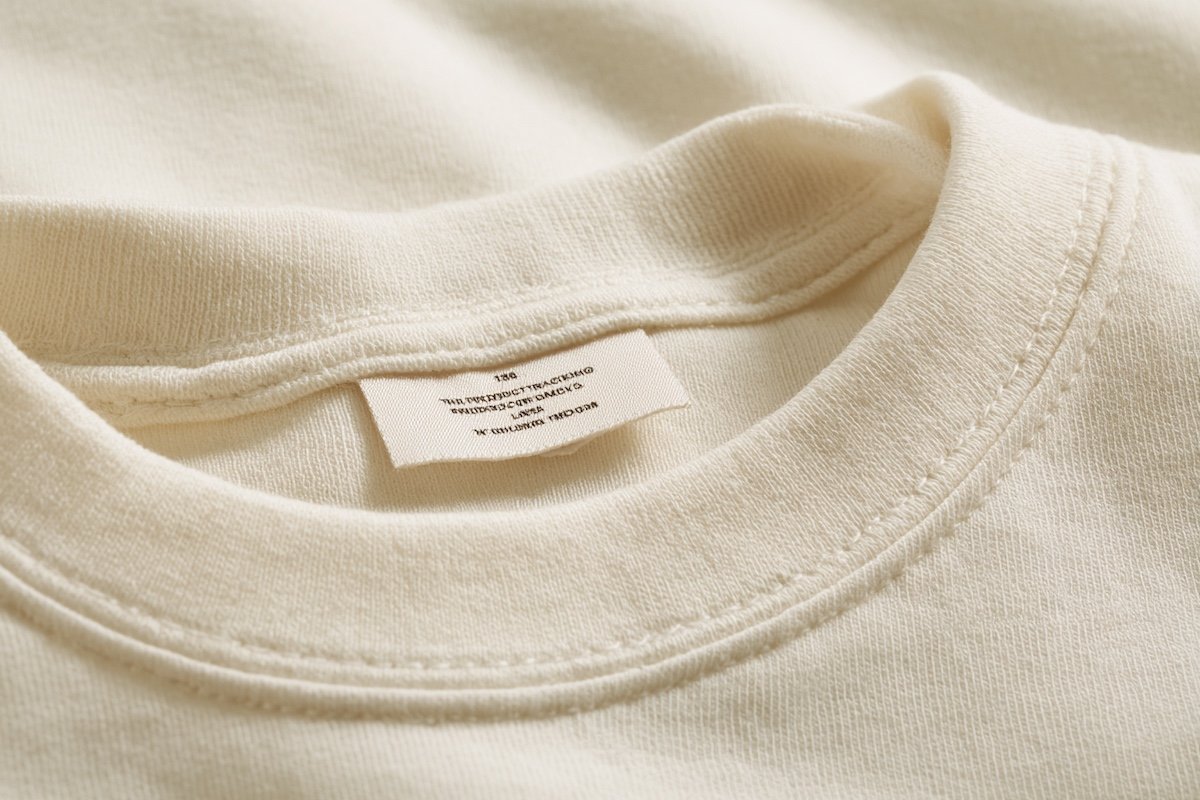
Every children’s product sold in the US must carry a permanent tracking label showing the manufacturer’s name, the production location, the date of manufacture, and a batch or cohort code. It must stay legible through washing and normal use, and it is required whether or not Amazon asks to see it.
The tracking label is the single most frequently overlooked compliance requirement in children’s apparel, because it does not come from a test report — it comes from the production process itself. The CPSIA requires it so that a product can be traced back to its source in the event of a recall, and it must be permanent, which in practice means a woven or printed label sewn or heat-applied into the garment.
The four required elements are specific: the manufacturer’s name, the production location, the date of production, and a cohort or batch number identifying the run. A care label that happens to include the brand name is not enough — the tracking information must be present and durable.
This is a factory-level requirement, which is why your manufacturer matters. A factory experienced in children’s export will already print or weave tracking labels as a standard part of production, with the batch code tied to its own production records. Ask to see a sample label before you commit to an order, and confirm that the batch code will appear on every unit, not just on the carton.
4. Small Parts and Choking Hazards
Garments for children under three are subject to small parts rules, which means any button, snap, rivet or attached decoration that can detach and fit inside a choking test cylinder is a compliance failure. For the youngest sizes, the safest design is one with no small parts at all.
The small parts rule is formally about toys, but it reaches into apparel for the youngest children through the components attached to the garment. A button that falls off a bodysuit and ends up in a child’s mouth is exactly the hazard the standard exists to prevent, and testing laboratories check the attachment strength and the size of every small component on a garment intended for children under three.
For a kids underwear or sleepwear brand, the practical lesson is design discipline. Baby and toddler garments should avoid decorative buttons, metal snaps, and any trims that can detach, in favour of flat, secure finishes and printed designs. If a small part is genuinely required, it must be attached so firmly that it cannot be removed by normal use or reasonable force — and even then, the design is better off avoiding it.
This is another point where the factory earns its role. A manufacturer that produces baby and toddler garments routinely knows which trims are permitted and which are not, and can flag a risky design at the sampling stage, before it becomes a bulk order. The cheapest compliance fix is the one made on paper, before a single garment is cut.
5. Drawstrings and Cords: The Bans You Must Know
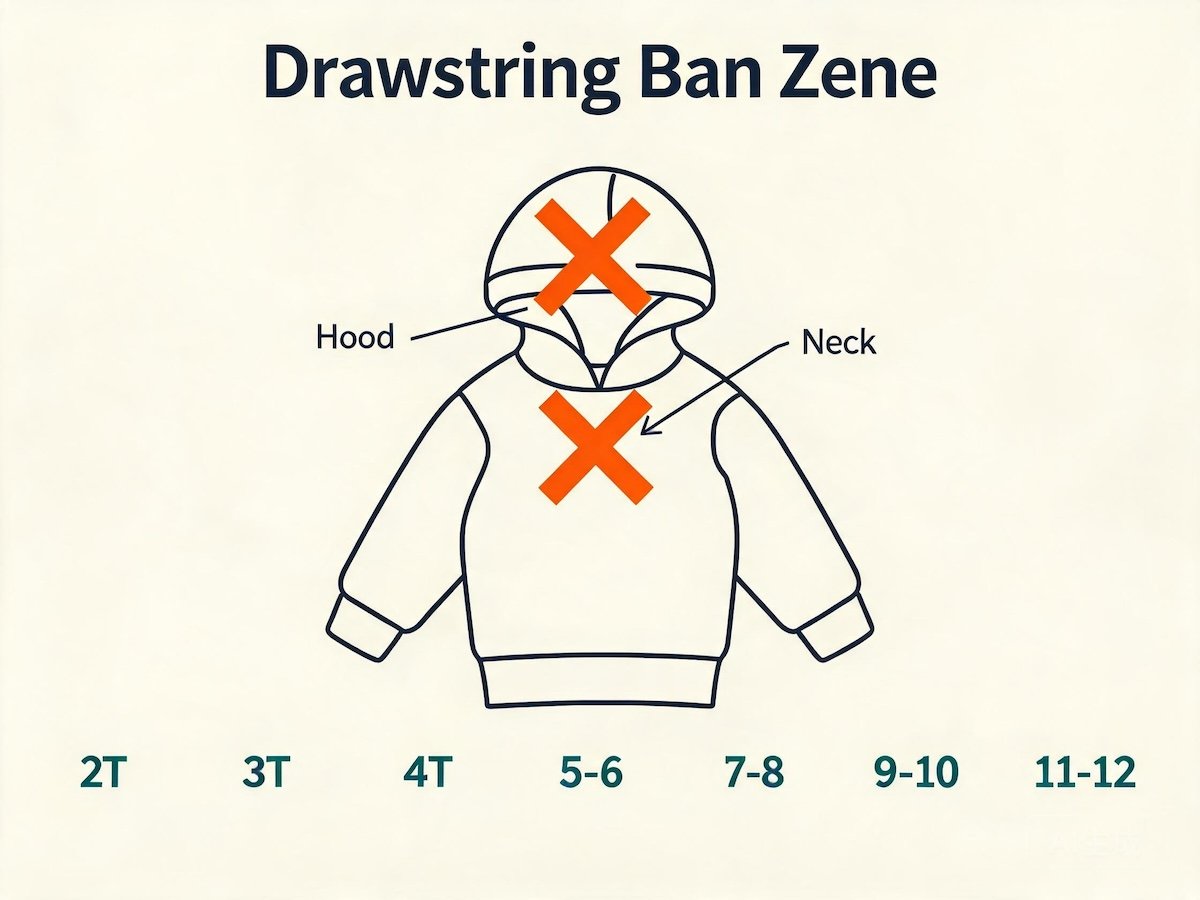
Hood and neck drawstrings are banned on children’s upper outerwear in sizes 2T through 12, and waist drawstrings are strictly limited in length. If your product line includes hoodies or tops with cords, remove them at the design stage — this is a hard, non-negotiable rule.
Drawstrings are the compliance issue with the most visible history, because the hazard is strangulation and entrapment. A hood cord that catches on playground equipment or a vehicle door is a genuine danger, and ASTM F1816 — the drawstring standard for children’s upper outerwear — bans hood and neck drawstrings in sizes 2T to 12 and limits waist and bottom drawstrings.
For most kids underwear and sleepwear brands, drawstrings are not a live concern, but the rule matters the moment you extend a range into hoodies, jackets or tops. The correct response is to design them out entirely: no functional cords at the hood or neck, and any decorative element sewn flat so it cannot catch. This is a case where the compliant design is also the safer and cheaper one.
Treat this rule as a checklist item to raise with your factory explicitly. A manufacturer experienced in US children’s export will know the standard by name and will already default to cord-free designs. If your supplier does not recognise the drawstring rules when you mention them, that is useful information about how much US-market children’s work they have actually done.
6. Flammability and Children’s Sleepwear
General children’s apparel must meet the flammability standard for wearing apparel, while children’s sleepwear must meet a stricter set of rules that effectively require either flame-resistant fabric or a snug fit. If you sell sleepwear, know which path your product takes before you produce it.
Flammability is where sleepwear becomes a genuinely different product from daytime underwear. General wearing apparel is tested under a standard that most ordinary fabrics pass without difficulty. Children’s sleepwear, in contrast, is tested under a stricter flammability standard, because a child asleep is less able to react to a flame — and the product must either be made from flame-resistant fabric or be designed to fit snugly so that air does not gather between the garment and the skin.
The practical consequence for a brand is a design decision. Most kids sleepwear brands take the snug-fit path, because it avoids the cost and complexity of flame-resistant fabrics and chemical finishes. Snug fit is a defined set of measurements — the garment must fit closely at the chest, waist, seat, and limbs — and it must be labelled as such. The alternative is flame-resistant fabric, which carries its own testing and cost.
This is precisely the kind of decision that should be made with your factory at the sampling stage, not discovered after production. A manufacturer that produces children’s sleepwear for export will already know the snug-fit measurement rules and can build the pattern to comply from the first sample. Confirm which path your sleepwear takes, in writing, before the bulk order.
| Product type | Standard | What it means for you |
|---|---|---|
| General wearing apparel | 16 CFR 1610 | Most ordinary fabrics pass; confirm at testing |
| Children’s sleepwear | 16 CFR 1615 / 1616 | Flame-resistant fabric or snug-fit design, plus labelling |
| Infant sleepwear (under 9 months) | 16 CFR 1615 | Snug fit is the standard path |
7. Testing Labs and the Documentation Trail
All CPSIA testing must be performed by a CPSC-accepted, third-party laboratory — names like SGS, Intertek and TUV SUD are the standard choices. Keep the test reports, the CPC, and the tracking label records together, because Amazon can request them at any time.
The laboratory is not a detail; it is a legal requirement. The CPSIA mandates third-party testing at a laboratory accepted by the CPSC, meaning the lab is independent of the manufacturer and accredited for the specific test methods. The familiar names — SGS, Intertek and TUV SUD — operate globally and are accepted for children’s product testing, which is why they appear on so many CPCs.
Your factory should be able to route testing through one of these labs and deliver the reports with the shipment. The documents you actually need to hold are three: the third-party test report for each product, the CPC that references it, and the tracking label records that tie the production batch to the certificate. Together they form the trail that both Amazon and the CPSC expect to see.
There is one more China-side document worth understanding. GB 31701 is the Chinese national standard for textile products, and Class A is its most stringent category, applying to infant and toddler garments. It is not a substitute for US CPSIA testing, but it is a strong signal that the factory produces to a high safety baseline — and it is the standard Nuohua Garment follows for its children’s range.

8. A Compliance Checklist Before You Ship to FBA
Before any children’s product reaches an Amazon warehouse, confirm five things: third-party testing is complete, the CPC is issued and correct, the tracking label is on every unit, the design has no banned drawstrings or detachable small parts, and sleepwear meets the right flammability path. Miss one, and the shipment is at risk.
Close with a checklist, because compliance is a sequence of yes-or-no questions, not a general feeling that the product is probably fine. Run through it before the bulk order is produced, again before it ships, and once more before it is received into FBA. The cost of catching an issue at each of those three points falls by an order of magnitude each time.
- Third-party testing complete? Test reports in hand from a CPSC-accepted laboratory such as SGS, Intertek or TUV SUD.
- CPC issued and correct? Names the right product, manufacturer, importer, laboratory and applicable rules.
- Tracking label on every unit? Manufacturer name, location, date and batch code, permanent and washable.
- Design clear of hazards? No hood or neck drawstrings, no detachable small parts on under-3 sizes.
- Sleepwear path confirmed? Snug-fit design with labelling, or flame-resistant fabric, documented in writing.
Want a factory that treats children’s compliance as standard production, not an add-on? Email info@nuohuagarment.com or message us on WhatsApp at +86 150 1198 5393 with your product type and size range, and we will walk you through the compliance path for your specific garment.