
This guide is part of the Kidswear Brand Building Guide.
Kids’ underwear is one of the most accessible categories in children’s apparel. It is high-repeat, lower in SKU complexity than outerwear, and rewards fit and fabric consistency over seasonal trend-chasing. But “accessible” is not the same as “easy”. Most founders we talk to fail not on design but on ordering too many SKUs too early, treating compliance as an afterthought, and chasing a price point instead of a reason to exist. This guide is the factory-side view of how to build kids underwear brand programs that survive their first reorder cycle: choosing a niche, sourcing the right fabric, locking safety compliance before cutting, and planning a first order you can actually fund.
On this page
- The Quick Answer: Building a Kids Underwear Brand in 2026
- Why Kids Underwear Is a Smart Private-Label Niche
- Competitor Research and Differentiation: Fabric, Fit, and Print
- Launch Faster with In-Stock Fabric (No Setup Fee)
- Get Compliance Right Before You Order: GB 31701 Class A and CPC
- MOQ and First-Order Planning: Start Lean
- Branding and Packaging: Hang Tags, Care Labels, and Private Labels
- The 12-Week Launch Roadmap
- After Launch: Iterate, Expand SKUs, and Scale
1. The Quick Answer: Building a Kids Underwear Brand in 2026
You can build a kids underwear brand in roughly 12 weeks from concept to first order. The shortest path is: pick a narrow niche (one age band plus one fabric story), start on an in-stock modal-spandex fabric to avoid setup fees, lock GB 31701 Class A and CPC compliance before cutting, and place a lean first order around a ready-stock minimum of 2 pcs. Upfront spend is usually lower than founders expect — the real risk is skipping compliance or over-ordering SKUs before you have sell-through data.
There is no single “right” way to launch, but there is a wrong way: trying to build a full-size-range, multi-style collection on your first order. That approach burns cash on fabric minimums and leaves you holding slow sizes. The sequence that works, in our experience as an OEM/ODM manufacturer, is to treat the first order as a paid market test — a narrow, compliant, well-differentiated range that proves demand, then scale from reorder data.
The rest of this article walks through each step in that sequence, with the real numbers we quote to brands every week: fabric weights, MOQ thresholds, lead times, and the compliance documents you must have before goods ship. If you are earlier in the process and still deciding between production models, start with our comparison of OEM, ODM, and private-label manufacturing.
2. Why Kids Underwear Is a Smart Private-Label Niche
Kids underwear is a smart private-label niche because it is high-frequency, low-fashion-risk, and driven by fit and comfort rather than seasonal trends. Parents rebuy the size that works, which creates predictable reorder behaviour that a founder can model from day one.
Compare the economics to outerwear. A child’s jacket is bought once or twice a year, is heavily trend-driven, and requires a deep size and colour matrix. Underwear is bought in multi-packs, replaced every few months as the child grows, and the purchase decision collapses to three questions: does it fit, is it soft, and is it safe. That makes the category unusually founder-friendly for a first private-label line.
There are three structural advantages worth naming explicitly:
- High repeat purchase. Underwear is a consumable. A customer who buys once and is happy will reorder the next size up, giving you a predictable retention loop instead of a constant hunt for new customers.
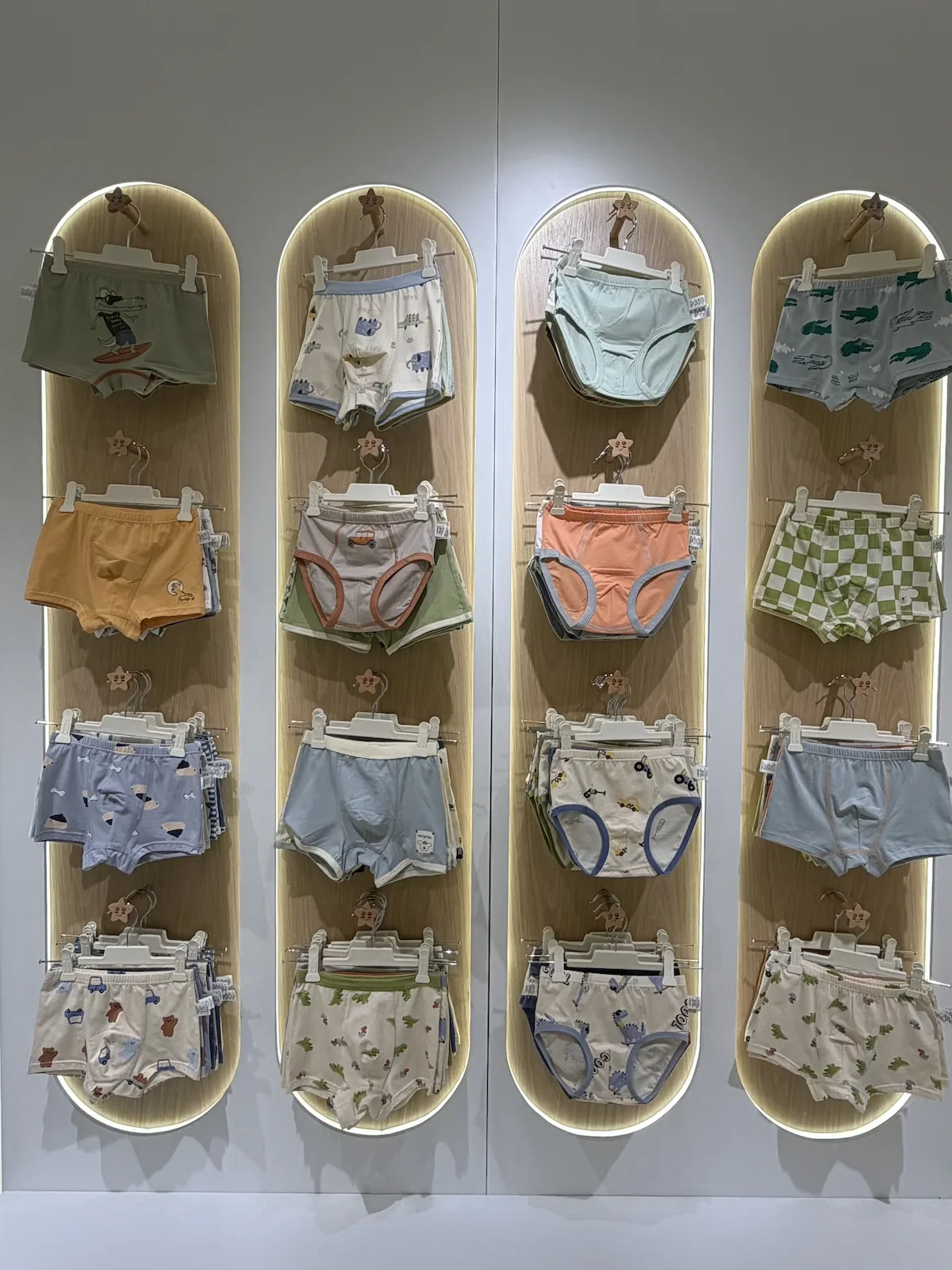
- Low SKU complexity. A brief, a boxer brief, and a triangle in three or four prints is a complete launch. Compare that to outerwear, which needs coordinating tops and bottoms across sizes.
- Fit and fabric are the moat. Parents cannot feel fabric through a listing. Once you deliver genuinely better hand-feel and consistent sizing, switching costs go up and price pressure goes down.
| Category | Repeat purchase | SKU complexity | Trend risk | Fit sensitivity | Compliance burden |
|---|---|---|---|---|---|
| Kids underwear | High (size laddering) | Low | Low | High | Moderate (Class A / CPC) |
| Kids sleepwear | Medium-high | Medium | Medium | Medium | Moderate (flammability) |
| Kids outerwear | Low-medium | High | High | Medium | Moderate-high |
| Baby bodysuits | High | Medium | Low | High | High (snap/trim safety) |
The trade-off is that the low barrier to entry means the category is crowded. Being “another soft kids underwear brand” is not a strategy. The next section is about finding the specific angle that makes your line defensible.
3. Competitor Research and Differentiation: Fabric, Fit, and Print
Differentiate on three levers you can actually control: fabric hand-feel (modal vs cotton), fit consistency (a true size run rather than vanity sizing), and print range — not on price alone, which is a race to the bottom for a small brand.
Before you write a spec, audit the shelf. Look at ten competing brands in your target market and record four things for each: the fabric composition they advertise, their size chart, their price per piece, and their packaging. You will quickly see that most compete on print and price, while very few compete on fabric origin or fit precision. That gap is your opening.
The three differentiation levers break down like this:
- Fabric. The single biggest driver of a parent’s “this is better” feeling. A modal vs cotton comparison is worth studying before you commit, because modal delivers the soft hand-feel and drape that photograph and feel premium, while cotton reads as natural and familiar. Our most popular in-stock option — 91.9% Lenzing™ Modal + 8.1% Spandex — is chosen specifically because it solves the “soft but still stretchy and durable” problem.
- Fit. Many budget brands run small or ship inconsistent waistbands. A brand that publishes an honest size chart and holds tolerance across a bulk run earns reorders. This is a manufacturing discipline, not a marketing trick.
- Print. With 3,000+ print options available, print is table stakes. The differentiator is print quality under wash — which is why colourfastness testing matters more than the artwork itself.
Do not try to win on price. A small brand cannot beat mass-market importers on landed cost, and trying to do so forces you toward cheaper fabric and looser quality, which destroys the exact trust the category runs on. Instead, pick one lever — usually fabric or fit — and make it the headline of the brand.
4. Launch Faster with In-Stock Fabric (No Setup Fee)
Start on in-stock fabric to skip fabric minimums and setup fees. Our 91.9% Lenzing™ Modal + 8.1% Spandex interlock (220–240 GSM) is available with no setup fee, so a first order can launch on proven fabric instead of paying for costly custom development.
Custom fabric development is the hidden cost that kills first orders. A cotton-only blend or an unusual composition usually means a development cycle with its own minimum order quantity, a longer lead time, and a setup fee before you have sold a single unit. For a founder validating a market, that is the wrong place to spend early capital.
The faster path is to launch on fabric that is already in stock and already proven in production. We hold two core options specifically so private-label founders can start without a setup fee:
| Fabric | Composition | Construction | Weight | Setup fee | Best for |
|---|---|---|---|---|---|
| Modal-Spandex (in stock) | 91.9% Lenzing™ Modal + 8.1% Spandex | Interlock | 220–240 GSM | None | Premium soft hand-feel, high stretch recovery, no cotton |
| Modal-Cotton-Spandex (in stock) | 49.9% Lenzing™ Modal + 43.3% Cotton + 6.8% Spandex | Interlock | ~220 GSM | None | Balanced natural feel for brands that want cotton in the story |
| Cotton-only / other blends | Custom | Custom | Custom | Yes | Custom fabric development line — longer lead time, fabric MOQ applies |
Starting on in-stock fabric does not mean compromising on differentiation. You can still differentiate on fit, print, waistband construction, and packaging while the fabric itself is a known quantity. That is the point: remove the one variable that carries the most cost and delay, and spend your energy on the variables that move the customer.
Once the brand is selling, moving to a custom fabric is a growth decision you can fund from reorders — not a gamble you take before your first customer exists.
5. Get Compliance Right Before You Order: GB 31701 Class A and CPC
Do compliance before production, not after. For the Chinese domestic market that is GB 31701 Class A (China children’s A-class safety standard); for the US that is a Children’s Product Certificate (CPC) backed by third-party laboratory testing. Both should be confirmed before the first metre is cut.
Compliance is the most common place first-time founders make a brand-damaging mistake, and it is almost always a mistake of timing. They treat certificates as a shipping-afterthought, then discover at the port that the documentation is incomplete. Children’s apparel is regulated because it sits against skin and, for the youngest sizes, ends up in mouths. Treat compliance as a pre-production requirement.
GB 31701 Class A — the Chinese standard
For any brand selling children’s garments into the Chinese domestic market, the governing standard is GB 31701, and the relevant classification is GB 31701 Class A (China children’s A-class safety standard). Class A is the strictest category, applying to infant and young children’s garments, with tighter limits on formaldehyde, pH, and other chemical and physical safety parameters than Class B or C. If you are exporting to China or selling to a buyer who resells there, this standard is non-negotiable for kids’ underwear.
CPC and CPSIA — the US requirement
For the US market, the document you need is a Children’s Product Certificate (CPC), which certifies that the product complies with the relevant sections of the CPSIA (lead content, phthalates, flammability, and small-parts rules where applicable). A CPC is issued by the importer or manufacturer — meaning you, the brand — and it must be supported by third-party laboratory test reports.
Third-party testing — and a wording trap
Here is the nuance most founders get wrong, and it matters for how you present your brand. SGS, TÜV SÜD, and Intertek are independent third-party testing laboratories. They test your product and issue reports that back your CPC. They are not a certificate you “hold”, and a factory should not claim to be “certified by” them. Similarly, our OEKO-TEX Standard 100 certification is currently in progress — we state it as in progress, not granted, and any honest supplier should be equally precise about the difference between a standard and a test report.
| Market | Requirement | Who issues / role | Key note |
|---|---|---|---|
| China (domestic) | GB 31701 Class A (China children’s A-class safety standard) | Mandatory national standard | Class A is the strictest category for infant and young children’s garments |
| United States | Children’s Product Certificate (CPC) + CPSIA | Issued by importer/manufacturer, backed by lab tests | Covers lead, phthalates, flammability |
| Third-party testing | Test reports | SGS / TÜV SÜD / Intertek — independent labs | They test and report; they are not our certificate |
| Chemical safety (voluntary) | OEKO-TEX Standard 100 | Currently in progress | Not yet granted — state it accurately |
6. MOQ and First-Order Planning: Start Lean
Stock-fabric underwear programs run from 2 pcs on selected in-stock styles, colors and sizes; custom runs (custom colour or new fabric development) are quoted separately, per fabric and colour; sleepwear is 1,000 sets per design. Keep the first order to 3–5 SKUs so you test sell-through before scaling, and let reorders fund the wider range.
MOQ is where first orders are won or lost. Order too little and you cannot meet minimums; order too much and you sit on inventory that ties up cash. The correct framing is to size the first order as a market test, not as a full collection launch.
Our MOQ for custom kids’ underwear is from 2 pcs on selected in-stock styles, colors and sizes on stock-fabric programs, and custom runs (custom colour or new fabric development) are quoted separately, per fabric and colour. Sleepwear and pajama sets are a separate category with a higher threshold — 1,000 sets per design. These are not interchangeable, and mixing them up in your budget is a common error. A first underwear order of three styles in two colours each means six line items from ready-stock minimum of 2 pcs — a manageable, fundable quantity that still gives you enough units to test sizing and sell-through.
| Product type | MOQ | Unit | Approx. lead time | Notes |
|---|---|---|---|---|
| Custom kids underwear (briefs / boxer briefs / triangle) | From 2 pcs | on selected in-stock styles, colors and sizes | Sampling + bulk 30±5 days | Can start on in-stock fabric, no setup fee |
| Sleepwear / pajama sets | 1,000 | sets per design per colour | Sampling + bulk | Higher minimum; plan as a phase-two expansion |
| Cotton-only / custom blends | Fabric MOQ applies | — | Longer (development) | Custom fabric development line |
Budget for the whole landed cost, not just the unit price. Your first-order math should include sampling, the bulk units themselves, packaging, third-party testing, and freight. Many founders under-budget freight and testing, then get surprised by a cost they could have seen coming. A simple rule: when you quote the unit price from a factory, assume landed cost is roughly 1.5–1.8× that number until you have a real freight quote in hand.
7. Branding and Packaging: Hang Tags, Care Labels, and Private Labels
Your packaging is part of the product. Hang tags, care labels, and private-label branding should be specified in the same tech pack as the garment itself — not added as an afterthought after production is already underway.
Private label means the product carries your brand, not the factory’s. That is obvious — but the execution detail that separates polished brands from generic ones is where and how the branding appears. Three elements matter:
- Hang tags. The first physical thing a customer sees. Specify material, size, hole placement, and the exact brand name and care icons before bulk. A tag that arrives inconsistent with your artwork is a rework cost you did not need.
- Care labels. Legally required and often the most rushed. Fibre composition and care instructions must be accurate and, for most markets, in the required language. This is where a factory that has done export work earns its keep.
- Private label branding. Whether your logo is printed inside the garment or sewn in is a real decision with cost and comfort trade-offs — printed vs sewn-in labels walks through both.
Packaging is also a differentiation lever you own completely. A multi-pack sleeve, a compostable mailer, or a simple size-label colour system can become a recognisable part of the brand without touching the garment cost. Just make sure every branded element is locked in the spec before cutting, because retrofitting branding after bulk is finished is expensive and slow.
8. The 12-Week Launch Roadmap
A realistic 12-week timeline: weeks 1–2 niche and spec, weeks 3–4 sampling and lab dips, weeks 5–6 pre-production and compliance, weeks 7–9 bulk production, weeks 10–12 inspection and shipping. The buffer is not optional — it is where compliance and QC actually happen.
A timeline keeps a launch honest. The most useful version maps weeks to the milestone that must be complete, because founders tend to compress the two stages that cannot be compressed: sampling approval and third-party testing. Here is the sequence we see work:
| Week | Milestone | Key deliverables |
|---|---|---|
| Weeks 1–2 | Niche and spec | Target age band, fabric choice, 3–5 styles, size chart, tech pack draft |
| Weeks 3–4 | Sampling and lab dips | Pre-production samples, print/colour approval, fit adjustments |
| Weeks 5–6 | Pre-production and compliance | Final spec sign-off, third-party testing initiated, CPC prepared, packaging approved |
| Weeks 7–9 | Bulk production | Cutting, sewing, 6-stage QC with needle detection on the line |
| Weeks 10–12 | Inspection and shipping | Pre-shipment inspection, packing, freight booking, documentation |
Three notes on reading this table correctly. First, weeks 3–4 and 5–6 are where most launches slip: lab dips and fit approvals always take a round longer than planned, and third-party testing runs on the lab’s clock, not yours. Second, the “6-stage QC with needle detection” line is not decoration — for kids’ underwear, a needle-detection step at the end of the line is a safety requirement, not a nice-to-have. Third, pre-shipment inspection is your last gate; do not skip it to save a few days of transit.
9. After Launch: Iterate, Expand SKUs, and Scale
Use reorder data to decide what to expand. Double down on the sizes and prints that reorder fastest, and only then add fabric options or new styles — scaling from a proven base, not a guess.
The first order is not the finish line; it is the experiment. The brands that grow are the ones that read reorder data without ego and let it dictate the second order. Three patterns show up consistently:
- Size distribution is lopsided. You will sell some sizes faster than others. Reorder the fast movers, and adjust the size ratio of the next bulk run rather than reordering a flat pack across every size.
- A few prints carry the brand. Two or three prints will outsell the rest. That is normal. Cut the laggards from the reorder and reinvest the print budget into variations of the winners.
- One complaint theme is the signal. If a size runs small or a waistband rolls, that is a manufacturing fix for the next run, not a marketing problem. Feeding this back to your factory is how the product gets better — a reason to work with a manufacturer, not a middleman.
Only after sell-through is proven should you widen the range — add a sleepwear line (remember its 1,000-sets-per-design-per-colour MOQ), introduce a cotton blend for a second fabric story, or extend the size run. Each expansion is a new bet, but now it is a bet funded by data and reorder cash flow instead of savings.
If you have made it this far, the next step is concrete: a development request that names your age band, your fabric preference, and your target market. That is enough for a factory to respond with real options, a sample plan, and a compliance checklist — no vague “let’s talk” required.
Ready to turn the plan into a first order? Send us your niche, target market, and preferred fabric, and we will come back with a sample plan, MOQ, and compliance checklist.