
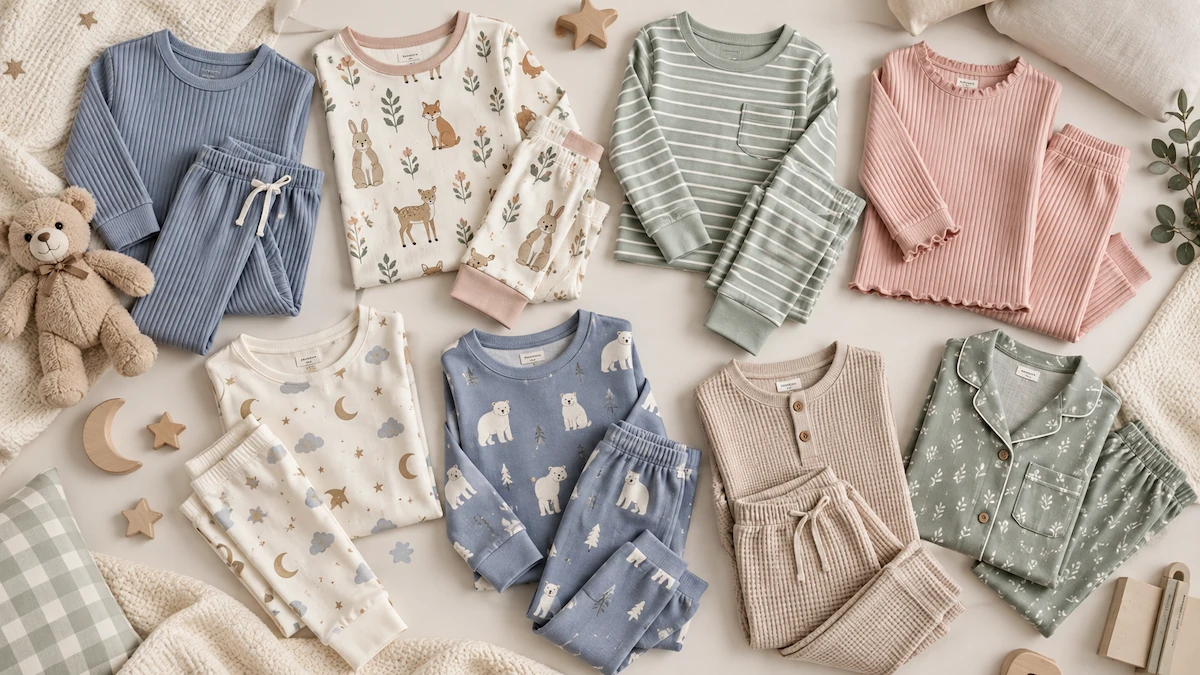
Kids Pajama Trends 2027: Sleepwear Design, Fabrics & US Safety
Children’s sleepwear is the one category where a trend decision can collide with a safety regulation before a single sample is cut. The 2027 sleepwear direction — softer coordinated sets, loungewear-grade comfort, nostalgic and tonal prints — is commercially attractive, but almost every one of those directions touches the US 16 CFR 1615 / 1616 flammability framework in some way.
This is a production-side reading of 2027 kids pajama trends. It follows the same 12-point structure we use for every trend guide on this site, and it treats compliance as a design input, not an afterthought. It is written for brand founders, buying teams and wholesalers who need a sleepwear range that looks current and clears customs.
On this page
- What is the trend?
- Why is it growing?
- Which kidswear products fit?
- What should buyers change?
- Production feasibility
- Fabric & construction
- MOQ, cost and lead time
- Market & compliance considerations
- Nuohua’s 20-year manufacturing view
- Buyer checklist
- Related manufacturing guides
- Turn the trend into a production plan
Back to the 2027 kidswear trends overview — pajama trends are one spoke of the full cluster.
1. What is the trend?
The 2027 kids sleepwear direction is five convergent aesthetic shifts: loungewear-grade comfort crossing into sleepwear, softer coordinated two-piece sets, nostalgic and story-book prints, tonal and “barely-there” colour, and breathable natural-fibre bases. All five are producible, but three of them interact directly with US sleepwear flammability labelling rules.
Sleepwear is unusual because the “trend” and the “regulation” are not separate tracks — they sit on the same table. A looser, fluttery nightdress is both a styling choice and a compliance event. A two-piece set is both a commercial win and a labelling decision. Reading 2027 sleepwear trends without the compliance lens produces ranges that look great in a lookbook and stall at the US port.
| Direction | What it looks like in a garment | Where it lands in production / compliance |
|---|---|---|
| Loungewear-grade comfort | Relaxed two-piece sets, brushed or interlock bases, worn day and night | Lower cost — base and finish choice; strong snug-fit candidate |
| Coordinated sets | Matching top + bottom in one base fabric and colourway | Lower cost — single dye lot, single fabric run |
| Nostalgic & story-book prints | Small-scale all-over or placement prints, soft illustrative motifs | Moderate — print screens; placement reduces register risk |
| Tonal & “barely-there” colour | Oatmeal, blush, sage, warm grey; one saturated accent | Lower cost — fewer dye lots across a range |
| Breathable natural-fibre bases | Cotton interlock, cotton-modal blends, light viscose from bamboo | Moderate — fibre sourcing and base stability |
The commercially strong sleepwear direction for 2027 is also the one that maps cleanly onto the compliant path: relaxed, close-to-body two-piece sets in stable knit bases. That is the format the US snug-fit exemption was built for.
2. Why is it growing?
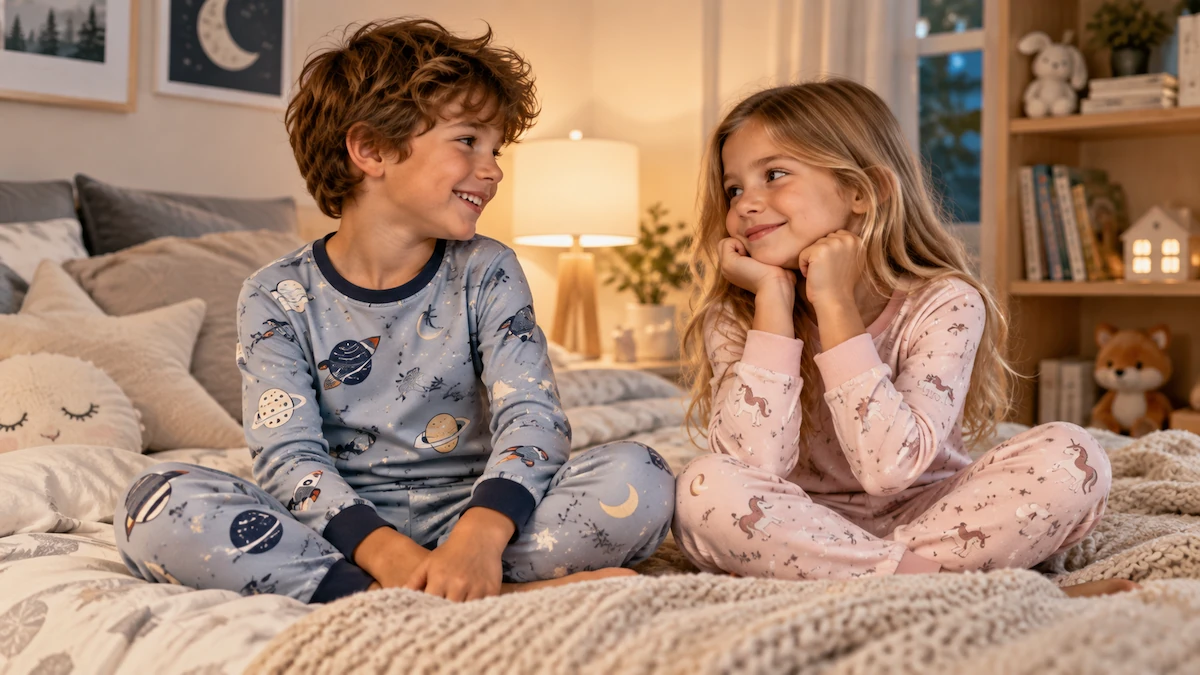
Four forces: at-home time normalised loungewear as everyday wear, parents increasingly buy sleepwear that doubles as daytime outfit, retailers shifted sleepwear shelf space toward coordinated sets, and brands compete on end-use comfort rather than surface novelty.
Market signalWe read the 2027 sleepwear direction from the same four source types we use for the broader cluster: colour and material forecasting services, kidswear retail assortments across major retailers, sector trade media and seasonal buying briefings, and Nuohua’s own sampling and production data. None of these alone is a conclusion.
Nuohua manufacturing viewA direction only becomes a plan once it passes the second question: can it be produced repeatedly, in the required sizes, at a quantity that makes commercial sense, and does it clear the destination-market compliance path?
The specific drivers behind 2027 sleepwear:
- Loungewear normalised as everyday wear. The boundary between “pyjamas” and “home clothes” has largely dissolved for children. Parents buy sets they can wear from breakfast to bedtime, which rewards relaxed, close-fitting construction over loose, decorative nightwear.
- Sleepwear that doubles as daywear. Coordinated two-piece sets read as outfits, not nightwear. That expands the wear occasion and the units per child — directly improving the economics of a sleepwear range.
- Retail assortment shift to sets. Major kidswear retailers continue moving sleepwear shelf space toward coordinated sets in stable bases. Assortment that has already survived a buying committee is the strongest trend signal available.
- Comfort as the differentiator. Brands increasingly compete on what sleepwear is for — soft hand-feel, easy dressing, a fit that stays put — rather than on novelty print. That pushes decisions into construction, where a manufacturer’s input affects margin.
3. Which kidswear products fit?
Produce: relaxed two-piece knit sets, coordinated top-and-bottom ranges, small-scale tonal prints, brushed or interlock bases. Avoid overdoing: loose fluttery nightdresses for the US market without a compliant path, any flame-retardant treatment claim, and labelling loungewear as sleepwear when the fit and fabric do not support it.
| Produce this | Avoid overdoing | Why |
|---|---|---|
| Relaxed two-piece knit sets (top + bottom) | Loose, flowing nightdresses for US sizes 9 months–14 years | Loose formats trigger the full 16 CFR 1615/1616 flammability test unless they are explicitly exempt; the compliant snug-fit path is far simpler |
| Coordinated sets in one base fabric and colourway | Four-fabric, four-colour ranges built around “variety” | Each extra base and dye lot adds cost and second-quality risk with no commercial return |
| Small-scale tonal or story-book prints | Large, high-coverage novelty prints on sleepwear | High coverage raises print registration and colourfastness risk; placement prints are safer |
| Brushed or interlock cotton, cotton-modal blends | Any claim of flame-retardant finishing or treatment | We do not offer or claim flame-retardant treatment; the compliant route is snug-fit labelling, not chemistry |
| Clearly-labelled sleepwear OR clearly-labelled loungewear | Products that blur “loungewear” and “sleepwear” labels | Mislabeling changes the applicable regulation; decide the intended end-use before sampling |
The single most common sleepwear mistake we see is designing a beautiful loose nightdress and only discovering at the compliance stage that it needs the full flammability test. Designing to the snug-fit format from the start removes that detour.
4. What should buyers change?
Change four habits: decide “sleepwear” vs “loungewear” before sampling, design sleepwear to the snug-fit format for the US, brief prints as placement rather than all-over, and stop treating flame-resistance as a feature to advertise.
| Change | Current practice | Change to | Why |
|---|---|---|---|
| End-use decision | Designed as “cute pyjamas,” label decided later | Decide sleepwear vs loungewear at tech-pack stage | The label decides the regulation; deciding late forces a re-sample |
| US fit strategy | Loose, flowing silhouettes | Snug-fitting two-piece format with required label | Snug-fit is exempt from the 16 CFR 1615/1616 flammability test when correctly labelled |
| Print brief | All-over novelty print | Placement or small-scale tonal print | Lower registration and colourfastness risk; fewer second-quality units |
| Flammability messaging | “Flame resistant” used as a selling point | No FR claim; rely on compliant snug-fit labelling | We do not apply or claim flame-retardant treatment; the compliant route is fit + label |
5. Production feasibility
Feasibility is high for snug-fit two-piece sets in stable knit bases and moderate for printed sets. The main risks are print registration, base stability after wash, and — above all — labelling correctness for the US market.
Seven checks we run on every sleepwear development before sampling:
- End-use confirmed. Sleepwear or loungewear? The answer decides the compliance track.
- Destination market set. US, EU, UK and China each carry different sleepwear rules; design to the strictest relevant one.
- Base stability. The knit must hold shape and dimension after repeated wash — loose bases bag and fail fit.
- Print process chosen. Placement or small-scale print reduces risk versus all-over coverage.
- Label plan locked. Snug-fit warning label text, placement and permanence defined in the tech pack.
- Closure safety. Snaps and elastics sized and positioned for the age range; no hard points on sleepwear.
- Second-quality budget. Print and base stability risks priced into the first production run.
| Element | Feasibility | Note |
|---|---|---|
| Snug-fit two-piece sets (US) | High | Standard knit production; compliance via correct labelling |
| Coordinated sets, one base | High | Single fabric run and dye lot |
| Placement / small-scale print | Medium-High | Register risk manageable with screen choice |
| All-over high-coverage print | Medium | Colourfastness and registration need extra QC |
| Loose nightdress (US, non-exempt) | Low | Full flammability test path; avoid unless required |
| Flame-retardant treatment claim | Not offered | Nuohua does not apply or claim FR treatment |
6. Fabric & construction
The 2027 sleepwear base is a stable knit — cotton interlock, cotton-modal blend, or light viscose from bamboo — finished soft, with covered or flat seams on skin-contact edges and a snap or elastic that survives wash. The failure modes are base bagging, print crack, and label loss.
Fabric direction. Cotton interlock gives the stable, dense hand that holds a snug fit through wash. Cotton-modal blends add drape and softness. Light viscose from bamboo offers a cool hand but needs base-stability validation before bulk. We cover the physical differences between knit bases in our fabric weight guide and our interlock vs jersey comparison — this article only states which base fits the 2027 sleepwear direction.
Construction and failure modes
- Seams. Covered or flat seams on skin-contact edges reduce abrasion. The trade-off is cost per unit versus return rate; for sleepwear the return is usually worth it.
- Closures. Snaps must be nickel-free and positioned clear of the neck; elastics must recover after wash. We cover seam and label choices in our bound vs flatlock seam guide and printed vs sewn-in label guide.
- Failure mode — base bagging.A weak knit loses snug fit after three washes and fails the fit intent. Solved by base selection, not by a larger size.
- Failure mode — print crack.All-over prints on a stretch base crack at the waistband. Solved by placement print or a more stable base.
- Failure mode — label loss.The required snug-fit warning label must be permanent. A printed-on label that washes out is a compliance failure, not a cosmetic one.
7. MOQ, cost and lead time
Sleepwear and homewear sets sit at 1,000 sets per design for custom development. Stock-base programmes can start lower and mix styles and colours. Cost is driven by base, print process and label permanence; lead time is driven by base availability and lab-dip approval.
| Route | MOQ |
|---|---|
| Stock fabric + existing colour | From 2 pcs on selected in-stock styles, colors and sizes (styles, colors and sizes mixable) |
| Custom dye (Pantone / lab dip) | Reviewed based on fabric and colour |
| Custom fabric development | Quoted separately, per fabric and colour |
| Sleepwear / homewear sets | 1,000 sets per design |
Four cost levers:
- Base.Interlock costs more than jersey; a stable base that survives wash is cheaper than the returns it prevents.
- Print process.Placement print on a flat panel costs less in second-quality than all-over coverage.
- Label permanence.A sewn-in permanent warning label costs marginally more than a printed-one but removes the compliance risk.
- Dye lots.Tonal ranges sharing one dye lot cut colour approval cost across the collection.
Lead-time chain: base sourcing → lab dip (if custom colour) → sample → fit and label approval → bulk → QC → freight. For a 2027 sleepwear range, the brief should reach the factory by late Q1 2027 to land US autumn shelf and to absorb lab-dip and re-sample time. Earlier is always safer than later.
8. Market & compliance considerations
For the US, children’s sleepwear in sizes roughly 9 months to 14 years must meet 16 CFR 1615 (sizes 0–6X) and 1616 (sizes 7–14); snug-fitting garments are exempt from the flammability test when they carry the required permanent warning label and hangtag. We do not apply or claim flame-retardant treatment. Other markets carry their own nightwear rules.
United States.Children’s sleepwear is regulated for flammability under 16 CFR Part 1615 (sizes 0–6X) and 16 CFR Part 1616 (sizes 7–14). Tight-fitting sleepwear is exempt from the flammability test provided it carries the specified snug-fitting warning — a permanent label reading substantially “Wear snug-fitting. Not flame resistant.” plus a corresponding hangtag. This is the path most 2027 sleepwear ranges should take. We produce to this framework; the label text and placement must be confirmed with a CPSC-accepted laboratory or qualified counsel.
European Union & United Kingdom.Children’s nightwear is subject to national fire-safety requirements (for example the UK Nightwear (Safety) Regulations). The specifics differ from the US snug-fit model, so a US-compliant label is not automatically sufficient for the UK or EU. Design the range to the strictest relevant market and confirm locally.
China.Domestic children’s garments are covered by GB 31701 Class A for infant and young-child products, with additional requirements as the child ages. Our general safety and certification position is summarised in our kids clothing safety certifications guide.
9. Nuohua’s 20-year manufacturing view
Two decades of children’s apparel production tell us: design sleepwear to the snug-fit format up front, price the permanent label into the tech pack, and treat print as placement. The mistake that costs the most time is deciding the label after the sample exists.
Experience judgments:
- Decide the label before the sample.The single most expensive sleepwear error is a beautiful loose nightdress that needs the full flammability path. A snug-fit two-piece designed from line one avoids the detour entirely.
- The permanent label is non-negotiable.We have seen printed warning labels survive two washes and then fail. For the US snug-fit exemption the label must be sewn-in and permanent; we brief it that way by default.
- Stable base beats soft base.A base that feels soft in the hand but bags after wash fails the fit. We weight base stability above initial hand-feel for sleepwear.
- Tonal ranges are a production gift.One dye lot across a coordinated set range cuts approval cost and second-quality simultaneously. The commercial and manufacturing answer is the same.
One question we would reframe.“Which print is on-trend for 2027 sleepwear?” is the wrong first question. The right first question is “what fit and label path does this market require, and which base holds it through wash?” — because the trend is useless if the garment cannot clear the port.
10. Buyer checklist
Ten checks before you brief a 2027 sleepwear range: end-use decided, market set, base stable, print placement, label permanent, closure safe, MOQ route known, cost levers priced, lead time mapped, compliance confirmed with a lab.
- Confirm the intended end-use: sleepwear or loungewear?
- Confirm the destination market(s) and their sleepwear rules.
- Choose a stable knit base that holds snug fit after wash.
- Brief prints as placement or small-scale tonal, not all-over.
- Lock the required warning label text, placement and permanence in the tech pack.
- Specify nickel-free snaps and wash-recovery elastics for the age range.
- Know the MOQ route: 1,000 sets per design for custom sleepwear sets.
- Price the four cost levers: base, print, label, dye lots.
- Map the lead-time chain and send the brief by late Q1 2027 for US autumn.
- Confirm compliance with a CPSC-accepted laboratory or qualified counsel — do not rely on a supplier statement.
11. Related manufacturing guides
12. Turn the trend into a production plan
Turn the 2027 sleepwear trend into a compliant production plan.
Send us your reference image, target market, and a one-line fit intent (snug-fit two-piece, or loungewear). We will return a feasibility read on base, print and labelling — and a sample plan that clears the port, not just the lookbook.
Or reply with your tech pack — see our tech pack guide.
Standards verified as of 2026-09; regulations change — confirm with a CPSC-accepted laboratory or qualified counsel before ordering. This article is a Nuohua buyer-side assessment, not compliance advice or an industry standard. Nuohua Garment — kidswear OEM & ODM manufacturer since 2016.