
Girls’ Clothing Trends 2027: Romantic Details, Sporty Prep & Playful Color
Girls’ wear is the part of the kidswear range where design ambition and production reality diverge fastest. A bow, a ruffle or a pleat that takes ten minutes to draw can add trim cost, a new failure mode and a second sample round if it is specified after the tech pack is written.
This is a production-side reading of 2027 girls’ clothing trends. It follows the same 12-point structure we use across this cluster, and it treats construction detail as a purchasing decision rather than a styling footnote. It is written for brand founders, designers and buying teams who need a range that looks current and survives a bulk run.
On this page
- What is the trend?
- Why is it growing?
- Which kidswear products fit?
- What should buyers change?
- Production feasibility
- Fabric & construction
- MOQ, cost and lead time
- Market & compliance considerations
- Nuohua’s 20-year manufacturing view
- Buyer checklist
- Related manufacturing guides
- Turn the trend into a production plan
Back to the 2027 kidswear trends overview — girls’ trends are one spoke of the full cluster.
1. What is the trend?
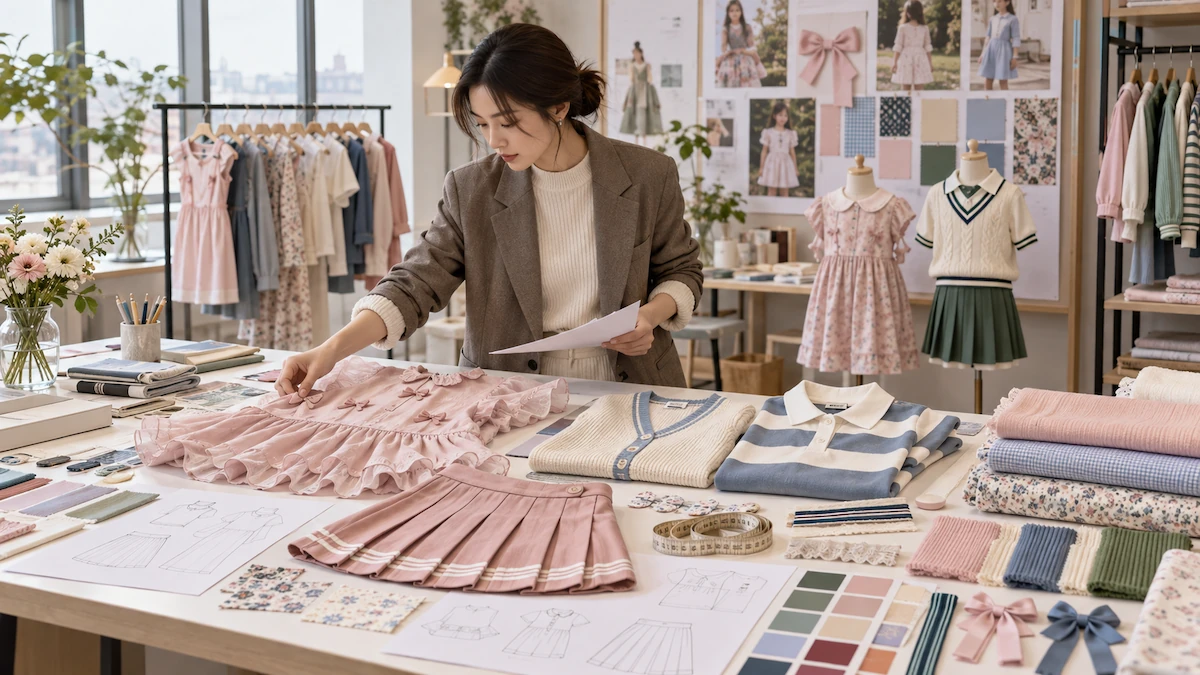
The 2027 girls’ direction is three convergent shifts: romantic detail moving from occasionwear into everyday dresses and tops, sporty-prep styling crossing from adult menswear into girls’ daywear, and playful colour led by saturated brights balanced against retro pastels. A fourth, quieter shift — soft “mini-me” tailoring in cardigans and lightweight separates — is the one that carries the highest repeat-purchase potential.
None of the three headline directions is new in isolation. What changed is where they land: romantic detail used to be reserved for birthday and occasion dresses, and in 2027 it is being specified on everyday jersey and poplin pieces. That migration is the whole story, because everyday garments are sold at everyday price points and at everyday volumes — which is exactly where construction cost stops being theoretical.
| Direction | What it looks like in a garment | Where it lands in production / cost |
|---|---|---|
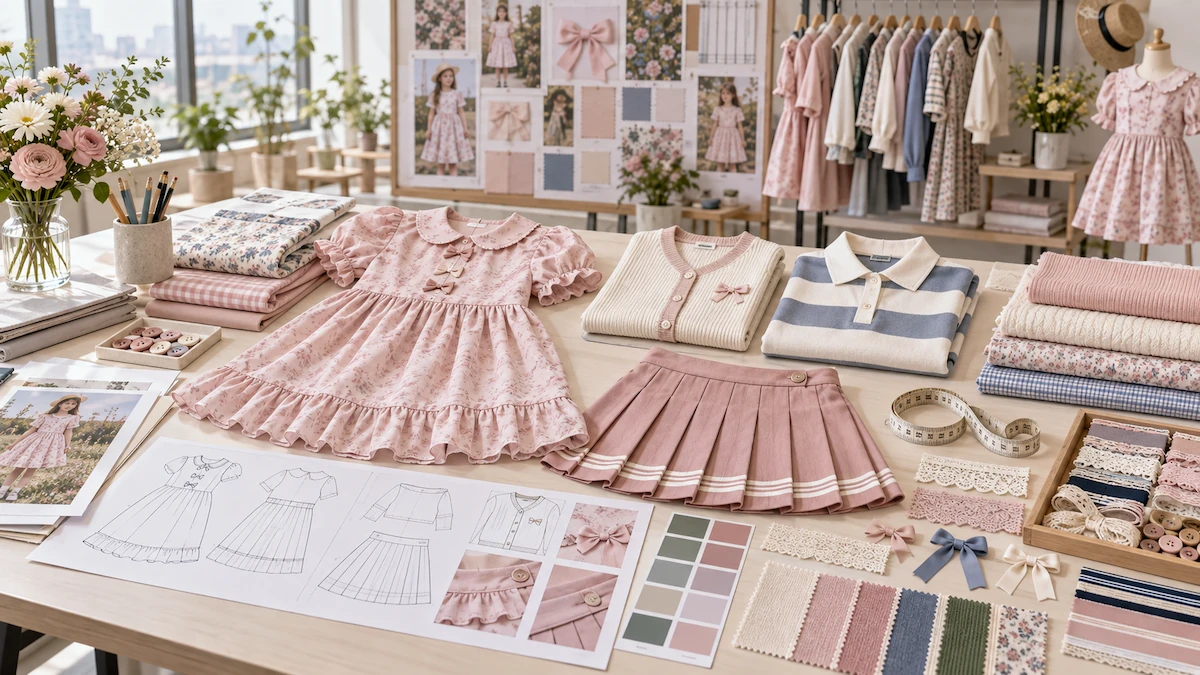
| Romantic detail as everyday wear | Small flat bows, single-layer ruffles, lace-trim edges, delicate embroidery on poplin and jersey | Higher cost — trim count, attachment method, extra handling per unit |
| Sporty prep | Pleated skirts, polo and rugby-inspired tops, varsity stripes, cardigans, contrast tipping | Moderate — panel count and pleat setting; stripes need alignment control |
| Playful colour | Confectionery brights as accents against retro pastels; two-tone blocking | Moderate — dye-lot count is the main driver; fewer colours lowers approval cost |
| Soft “mini-me” tailoring | Structured-shoulder cardigans, knit vests, simple A-line shapes in heavier knits | Lower cost — fewer trims, stable bases, high repeat potential |
The commercially strongest position for most 2027 girls’ ranges is a deliberate split: one or two detail-heavy hero pieces per collection, carrying the trend narrative, surrounded by detail-light everyday pieces that carry the volume. Ranges that apply full romantic detail across every style pay the trim cost on all of them and earn it on none.
2. Why is it growing?
Four forces: adult-runway detail cycles now reach kidswear within a season rather than a year, occasionwear and everydaywear merged after years of dress-up-at-home demand, retailers gave mid-price girls’ ranges more shelf space for detail-driven pieces, and parents increasingly buy pieces that photograph well and read as an outfit rather than a garment.
Market signalWe read the 2027 girls’ direction from the same four source types we use across this cluster: colour and material forecasting services, kidswear retail assortments across major retailers, sector trade media and seasonal buying briefings, and Nuohua’s own sampling and production data. No single source is a conclusion, and none of the four tells you whether a direction is producible at your price point.
Nuohua manufacturing viewA styling direction only becomes a plan once it answers the second question: can it be produced repeatedly, in the full size run, at a quantity that makes commercial sense, and does it clear the destination market’s requirements for trims and attachments?
- The trend pipeline compressed. Detail cycles that previously took three to four years to reach childrenswear now arrive within a season or two. That shortens the window in which a detail still reads as current — which argues for fewer, better-executed detail pieces rather than more.
- Occasionwear and everydaywear merged. Children’s dressing has become less segmented: a dress is worn to school, to a birthday and to a restaurant. Buyers respond by specifying detail that survives all three — which pushes detail toward durable construction rather than delicate decoration.
- Retail assortment shift. Mid-price girls’ ranges have gained shelf space for detail-driven pieces such as bow-front dresses, pleated skirts and ribbed cardigans. Assortment that has already passed a retail buying committee is the strongest trend signal available to a manufacturer, because it has survived a commercial filter.
- Outfit culture. Parents increasingly buy coordinated looks rather than single garments, which rewards ranges built from a small number of shared bases and colours — and punishes ranges built from many one-off styles.
3. Which kidswear products fit?
Produce: single-layer flat ruffles, small flat bows on stable bases, heat-set knife pleats, small-scale tonal embroidery, rib knit cardigans and vests. Avoid overdoing: multi-tier gathered ruffles on stretch jersey, oversized multi-loop bows on lightweight bases, unset pleats, heavy 3D embroidery on knits, and any fragile bead or sequin embellishment on garments for younger children.
| Produce this | Avoid overdoing | Why |
|---|---|---|
| Single-layer flat ruffle with a finished edge on poplin or lawn | Multi-tier gathered ruffle on stretch jersey | Gathering a stretch base produces uneven waviness, and every extra tier multiplies cut, sew and press time per unit |
| Small flat bow anchored at a seam or centre-front point | Oversized multi-loop bow on a lightweight base | A large bow on a light base pulls the neckline or waist out of shape in wear and after wash |
| Heat-set knife pleats on a woven skirt | Pleats pressed but not heat-set | Unset pleats open after the first wash and the garment is returned as “not as pictured” |
| Small-scale tonal embroidery on woven panels | Heavy 3D embroidery on fine-gauge knits | Dense embroidery on a knit causes needle holes, backing show-through and stiffness |
| Contrast tipping and piping on knits and poplin | Three or more contrast colours on one garment | Each additional contrast colour is a separate trim source and a separate colour-approval step |
| Detachable or sewn-in small trims on older-girl sizes | Fragile beads, sequins or glued-on decoration for younger children | Small attached parts are a recognised safety category for children’s garments; attachments must resist removal force |
The most common girls’ range mistake we see is treating the detail as free. A ruffle is not a styling note — it is an additional panel, an additional edge finish, an additional pressing step and a new failure mode. Three detail-heavy styles are usually a stronger commercial result than ten detail-light styles with a ruffle bolted onto each.
4. What should buyers change?
Change four habits: specify detail by construction rather than by description, design girls’ patterns from a girls’ block instead of scaling a unisex or boys’ block, cap the trim variants per style, and price the detail into the sampling plan rather than discovering it in the quotation.
| Change | Current practice | Change to | Why |
|---|---|---|---|
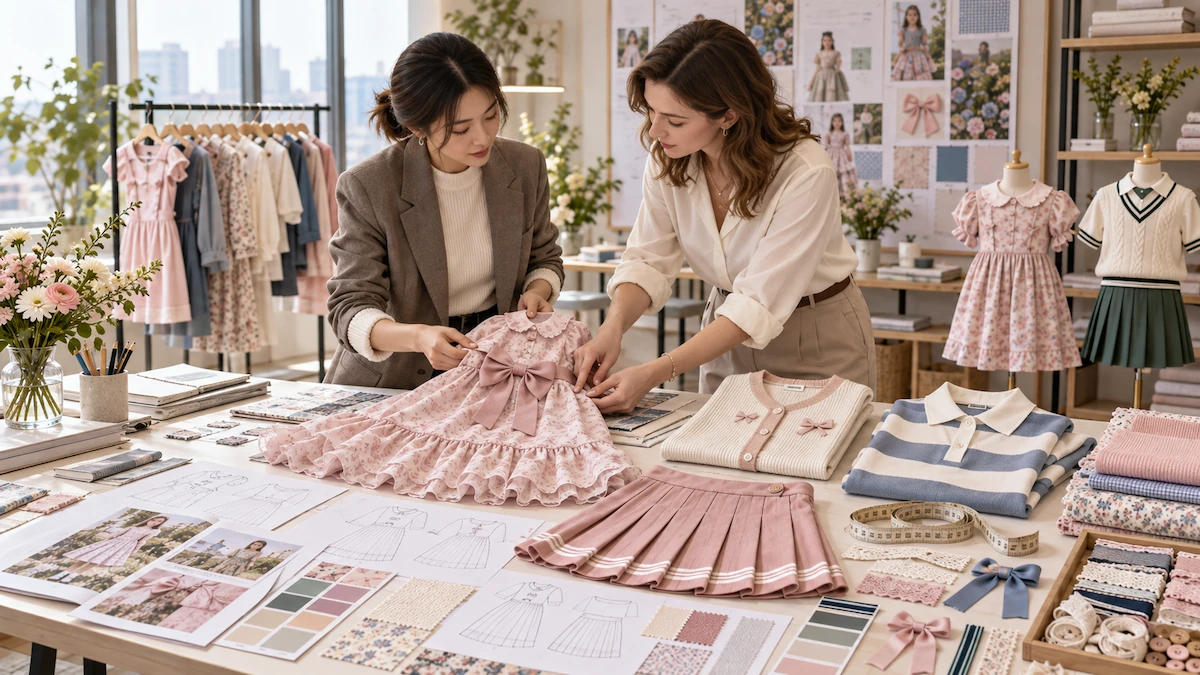
| Detail specification | “Add a bow at the front” | Define bow size, loop count, base fabric, attachment point and attachment method | An unspecified bow will be interpreted differently at sampling and at bulk, producing two different products |
| Pattern origin | Scale a unisex or boys’ block into girls’ sizes | Develop girls’ patterns on a girls’ block for the target size range | Shoulder slope, waist placement and skirt lengths differ; scaled blocks produce fit complaints in the larger sizes |
| Trim variants per style | Two or three lace or ribbon options kept “open” | Lock one approved trim per style before sampling | Each open trim is a separate sourcing enquiry, test question and colour-approval step |
| Colour count | Six to eight colours per collection | Four to five colours with one saturated accent | Dye-lot count drives colour approval cost and shade-band risk more than any other decision |
| Detail pricing | Detail added after the base price is quoted | Detail included in the first brief so it is costed with the base | Retrofitting detail after quotation is the most common cause of a mid-project price revision |
Of these, the two with the largest downstream effect are the bow specification and the pattern origin. A bow described in four words will be sampled one way and produced another; and a girls’ range graded from a unisex block will fit acceptably in the small sizes and poorly in the large ones, which is where the returns appear.
5. Production feasibility
Feasibility is high for rib knits, stable poplin pieces and heat-set pleats, and moderate for ruffle and bow detail on woven bases. It drops sharply when romantic detail is applied to stretch jersey or when the trim list stays open. The three recurring risks are trim shrinkage, pleat loss after wash and attachment integrity.
Seven checks we run on every girls’ wear development before sampling:
- Base stability. Does the base hold the detail in shape, or will the detail distort the base?
- Trim behaviour. Does the lace, ribbon or piping shrink at the same rate as the base under the care instruction you plan to print?
- Attachment method. Is the bow or trim sewn through a structural seam, bar-tacked, or only edge-stitched? Edge-stitched decoration is the most common failure.
- Pleat setting. Is the pleat heat-set, and has that been written into the technical specification rather than assumed?
- Size-run consistency. Does the detail scale cleanly across the full size range, or does the same bow become disproportionate in the smallest and largest sizes?
- Embroidery support. On knits, is a backing required, and will it show through or stiffen the panel?
- Second-quality budget. Trim and attachment risks priced into the first production run rather than discovered in inspection.
| Element | Feasibility | Note |
|---|---|---|
| Rib knit cardigans, vests, co-ords | High | Stable bases, minimal trims, strong repeat potential |
| Heat-set knife pleats on woven skirt | High | Standard woven production once setting is specified |
| Single-layer flat ruffle on poplin | Medium-High | Even edge finish is the main control point |
| Small flat bow, sewn through a structural seam | Medium-High | Attachment method determines durability, not the bow itself |
| Small-scale tonal embroidery on woven panel | Medium | Density and backing need sample validation |
| Multi-tier gathered ruffle on stretch jersey | Low | Uneven wave and distorted base; avoid unless the style requires it |
| Fragile bead or sequin embellishment (younger sizes) | Not recommended | Attachment integrity risk on garments for younger children |
6. Fabric & construction
The 2027 girls’ base is split by category: woven (cotton poplin, cotton lawn, light baby corduroy) for detail-heavy dresses and skirts, and knit (single jersey, 1×1 rib, interlock) for everyday tops and co-ords. Detail belongs on stable woven bases; knits should carry colour and shape, not trims. The failure modes are trim shrinkage, pleat loss, attachment failure, needle holes on knits and ruffle-edge fraying.
Fabric direction. Cotton poplin gives the crisp hand that holds a ruffle or a pleat and is the default base for detail pieces. Cotton lawn is lighter and better suited to layered summer styles, but its lighter weight makes oversized trims problematic. Baby corduroy carries the soft-tailoring direction well. On the knit side, 1×1 rib holds shape across a cardigan or vest and is the most reliable base for the mini-me tailoring direction. We cover base weight and knit behaviour in our fabric weight guide and our interlock vs jersey comparison; this article only states which base fits which 2027 direction.
Construction and failure modes
- Trim shrinkage. Lace, ribbon and piping are often sourced from a different mill than the base. If the trim shrinks differently under the printed care instruction, the hem ripples after the first wash. Solved by specifying the care instruction first and validating the trim against it.
- Pleat loss. A pressed-but-not-set pleat opens after one wash. Heat-set pleats hold; the setting step is a cost line that must be in the specification, not assumed.
- Attachment integrity. Bows are most durable when sewn through a structural seam or bar-tacked at the base. Edge-stitched-only attachment is the single most common cause of a bow arriving detached.
- Needle holes on knits. Dense embroidery on fine-gauge knit leaves permanent needle marks. If embroidery is required on a knit, specify a heavier gauge or move the embroidery to a woven panel.
- Ruffle-edge fraying. A light base with a narrow rolled hem can fray inside the care instruction’s wash cycle. A slightly wider hem or a bound edge costs marginally more and removes the failure. We cover seam choices in our bound vs flatlock seam guide.
- Decoration versus labels. How a decorative element is applied also affects what can be labelled; our printed vs sewn-in label guide covers the labelling side.
7. MOQ, cost and lead time
From 150–300 pcs per color on selected styles, depending on fabric, size range and customization requirements, mixable across styles and colours. Custom dyeing is reviewed case by case, and MOQ is confirmed after reviewing fabric composition, GSM, yarn count, size range, artwork, print method, construction and other customization requirements. Cost is driven by trim count, panel count, pleat setting and colour count; lead time is driven by trim sourcing and lab-dip approval.
| Route | MOQ |
|---|---|
| Stock fabric + existing colour | From 2 pcs on selected in-stock styles, colors and sizes (styles, colors and sizes mixable) |
| Custom dye (Pantone / lab dip) | Reviewed based on fabric and colour |
| Custom fabric development | Quoted separately, per fabric and colour |
| Baby sizes 50–90 (three-piece / set programmes) | From 150–300 pcs per color on selected styles |
Five cost levers, in the order they usually move a girls’ price:
- Trim count. Every trim is a separate sourced component with its own colour approval and its own shrinkage behaviour. Reducing three trims to one is the single fastest cost reduction available.
- Panel count. Tiered skirts, multi-panel bodices and contrast side panels multiply cut and sew time. Each additional panel adds a seam, a seam finish and a matching risk.
- Pleat setting. Heat-set pleating is a real cost line, but it is cheaper than the return rate that follows unset pleats.
- Colour count. Four colours sharing two dye lots cost noticeably less in approval time than seven colours in seven lots.
- Decoration process. Small tonal embroidery is cheaper and safer than heavy 3D work on knits, both in unit cost and in second-quality units.
Lead-time chain: base and trim sourcing → lab dip (if custom colour) → prototype → fit and construction approval → pre-production sample → bulk → QC → freight. For a 2027 girls’ range, the brief needs to reach the factory in time to absorb trim sourcing and at least one fit revision, not just bulk sewing time. The question to answer internally is not “how fast can the factory sew it” but “when must the factory have the brief” — and for detail-heavy styles, that date moves earlier, not later.
8. Market & compliance considerations
Girls’ daywear has no single category-specific regulation, but three adjacent rules apply directly to 2027 detail-driven ranges: small-parts and attachment requirements for decorative trims on children’s garments, cord and drawstring requirements where ties are used, and surface-coating limits where a design carries a printed or coated decoration. Sleepwear-intended pieces fall under a separate flammability framework.
United States. For children’s garments, two adjacent rules matter more in 2027 than they did in a plainer assortment. First, the small-parts framework at 16 CFR Part 1501 governs whether a component can be pulled free and become a choking hazard for children under three; decorative trims on younger-size garments must be assessed against it. Second, 15 U.S.C. 2063(a)(5) sets the tracking-label requirement for children’s products, which determines what a factory must print on the garment — our compliance checklist walks through the label side. Where a design includes cord or a tie, the CPSC guidance on drawstrings in children’s upper outerwear and ASTM F1816 apply; a decorative sash on a dress is not the same category as a hood cord, and the distinction should be confirmed rather than assumed.
European Union. Two instruments sit behind most girls’ detail questions. REACH Annex XVII entry 43 restricts azo colourants that can release listed aromatic amines, with testing carried out under the EN ISO 14362 series — this is the entry that governs dyed and printed trims as much as the base fabric. EN 14682 is the standard for cords and drawstrings on children’s clothing, and it applies to decorative ties as well as functional ones. Both should be confirmed for the specific garment category rather than applied as a blanket rule.
Sleepwear-intended pieces. If any style in a girls’ range is marketed as nightwear, it moves into the sleepwear framework rather than girls’ daywear — for the US, that is 16 CFR Part 1615 (sizes 0–6X) and 16 CFR Part 1616 (sizes 7–14), with the snug-fit labelling path. Our pajama and sleepwear trends guide covers that path in detail; the point here is that intended end-use changes the applicable rule, and it is decided at tech-pack stage, not at labelling.
9. Nuohua’s 20-year manufacturing view
Two decades of children’s apparel production tell us: detail is where girls’ ranges fail in bulk, not where they fail in design. Specify the bow, set the pleat, lock the trim before sampling — and accept that one well-executed detail style can be commercially stronger than several under-specified ones.
- The bow is the most underestimated component. A bow described as “a bow” will be produced at a size, a rigidity and an attachment strength that nobody agreed on. We now brief every bow with a reference sample or a dimensional drawing, because a bow that fails is not a styling problem — it is a return.
- Ruffle plus stretch is a trap. Gathering a stretch knit produces a wave that cannot be pressed flat and varies from operator to operator. If a ruffle is non-negotiable, move it to a woven panel or a stable base; if the style needs stretch, drop the ruffle.
- Unset pleats always come back. Unset pleats are highly prone to losing definition through repeated washing and wear. Heat-setting is a fixed cost per unit and it buys the garment its entire visual identity.
- Trim and base must be validated together. The most expensive girls’ defect we see is a hem that ripples after wash, and it is almost always caused by a trim sourced from a different mill shrinking at a different rate. The fix is a wash test on the assembled trim plus base, before bulk.
One question we would reframe. “Which 2027 detail is most on-trend?” is the wrong first question. The right first question is “which one detail can this style carry at this price point, in this size run, and hold after wash?” — because a detail that cannot survive wear is not a trend, it is a defect.
10. Buyer checklist
Eleven checks before you brief a 2027 girls’ range: detail specified by construction, girls’ block confirmed, trims locked and wash-tested with the base, pleats heat-set, colour count capped, size-run consistency reviewed, attachment method defined, printed-surface requirements confirmed, lead-time chain mapped, MOQ route known, and detail-heavy hero styles capped.
- Is the detail specified by construction (size, method, attachment point), not by description?
- Is the pattern developed on a girls’ block for the target size range?
- Is one trim variant locked per style before sampling begins?
- Has the trim been wash-tested together with the base at the planned care instruction?
- Are pleats specified as heat-set in the technical document?
- Is the colour count capped, with one saturated accent carrying the trend?
- Does the detail scale acceptably across the smallest and largest size?
- Is the attachment method defined (structural seam, bar-tack) rather than left to the line?
- Have restricted-substance and small-parts questions been confirmed for each trim?
- Is the lead-time chain mapped with trim sourcing and at least one fit revision included?
- Are detail-heavy hero styles deliberately limited to one or two per collection?
11. Related manufacturing guides
12. Turn the trend into a production plan
Turn the 2027 girls’ trend into a producible range.
Send us your reference images, target market and the detail call-outs you are considering — bow, ruffle, pleat or embroidery. We will return a feasibility read on construction, trim and size-run behaviour, plus a sample plan that holds up in bulk rather than only in the lookbook.
Or reply with your tech pack — see our tech pack guide.
Standards verified as of 2026-09; regulations change — confirm with a qualified laboratory or qualified counsel before ordering. This article is a Nuohua buyer-side assessment, not compliance advice or an industry standard. Nuohua Garment — kidswear OEM & ODM manufacturer since 2016.