
Boys’ Clothing Trends 2027: Utility, Sport, Retro Graphics & Outdoor Style
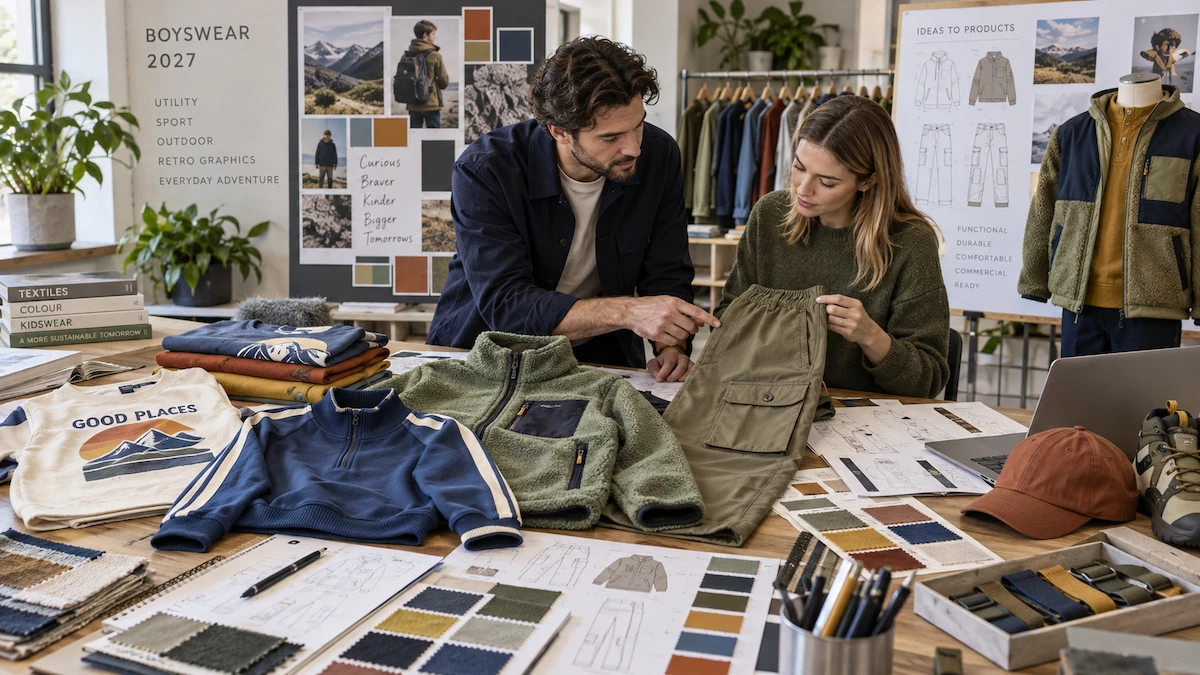
Boys’ wear is the most construction-driven part of the kidswear range. The 2027 direction — utility detailing, sport and athleisure, retro graphics, and outdoor-inspired layering — is almost entirely expressed through panels, pockets, ribbing and print. That means the trend decisions and the manufacturing decisions are the same decisions.
This is a production-side reading of 2027 boys’ clothing trends. It follows the same 12-point structure we use across this cluster, and it flags the two things that most often derail a boys’ range before bulk: pocket and panel engineering, and graphic artwork that carries an intellectual-property question. It is written for brand founders, designers and buying teams.
On this page
- What is the trend?
- Why is it growing?
- Which kidswear products fit?
- What should buyers change?
- Production feasibility
- Fabric & construction
- MOQ, cost and lead time
- Market & compliance considerations
- Nuohua’s 20-year manufacturing view
- Buyer checklist
- Related manufacturing guides
- Turn the trend into a production plan
Back to the 2027 kidswear trends overview — boys’ trends are one spoke of the full cluster.
1. What is the trend?
The 2027 boys’ direction has four parts: utility detailing moving from outerwear into everyday trousers and tops, sport and athleisure reading as daywear rather than gym wear, retro graphics returning as a print language, and outdoor-inspired layering — fleece, knit sweaters, cargo shapes — carrying the seasonal range. A fifth, quieter shift is the co-ord set, sold as an outfit rather than as separate pieces.
What makes the boys’ direction different from the girls’ direction in this cluster is where the cost sits. Girls’ trends tend to spend on trims and detail handling; boys’ trends spend on panel engineering, pockets and print. A cargo pocket is not decoration — it is a pattern piece, a topstitching operation, a pocket bag, and a bar-tack. Multiply that across a size run from toddler to teen and it becomes the dominant cost line in the garment.
| Direction | What it looks like in a garment | Where it lands in production / cost |
|---|---|---|
| Utility detailing | Cargo and patch pockets, contrast topstitching, webbing or tape pulls, workwear-inspired silhouettes | Higher cost — pattern pieces, topstitching density, bar-tacks per pocket |
| Sport & athleisure | Track sets, panelled jerseys, ribbed cuffs and hems, mesh inserts, side stripes | Moderate — panel count and stripe alignment; rib recovery is the quality driver |
| Retro graphics | Varsity-style numbering, 1990s illustrative graphics, bold placement prints | Moderate — print process and artwork rights; the rights question is the bigger risk |
| Outdoor-inspired layering | Fleece, knit sweaters, cargo trousers, colour-blocked outer layers, trail-inspired prints | Moderate-High — heavier bases, more components, longer construction time |
| Co-ord sets | Matching top-and-bottom in one base and colourway | Lower cost — single dye lot, single fabric run, higher units per sale |
The commercially strongest 2027 boys’ position for most ranges is a small number of utility or outdoor hero styles carrying the narrative, plus a larger body of plain or lightly-printed everyday pieces in the same base and colourway. That structure keeps the range coherent while keeping the average unit cost where the price point requires it.
2. Why is it growing?
Four forces: adult utility and gorpcore styling continues to feed down into kidswear, sportswear and daywear have effectively merged for children, retro graphics returned on the back of a wider 1990s revival, and the outdoors became a mainstream family activity rather than a specialist one.
Market signalWe read the 2027 boys’ direction from the same four source types we use across this cluster: colour and material forecasting services, kidswear retail assortments across major retailers, sector trade media and seasonal buying briefings, and Nuohua’s own sampling and production data. The retail assortment signal matters most here, because utility and outdoor styling has survived multiple retail buying cycles rather than a single season.
Nuohua manufacturing viewBoys’ trends convert into cost faster than girls’ trends do, because they express themselves through structure. A utilitarian silhouette is a pattern decision; an outdoor-inspired winter layer is a fabric-weight decision. Both should be reviewed before the design is finalised, not after the quotation.
- Adult utility styling keeps feeding down. Cargo pockets, contrast topstitching and workwear shapes have been stable in adult menswear for several seasons. Kidswear follows adult silhouettes with a delay, and this direction has been in the pipeline long enough to have reached childrenswear assortments broadly.
- Sport and daywear merged. For children, athletic-looking clothing is everyday clothing. That removes the need for a separate “sportswear” design and lets a single track-style set serve school, weekend and travel — which improves units per style.
- The 1990s revival reached boys’ graphics. Retro lettering, varsity numbering and illustrative graphics returned as a print language, driven by a broader nostalgia cycle. This is the direction with the highest artwork risk, because a graphic that reads as nostalgic to one buyer can read as a licensed property to another.
- The outdoors went mainstream. Family outdoor activity normalised fleece, knit sweaters and trail-inspired prints in everyday assortments. This is why the outdoor direction shows up in mid-weight knitwear rather than only in technical outerwear.
- Co-ords solve a parent problem. Sets remove the decision of what goes with what, and they raise average units per transaction. For a manufacturer, a set is cheaper per garment than two independent styles because it shares a base and a dye lot.
3. Which kidswear products fit?
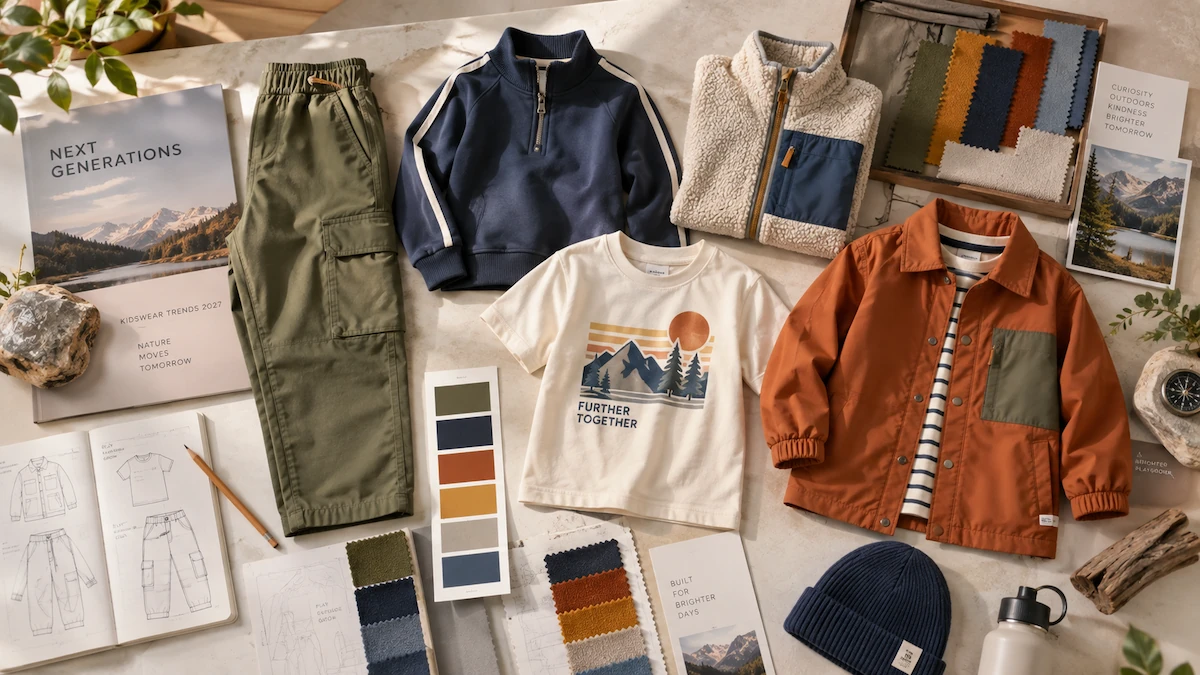
Produce: co-ord sets, ribbed track styles, flat patch pockets, single cargo pockets per leg, small-scale placement prints, fleece and knit layering pieces. Avoid overdoing: multiple cargo pockets per garment on lightweight bases, dense topstitching across seams, mesh inserts on everyday styles, large graphic prints on licensed-looking artwork, and heavy hardware such as multiple zips or buckles on younger sizes.
| Produce this | Avoid overdoing | Why |
|---|---|---|
| One cargo pocket per leg on a mid-weight woven | Three or four pockets per garment on a light woven | Each pocket adds a pattern piece, a topstitching pass and a bar-tack; light bases distort under pocket weight |
| Flat patch pocket with a clean edge | Box-pleat pocket with flap, button and tape trim | Component count multiplies cut and sew time with no measurable commercial return |
| Rib cuffs and hems on track sets | Rib cuffs on lightweight summer bases | Light bases cannot support rib recovery; cuffs stretch out and the garment reads as low quality |
| Small or mid-size placement print | Large all-over graphic coverage on a knit base | Print crack at high-stretch areas; also raises the artwork rights question |
| Co-ord set in one base and colourway | Set built from two different bases “for texture” | Two bases means two fabric runs, two dye lots and two colour approvals |
| Fleece or knit layering piece | Technical outerwear construction (sealed seams, waterproof zips) | Technical outerwear is a different compliance and tooling category, not a styling variation |
| Original or licensed artwork with documentation | Artwork that resembles a protected character or sports mark | Resemblance is enough to create exposure; this is the single largest legal risk in a boys’ graphic range |
The most expensive boys’ range mistake we see is under-costing pockets. Designers add cargo pockets as a silhouette gesture; production sees a pattern piece, a fold, a stitch line, a pocket bag, a bar-tack and an additional press. One pocket per leg on a mid-weight base is a design decision. Three pockets on a light base is a quality problem that shows up in the wash.
4. What should buyers change?
Change four habits: decide the artwork’s rights position before the graphic is drawn, convert silhouette ambition into a component count you have costed, specify base weight against the detail rather than separately from it, and treat the co-ord set as the default unit rather than the exception.
| Change | Current practice | Change to | Why |
|---|---|---|---|
| Artwork rights | Graphic chosen for the look, rights checked later | Confirm the artwork’s origin and rights position before it enters the tech pack | Resemblance to a protected character or sports mark creates exposure even without intent to infringe |
| Component budget | Pockets, tape and hardware added as styling notes | Count and cost every pattern piece and trims component per style | Component count is the dominant cost variable in utility-styled boys’ wear |
| Base weight | Base chosen first, detail added after | Choose the base against the detail it must carry | A light base cannot hold a loaded pocket or recover a rib cuff |
| Set structure | Top and bottom designed as separate styles | Design the co-ord as one programme sharing base, colour and print | Shared base and dye lot lower cost per garment and simplify colour approval |
| Hardware count | Multiple zips, buckles or cords for a “technical” read | Reduce to the minimum functional hardware | Every cord, zip pull and small part is an attachment and small-parts question as well as a cost |
The artwork point deserves emphasis because it is the one risk in a boys’ range that is not a manufacturing problem. Utility styling and retro graphics are both directions where a reference image pulled from a marketplace listing can carry someone else’s protected mark. Once that artwork is in a tech pack and a print screen has been made, unwinding it is far more expensive than checking it.
5. Production feasibility
Feasibility is high for co-ord sets, ribbed track styles and flat patch pockets, and moderate for single cargo pockets and placement prints. It drops when detail density rises on light bases, when ribbing is specified on a summer-weight fabric, and when the artwork rights position is unresolved. The three recurring risks are pocket distortion, rib recovery loss and print crack at high-stretch areas.
Seven checks we run on every boys’ wear development before sampling:
- Component count. How many pattern pieces and trim components does the style carry, and has each been costed?
- Base versus load. Is the base weight sufficient for the pocket and hardware load the style carries?
- Rib recovery. Will the rib or cuff recover its shape after wash, given the base it is attached to?
- Stitch density. Does the topstitching across seams and pockets risk needle damage or puckering on the specified base?
- Print stretch. Does the print pass across a high-stretch zone where crack is likely?
- Artwork rights. Is the graphic original, licensed with documentation, or pending review?
- Hardware safety. Have zips, pulls, cords and small attached components been reviewed against the requirements of the destination market and the age group?
| Element | Feasibility | Note |
|---|---|---|
| Co-ord set, one base and colourway | High | Single fabric run and dye lot; strong units per sale |
| Ribbed track style (mid-weight base) | High | Standard knit production; rib recovery must be validated |
| Flat patch pocket, clean edge | High | Single pattern piece and stitch pass |
| Single cargo pocket per leg, mid-weight woven | Medium-High | Base weight is the determining factor |
| Placement print, small to mid-size | Medium-High | Avoid placement over high-stretch zones |
| Multiple pockets on light woven base | Low | Pocket weight distorts the base and shows after wash |
| Rib cuffs on lightweight summer base | Low | Rib cannot recover against a light base |
| Technical outerwear construction | Separate category | Different tooling and compliance path; quoted as its own programme |
6. Fabric & construction
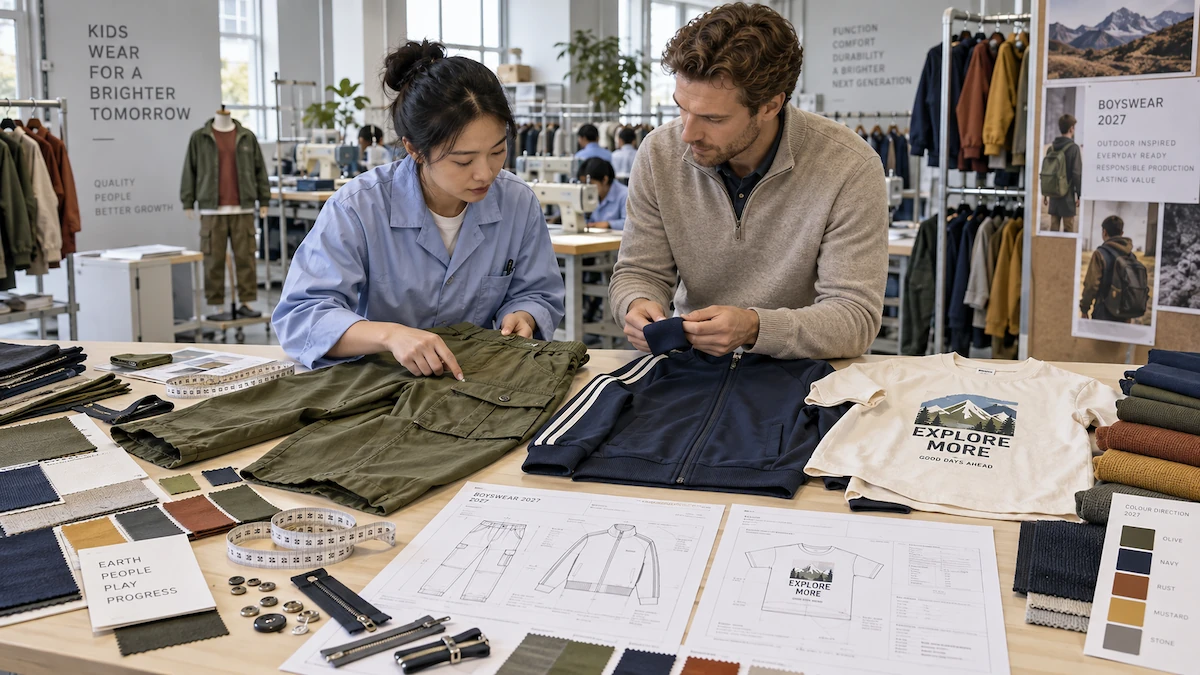
The 2027 boys’ base is split three ways: mid-weight woven twill or canvas for utility trousers, French terry and fleece for sport and layering, and single jersey or interlock for tops and co-ords. Rib knits supply cuffs, hems and collars and are the quality-critical component. The failure modes are pocket distortion, rib recovery loss, print crack, topstitch puckering and hardware detachment.
Fabric direction. Utility trousers need a mid-weight woven with enough body to hold a pocket without sagging — a light woven will carry the shape on the hanger and lose it in wear. Sport and outdoor layering need French terry, loopback or fleece, with the weight chosen against the layer’s purpose rather than the season label. Tops and co-ords work in single jersey or interlock, with interlock preferred where the garment must hold shape across a longer size run. We cover weight and knit behaviour in our fabric weight guide and our fabric shortlist guide; this article only maps bases to 2027 directions.
Construction and failure modes
- Pocket distortion. A loaded patch or cargo pocket on an underweight base pulls the side seam and creates a highlighted shape after wash. Solved by base weight and by reducing pocket count, not by adding interlining.
- Rib recovery loss. Rib that has been over-stretched in sewing does not return. If a cuff goes baggy after three washes, the cause is almost always the rib-to-base relationship, and it cannot be corrected at inspection.
- Print crack. Placement prints that cross a high-stretch zone — the neckline, the armhole, the knee — crack first. Moving the print a few centimetres off the stretch zone usually solves it entirely.
- Topstitch puckering. Dense topstitching on a light woven puckers the seam and reads as a defect. Either reduce stitch density or step the base up in weight.
- Hardware detachment. Zip pulls, cord ends and small attached components must survive a pull force appropriate to the age group, and their attachment is a safety question as much as a durability one. We cover seam choices in our bound vs flatlock seam guide and the labelling side in our printed vs sewn-in label guide.
7. MOQ, cost and lead time
From 150–300 pcs per color on selected styles, depending on fabric, size range and customization requirements, mixable across styles and colours. Custom dyeing is reviewed case by case, and MOQ is confirmed after reviewing fabric composition, GSM, yarn count, size range, artwork, print method, construction and other customization requirements. Cost is driven by component count, panel count, base weight and hardware; lead time is driven by fabric availability and artwork or lab-dip approval.
| Route | MOQ |
|---|---|
| Stock fabric + existing colour | From 2 pcs on selected in-stock styles, colors and sizes (styles, colors and sizes mixable) |
| Custom dye (Pantone / lab dip) | Reviewed based on fabric and colour |
| Custom fabric development | Quoted separately, per fabric and colour |
| Homewear / set programmes | 1,000 sets per design |
Five cost levers, in the order they usually move a boys’ price:
- Component count. Each pocket, tape, pull and piece of hardware is a pattern piece or a trim component with its own operation. Reducing a style from three pockets to one is the largest single saving available on a utility silhouette.
- Panel count. Panelled jerseys and multi-panel tracks multiply cut and sew time and introduce matching risk on stripes.
- Base weight. Heavier bases cost more per metre and take longer to sew, but they are what makes a utility silhouette hold its shape. The saving from downgrading the base is usually paid back in returns.
- Print process. Smaller placement prints cost less in screen setup and produce fewer second-quality units than large coverage.
- Set structure. Building a co-ord on one base and one colourway reduces both fabric runs and colour approvals compared with two independent styles.
Lead-time chain: base sourcing → artwork approval and print screen → lab dip (if custom colour) → prototype → fit and construction approval → pre-production sample → bulk → QC → freight. For a 2027 boys’ range, the two stages that most often delay launch are artwork approval and base availability — both of which sit before sampling. The question to answer internally is not “how fast can the factory produce it” but “when must the factory have the final artwork and the brief”.
8. Market & compliance considerations
Three adjacent rules apply directly to 2027 boys’ ranges: small-parts requirements for attached components such as zip pulls and cord ends, cord and drawstring requirements where functional or decorative cords are used, and restricted-substance requirements that cover dyed and printed surfaces. Intended sleepwear falls under a separate flammability framework.
United States. 16 CFR Part 1501 is the small-parts framework that determines whether a component can be pulled free and become a choking hazard for children under three — the relevant question for zip pulls, cord ends, snaps and any attached decoration on younger sizes. Where a hood or upper-outerwear piece carries a cord, CPSC guidance on drawstrings in children’s upper outerwear and ASTM F1816 apply. 15 U.S.C. 2063(a)(5) sets the tracking-label requirement for children’s products, which determines what the factory must print; our compliance checklist covers the label side.
European Union. EN 14682 governs cords and drawstrings on children’s clothing and is the standard to check against for any functional or decorative cord. REACH Annex XVII entry 43 restricts azo colourants that can release listed aromatic amines, tested under the EN ISO 14362 series — this applies to printed graphics as well as to dyed base fabric. Confirmation should be for the specific garment category and the specific print or dye, not applied as a blanket assumption.
Intended sleepwear. If any style in a boys’ range is marketed as nightwear, it moves into the sleepwear framework — for the US, 16 CFR Part 1615 (sizes 0–6X) and 16 CFR Part 1616 (sizes 7–14), with the snug-fit labelling path. See our pajama and sleepwear trends guide for that route. A track-style set sold as daywear and the same set sold as sleepwear are different compliance programmes, which is why intended end-use is decided at tech-pack stage.
9. Nuohua’s 20-year manufacturing view
Two decades of children’s apparel production tell us: in boys’ wear, cost lives in component count, not in fabric price. Count the pattern pieces before you approve the design, match the base to the load the garment carries, and settle artwork rights before anyone draws a screen.
- Count components, not fabrics. A buyer will negotiate the fabric price to the third decimal and then approve a style with four pockets, tape pulls and a contrast panel. In practice the component count and the operations around it decide the price, and they are set at design, not at costing.
- The base is chosen by the load. A utility trouser on a light woven looks right in a flat lay and fails in wear. We now ask what the garment has to carry — pocket contents, hardware weight, number of layers — before recommending a base weight, rather than starting from a season label.
- Rib failures are not repairable downstream. Rib that loses recovery cannot be corrected in inspection. It has to be right in the specification: the rib’s own quality, the ratio of rib to base, and the tension used in sewing.
- Print crack is a placement decision. Most crack complaints we investigate trace to a print placed across a high-stretch zone. Moving the artwork off the stretch area costs nothing and removes the defect class.
One question we would reframe. “How technical can we make this boys’ style?” is the wrong first question. The right first question is “what does this garment have to do, and which base and component set does that require?” — because technical styling that cannot survive wear or wash is not a design win, it is a claim waiting to be refused.
10. Buyer checklist
Eleven checks before you brief a 2027 boys’ range: component count costed, artwork rights confirmed, base matched to load, rib recovery validated, print placement clear of stretch zones, hardware minimised and reviewed for small-parts risk, set structure planned on one base, colour count capped, lead-time chain mapped, MOQ route known, intended end-use confirmed.
- Has every pattern piece and trim component been counted and costed?
- Is the artwork’s rights position confirmed in writing before it enters the tech pack?
- Is the base weight matched to the pocket, hardware and layer load the style carries?
- Has rib recovery been validated against the specific base it attaches to?
- Is the print placement clear of high-stretch zones?
- Has the hardware count been reduced to what the garment actually needs?
- Have small attached components been reviewed against the destination market’s small-parts requirements for the age group?
- Is the co-ord designed as one programme sharing base, colour and print?
- Is the colour count capped, with the accent colour serving the trend?
- Is intended end-use confirmed as daywear rather than sleepwear where relevant?
- Is the lead-time chain mapped with artwork approval and base availability included?
11. Related manufacturing guides
12. Turn the trend into a production plan
Turn the 2027 boys’ trend into a costed, producible range.
Send us your reference images, target market and the construction call-outs you are considering — cargo pockets, panelling, ribbing or a graphic. We will return a feasibility read on component count, base weight and print placement, plus a sample plan that holds its shape after wash.
Or reply with your tech pack — see our tech pack guide.
Standards verified as of 2026-09; regulations change — confirm with a qualified laboratory or qualified counsel before ordering. This article is a Nuohua buyer-side assessment, not compliance advice or an industry standard. Nuohua Garment — kidswear OEM & ODM manufacturer since 2016.