
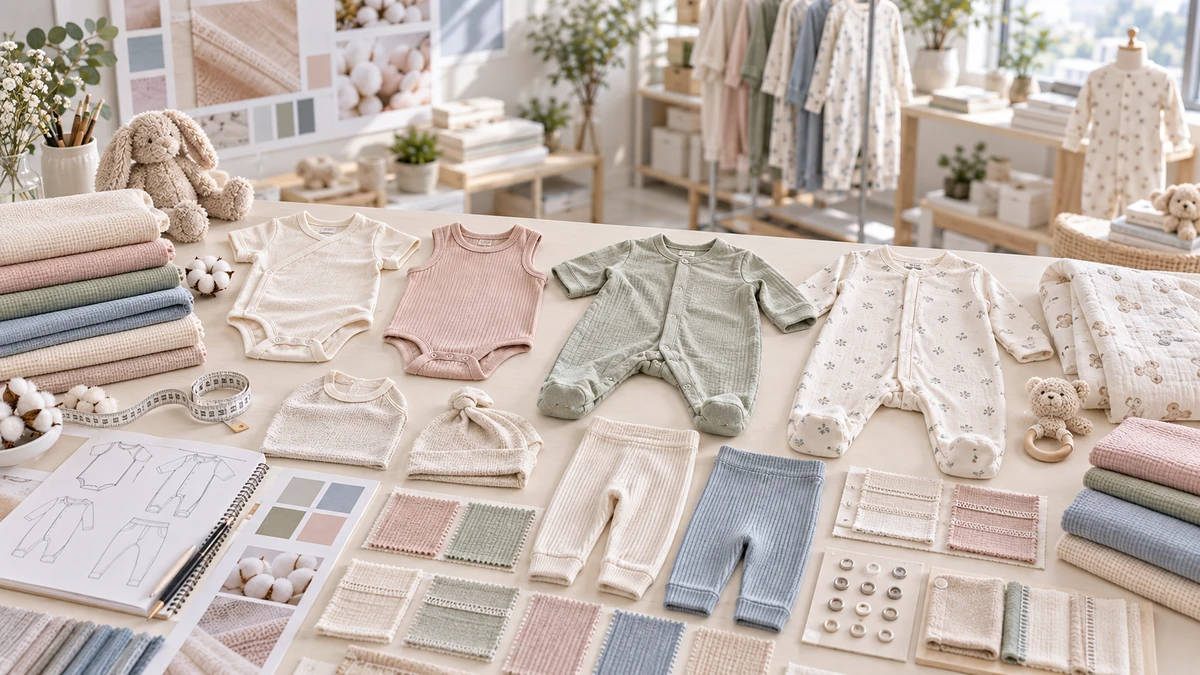
Baby Apparel Trends 2027: Sensory Softness, Flat Seams & Functional Design
Baby apparel is the one kidswear category where the trend and the specification are almost the same thing. In adult fashion a direction can live entirely in silhouette and colour. In baby clothing from 50 to 90 (newborn to about 24 months), one of the clearest 2027 directions — softness, flat seams, tagless construction and easier closures — is a set of construction decisions. A brand that likes the direction but specifies ordinary overlocked seams and a stiff neckline has not made the product.
This guide follows our standard 12-point trend structure: what the trend is, why it is growing, which products fit, what buyers should change, production feasibility, fabric and construction, MOQ and lead time, market and compliance considerations, what two decades of children’s apparel production would have us change, and a buyer checklist. It is written for brand founders, buying teams and wholesalers who have to commit to a range rather than admire a mood board.
On this page
- What is the trend?
- Why is it growing?
- Which baby products fit?
- What should buyers change?
- Production feasibility
- Fabric & construction
- MOQ, cost and lead time
- Market & compliance considerations
- Nuohua’s 20-year manufacturing view
- Buyer checklist
- Related manufacturing guides
- Turn the trend into a production plan
1. What is the trend?
The 2027 baby apparel direction has five parts: sensory softness in the base fabric, flat or covered seams on every skin-contact surface, tagless or printed labelling, fewer and more functional closures, and coordinated sets built from a shared palette and base.
The direction is coherent because all five parts point the same way — toward a garment that is simpler to make and more comfortable to wear. That alignment is unusual, and it is why 2027 is a good season for a brand entering baby apparel: the commercially preferred version of the trend is also the one with fewer failure modes.
| Direction | What it looks like in a garment | Where the cost sits |
|---|---|---|
| Sensory softness | Smooth, low-pill bases with a soft hand; brushed or peached surfaces; no stiff trims | Marginal — a base and finishing choice |
| Flat & covered seams | Flat-felled or covered seams, no exposed overlock against skin, taped or bound edges | Moderate — extra operations per seam |
| Tagless / printed labelling | Printed neck label or a label moved off the skin-contact position | Low — a print method decision, with wash-life implications |
| Functional closures | Envelope shoulders, well-placed snaps, two-way zips on footies, convertible feet and cuffs | Moderate to higher — hardware and operation count |
| Coordinated sets | Multi-piece sets built from one base and one palette | Low — fewer fabrics and dye lots to develop |
One clarification worth making early, because it shapes everything downstream. “Sensory softness” here is a construction and material description, not a health claim. It means a smoother surface, softer hand-feel, fewer rigid components and no scratchy internal finishes. We deliberately avoid describing baby garments in medical or therapeutic terms — partly because it is not accurate, and partly because unverifiable claims create real problems for a brand selling in regulated markets.
2. Why is it growing?
Four drivers: parents prioritising comfort and easy dressing over decoration in the first two years, a retail assortment shift toward considered baby basics, coordinated sets converting well as gifts, and durability expectations rising as parents buy fewer and better garments.
Baby apparel has a different commercial logic from older kidswear, and the 2027 direction follows directly from it.
- Easy dressing is a purchase driver, not a detail. In the first year, the person buying is also the person dressing the baby several times a day, often at night. A neckline that does not open wide, or a closure that requires two hands and good light, is a product failure regardless of how it photographs. This is the single strongest reason the functional-design direction has grown.
- Comfort is judged before aesthetics. Parents handle baby garments constantly, so hand-feel and internal finish get evaluated directly. A rough interior seam is noticed within the first few wears in a way that an adult garment’s interior never is.
- Assortments have shifted toward considered basics. Baby retail has moved toward softer palettes, tonal ranges and multi-piece sets, and away from high-coverage novelty print. Because retail assortment has already passed a buying committee and a margin test, it is the strongest single signal available.
- Coordinated sets sell as gifts. A set reduces the buyer’s decision to one purchase and works as a gift, which improves both conversion and average order value. For a manufacturer this is also the friendliest direction, because a set shares one base fabric and one palette across several pieces.
There is also a supply-side reason the direction has held. Softness and flat seams are achievable on the production lines that already exist for baby apparel — they are finishing and base choices rather than new machinery. Directions that require new capability tend to stall at the sampling stage; this one does not.
3. Which baby products fit?
Bodysuits and onesies, sleepsuits and footies, rompers, vests and undershirts, leggings and pull-on pants, swaddles and blankets, and multi-piece coordinated sets — across sizes 50 to 90, roughly newborn to 24 months.
Here is the direction briefed by product, including what not to add — which in baby apparel matters more than in any other category, because every extra component sits next to an infant.
| Product | Direction | Specify this | Avoid overdoing |
|---|---|---|---|
| Bodysuits & onesies | Soft base with easy overhead dressing | Envelope (overlapping) shoulder, covered or flat-felled seams, printed neck label, snap crotch | Narrow neckline bindings, layered decorative panels across the chest |
| Sleepsuits & footies | Night-time changeability and warmth control | Two-way zip or open-front closure, convertible feet, convertible cuffs at the smallest sizes | Excess zipper length that stiffens the front panel, decorative zip pulls near the face |
| Rompers & playsuits | Soft, roomy, easy change | Soft elasticated legs with generous ease, simple snap or button entry, one-piece front | Multi-panel patchwork, structured collars |
| Vests & undershirts | Base layer softness and stretch | Envelope neckline, flat seams, close-fitting but not restrictive body | Heavy rib that reduces stretch recovery, decorative edged trims |
| Leggings & pull-on pants | Comfort waistband and easy pull-up | Soft covered elastic, generous rise, stretch base | Exposed elastic edges, tight leg openings, bulky waistband folds |
| Swaddles & blankets | Softness at scale, gift-ready | One base, one or two colourways, size-appropriate dimensions | Heavy appliqué, multiple prints across one collection |
| Coordinated sets | One base, one palette, several pieces | Shared fabric and colour across all pieces; consistent labelling | Different bases per piece, which multiplies dye lots and matching risk |
Two things stand out when you read the table as a whole. First, the body style rarely decides success in baby apparel — the closure and the neckline do. Second, the “avoid” column is not about style at all; it is about components an infant will contact. If you are deciding whether baby apparel is the right category for your brand before choosing a direction, the category overview is here: baby and toddler clothing manufacturing.
4. What should buyers change?
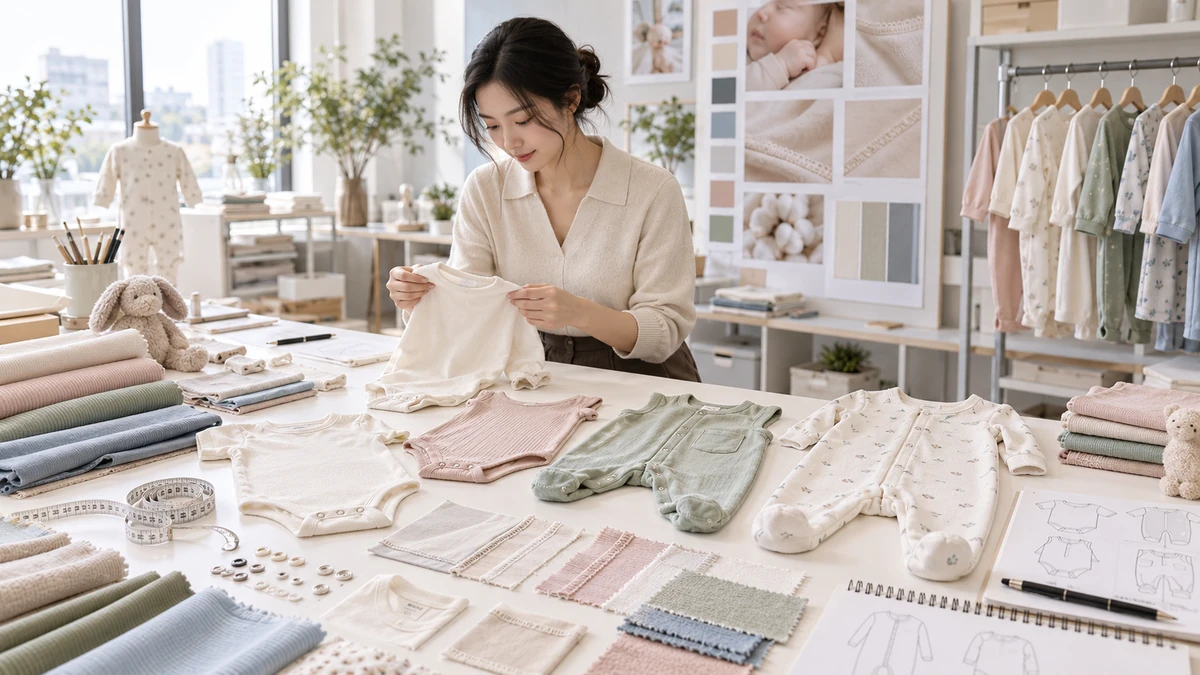
Six changes: settle the closure and neckline before styling, write the seam type into the tech pack explicitly, decide the label method early, cut hardware near the face, plan the size ladder around growth, and build sets from one base.
Most of the avoidable cost in a baby range comes from decisions made in the wrong order. These are the six shifts we would recommend for a 2027 baby collection.
| Change | Typical current behaviour | What we would do instead | Why it matters |
|---|---|---|---|
| Decision order | Style and print first, closure decided at sampling | Lock the closure and neckline type before styling | The closure determines the pattern block, the fabric consumption and the price |
| Seam specification | “Soft seams” written in the brief | Name the seam type on every skin-contact surface | “Soft” is not manufacturable as an instruction; a named seam is |
| Label method | Tagless chosen as a style preference | Decide print method with wash-life in mind | Tagless printing is not one process; the wrong one degrades quickly |
| Hardware | Decorative hardware added where it looks good | Keep hardware away from the face and hands; use it only where it functions | Component placement is a safety question, not a styling one |
| Size ladder | Sizes treated as a list to tick off | Plan the ladder around growth and layerability | Baby sizes move in small increments; measuring the smallest size properly matters most |
| Set construction | Each piece developed as its own style | Build every piece of a set from one base and one palette | Shared base means one dye lot instead of three |
The first and second changes on that list are the ones that most often force a redesign. A brief that says “soft seams and an easy closure” can be satisfied in several incompatible ways, and the factory will choose one — usually the simplest to run. Naming the construction is how a brand keeps control of the product it is paying for.
5. Production feasibility
Most 2027 baby directions are highly feasible. The three that demand real attention are flat seams on high-stretch bases, tagless printing on fuzzy surfaces, and convertible feet — all three are achievable but need the right method chosen up front.
We assess every direction against seven checks, the same ones we apply across our trend guides:
- Fabric availability. Is the base held in stock, or does it require a mill development run with its own lead time and minimum?
- Construction complexity. How many extra operations per garment, and does that scale across the size ladder?
- Grading behaviour. Does the detail hold proportion from size 50 to size 90?
- Trim sourcing. Does the closure or elastic carry its own minimum?
- Sampling risk. How many rounds before approval, realistically?
- QC risk. What is the realistic second-quality rate at this construction?
- Repeatability. On order three, does it match order one?
| Direction | Feasibility | Main risk | Best route |
|---|---|---|---|
| Soft bases, brushed or peached finish | High | Hand-feel drift between production lots | Qualified in-stock base, fixed finishing spec |
| Envelope (overlapping) shoulder | High | Neckline recovery after repeated dressing | Specify the overlap depth and the neckline finish together |
| Snap crotch closure | High | Snap setting consistency and opening force | Standard nickel-free snaps, documented setting check |
| Coordinated sets | High | Colour matching across pieces | One base, one dye lot, matched cutting |
| Flat & covered seams | Medium–High | Seam bulk and stretch recovery on thin knits | Match seam type to base weight; prototype before committing |
| Tagless / printed neck label | Medium | Print durability on textured or fuzzy surfaces | Choose the print method against the base surface, not the other way round |
| Two-way zip on footies | Medium | Zipper stiffness on a fine base; tape alignment | Zip specification chosen to match base weight |
| Convertible feet and cuffs | Medium | Folding accuracy and edge finish at small sizes | Prototype the smallest size; the detail is proportionally largest there |
Notice that no direction here is rated Low. Baby apparel has fewer outright production traps than older kidswear, because the garments are simple. The risk sits in specification precision rather than in difficulty — which is a good problem to have, and an easy one to fix with a better tech pack.
6. Fabric & construction
For baby apparel, choose the base by weight and surface, then match the seam type to that base. Interlock in the 180–200 GSM range is the standard everyday choice; cotton-spandex adds recovery; Modal and cotton-Modal give a smoother hand. On skin-contact surfaces, avoid exposed overlock.
6.1 Choosing the base
- 100% cotton interlock, roughly 180–200 GSM. The standard everyday base for baby garments: smooth on both faces, reasonable opacity, and a familiar hand. Pre-shrunk and wash-tested for dimensional stability before cutting.
- Cotton-spandex. Adds recovery and shape retention, which matters most on leggings, pull-on pants and any close-fitting piece that has to survive repeated dressing. Compatible with flat-seam construction when the base weight is chosen correctly.
- Modal and cotton-Modal. A smoother, more fluid hand than cotton. Commonly used where the brief says “premium soft”. Available as in-stock bases in the ratios we hold, which shortens the development cycle considerably.
- Bamboo viscose. Soft and breathable, with its own hand-feel profile. Where a brand’s material story depends on it, the correct commercial description is “viscose from bamboo” rather than a fibre claim.
- Jersey for lighter pieces. Single-knit jersey is lighter and more drapey but thinner and more prone to opacity issues under stretch — which is why bodysuit bases are normally interlock.
For the practical comparison — composition, GSM, best use and stock status side by side — see our manufacturer’s fabric shortlist. For how weight translates into softness and opacity, see what fabric weight in GSM really tells you, and for why the two knit structures behave differently on a bodysuit, see interlock vs jersey for kids’ bodysuits.
6.2 Matching the seam to the base
This is where the 2027 direction is won or lost, and where the specification most often goes unstated. Four finishes are relevant:
- Flat-felled. The strongest and flattest finish, with the raw edge enclosed. Good for side seams and shoulder seams on baby garments, but it consumes more fabric and adds operations.
- Covered seam (bound or taped). The raw edge is enclosed by a strip of the same or contrasting fabric. Useful at necklines and armholes where the edge is visible.
- Flatlock. A low-profile stitch commonly used on stretch bases and training styles, where a smooth interior matters more than seam strength.
- Overlock (serged). Fast and economical, and perfectly acceptable on seams that never touch skin. Where it does touch skin on a baby garment, it is usually the wrong choice — this is the specification most often left to the factory by default.
For the detailed comparison of the two finishes most often confused, see bound vs flatlock seams. The practical rule for baby apparel: name the seam on every surface that contacts skin, and say explicitly where overlock is acceptable. A factory given no instruction will optimise for cost and speed, which is a reasonable default everywhere except against a baby’s body.
6.3 Closures and labelling
- Envelope shoulders. An overlapping shoulder opening that lets the neckline open fully instead of pulling over the head. Standard on bodysuits and vests through the smaller sizes; the overlap depth and neckline finish need to be specified together, or recovery suffers.
- Snaps. Nickel-free, with a documented setting check and consistent opening force. Snap placement matters as much as snap quality — a crotch opening set too far forward defeats the purpose.
- Zips. Two-way zips on footies make night changes easier, but the zip specification has to suit the base weight, or the front panel stiffens. On baby garments, zip pulls and hardware should be kept away from the face and hands.
- Tagless and printed labelling. A genuine comfort benefit, but not a single process. Print durability depends on how the method interacts with the base surface — which is why the method should be chosen after the fabric, not before. The trade-offs between printed and sewn-in labelling are covered in printed vs sewn-in labels for kids’ clothing.
7. MOQ, cost and lead time
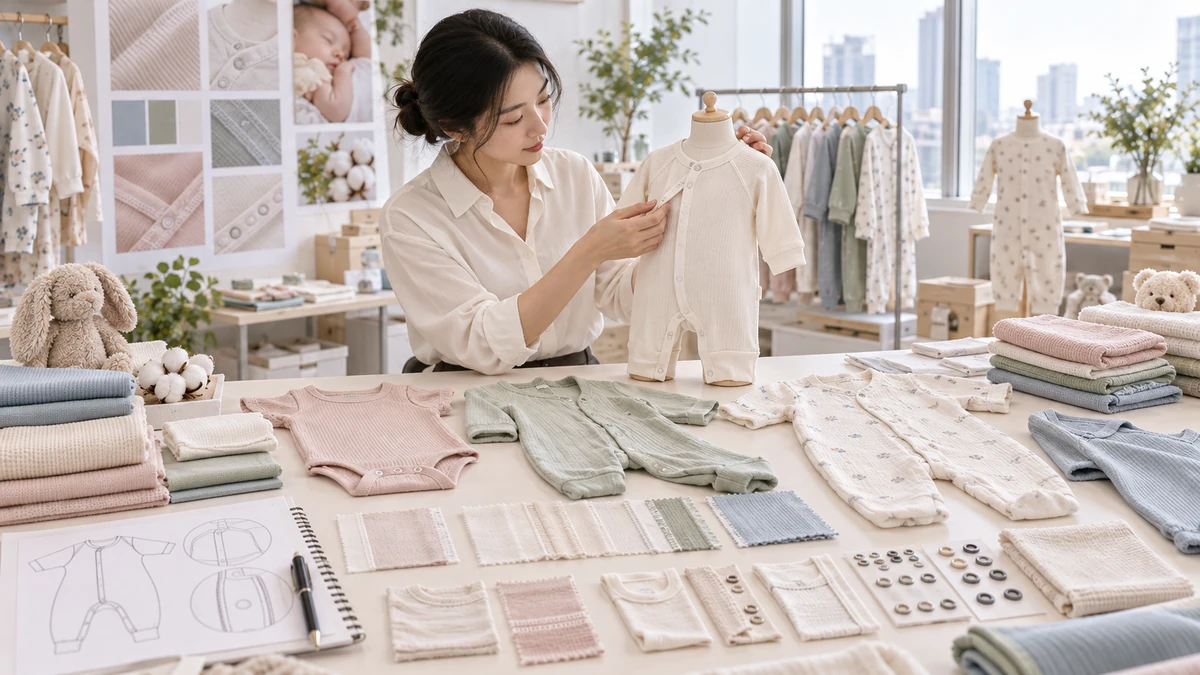
MOQ follows the manufacturing route. Stock fabric with an existing colour starts from 2 pcs on selected in-stock styles, colors and sizes and can be mixed; baby size sets from 50 to 90 start from 150–300 pcs per color on selected styles. Cost is driven by operation count, small-piece cutting and set matching.
7.1 What MOQ depends on
We quote MOQ by route rather than as a single figure, because a stock-fabric program and a custom-development program consume entirely different minimums upstream.
| Route | Minimum | What drives it |
|---|---|---|
| Stock fabric + existing colour | From 2 pcs on selected in-stock styles, colors and sizes, mixable across styles and colours | No dye lot, no fabric development |
| Custom dyeing (Pantone / lab dip) | Reviewed case by case against fabric and colour | Each colour is a separate dye lot |
| Baby sizes 50–90, per pattern | From 150–300 pcs per color on selected styles | Small-piece cutting and pattern minimums |
| Custom fabric development | Quoted separately, per fabric and colour | Mill minimum plus development cycle |
For a first baby collection, the practical implication is the same as elsewhere in kidswear: the lowest-risk test is a stock base in a colour that already exists, run as a small initial quantity, with the custom palette introduced once the style is proven. See how low MOQ actually works for the mechanics of mixing styles and colours within one minimum.
7.2 What drives the unit cost
- Operation count. Flat seams, bound edges, snap setting and zip insertion each add labour. Baby garments are small, so the labour per unit is high relative to fabric cost — this is the opposite of adult apparel, where material dominates.
- Small-piece cutting. Sizes 50–90 produce many small panels. Cutting, bundling and handling costs per garment rise as the pieces get smaller.
- Set matching. Multi-piece sets require the pieces to match in shade and to be bundled together. This is cheap when the set shares one base and one dye lot, and expensive when it does not.
- Base and finishing. A brushed or peached surface and a higher GSM both cost more per garment, but usually less than adding a decorative component would.
- Colour count. Every additional custom colour adds a dye lot. Reducing six colourways to three plus one accent is normally the largest single saving available in a baby range.
Before bulk, the development cost picture is covered in what a sample actually costs.
7.3 Lead time
Lead time in baby apparel runs from approved specification, and small-piece production is typically slower per unit than larger kidswear sizes — more pieces to cut, handle and match for the same number of garments. The realistic chain runs through pattern development, sampling, fit revision, pre-production approval, bulk production, inspection and freight, and sampling revision is the stage brands most often underestimate. Our production timeline case study shows where the weeks actually go.
8. Market & compliance considerations
Baby apparel sits at the strictest end of children’s product requirements. Two practical priorities: keep components away from the face and hands, and get the documentation route right for your destination market before the range is locked.
We only include a compliance section where the trend creates a real design obligation. For baby apparel it does, in two places.
8.1 Component safety on the smallest garments
The functional-design direction adds closures and hardware, and on garments for the youngest sizes every added component sits close to a small body. Snap and button security, the absence of long cords or ties near the neck, and the size and placement of any attached element are design questions that need resolving before sampling rather than after. The positive version of this is that the 2027 direction — fewer, more functional components — reduces exposure rather than increasing it.
8.2 Standards, documentation and labelling
China’s national standard for infant and children’s textile products, GB 31701, defines a Class A grade for infant products, with Class B and C for direct and non-direct skin contact respectively. The infant category is the most tightly specified of the three, and it is the benchmark we develop baby programs toward. For orders shipping to the United States, the relevant documentation runs through the Children’s Product Certificate (CPC) and CPSC-accepted third-party testing.
Where testing is required, we arrange it with recognised laboratories and supply the resulting documentation for the specific style and material. Labelling — fibre composition and care information, and the official language requirements of the market you are selling into — is best treated as part of the tech pack conversation rather than a post-production step.
For the certification landscape in practice, see what GB 31701, CPC and OEKO-TEX certification actually mean and the kids’ underwear and sleepwear compliance checklist. For imports into the US, the customs and documentation path is covered in importing kids’ clothing from China: US customs, CPC and labelling.
9. Nuohua’s 20-year manufacturing view
Small sizes amplify everything. A millimetre of seam bulk that is invisible at 150 size is a real problem at size 50. Approve the smallest size first, because it is the hardest garment in the range, not the easiest.
With more than two decades across children’s apparel development in our team, these are the four things we would tell a brand planning its first baby range.
The smallest size is the hardest, not the simplest. In older kidswear the small sizes are easier — less fabric, fewer fitting variables. In baby apparel it inverts. The neckline has to open wide enough to pass a head, the seams have to be flat enough not to mark skin, and every fold in a convertible foot is proportionally enormous at size 50. If you can only afford one early sample, make it the smallest size.
The closure decides the pattern, not the other way round. We regularly see brands settle the styling, choose a print, then discover at sampling that the closure they wanted does not work with the neckline they drew. Because the closure affects the pattern block, the fabric consumption and ultimately the price, it belongs at the start of the process. A brief that opens with “envelope shoulder, snap crotch, sizes 50–90” will cost less and take fewer rounds than one that opens with a mood board.
Tagless printing is a method choice disguised as a style choice. “Tagless” reads as a single decision but covers several processes with different durability profiles. On a smooth interlock the options are generous; on a textured or brushed surface they narrow sharply. Choose the base first, then the label method — the reverse order is a common and expensive mistake.
Build sets from one base. Coordinated sets are the most commercially efficient direction in the 2027 baby range, and the reason is production rather than design. One base and one palette means one dye lot, matched cutting and a single quality standard across several pieces. Brands that develop each piece on its own base acquire three colour-matching problems instead of one.
10. Buyer checklist
Before approving a baby range, confirm eleven things: target market, size ladder, closure type, neckline type, seam specification, label method, base fabric and GSM, hardware placement, MOQ route, sampling sizes, and bulk timeline.
- ☐ Target market confirmed, with the labelling obligations and language requirements that follow it
- ☐ Size ladder settled — 50 to 90, and how each size layers over the next
- ☐ Closure type chosen before styling (envelope neckline, snaps, zip, or open front)
- ☐ Neckline type and overlap depth specified together, with recovery checked
- ☐ Seam specification named on every skin-contact surface, with overlock permitted only where stated
- ☐ Label method chosen after the base fabric, with wash durability considered
- ☐ Base fabric and GSM fixed, with opacity checked under stretch and shrinkage confirmed
- ☐ Hardware placement reviewed against the face and hands; snap security and opening force documented
- ☐ MOQ route chosen — stock base and existing colour, or custom development — with colourways priced
- ☐ Sampling sizes agreed; the smallest size sampled first
- ☐ Bulk timeline worked backwards from your launch date, allowing for small-piece production time
If you are still at the reference-image stage, the useful next reads are how to turn inspiration into a style brief and how to build a tech pack.
11. Related manufacturing guides
This guide covers the 2027 baby apparel direction and its production implications. The underlying manufacturing knowledge is covered in the guides below.
2027 trend cluster
- 2027 kidswear trends overview
- Kids pajama trends 2027 & US sleepwear safety
- Kidswear colour trends 2027
- Kidswear fabric trends 2027
- Which 2027 trends are worth producing in bulk
Fabric and knit structure
- Interlock vs jersey knit for kids’ bodysuits
- The kids’ underwear fabric shortlist: a manufacturer’s practical guide
- Reading fabric weight: what GSM really tells you
- Fabric opacity, density and colour in kids’ underwear
Construction and labelling
- Bound vs flatlock seams for kids’ underwear
- Printed vs sewn-in labels for kids’ clothing
- Sleepwear fabric weight: matching GSM to night comfort
Cost, quantity and timeline
- Low MOQ kids’ underwear manufacturing: how ready stock from 2 pcs works
- How much does a kids’ underwear sample cost?
- From tech pack to bulk delivery: a production timeline case study
- Kids’ clothing brand startup cost: full budget breakdown
Quality and compliance
- Garment AQL inspection explained
- Kids’ clothing safety certifications: GB 31701, CPC and OEKO-TEX
- Importing kids’ clothing from China: US customs, CPC and labelling
- Kids’ underwear and sleepwear compliance checklist
Trend and product planning
- Why premiumization is reshaping kids’ products
- US kidswear trends 2026 — the previous season’s picture
12. Turn the trend into a production plan
Send a reference image, product brief or tech pack, plus your product type, size range, quantity and target market. We will assess the base fabric, closure and seam construction, and MOQ route before you commit to sampling.
Baby apparel rewards precision more than any other kidswear category, and the precision is cheapest to apply before the first sample is cut. Send us what you have — even a reference image and a rough size ladder is enough to start a useful conversation about closure, base and quantity.
Ready to turn a 2027 baby apparel trend into a production plan?
Send your reference images, product brief or tech pack, with your target market. We will come back with the fabric options, construction notes and MOQ route that fit the project.
Nuohua Garment is a kidswear OEM/ODM manufacturer producing children’s underwear, sleepwear, baby apparel and custom kidswear for brands, retailers and wholesalers, with an 8,000 m² production base in Guangdong, China. Feasibility ratings in this guide are Nuohua’s buyer-side assessment based on our own production experience and are not an industry standard. Standards referenced as of 2026-09; regulations change — confirm requirements for your market and product before ordering.