

Kidswear Print Trends 2027: Print Methods, Surface Details & Bulk Feasibility
Print and surface detail is where a kidswear range differentiates itself and where it most often loses money. Two styles can sit side by side on the same wholesale price with the same base fabric and the same silhouette — and one will run profitably while the other spends its margin on second-quality units, extra screens and rework.
This is a production-side reading of 2027 kidswear print and detail trends. It follows the same 12-point structure we use across this cluster, and it ranks each direction by bulk feasibility rather than by how good it looks on a mood board. It is written for brand founders, designers and buying teams who need the print brief to be costable before it is drawn.
On this page
- What is the trend?
- Why is it growing?
- Which kidswear products fit?
- What should buyers change?
- Production feasibility
- Fabric & construction
- MOQ, cost and lead time
- Market & compliance considerations
- Nuohua’s 20-year manufacturing view
- Buyer checklist
- Related manufacturing guides
- Turn the trend into a production plan
Back to the 2027 kidswear trends overview — print and detail trends are one spoke of the full cluster.
1. What is the trend?
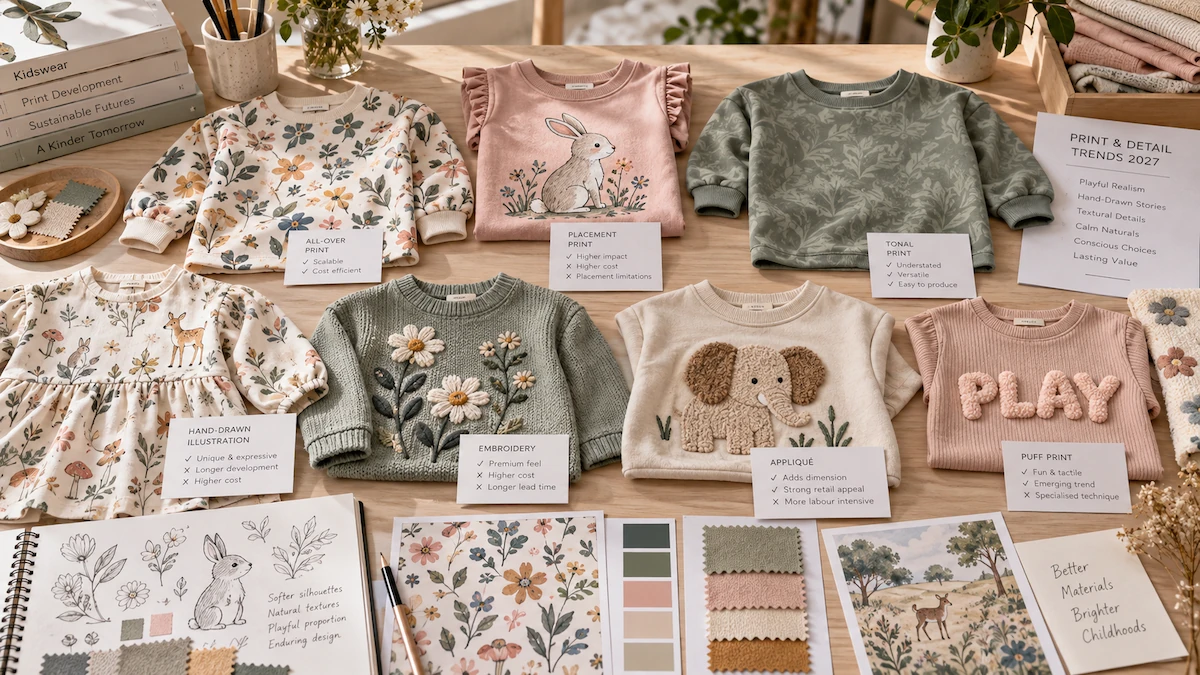
The 2027 direction splits into two halves. Print moved from “a pattern on a fabric” to “the garment’s main design statement” — all-over print, engineered print, oversized single motif, tonal and hand-drawn illustration. Surface detail moved in the opposite direction: raised and textured processes such as puff print, embroidery, appliqué and mixed-media trim. The first half is limited mainly by print engineering; the second is limited by wash durability and QC yield.
The distinction that matters commercially is between flat print and raised or attached detail. Flat print is a fabric or cut-panel decision: its risks are registration, colour accuracy and colourfastness, all of which are controllable with screens and wash testing. Raised and attached detail is a durability decision: its risks are cracking, peeling, shedding, collapse and detachment, all of which appear after the customer has worn the garment rather than before it ships.
| Direction | What it looks like in a garment | Where it lands in production / risk |
|---|---|---|
| All-over print (AOP) | Repeating small-scale motif across the whole garment | Higher cost — fabric must be printed before cutting; consumption and cutting waste rise |
| Engineered print | Motif aligned to a specific panel, seam or placement | Higher cost — panel-matched cutting and registration control per piece |
| Oversized single motif | One large graphic or illustration across the chest or back | Moderate — screen setup, and stretch-zone crack risk if placed over a moving area |
| Tonal & subtle print | Tone-on-tone motif, low contrast, often textured | Lower cost — fewer screens, and shade variation reads as intentional |
| Hand-drawn illustration | Loose line work, watercolour wash, sketch-style motif | Moderate — screen count rises with colour count in the artwork |
| Puff, raised and silicone print | Three-dimensional raised surface, matte or glossy | Higher risk — cracking, collapse after wash, thickness at seams |
| Embroidery and appliqué | Stitched motif, felt or woven patch, layered shapes | Higher cost — stitch count, backing, needle-hole and weight risk on knits |
| Foil, glitter and metallic | Reflective or sparkle surface detail | Highest risk — shedding, flaking, wash failure, and attachment questions |
For most 2027 ranges, the reliable structure is a small number of detail-led hero styles using raised or attached processes, surrounded by a larger body of flat-printed or tonal pieces. That keeps the trend visible in the assortment without exposing the whole range to the failure modes that raised detail brings.
2. Why is it growing?
Four forces: print became the fastest way to differentiate a style on a mid-price base, artwork tools and lower-volume print methods lowered the barrier to entry, original illustration gained ground as licensed characters saturated the market, and product photography made print the signal that decides whether a listing gets clicked at all.
Market signalWe read the 2027 print direction from the same four source types we use across this cluster: colour and material forecasting services, kidswear retail assortments, sector trade media, and Nuohua’s own sampling and production data — in this case our print-related second-quality and rework records, which are the clearest evidence available to us about which processes actually survive bulk.
Nuohua manufacturing viewPrint and detail selections should be made against two questions at once: does it survive the care instruction, and does it still read as intended when the garment is on a child rather than on a mannequin? A raised detail that cracks within three wears is a return; a printed motif that lands off-centre on the body is a style failure even though the print itself was technically correct.
- Print differentiates a mid-price base. When several brands use the same knit or woven base, the print is what makes the style identifiable on a shelf and on a listing. That has made print the cheapest available point of difference — which is also why print quality is where a range is judged.
- Lower barriers to lower-volume print. Smaller production routes for digital and small-run screen printing made it viable for emerging brands to print at quantities that once would not have covered the setup cost. That widened the number of brands printing, and raised the expected standard.
- Original illustration gained ground. As licensed-character programmes saturated the mass market, original illustration became a way to look distinct without an IP arrangement. The commercial cost of that shift is higher screen counts and more colour accuracy work.
- Photography made print the click signal. For online-first kidswear, print is usually the differentiator visible in a thumbnail. That increases the incentive to use print even on plain everyday styles — and the penalties for a print that photographs inconsistently.
3. Which kidswear products fit?
Produce: small-scale tonal or AOP on stable woven bases, placement prints clear of stretch zones, single-detail embroidery on woven panels, woven patch and appliqué on heavier bases. Avoid overdoing: puff, foil and glitter on garments that will be washed frequently, dense embroidery on fine-gauge knits, high-coverage AOP on stretch bases for fitted styles, engineered print on small panel garments, and any attached decoration on sizes for the youngest children.
| Produce this | Avoid overdoing | Why |
|---|---|---|
| Small-scale tonal or AOP print on woven poplin or lawn | High-coverage AOP on a stretch knit for a fitted style | Print on a stretch base cracks at the points that move most; woven bases hold print far more reliably |
| Placement print on a flat, stable panel area | Placement print across the neckline or armhole | High-stretch zones are the first place a print fails, and they are the most visible failure |
| Single-detail embroidery on a woven panel | Dense embroidery on a fine-gauge knit | Dense stitching on a light knit leaves permanent needle marks and stiffens the panel |
| Woven patch or appliqué on a heavier base | Layered appliqué with small loose shapes | Layer count adds weight and creates edges that can lift; small shapes raise attachment questions |
| Engineered print on a large, simple panel | Engineered print across multiple small panels | Every panel boundary is a registration point; the risk rises with each one |
| Everyday pieces in flat print or tonal print | Puff, foil or glitter across a whole range | Raised and metallic processes degrade under repeated washing; concentrate them in fewer styles |
| No attached decoration on the youngest sizes | Beads, sequins or glitter on infant styles | Small attached parts raise attachment and ingestion questions on garments for the youngest children |
The pattern across all seven rows is the same: flat processes on stable bases are reliable, and everything raised, metallic or attached trades durability for effect. The point is not to avoid those processes — it is to limit how much of the range depends on them.
4. What should buyers change?
Change four habits: give the printer artwork built for the process and the fabric rather than a screen mock-up, specify print colour against a standard instead of against a monitor, put the care instruction into the print brief, and cap the number of processes per style so the second-quality risk stays priced.
| Change | Current practice | Change to | Why |
|---|---|---|---|
| Artwork format | Mock-up rendered on a screen at final size | Vector or high-resolution artwork built for the specified process and print repeat | A screen mock-up hides line weights, minimum detail and colour-to-colour registration issues |
| Print colour | Colour judged against a monitor or a phone screen | Colour specified against a physical standard and approved on a printed strike-off | Screens vary; a strike-off on the actual base is the only reliable approval |
| Care instruction | Care label decided after the print is chosen | Care instruction agreed first, and the print tested against it | A print that survives 30°C may fail at 40°C; the label defines what the print must withstand |
| Process count per style | Print plus embroidery plus a patch on one garment | One process per style wherever possible | Each additional process adds a handling pass, a failure mode and its own second-quality risk |
| Strike-off approval | Approval given from a digital proof | Approve from a physical strike-off on the production base, after wash | Crack, bleed and shade shift only appear on the real base after a real wash |
The strike-off point is the one most often skipped, and it is the cheapest control available. Approving a print from a digital proof tells you what the artwork looks like; a washed strike-off on the production base tells you what the garment will look like after the customer’s fifth wash — which is the version that produces returns.
5. Production feasibility
Feasibility is high for tonal and small-scale AOP on woven bases and for placement print clear of stretch zones. It is moderate for engineered print and single-detail embroidery, and low for high-coverage AOP on stretch bases, dense embroidery on fine knits, and foil or glitter on frequently washed garments. The three recurring risks are print crack, colour inconsistency across panels and detail detachment.
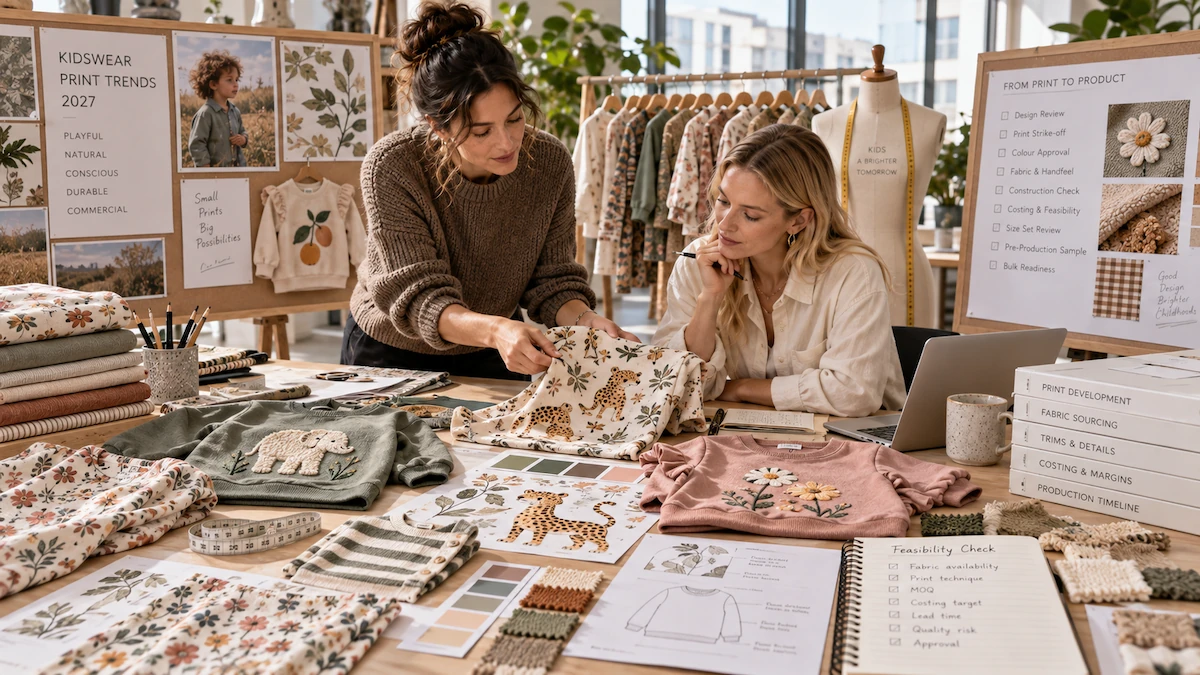
Seven checks we run on every print or detail development before sampling:
- Base compatibility. Is the print or detail process appropriate for the base, or is it being applied to a base that moves too much?
- Placement. Does the motif sit clear of the neckline, armhole, waist and knee — the high-stretch zones?
- Artwork resolution. Does the artwork carry the minimum line weight and detail the process can reproduce?
- Colour count. How many screens or passes does the artwork require, and has that been costed?
- Care instruction. Has the process been wash-tested at the specified care instruction, on the actual base?
- Registration across panels. On multi-panel garments and AOP, how is alignment controlled at cutting and at sewing?
- Attachment integrity. For appliqué, patches and any attached element, is the attachment method specified and tested?
| Process | Feasibility | Primary risk | Best used for |
|---|---|---|---|
| Tonal / low-contrast print | High | None significant; shade variation reads as intentional | Everyday tops, sets, sleepwear bases |
| Small-scale AOP on woven base | High | Cutting waste; motif scale on small parts | Dresses, skirts, woven shirts |
| Placement print, clear of stretch zones | High | Registration to the panel edge | Tops, tees, fleece and terry pieces |
| Single-detail embroidery on woven panel | Medium-High | Backing show-through; stitch density | Hero styles, chest and hem detail |
| Engineered print on large simple panel | Medium | Panel matching at cutting and sewing | Statement tees, one-piece styles |
| High-coverage AOP on stretch knit | Medium-Low | Print crack at high-stretch points | Only on looser fits with a stable knit |
| Puff / raised print | Medium-Low | Collapse and cracking after repeated wash; thickness at seams | Few hero pieces, light wash frequency |
| Dense embroidery on fine-gauge knit | Low | Needle holes, panel stiffness, weight | Not recommended — move to a woven panel |
| Foil, metallic or glitter | Low | Shedding, flaking, wash failure | Occasion pieces only, with a clear wash warning |
6. Fabric & construction
Print behaves differently on every base. Woven bases — poplin, lawn, twill — hold flat print reliably and are the safest home for detailed or tonal motifs. Stable knits such as interlock and 1×1 rib hold placement print acceptably. Fine single jersey and any high-stretch base are where print fails first. The failure modes are crack, bleed, ghosting, shade inconsistency across panels, motif scale error on small parts, and detachment of attached detail.
Base direction. Flat print wants a stable, low-stretch surface. Woven poplin and lawn are the most forgiving for fine or tonal motifs; interlock and rib handle placement print well; fine single jersey and anything engineered for stretch will crack a detailed print where the garment moves. If a design requires both stretch and print, the reliable answer is a smaller, simpler motif placed away from the moving areas. We cover base weight and knit behaviour in our fabric weight guide and our fabric shortlist guide.
Failure modes and how each is prevented
- Crack. Print on a stretch base fractures along the direction of movement. Prevented by base choice and placement, not by a heavier ink deposit — a heavier deposit cracks sooner, not later.
- Bleed and ghosting. Adjacent colours merge where a detail is too fine for the process. Prevented at artwork stage by respecting the process’s minimum line weight and gap.
- Shade inconsistency across panels. Prints applied to panels separately can differ perceptibly. Prevented by printing whole panels in one pass, or by printing fabric before cutting for AOP styles.
- Motif scale error on small parts. An AOP motif sized for a body panel becomes oversized or truncated on a cuff, placket or pocket. Prevented by checking the repeat against the smallest pattern piece, not against the largest.
- Detail detachment. Applied elements fail when they are only edge-stitched. The attachment method has to be specified — stitched through a structural seam, bar-tacked, or bonded with a tested process — and it is a small-parts question as well as a durability one.
- Wash-cycle degradation. Raised, metallic and glitter processes lose appearance after repeated laundering. The care instruction is the control: a process that only survives a delicate cold wash is not suitable for a garment a parent will launder weekly.
For the label and declaration side of decoration — how a printed element interacts with a printed label claim — see our printed vs sewn-in label guide and our bound vs flatlock seam guide.
7. MOQ, cost and lead time
Stock-fabric styles start from 2 pcs on selected in-stock styles, colors and sizes, mixable across styles and colours. All-over print changes the economics, because fabric is printed before cutting — so the print run, not the garment order, sets the practical minimum. Custom fabric development is quoted separately, per fabric and colour. Cost is driven by screen count, process count, fabric consumption and second-quality allowance; lead time is driven by strike-off approval and wash testing.
| Route | MOQ |
|---|---|
| Stock fabric + existing colour, placement or tonal print | From 2 pcs on selected in-stock styles, colors and sizes (styles, colors and sizes mixable) |
| Custom dye (Pantone / lab dip) | Reviewed based on fabric and colour |
| Custom fabric development, including printed fabric runs | Quoted separately, per fabric and colour |
| Homewear / set programmes | 1,000 sets per design |
Five cost levers, in the order they usually move a printed style’s price:
- Screen or pass count. Every colour in the artwork is a screen and a pass. Reducing an artwork from six colours to three frequently reduces the print cost more than any negotiation on the base.
- Process count per style. Print plus embroidery plus patch means three handling passes and three failure modes. One process per style is the cheapest structure available.
- Fabric consumption. AOP is printed before cutting, so motif scale and repeat determine how much fabric is consumed — and how much is wasted at the cutting table.
- Second-quality allowance. Raised and metallic processes should carry an explicit second-quality allowance in the costing. A price that assumes flat-print yield is not a price for puff or foil.
- Strike-off and wash testing. A modest fixed cost that prevents a bulk-scale error. It is the cheapest item in the print budget and the one most often omitted.
Lead-time chain: artwork finalisation → print repeat and screen setup → strike-off → wash test → lab dip (if a new colour) → prototype → approval → pre-production sample → bulk → QC → freight. For a 2027 printed range, artwork finalisation is the stage that most often delays launch, because every artwork revision restarts the setup. The question to answer internally is not “how long does printing take” but “when must the factory have final artwork” — and for AOP or engineered styles that date is earlier than for plain ones.
8. Market & compliance considerations
Printed and decorated surfaces bring their own compliance questions on top of the base garment: restricted colourants in the dye or ink, the status of a printed decoration where lead-in-surface-coating limits apply, attachment and small-parts requirements for any attached detail, and the sleepwear flammability framework if the garment is intended as nightwear.
Restricted colourants. In the European Union, REACH Annex XVII entry 43 restricts azo colourants that can release listed aromatic amines, with testing under the EN ISO 14362 series. It applies to printed and decorated surfaces as well as to dyed base fabric, which means an ink needs the same documentation discipline as a dye. Where an infant textile is involved, REACH Annex XVII entry 23 addresses formaldehyde and should be confirmed for the specific article.
Surface decoration status. In the United States, decoration applied to a children’s product may be assessed as a surface coating, which brings the lead limit in 16 CFR Part 1303 into scope. Whether a specific print or coating falls into that assessment is a determination to confirm with a CPSC-accepted laboratory rather than to assume — and the answer can differ between a flat screen print and a thick raised deposit.
Attached detail. Appliqué, patches, beads and any attached element bring the small-parts framework at 16 CFR Part 1501 into scope for younger sizes: the question is whether the element can be pulled free. 15 U.S.C. 2063(a)(5) sets the tracking-label requirement for children’s products and determines what must be printed on the finished garment; our compliance checklist covers that side.
Intended sleepwear. Surface decoration on a garment intended as nightwear is assessed within the sleepwear framework, not separately from it — for the US, 16 CFR Part 1615 (sizes 0–6X) and 16 CFR Part 1616 (sizes 7–14) with the snug-fit labelling path. Our pajama and sleepwear trends guide covers that route, and our kids clothing safety certifications guide summarises our general position.
9. Nuohua’s 20-year manufacturing view
Two decades of children’s apparel production tell us: the print decision is really a wash decision. Approve from a physical strike-off that has been through the specified care instruction rather than from a proof, cap the process count, and keep the raised and metallic processes for the few styles where they earn their risk.
- Approve washed, not just printed. The print that arrives from the printer is not the print the customer sees. We ask for a strike-off that has been laundered at the specified care instruction, because that is the version that determines whether the style generates returns.
- Heavier deposits fail sooner. When a print cracks, the instinct is to deposit more ink. In practice a thicker deposit cracks earlier and more visibly. The fix is base and placement, not volume.
- The smallest panel decides the motif. AOP artworks are usually reviewed on the body panel, where they look right. They then land on a cuff or a placket at a scale nobody intended. We check the repeat against the smallest pattern piece in the style.
- One process per style. Styles that combine print, embroidery and an applied patch are the most common source of argument about who caused a defect — and the argument costs more time than the detail earns commercially.
- Glitter and foil are return generators on wash-heavy garments. Used on an occasion piece with a clear care instruction they are fine; applied across an everyday range they shed, and shedding reads as a quality failure rather than as a styling choice.
One question we would reframe. “How much print can we put on this style?” is the wrong first question. The right first question is “what care instruction will this garment carry, and which print processes survive it on this base?” — because a print that fails at the third wash is not a design decision, it is a defect with a stylistic label.
10. Buyer checklist
Eleven checks before you brief a 2027 printed range: base chosen for the process, placement clear of stretch zones, artwork at process-appropriate resolution, screen count costed, care instruction agreed first, washed strike-off approved on the production base, repeat checked against the smallest pattern piece, registration method defined for multi-panel styles, attachment method specified for applied detail, restricted-substance and surface-coating questions confirmed, second-quality allowance priced in.
- Is the base chosen for how it behaves under print, not only for how it feels?
- Is the motif placed clear of the neckline, armhole, waist and knee?
- Is the artwork at a resolution and line weight the specified process can reproduce?
- Has the screen or pass count been costed before the artwork is finalised?
- Was the care instruction agreed before the print process was selected?
- Has a strike-off been approved on the production base after laundering at that care instruction?
- Has the print repeat been checked against the smallest pattern piece in the style?
- Is the registration method defined for engineered print and multi-panel AOP?
- Is the attachment method specified for appliqué, patches or any attached element?
- Have restricted-substance and surface-decoration questions been confirmed with a laboratory?
- Is an explicit second-quality allowance carried in the costing for raised or metallic processes?
11. Related manufacturing guides
12. Turn the trend into a production plan
Turn your 2027 print brief into a producible, costed range.
Send us your artwork or reference images, the base you are considering and the care instruction you plan to print. We will return a feasibility read on process, placement and wash behaviour — plus a strike-off and sample plan that gets the print through the fifth wash, not just the first photo.
Or reply with your tech pack — see our tech pack guide.
Standards verified as of 2026-09; regulations change — confirm with a qualified laboratory or qualified counsel before ordering. This article is a Nuohua buyer-side assessment, not compliance advice or an industry standard. Nuohua Garment — kidswear OEM & ODM manufacturer since 2016.