
2027 Kidswear Trends in the US: What Brands Should Produce Differently
The United States is the market where a good kidswear design is most likely to be commercially rewarded — and most likely to be destroyed by a specification error. The buying appetite is there. What filters ranges out is not taste; it is whether the garment can be labelled, tested, sized and shipped the way the US market expects.
This is a production-side reading of 2027 US kidswear trends. It takes the same direction the wider 2027 cluster describes and asks the harder question: what does that direction have to become before it can ship into the US? It is written for brand founders, designers and buying teams who are sourcing from an overseas factory and need their first range to clear customs, labelling and returns scrutiny — not just the lookbook.
On this page
- What is the US trend direction?
- Why does it matter in the US?
- Which products should US buyers produce differently?
- What should buyers change in the tech pack?
- Production feasibility
- Fabric & construction
- MOQ, cost and lead time
- US market & compliance considerations
- Nuohua’s 20-year manufacturing view
- Buyer checklist
- Related manufacturing guides
- Turn the trend into a production plan
Back to the 2027 kidswear trends overview — the US reading is one of four market lenses in this cluster.
1. What is the US trend direction?
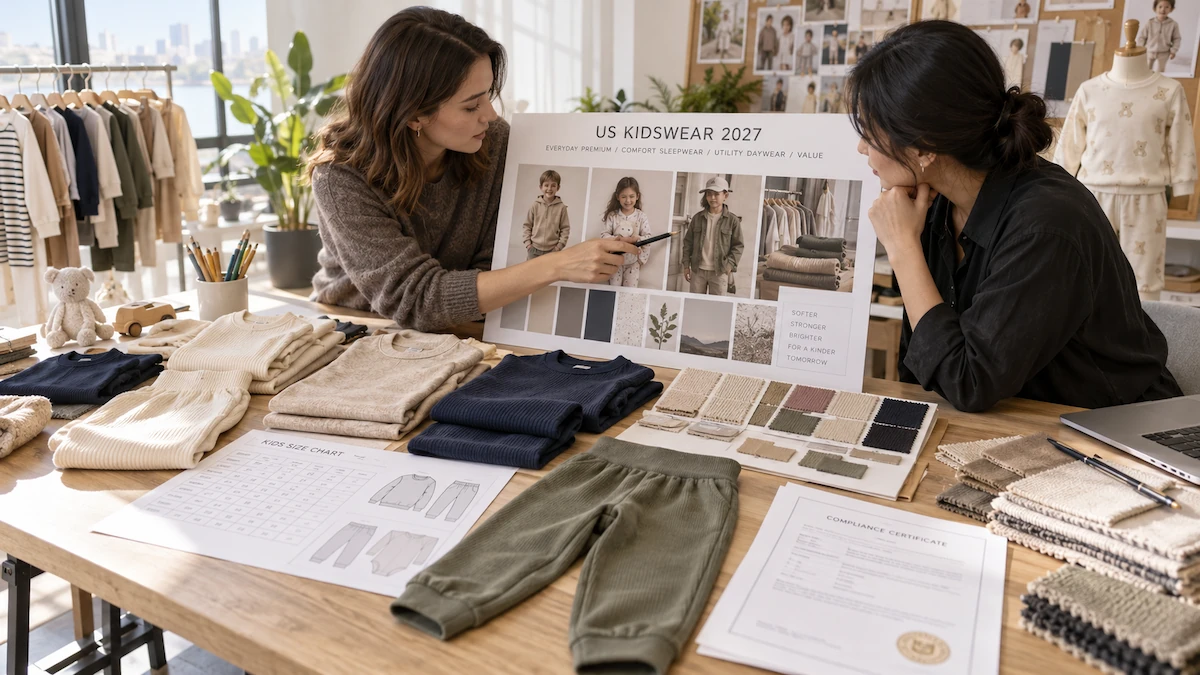
Three directions are landing hardest in the US for 2027: everyday premium basics — ribbed sets, layered knits and soft-tailored separates sold at a mid price rather than an occasion price; comfort-led sleepwear and loungewear built around two-way openings, snag-resistant surfaces and easy dressing; and utility-influenced daywear, where pockets, contrast panels and durable finishes read as value rather than decoration. The US-specific twist is that all three are judged on wash performance and documented safety, not on print novelty.
None of these is a US invention. The American market rarely invents the direction — it decides which direction survives at volume. A detail that sells in an EU boutique assortment has to survive a US return rate, a US care instruction and a US testing regime before it becomes a range.
| Direction | What it looks like in a garment | What US production demands |
|---|---|---|
| Everyday premium basics | Ribbed two-piece sets, interlock tops, soft-tailored cardigans, relaxed joggers | Consistent hand feel across dye lots and a wash result that matches the care label |
| Comfort-led sleepwear and loungewear | Two-way zippers on infant pieces, snug-fit two-piece sets, tagless necklines, wide waistbands | An early decision on sleepwear versus daywear classification — it changes the whole test path |
| Utility-influenced daywear | Cargo and patch pockets, contrast panelling, reinforced knees, durable knit outer layers | Panel-count discipline, and no cord or tie anywhere near an upper-outerwear hood |
The commercially strongest position for most first US ranges is a narrow base: two or three shared fabric platforms, one colour story, and a small number of styles that differ by construction rather than by print. That structure reduces the number of tests, the number of dye lots and the number of things that can go wrong at inspection — and in the US market, those three variables decide whether a range is repeatable.
2. Why does it matter in the US?
Four forces: US parents have been trained by a decade of recalls and publicised enforcement to check safety documentation; premium children’s basics have proven they can hold a mid price point rather than a discount price; the DTC and marketplace channel mix rewards ranges that photograph consistently; and return behaviour is more aggressive than in most markets, which makes wash performance and fit accuracy a revenue issue rather than a quality issue.
Market signalWe read the US direction from the same four source types we use across this cluster: colour and material forecasting services, US retail and marketplace assortments, sector trade media and seasonal buying briefings, and Nuohua’s own sampling and production data on US-bound orders. No single source is a conclusion — and none of them tells you whether a direction is producible at your price point.
Nuohua manufacturing viewA US range only becomes a plan once it answers the second question: can it be produced repeatedly, in the full size run, at a quantity that makes commercial sense, and does it clear the compliance path its intended end-use puts it on?
- Safety documentation became a purchase criterion. US buyers increasingly ask for test reports and a Children’s Product Certificate before they ask for a price. A factory that can produce both quickly is a shorter path to a purchase order than one that can only produce a sample.
- Everyday premium outgrew occasionwear. The volume in US kidswear is in pieces worn several times a week. That rewards fabric quality and construction and punishes decoration, because decoration costs money on every unit and earns nothing on the third wear.
- Channel consistency matters more than country-specific styling. A single style has to work as a marketplace listing image, a DTC product page and a wholesale line sheet. Ranges built from a few strong shared bases photograph consistently; ranges built from many one-off prints do not.
- Returns are a design constraint. Fit complaints and “not as pictured” claims are the two most expensive US outcomes. Both are decided before bulk: one by pattern development, one by wash testing.
3. Which products should US buyers produce differently?
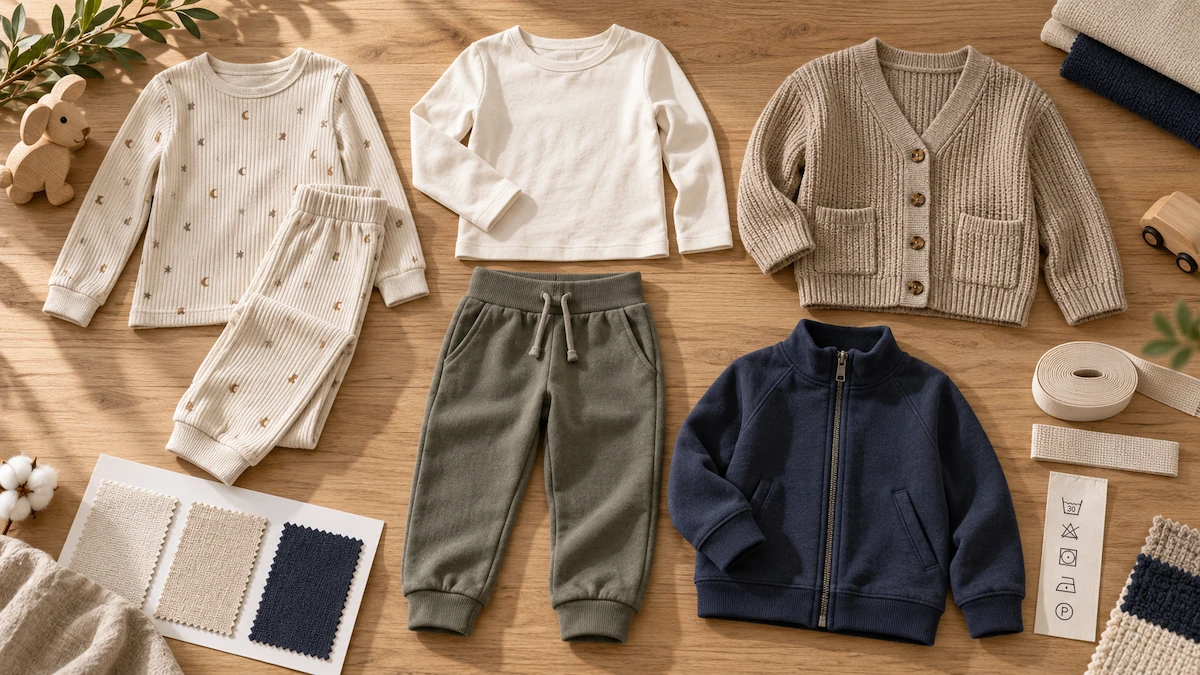
Produce: ribbed two-piece sets, interlock and cotton-spandex everyday tops, joggers with a controlled-width waistband, snug-fit two-piece sleepwear, infant one-piece styles with a two-way opening, and knit layering pieces. Review carefully before producing: three-piece matched sets, heavy decoration, anything with a cord or a tie on an upper garment, and any loungewear style that could reasonably be marketed as sleepwear.
| Produce this | Review before producing | Why |
|---|---|---|
| Ribbed two-piece sets in a single fabric platform | A different fabric platform per colour | Each additional platform is a separate wash test, a separate shrinkage behaviour and a separate hand-feel approval |
| Snug-fit two-piece sleepwear with a defined fit tolerance | Relaxed-fit sleepwear intended for the US market | Sleepwear fit is a compliance input, not only a comfort choice; the fit route has to be decided before the pattern is graded |
| Infant one-piece styles with a two-way opening | One-piece styles with a single-direction opening and a decorative pull | Night-time changing is the use case the parent is buying for, and hardware has to be selected with that in mind |
| Joggers and leggings with a wide, defined waistband | Narrow elastic applied without a defined finished width | Waistband construction is the most common source of fit complaints in children’s bottoms |
| Tonal print on a single base colour | Multi-colour all-over print across several bases | Print complexity multiplies colour-approval steps and magnifies any registration drift |
| Pockets and contrast panels on woven daywear | Cord or tie on an upper-outerwear hood or neckline | Drawstring rules for children’s upper outerwear are a distinct and strictly applied category in the US |
| Knit layering pieces for autumn and winter | Heavy 3D embellishment on fine-gauge knit | Dense surface decoration on fine-gauge knit produces needle marks and stiffness |
The single highest-value decision in a US range is made before design: is this style sleepwear or daywear? That decision determines the applicable test path, the fit direction and the label content. A soft loungewear set that a brand markets as “bedtime” moves into the sleepwear framework even if it was designed as loungewear, so the classification must be settled at tech-pack stage — not discovered at the testing stage.
4. What should buyers change in the tech pack?
Five changes: state the intended end-use in writing, because sleepwear versus daywear changes the test path; specify fit numerically rather than by adjective; fix the care instruction before fabric approval so the wash test has a target; define the size range in US size labels alongside centimetres; and put the tracking-label content and placement into the tech pack instead of leaving it to the factory to interpret.
| Change | Current practice | Change to | Why |
|---|---|---|---|
| Intended end-use | Not stated; implied by the style name | Written on the tech pack: daywear, sleepwear, or loungewear not marketed for sleep | End-use determines which flammability and labelling framework applies |
| Fit specification | “Slim”, “relaxed”, “comfortable” | Target body measurements plus a stated tolerance per size | An adjective is interpreted differently at sampling and at bulk, producing two different garments |
| Care instruction | Decided after fabric approval | Fixed before fabric approval, then used as the wash-test condition | Shrinkage and colourfastness are only meaningful against a defined wash condition |
| Size labelling | Centimetres only, or a manufacturer suggestion | US size labels mapped to a measurement table, per size | US parents buy by the label on the garment; the mapping is the brand’s decision, not the factory’s |
| Tracking label | Left to the factory to add | Content, placement and durability specified in the pack | Tracking information is a defined requirement for children’s products; it should not be improvised per order |
Of these, the end-use statement has the largest downstream effect. Two identical garments — one sold as daywear, one sold as sleepwear — follow different test paths, and the cost difference is not in the fabric. Getting it wrong is not a labelling fix; it is a re-test.
5. Production feasibility
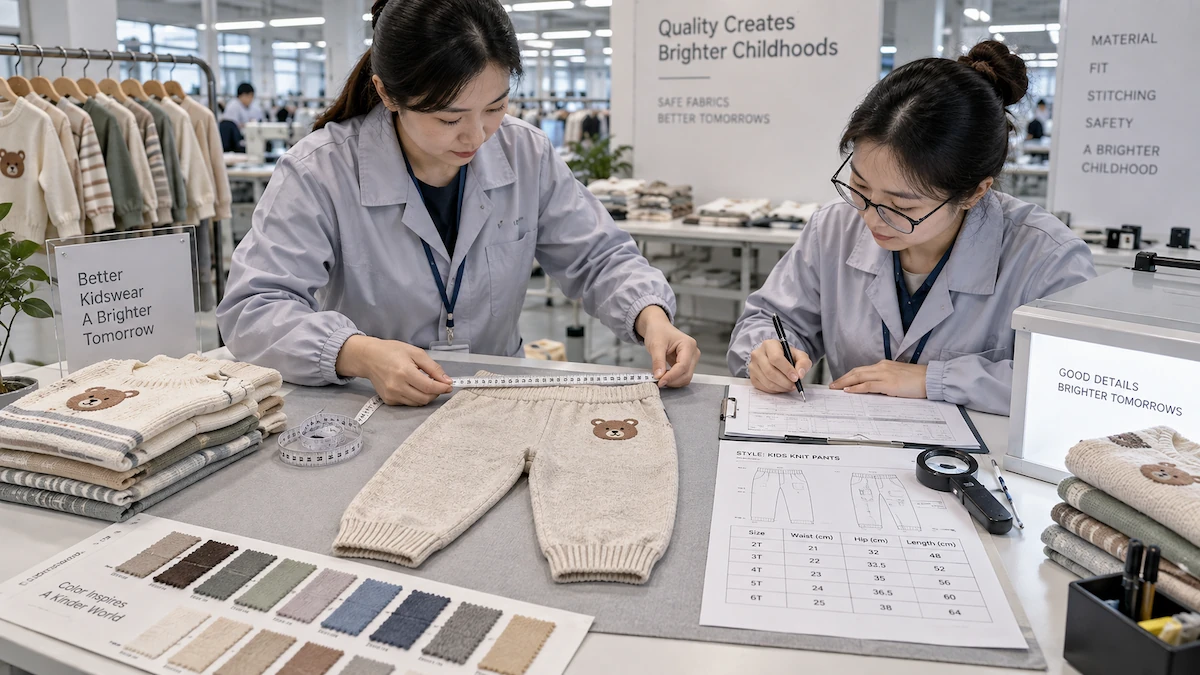
Feasibility is high for rib knits, interlock, cotton-spandex jersey and simple woven daywear, and medium-high for snug-fit two-piece sleepwear once the fit tolerance is defined. It drops when a style combines stretch bases with heavy decoration, when the fabric platform changes per colour, or when the pattern is graded from an adult or unisex block. The recurring US risks are shrinkage against the printed care label, waistband consistency and hardware retention on infant pieces.
Seven checks we run before sampling on a US-bound range:
- End-use classification. Is the style daywear, sleepwear, or loungewear not sold for sleep — and is that written down?
- Shrinkage against the care instruction. Does the fabric meet the labelled care condition, or will the garment be returned as undersized after one wash?
- Waistband definition. Is the finished elastic width specified, or left as “elastic”?
- Hardware retention. For any snap, button, zip pull or attached trim on a garment sold for younger children, is the attachment strength defined and testable?
- Panel and trim count. Does each additional panel or trim earn its cost at this price point?
- Size-run consistency. Does the construction behave the same at the smallest and largest size, not just the middle?
- Second-quality budget. Are the known risks priced into the first run rather than discovered at final inspection?
| Element | Feasibility | Note |
|---|---|---|
| Ribbed and interlock two-piece sets | High | Stable bases, predictable shrinkage once the fabric is pre-shrunk, strong repeat potential |
| Cotton-spandex everyday tops and joggers | High | Standard production; waistband specification is the main control point |
| Snug-fit two-piece sleepwear | Medium-High | Requires a defined fit tolerance before grading |
| Infant one-piece with two-way opening | Medium-High | Hardware selection and retention are the risk, not the sewing |
| Woven daywear with pocketing and contrast panels | Medium | Panel count drives both cost and alignment risk |
| Multi-colour all-over print across several bases | Low-Medium | Registration drift and per-colour approval multiply the approval cycle |
| Decoration-heavy styles on stretch knit | Low | Distortion at the attachment point; usually not worth the unit cost |
6. Fabric & construction
The 2027 US base is built on two platforms more than any others: cotton-spandex single jersey and rib for everyday and sleepwear, and interlock or french terry for layering and cooler-season pieces. Cotton-rich blends dominate because they align with US care habits and price expectations. The failure modes are shrinkage against the care label, waistband collapse, print registration drift and hardware separation on infant styles.
Fabric direction. Cotton with a small elastane content gives the recovery that everyday US kidswear needs and washes predictably when the fabric is pre-shrunk before cutting. Rib holds shape at cuffs and necklines and is the most reliable base for a two-piece set. French terry carries the utility and layering direction with a surface that resists the pilling that kills repeat purchase. Bamboo viscose and modal both have a place in the premium end, but they change the care instruction and the hand-feel approval — a decision worth making deliberately rather than by default. We cover base behaviour in our fabric weight guide and the trade-offs in our modal versus cotton comparison and combed cotton versus cotton-spandex comparison; this article only states which base fits which US direction.
Construction and failure modes
- Shrinkage against the care label. The most expensive US defect, because it arrives as a size complaint after a wash rather than at inspection. The fix is a pre-shrunk fabric and a wash test run against the care instruction you plan to print — not a generic one.
- Waistband collapse and roll. Caused by an elastic width that was never specified, or by a waistband channel that is narrower than the elastic after the seam allowance. Specify the finished width, not the elastic width.
- Print registration drift. Multi-colour all-over print on stretch bases drifts at the seams. It is manageable on a stable base and difficult on a highly elastic one — and it is visible immediately to a customer.
- Hardware separation. The category risk on infant styles. Attachment strength must be defined and testable, and the hardware selected for the child’s age band rather than for appearance.
- Neckline recovery. A ribbed neckline that has not been specified with a recovery requirement opens after a few wears and reads as cheap. It is one of the few visible defects that costs almost nothing to prevent. Seam choices are covered in our bound versus flatlock seam guide.
- Label behaviour. What can be printed on the garment is also a construction decision; our printed versus sewn-in label guide covers the labelling side.
7. MOQ, cost and lead time
US-facing ranges are usually built on stock-fabric styles from 2 pcs on selected in-stock styles, colors and sizes, mixable across styles and colours. Custom dyeing is reviewed case by case, and custom fabric development is quoted separately, per fabric and colour. Cost is driven by fabric platform count, waistband and hardware specification, print complexity and colour count; lead time is driven by lab-dip approval, testing and the US retail calendar the range is aimed at.
| Route | MOQ |
|---|---|
| Stock fabric + existing colour | From 2 pcs on selected in-stock styles, colors and sizes (styles, colors and sizes mixable) |
| Custom dye (Pantone / lab dip) | Reviewed based on fabric and colour |
| Custom fabric development | Quoted separately, per fabric and colour |
| Sleepwear and loungewear sets | From 1,000 sets per design |
| Baby sizes 50–90 (set programmes) | From 150–300 pcs per color on selected styles |
Five cost levers, in the order they usually move a US price:
- Fabric platform count. Consolidating a range onto two platforms instead of five reduces testing, colour approval and minimum-quantity risk at once. It is the largest single lever available.
- Colour count. Four colours sharing two dye lots cost materially less in approval time than seven colours in seven lots — and they reduce the risk of a shade band complaint.
- Panel and trim count. Each panel is a seam, a seam finish and an alignment risk. Utility pockets and contrast panels must earn their place.
- Print complexity. Tonal placement print is cheaper and safer than multi-colour all-over print across several bases, in unit cost and in second-quality units.
- Hardware specification. Defined, age-appropriate hardware costs a little more per unit than an undefined choice — and removes a category risk worth far more than the difference.
Lead-time chain: fabric sourcing → lab dip (if custom colour) → prototype → fit and construction approval → testing → pre-production sample → bulk → QC → freight. For a US range, the date that matters is not how fast bulk can be sewn but when the factory must receive the brief in order to fit testing and at least one fit revision before the retail calendar moves. Working backwards from the launch date is the only reliable way to set that date. Our production timeline case study walks through the full sequence.
8. US market & compliance considerations
Four instruments decide most US kidswear questions. CPSIA sets the children’s product safety regime and the Children’s Product Certificate obligation, with testing arranged through a CPSC-accepted laboratory. The children’s sleepwear flammability rules at 16 CFR Part 1615 (sizes 0–6X) and 16 CFR Part 1616 (sizes 7–14) apply to garments intended for sleep. 15 U.S.C. 2063(a)(5) sets tracking-label requirements. 16 CFR Part 1501 governs small parts on garments for children under three, and CPSC drawstring guidance with ASTM F1816 covers cords on children’s upper outerwear.
The children’s product safety framework. Children’s apparel sold in the US sits inside CPSIA, which requires that a Children’s Product Certificate accompany the shipment and that testing be carried out by a CPSC-accepted laboratory, at the standard and to the scope the product requires. Two practical consequences for a 2027 range: testing is triggered by the product and its intended use, and a material or construction change can move the product outside the scope of an existing report. Our guide to the Children’s Product Certificate and our guide to importing kids clothing from China cover the paperwork side, and our compliance checklist walks through the garment side.
Sleepwear flammability. Garments intended for sleep fall under a distinct framework rather than the general apparel rules: 16 CFR Part 1615 for sizes 0–6X and 16 CFR Part 1616 for sizes 7–14. Within that framework, tight-fitting garments follow a different path from loose-fitting ones, and the fit itself becomes a compliance input. This is the reason the daywear-versus-sleepwear decision has to be made at tech-pack stage: fit tolerance, labelling and test scope all follow from it. Our pajama and sleepwear trends guide covers that path in detail, and best fabrics for kids’ pajamas covers the fabric implications.
Tracking labels. 15 U.S.C. 2063(a)(5) requires tracking information on children’s products, which in practice means the factory must print specified information in a specified place, and it must remain legible through the product’s expected life. This is a spec item, not a warehouse item.
Small parts and drawstrings. 16 CFR Part 1501 governs whether a component can be pulled free and become a choking hazard for children under three — which is why infant hardware and attached trims need a defined attachment strength rather than a visual inspection. Separately, CPSC guidance on drawstrings in children’s upper outerwear, alongside ASTM F1816, addresses cords at the hood and neckline. A decorative belt on a dress is not the same category as a hood cord, and the distinction should be confirmed for the specific garment rather than assumed either way.
Labelling. 16 CFR Part 303 governs fibre content and care labelling, and 19 CFR Part 134 governs country-of-origin marking for imported goods. Both attach to the garment, and both are checked far more often than buyers expect. Our factory certification verification guide sets out how to check what a supplier is actually claiming.
California. Proposition 65 applies to products sold in California and operates on a different basis from federal apparel safety rules — it is a warning-and-exposure regime with safe-harbour levels for listed substances, and print inks and plastisol decoration are common areas of enquiry. It should be confirmed for the specific decoration and substrate.
9. Nuohua’s 20-year manufacturing view
Two decades in children’s apparel tell us that US ranges fail on classification and wash behaviour, not on design. Settle end-use first, define the waistband and the care instruction numerically, and consolidate the fabric platforms — then the trend has somewhere to land.
- End-use is decided earlier than buyers think. We have watched a loungewear set marketed as “bedtime comfort” move into the sleepwear framework after the artwork was finalised. Reworking the fit, the label and the test scope at that point costs more than the entire first sample round. Our recommendation is blunt: decide the classification on the tech pack, and design to it.
- Shrinkage is a sizing problem wearing a quality costume. A garment that measures correctly before wash and undersized after wash produces a fit complaint, not a fabric complaint. Pre-shrinking and a wash test against the printed care instruction remove the failure — and both are cheaper than the returns they prevent.
- The waistband is the most under-specified component in children’s bottoms. A finished width, an elastic type and a stretch target take three lines in a tech pack. Without them, the same style produced twice will not fit the same way twice.
- Fewer platforms, better ranges. The strongest US ranges we produce are built on two or three fabric platforms. The weakest are built on a different base for every colourway, which multiplies testing, minimums and shade risk while adding nothing a customer can perceive.
One question we would reframe. “Which 2027 style is most on-trend in the US?” is the wrong first question. The right first question is “which style can this range carry at this price, in this size run, on this compliance path, and still measure the same after wash?” — because a garment that cannot be labelled and shipped is not a product, it is a sample.
10. Buyer checklist
Eleven checks before briefing a 2027 US range: end-use written per style, fit defined numerically, care instruction fixed before fabric approval, waistband specified by finished width, hardware retention defined, size labels mapped to a measurement table, tracking-label content specified, fabric platforms consolidated, print complexity justified, testing scope confirmed by a laboratory, and the lead-time chain mapped backwards from the launch date.
- Is the intended end-use written on the tech pack for every style — daywear, sleepwear, or loungewear not sold for sleep?
- If the style is sleepwear, has the fit direction and tolerance been defined before grading?
- Is fit specified as target measurements plus tolerances, rather than as an adjective?
- Is the care instruction fixed before fabric approval, and is the wash test run against it?
- Is the waistband specified as a finished width with a stretch target?
- Is the attachment strength of hardware and attached decoration defined for the child’s age band?
- Are US size labels mapped to a per-size measurement table?
- Is the tracking-label content and placement specified in the pack?
- Has the range been consolidated onto as few fabric platforms as the design allows?
- Has the applicable testing scope been confirmed by a CPSC-accepted laboratory for this product and end-use?
- Is the lead-time chain mapped backwards from the launch date, including testing and one fit revision?
11. Related manufacturing guides
12. Turn the trend into a production plan
Turn the 2027 US direction into a range that clears its compliance path.
Send us your reference images, target price point and the styles you are considering. We will return a feasibility read on construction, fabric platform and size-run behaviour, plus the classification and testing questions that need answering before sampling.
Or reply with your tech pack — see our tech pack guide.
Standards verified as of 2026-09; regulations change — confirm with a qualified laboratory or qualified counsel before ordering. This article is a Nuohua buyer-side assessment, not compliance advice or an industry standard. Nuohua Garment — kidswear OEM & ODM manufacturer since 2016.