
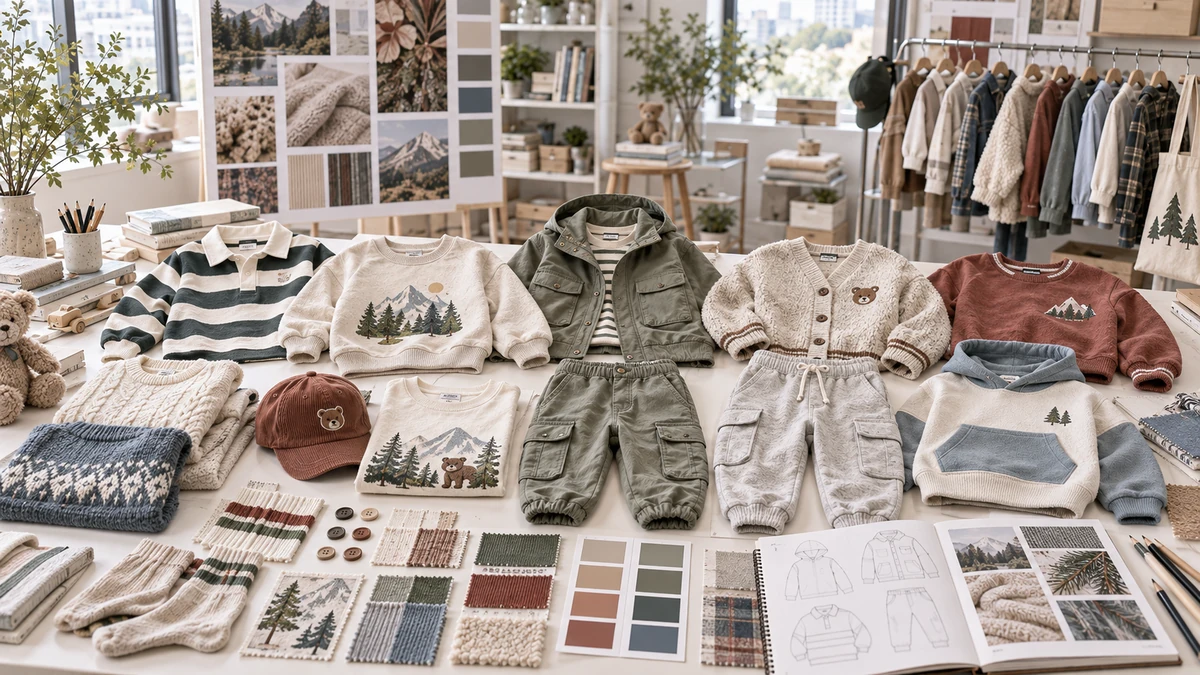
Kidswear Trends 2027: What Brands & OEM Buyers Should Watch
Every season, a wave of “Top 20 Kids Fashion Trends” posts tells brand owners what shoppers will want. Almost none of them answer the question that actually decides whether a collection makes money: which of these trends can be produced repeatedly, at your order quantity, without triggering a fabric development run or a compliance detour?
This is a production-side reading of 2027. It follows the same 12-point structure we use for every trend guide on this site — what the trend is, why it is growing, which products fit, what buyers should change, how feasible it is to manufacture, what happens at the fabric and construction level, what it does to MOQ and lead time, where compliance intervenes, and what two decades of children’s apparel production would have us change. It is written for brand founders, buying teams and wholesalers who have to commit to a range, not for a mood board.
On this page
- What is the trend?
- Why is it growing?
- Which kidswear products fit?
- What should buyers change?
- Production feasibility
- Fabric & construction
- MOQ, cost and lead time
- Market & compliance considerations
- Nuohua’s 20-year manufacturing view
- Buyer checklist
- Related manufacturing guides
- Turn the trend into a production plan
1. What is the trend?
The 2027 kidswear direction is not one trend but five converging ones: comfort-first construction, retro-prep and collegiate detailing, outdoor and utility function, warm-neutral colour with concentrated accents, and print moving from all-over graphics to placement and texture. All five are executable on existing knitwear lines.
What makes 2027 easier to plan than a typical fashion season is that its directions pull in the same practical direction. Comfort-first construction and outdoor function both reward softer, more forgiving bases. Retro-prep and collegiate detailing both live in print, rib trim and simple colour blocking rather than complex structure. The warm-neutral palette reduces the number of dye lots a range needs. And the print shift from all-over to placement reduces both register risk and second-quality rates.
In other words, the commercially strong direction for 2027 happens to also be the manufacturable one. That is not always true — several recent seasons pushed toward dense embellishment and multi-panel patchwork, which look excellent in a lookbook and behave badly on a cutting table.
| Direction | What it looks like in a garment | Where the cost sits |
|---|---|---|
| Comfort-first construction | Soft interlock bases, tagless necklines, flat or covered seams, easy-change closures | Marginal — usually a base and finishing choice, not extra components |
| Retro-prep & collegiate | Chest placement graphics, rib collars and cuffs, tipped trims, simple colour blocking | Low to moderate — print screens and rib trim |
| Outdoor & utility | Functional pockets, raglan and relaxed silhouettes, durable rib, tonal zips | Moderate — panel count and hardware |
| Warm-neutral colour | Oatmeal, clay, sage, warm grey bases with one saturated accent | Low — fewer colourways, less dyeing |
| Placement print & texture | Single chest graphics, embroidery on flat panels, self-fabric texture, contrast piping | Low to moderate — depends on process, not coverage |
One caveat before you build a range around this. A “direction” is not a design. Retro-prep does not tell you whether to make a rugby top or a pleated skirt; placement print does not tell you which graphic. The next three sections exist to convert direction into a product decision.
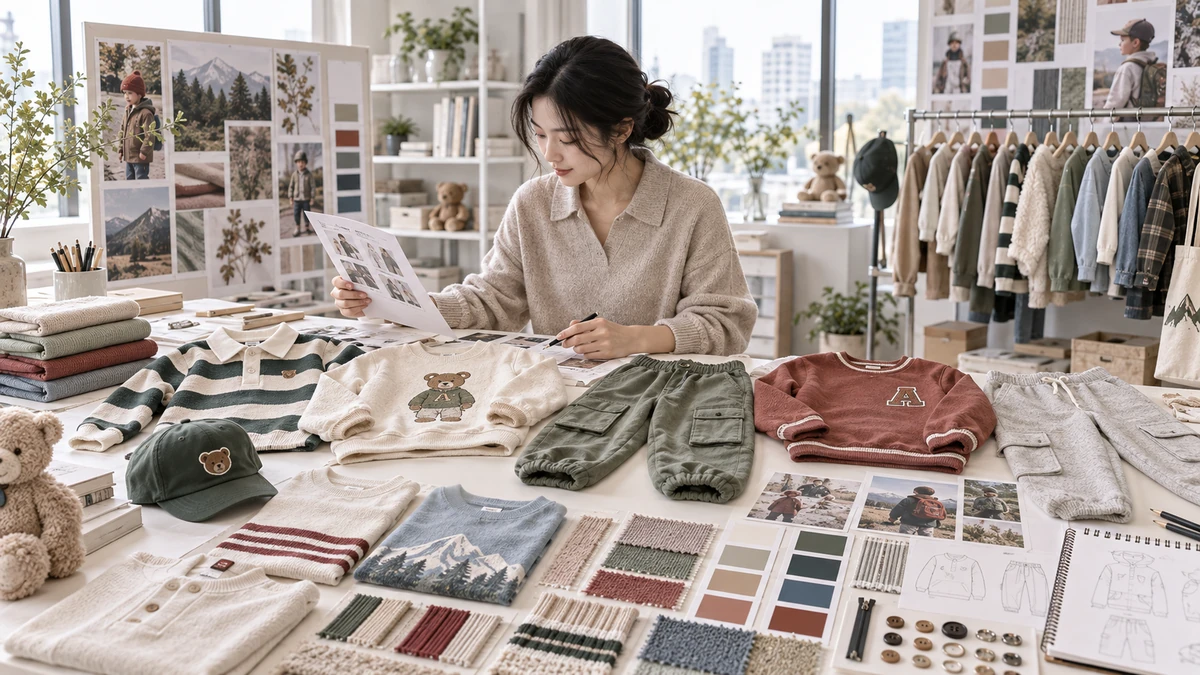
2. Why is it growing?
Three forces: parents buying fewer but better children’s garments, kidswear retail assortments shifting from graphic-heavy basics toward softer and more considered product, and brands competing on end-use performance rather than on print novelty.
2027 trend signals we are watching
Market signalCurrent kidswear forecasting points toward softer tactile surfaces, simpler comfort-led silhouettes, nature-oriented palettes and functional detailing. We read these signals from four source types: colour and material forecasting services such as Pantone Color Institute and Première Vision, kidswear retail assortments across major retailers, sector trade media and seasonal buying briefings, and our own sampling and production data.
Nuohua manufacturing viewWe treat all of the above as a starting point, not a conclusion. A signal only becomes a direction for us once it passes a second question: can it be produced repeatedly, in the sizes required, at a quantity that makes commercial sense?
Trend growth in kidswear has a different engine from adult fashion. Adult trends are largely driven by novelty and media exposure. Children’s trends are driven by parental economics, because the person making the decision is buying for someone else, at a stage of life that changes every six months.
That produces three durable drivers behind the 2027 direction:
- Fewer, better garments per child. Parents who face a size change every few months increasingly prefer a smaller number of garments that wash well and hold shape. This rewards fabric quality and finishing over surface decoration — exactly the direction 2027 points toward.
- Retail assortment shift. Large kidswear retailers have continued moving shelf space toward softer bases, tonal ranges and coordinated sets, and away from high-coverage novelty print. Retail assortment is the strongest single trend signal available, because it has already survived a buying committee and a margin model.
- End-use competition. Brands are increasingly differentiating on what a garment is for — sensory-friendly seams, easy dressing, sleepwear that actually fits — rather than on how it looks. That pushes design decisions down into construction, which is where a manufacturer’s input starts to matter to the brand’s margins.
There is a fourth, less comfortable driver: trend cycles in kidswear have compressed. A print family that once held for two seasons now often reads as dated within one. That makes repeatability more valuable than novelty, and it is the main reason we weight production feasibility as heavily as we do in the sections below.
3. Which kidswear products fit?
Baby: softness and ease of dressing. Girls: romantic detail balanced with modern prep. Boys: utility, sport and retro graphics. Sleepwear: elevated print on snug-fit construction. Print: placement graphics and texture rather than full coverage.
Here is the same 2027 direction briefed by category — including what not to overdo, which matters more than the recommendation itself.
| Category | Direction | Produce this | Avoid overdoing |
|---|---|---|---|
| Baby & toddler | Sensory softness, flat seams, functional closures | Soft interlock bases, tagless necklines, envelope shoulders, easy-change closures, coordinated sets | Heavy trim, multiple small hardware pieces, elaborate appliqué below 12M |
| Girls | Romantic detail meeting sporty prep | Bows as clean-finished or detachable trims, pleated and tiered silhouettes, embroidery on flat panels, cardigan sets | Dense ruffle stacks at the neckline, dangling cords and ties, fragile beading |
| Boys | Utility, sport, outdoor, retro graphics | Functional pockets, raglan and relaxed silhouettes, rib trims, collegiate graphics, coordinated sets | Multi-panel patchwork that multiplies cutting operations, hard hardware near the face |
| Sleepwear & loungewear | Comfort aesthetics in elevated prints and soft bases | Snug-fit two-piece sets, soft knitted bases, seasonal print families, gift-ready packaging | Loose flowing silhouettes positioned as sleepwear in markets with flammability rules |
| Print & detail | Placement print, texture and contrast | Chest placement prints, embroidery on woven panels, rib and contrast piping, tonal self-fabric detail | High-coverage all-over print on high-stretch bases, heavy puff on fine-gauge knit |
Two observations that matter more than the table. First, the print shift is real and it favours production: a placement graphic holds register more reliably than an all-over print on a stretch base, so it generates fewer second-quality garments for the same design intent. Second, in every category above, the manufacturable version of the trend is the version with fewer components — not the version on the mood board.
If you are still deciding which categories to enter rather than which trends to apply, the category-level manufacturing pages are the better starting point: kids’ underwear, kids’ sleepwear, baby and toddler apparel.
4. What should buyers change?
Six concrete changes: fewer colourways with one accent, fewer components per garment, decide intended use before construction, build the fabric shortlist before styling, move print budget from coverage to placement, and prototype the two extreme sizes rather than the middle.
This is the section most trend content skips, and in practice it is where the money is decided. A trend does not require a brand to change what it makes as much as it requires a brand to change how it decides. These are the six shifts we would recommend for a 2027 range.
| Change | Typical current behaviour | What we would do instead | Why it matters |
|---|---|---|---|
| Colour architecture | Six colourways per style, each fully developed | Three core colours plus one seasonal accent; accent applied to small areas | Every custom colour is a separate dye lot with its own approval and minimum |
| Component count | Detail added wherever the mood board shows it | One hero detail per style, cleanly finished | Each added operation compounds defect risk and cutting time |
| Decision order | Style first, then intended use, then fabric | Intended use first, then construction, then styling | Intended use can change which compliance route applies |
| Fabric selection | Browse a catalogue after the design is signed off | Shortlist qualified bases before styling begins | A design built on an unavailable base has to be redesigned, not re-sourced |
| Print strategy | Budget spent on coverage (all-over) | Budget spent on quality of a smaller placement graphic | Placement prints hold register better and reduce second-quality output |
| Sampling | One sample in the middle of the size run | Prototype the smallest and largest sizes | Grading and consumption problems are almost always visible at the extremes |
The most valuable change on that list is the third one. Deciding intended use first feels bureaucratic until you realise it can change the garment itself — the fit, the construction, sometimes the silhouette — rather than just the paperwork. We come back to this in section 8.
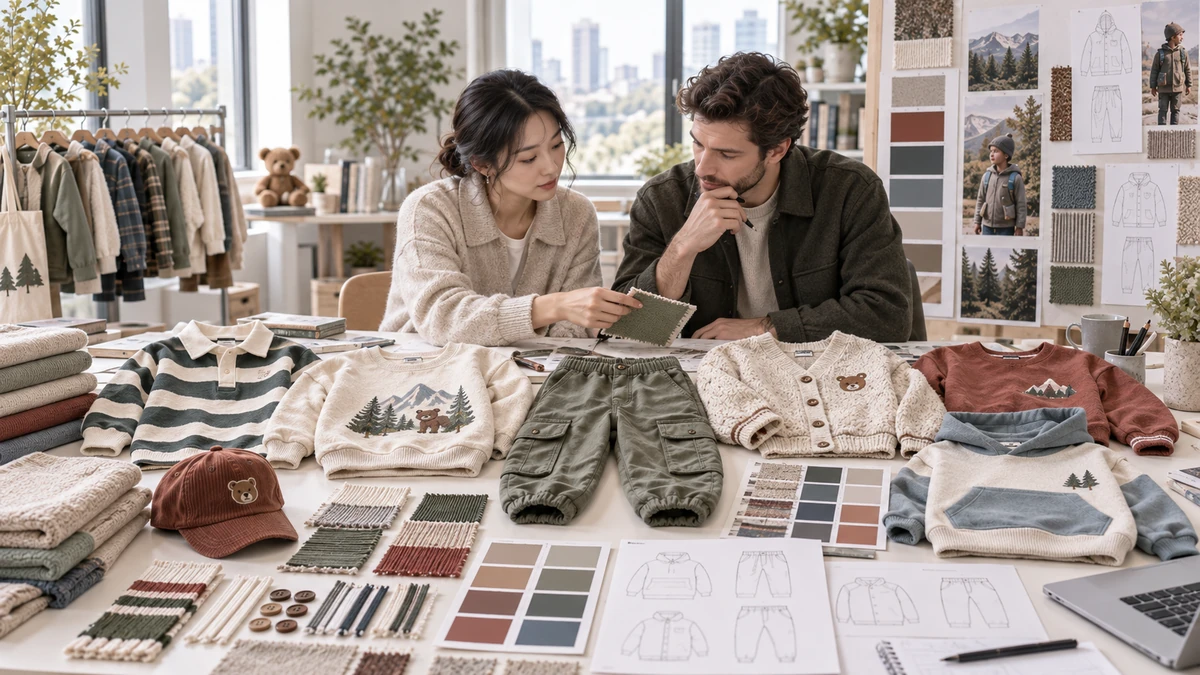
5. Production feasibility
We rate every direction on seven checks — fabric availability, construction complexity, grading behaviour, trim sourcing, sampling risk, QC risk and repeatability — then classify it High, Medium or Low. Trends that fail repeatability are a test order, not a range.
A feasibility rating is not a judgement on how attractive a trend is. It is a judgement on how expensive it is to get wrong. These are the seven checks we apply, and the reasons behind them:
- Fabric availability. Is the base held in stock, or does it require a mill development run with its own lead time and minimum?
- Construction complexity. How many operations and panels does the detail add per garment, and does that scale across a size run?
- Grading behaviour. Does the detail hold its proportion from the smallest to the largest size you will produce?
- Trim sourcing. Does it need a custom jacquard, custom elastic, or a non-standard fastener with its own minimum?
- Sampling risk. How many sample rounds before approval, realistically?
- QC risk. What is the realistic second-quality rate at this construction, before you apply any commercial cushion?
- Repeatability. On order three, does it still come out the same as order one?
| Direction | Feasibility | Main risk | Best route |
|---|---|---|---|
| Retro-prep and collegiate graphics | High | Print placement consistency | Placement print on an in-stock knit |
| Utility and functional pockets | High | Panel count raises cutting time | Simplified pocket bags, standard hardware |
| Warm neutral and earth colour direction | High | Shade approval across dye lots | Closest stock colour, or lab-dip approval |
| Texture-led knits (rib, ottoman, terry) | Medium–High | Mill minimums and availability window | Order texture on the main body only |
| Sporty prep: pleats, tiers, cardigan sets | Medium | Grading behaviour and fabric consumption | Prototype two sizes before committing the run |
| Romantic detail: bows, ruffles, embroidery | Medium | Seam bulk, neckline recovery, edge hand-feel | Clean-finish or detachable trims; embroidery on flat panels |
| Heavy puff print and raised detail | Medium–Low | Wash durability and hand-feel degradation | Restrict to low-stretch, low-wash-frequency garments |
| Dense multi-panel patchwork | Low | Defect rate and per-piece cost both climb | Simulate with print rather than construction |
The bottom two rows deserve attention, because they are where trend-led collections most often lose money. A detail that reads as charming and handmade on a mood board can lift your second-quality rate enough to erase the margin — and unlike a fabric substitution, you cannot fix it after cutting.
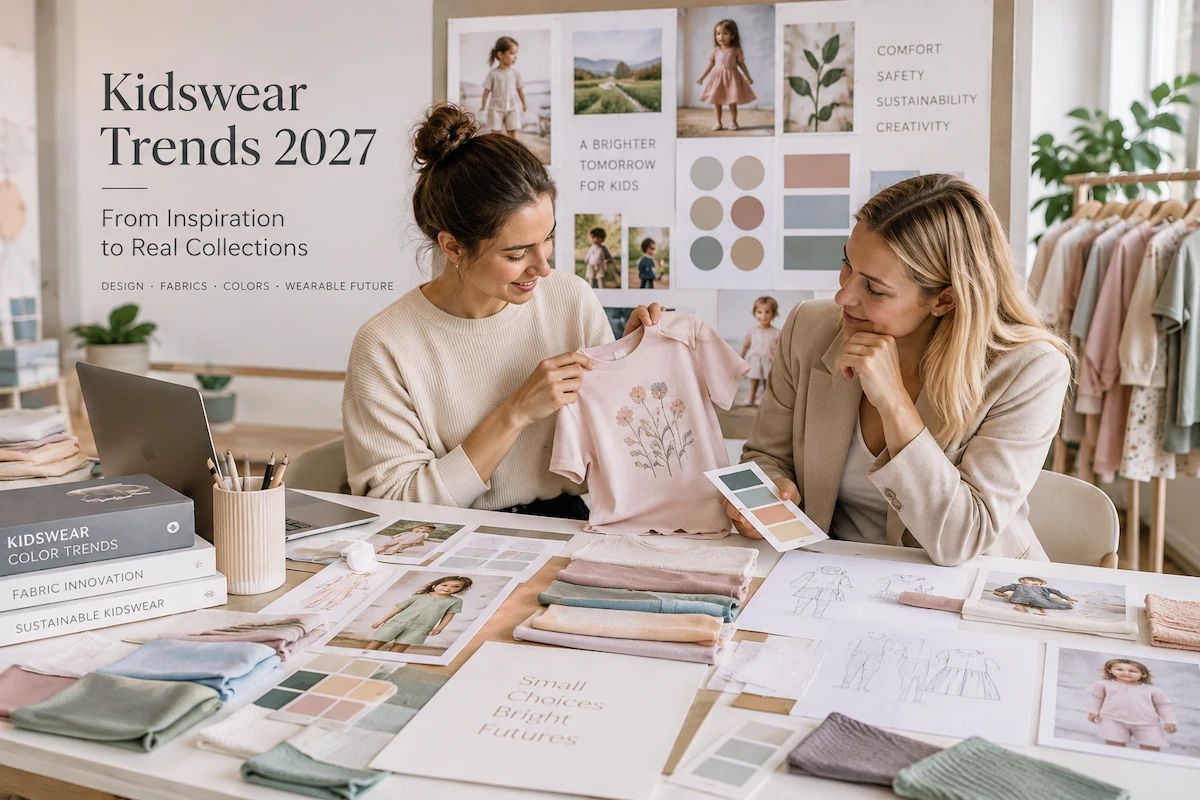
6. Fabric & construction
2027 rewards texture and softness over sheen. Practically, that means slightly higher GSM on main bodies, textured knits reserved for hero styles because of mill minimums, and opacity tested under stretch rather than judged flat.
Fabric and construction are where a season’s direction becomes a purchase order, and where small specification choices show up later as either a reorder or a returns problem.
6.1 Fabric direction
- Softness over sheen. The direction favours brushed, textured and matte surfaces. For a practical comparison of how the common bases behave, our manufacturer’s fabric shortlist covers composition, GSM and stock status side by side.
- Texture carries a minimum. Rib, ottoman and terry-style surfaces usually require a mill minimum run. That makes them right for the main body of one hero style, and wrong when spread thinly across six colourways.
- Higher GSM reads as premium, and costs more. A slightly heavier interlock feels more substantial in the hand, but consumes more yarn per garment. When choosing between a higher GSM and a fancier trim, the GSM usually converts better at retail. The mechanics are explained in what fabric weight in GSM really tells you.
- Test opacity under stretch, not flat. On children’s underwear and light-coloured bottoms, it is stretch that makes a fabric go sheer. The weight that looks opaque on a table is not the weight that holds up on a moving child.
6.2 Construction risk in the 2027 direction
Each of the four higher-risk details fails for a specific, predictable reason:
- Ruffles and gathered trims. The problem is not the ruffle itself; it is what the ruffle does to the edge it is attached to. Neckline recovery, seam bulk and ease of dressing are what actually determine approval — and all three get worse as the gather density increases.
- Bows and ties. As a permanently attached loop near a child’s neckline, this is both a construction and a safety question. A clean-finished flat bow, or a detachable one, solves most of it. Cords and drawstrings on outerwear belong in a separate conversation covered in section 8.
- Embroidery. Reliable on woven and low-stretch panels, less so on fine-gauge knit, where thread density can stiffen the hand-feel and distort the panel. If embroidery is the trend you want, put it where the base can carry it.
- Puff and raised print. Wash durability and hand-feel degradation are the two failure modes, and both get worse as the deposit gets thicker. Keep it on low-stretch, lower-wash-frequency garments. For how print quality is actually measured in bulk, see colourfastness and opacity in bulk kidswear printing.
7. MOQ, cost and lead time
MOQ depends on the manufacturing route, not on a single number. Cost is driven by fabric consumption, component count, custom colour and trim minimums. Lead time runs from approved specification, so the brief arriving late cannot be recovered later in the process.
7.1 What MOQ actually depends on
Buyers often ask for “the MOQ” as if it were a fixed figure. It is a function of route, because a stock-fabric program and a custom-development program consume completely different minimums upstream.
| Route | Minimum | What drives it |
|---|---|---|
| Stock fabric + existing colour | From 2 pcs on selected in-stock styles, colors and sizes, mixable across styles and colours | No dye lot, no fabric development |
| Custom dyeing (Pantone / lab dip) | Reviewed case by case against fabric and colour | Each colour is a separate dye lot |
| Custom fabric development | Quoted separately, per fabric and colour | Mill minimum plus development cycle |
| Baby sizes 50–90 | From 150–300 pcs per color on selected styles | Small-piece cutting and pattern minimums |
| Sleepwear / homewear sets | 1,000 sets per design | Set-based cutting and matching |
The practical consequence for a trend-led range is straightforward: the cheapest way to test a trend is to test it on a base that already exists, in a colour that already exists. Our guide to how low MOQ actually works explains the mechanics, including how styles and colours combine within one minimum.
7.2 What drives the unit cost
Four levers, in order of impact:
- Fabric consumption. Panel count, silhouette volume and the grade spread in your size run all consume fabric. A relaxed silhouette at the top of the size range costs more than the same style in the middle.
- Component count. Every added operation — an extra panel, a pocket bag, a contrast trim — adds labour and QC exposure, not just material.
- Colour and dyeing. Custom colour adds a dye lot; a wider colour range multiplies it. This is the single largest avoidable cost in most trend ranges.
- Trim minimums. Custom jacquard waistbands, custom elastic and non-standard hardware each carry their own minimum, which can exceed the garment minimum on a small order.
For a realistic view of where development money sits before bulk, see what a sample actually costs.
7.3 Lead time, and why it starts earlier than most brands think
Talking about “production lead time” in isolation is misleading, because production is the last and often shortest part of the chain. The realistic sequence from a trend decision to goods in hand runs through design adaptation, specification, sampling, fit revision, approval, bulk production, inspection and freight. Sampling and revision are the parts brands most often underestimate.
The consequence: the question worth asking a factory is not “how fast can you make it?” but “when do you need the brief in hand?” Speed in sampling cannot recover a season that started two months late. For the end-to-end picture, including where the weeks actually go, see our production timeline case study.
8. Market & compliance considerations
For most kidswear, compliance is a documentation exercise. For children’s sleepwear it is a design input: the applicable flammability route in the US can depend on intended use, fit and construction — which means a styling choice can become a compliance choice.
We do not add a compliance section to every trend guide; we add it where the direction creates a real design obligation. For 2027, that means sleepwear and a handful of specific trims.
8.1 Children’s sleepwear
In the United States, children’s sleepwear flammability requirements sit in 16 CFR Part 1615 and 16 CFR Part 1616, and there is a defined route for snug-fitting garments that relies on fit and permanent labelling rather than a chemical finish. The operational meaning is concrete: a loose, flowing silhouette and a snug-fitting silhouette are not two styling options of one product — they can be two different compliance paths. For a brand planning a 2027 sleepwear range around elevated print and soft bases, this is the constraint that should shape the block, not the trim.
8.2 Cords, drawstrings and small parts
The 2027 utility direction invites drawcords, toggles and functional hardware. Where these sit relative to a child’s head and neck, and how they are secured, is a genuine design question rather than a labelling one. The same applies to detachable elements on garments for the youngest sizes. These are not reasons to avoid the trend — they are reasons to decide the intended use and the construction before the styling is locked.
8.3 Labelling and market documentation
Fibre composition labelling, care labelling, language requirements and traceability obligations differ by market, and they are typically resolved at the specification stage rather than the shipping stage. If your range spans several markets, the labelling plan should be part of the tech pack conversation rather than a post-production afterthought.
For the documentation side, see what GB 31701, CPC and OEKO-TEX certification actually mean for kids’ clothing and the kids’ underwear and sleepwear compliance checklist. Sleepwear-specific requirements are covered in which fabrics work for children’s pajamas under flammability rules.
9. Nuohua’s manufacturing view
Most trend-led collections fail in development, not in the market. The fix is to choose the construction before the styling, prototype the two extreme sizes, and accept that the manufacturable version of a trend is usually the simpler one.
Our manufacturing team brings more than 20 years of combined experience in children’s apparel development and production. Note the distinction: Nuohua has been producing under its own name since 2016, while the depth of experience in our development and production team spans considerably longer. Three patterns repeat often enough to be worth stating plainly — and each of them is a place where a 2027 trend can quietly go wrong.
Nuohua manufacturing viewThe detail is rarely the problem; its edge is. A ruffle is straightforward to sew. What decides whether it works at volume is what happens at the neckline once the ruffle is attached — whether the neckline recovers, whether the seam accumulates bulk, and whether a small child can be dressed in it without a struggle. A brand briefing “add a ruffle” and a brand briefing “add a ruffle that does not compromise neckline recovery from 2T to 6T” will receive two different garments and two different approval timelines.
Prototype the extremes, not the middle. Nearly every grading problem we catch late was already visible at the smallest or the largest size in the run. A sample made in the mid-size can look perfect while the smallest size fails on proportion and the largest fails on fabric consumption. Two samples at the extremes cost far less than a revision after cutting.
The simpler construction almost always wins commercially. When a trend can be delivered either through construction or through print, print generally gives a better margin, a lower defect rate and more reliable repetition. Parents judge hand-feel and how a garment survives the wash; nobody counts panels. This is why the 2027 print direction — less coverage, more placement — is commercially favourable rather than a compromise.
One further pattern, specific to trend work: brands that keep one hero trend at full depth and test the rest at small volume outperform brands that spread a season across many shallow styles. A shopper remembers one good garment. A buying account reorders it. Neither happens when every style is a partial bet.
10. Buyer checklist
Before approving a 2027 trend for production, confirm ten things: target market, intended use, fabric and GSM, colour standard, construction detail, testing requirements, MOQ route, sampling plan, bulk timeline, and packaging and labelling.
Work through this list before a trend becomes a purchase order. Every line has cost the industry money when skipped.
- ☐ Target market confirmed, along with the labelling obligations that follow it
- ☐ Intended use stated explicitly — especially whether a garment is positioned as sleepwear
- ☐ Fabric and GSM specified, with opacity and recovery checked under stretch
- ☐ Colour standard set as a Pantone or physical reference, never a screenshot
- ☐ Construction detail written into the tech pack, including how edges are finished
- ☐ Testing requirements identified for the style, size range and market
- ☐ MOQ route chosen — stock fabric or custom development — with colourways priced
- ☐ Sampling plan agreed, including which sizes get prototyped
- ☐ Bulk timeline worked backwards from your launch date, not forwards from approval
- ☐ Packaging and labelling briefed, including care and size labelling for the destination market
If you are earlier in the process — still translating references into a specification — the two useful next reads are how to turn inspiration into a style brief and how to build a tech pack.
11. Related manufacturing guides
This guide covers trend-to-production decisions. The underlying manufacturing knowledge — fabric behaviour, colour approval, quality control, compliance and costing — is covered in the guides below.
2027 trend cluster
- Baby apparel trends 2027
- Kids pajama trends 2027 & US sleepwear safety
- Kidswear colour trends 2027
- Kidswear fabric trends 2027
- Which 2027 trends are worth producing in bulk
Fabric and material
- The kids’ underwear fabric shortlist: a manufacturer’s practical guide
- Reading fabric weight: what GSM really tells you
- Interlock vs jersey knit for kids’ bodysuits
- Fabric opacity, density and colour in kids’ underwear
Colour and print
- From swatch to shipment: controlling colour and hand-feel
- Holding the colour line: shade bands and batch consistency
- Keeping prints true: colourfastness and opacity in bulk kidswear
Cost, quantity and timeline
- Low MOQ kids’ underwear manufacturing: how ready stock from 2 pcs works
- How much does a kids’ underwear sample cost?
- From tech pack to bulk delivery: a production timeline case study
- Kids’ clothing brand startup cost: full budget breakdown
Quality and compliance
- Garment AQL inspection explained
- Why kids’ underwear fails QC: a field guide to defects
- Kids’ clothing safety certifications: GB 31701, CPC and OEKO-TEX
- Kids’ underwear and sleepwear compliance checklist
Design to specification
- From Pinterest to production: how to turn inspiration into a style brief
- How to create a tech pack for kids’ underwear and sleepwear
- US kidswear trends 2026 — the previous season’s picture
12. Turn the trend into a production plan
Send a reference image, product brief or tech pack, plus your product category, size range, quantity and target market. We will assess fabric, construction and MOQ route before you commit to sampling.
A trend becomes commercially useful at the moment someone works out whether it can be made — repeatedly, in your size range, at a quantity that makes sense for a first order. That assessment is the part we can do before you spend money on sampling. Send us what you have, even if it is only a reference image and a rough idea of the size range.
Ready to turn a 2027 kidswear trend into a production plan?
Send your reference images, product brief or tech pack, with your target market. We will come back with the fabric options, construction notes and MOQ route that fit the project.
Or explore our kidswear manufacturing capabilities.
Nuohua Garment is a kidswear OEM/ODM manufacturer producing children’s underwear, sleepwear, baby apparel and custom kidswear for brands, retailers and wholesalers, with an 8,000 m² production base in Guangdong, China. Feasibility ratings in this guide are Nuohua’s buyer-side assessment based on our own production experience and are not an industry standard. Standards referenced as of 2026-09; regulations change — confirm requirements for your market and product before ordering.