

2027 Kidswear Trends in Europe: What Buyers Should Watch
Europe is not one market. It is a set of national markets that share a regulatory floor and disagree about almost everything above it — palette, fit, price, and how much a parent expects a garment to survive. A 2027 range built for “Europe” as a single idea usually ends up selling in one country and sitting in a warehouse in another.
This is a production-side reading of 2027 European kidswear trends. It follows the same structure as the wider 2027 cluster and treats the European angle as two questions: which direction lands per market, and what has to change in the tech pack before the garment can legally be sold there. It is written for brand founders, designers and buying teams sourcing from overseas who need their first EU range to clear labelling and documentation scrutiny, not just the buyer presentation.
On this page
- What is the European trend direction?
- Why does it matter in Europe?
- Which products should European buyers produce differently?
- What should buyers change in the tech pack?
- Production feasibility
- Fabric & construction
- MOQ, cost and lead time
- EU market & compliance considerations
- Nuohua’s 20-year manufacturing view
- Buyer checklist
- Related manufacturing guides
- Turn the trend into a production plan
Back to the 2027 kidswear trends overview — the European reading is one of four market lenses in this cluster.
1. What is the European trend direction?
Four directions are landing in Europe for 2027: durability-led everydaywear, where construction and repair-friendliness are part of the product story; a restrained natural palette built on undyed and earthy tones rather than brights; relaxed gender-neutral styling with functional, adjustable construction; and soft outdoor-influenced daywear for the shoulder seasons. The European-specific twist is that these directions are judged on longevity and material honesty, not on novelty.
What makes Europe different is not the styling — it is the buyer’s assumption about time. European buying teams model a garment over more wears and more owners than most other markets. A design that looks current for a season but cannot hold its shape for a year reads as poor value, and value is the argument the mid-market runs on.
| Direction | What it looks like in a garment | What European production demands |
|---|---|---|
| Durability-led everydaywear | Reinforced knees and elbows, flat-felled or covered seams, generous seam allowances, replaceable trims | Construction that survives repeated washing at the care condition on the label — not one cycle |
| Restrained natural palette | Undyed and earthy tones, tonal layering, one accent instead of a bright story | Colour consistency across a narrow tonal range, which is easier to approve and harder to get visibly right |
| Relaxed gender-neutral styling | Straight cuts, dropped shoulders, shared blocks across the range, adjustable waists | A block that genuinely works across the size run, rather than a unisex label on an adapted boys’ or girls’ pattern |
| Soft outdoor daywear | Knit outer layers, brushed back sweatshirting, wind-resistant woven overlays, zip-front styles | Stable knit bases and hardware selected for the age band it is sold into |
The commercially strongest position for a first EU range is a narrow, deep assortment: fewer styles, more sizes and more colour coverage per style, on two shared fabric platforms. European wholesale generally rewards depth over breadth because it reduces the number of reorders a retailer has to place to keep a size run complete.
2. Why does it matter in Europe?
Four forces: European consumers increasingly treat longevity as the sustainability claim they trust; national extended-producer-responsibility and waste-reduction frameworks are pushing brands toward fewer, better-documented products; buyers now expect traceable supply-chain documentation as routine rather than on request; and the EU market’s labelling and substance rules apply per selling country and per language, which rewards ranges that are specified once and labelled deliberately.
Market signalWe read the European direction from the same four source types we use across this cluster: colour and material forecasting services, European retail and wholesale assortments, sector trade media and seasonal buying briefings, and Nuohua’s own sampling and production data on EU-bound orders. No single source is a conclusion — and none of them tells you whether a direction is producible at your price point.
Nuohua manufacturing viewA European range only becomes a plan once it answers the second question: can it be produced repeatedly, in the full size run, at a quantity that makes commercial sense, and does it carry the documentation and labelling the destination market expects — in the right language?
- Longevity replaced the eco-label as the selling argument. Brand-side messaging in Europe has moved toward durability, repairability and resale value. That puts pressure on construction quality: a garment whose seams or waistband fail early undermines the claim regardless of what the fabric is made of.
- Documentation became routine. Component and material information now gets requested as part of normal onboarding rather than in a crisis. Factories that can produce a coherent documentation pack are a shorter route to a purchase order.
- National fragmentation is real. The palette, the price point, the fit preference and even the acceptable care instruction differ between Germany, France, the Netherlands, Italy, Spain, Poland and the Nordics. A single “European” range is usually a single-country range with extra freight cost.
- Language is a production input. Where a label must be readable in the language of the country of sale, the number of languages is decided before the label is ordered — not at the warehouse.
3. Which products should European buyers produce differently?
Produce: knit and sweatshirt layering, straight-cut everyday separates, adjustable-waist bottoms, tonal and undyed-looking basics, and gender-neutral blocks shared across the range. Review carefully before producing: a heavy print story across many colourways, fast-fashion-sized assortments with shallow size coverage, narrow care instructions that the fabric cannot hold, and any label built around a single language for a multi-country launch.
| Produce this | Review before producing | Why |
|---|---|---|
| Depth per style: more sizes, fewer styles | Breadth per style: many prints, thin size coverage | European wholesale reorders by size run; a thin run forces the retailer to place several orders to keep a shelf complete |
| Shared gender-neutral blocks across the range | A unisex label applied to an adapted boys’ or girls’ block | Shoulder slope and waist placement differ; a relabelled block produces fit complaints in the larger sizes |
| Adjustable waists and grown-on openings on bottoms | Fixed waists with no adjustment range | Adjustability extends the useful life of the garment and supports the durability story |
| Narrow tonal palette with one accent | Multi-colour print assortment across several bases | Registration drift and shade variation are far more visible in a tonal range |
| Brushed-back sweatshirting and knit outer layers | Heavy surface decoration on fine-gauge knit | Dense decoration produces needle marks and stiffness on fine-gauge knit |
| Multi-language label designed once, ordered once | Language added per order, later | The label is a printed component; changing languages late means reprinting and a new approval cycle |
| Construction that holds the printed wash condition | A care instruction chosen for marketing rather than for fabric performance | The wash condition on the label is the condition the garment must survive — including stitch and trim behaviour |
The most common European range mistake we see is treating the multi-country launch as a labelling task. It is a product decision: each additional language is a label component, each additional country can mean an additional documentation route, and each additional colour adds a lab-dip approval. Ranges that plan for three countries from the start cost less than ranges that add the second country after the label is printed.
4. What should buyers change in the tech pack?
Five changes: name the countries of sale and their required label languages; fix the care instruction before fabric approval and treat it as the wash-test condition; specify fibre composition to the naming the regulation uses, not a marketing description; state the intended end-use so the nightwear question is answered on paper; and add a documentation line to the pack covering the material and component information the buyer will be asked for.
| Change | Current practice | Change to | Why |
|---|---|---|---|
| Countries of sale | Left open until launch | Named on the tech pack, with the label languages each one requires | Label languages, documentation and even care instructions differ by country |
| Fibre composition wording | A descriptive or commercial name | The fibre name as defined in the applicable textile naming rules | Composition wording on the label is a regulated statement, not a copy decision |
| Care instruction | Decided after fabric approval | Fixed before fabric approval and used as the wash-test condition | Shrinkage, colourfastness and trim behaviour are only meaningful against a defined condition |
| Intended end-use | Implied by the style name | Written: daywear, or nightwear | The nightwear question has its own standards framework and is not answered by the label alone |
| Documentation | Collected reactively when a buyer asks | A defined documentation line in the pack, covering material and component information | Buyer onboarding asks for it as routine; assembling it after the order is slower than specifying it before |
Of these, the fibre-composition wording causes the most avoidable rework, because it sits at the intersection of marketing and regulation. A name that reads well in a product description is not always the name the label is required to carry — and the label is what an inspector or a buyer’s compliance team checks. Our guide to EU fibre label checks covers where this goes wrong in practice.

5. Production feasibility
Feasibility is high for knit and sweatshirt layering, cotton-spandex everyday bases and simple straight-cut separates, and medium-high for wash-heavy constructions once the care condition is fixed. It drops when the range mixes many fabric platforms, when the tonal palette is spread across many dye lots, or when a care instruction is specified for marketing reasons rather than fabric performance. The recurring European risks are shrinkage against the label, shade variation across a tonal range, and trim behaviour at the printed wash condition.
Seven checks we run before sampling on an EU-bound range:
- Countries and languages. Which countries of sale, and therefore which label languages, must the label component carry?
- Care condition as the test condition. Has the wash test been run at the exact condition printed on the label?
- Tonal shade control. In a narrow tonal range, does the shade band tolerance actually cover the range, or will the middle tones look different from each other?
- Trim behaviour. Does the trim shrink at the same rate as the base under the printed care condition?
- Block integrity. If the style is sold as gender-neutral, was it developed on a shared block rather than relabelled?
- Hardware and cords. Is there any cord, tie or functional string on the garment, and has the applicable cords and drawstrings standard been checked for the specific garment category?
- Documentation readiness. Can the material and component information be produced before the buyer asks for it?
| Element | Feasibility | Note |
|---|---|---|
| Knit and sweatshirt layering, brushed-back styles | High | Stable bases, few trims, strong depth-per-style potential |
| Cotton-spandex everyday separates | High | Standard production; care-condition discipline is the main control point |
| Straight-cut adjustable-waist bottoms | Medium-High | Adjustment hardware must be specified and age-appropriate |
| Tonal range across several dye lots | Medium | Shade variation is more visible between close tones than between contrasting ones |
| Multi-platform range (three or more bases) | Medium | Each platform is a separate wash test, shrinkage behaviour and approval |
| Multi-language label across a multi-country launch | Medium | Manageable when designed once; expensive when added per order |
| Care instruction chosen for marketing rather than fibre performance | Not recommended | The label defines the test condition; a claim the fabric cannot meet becomes a returns problem |
6. Fabric & construction
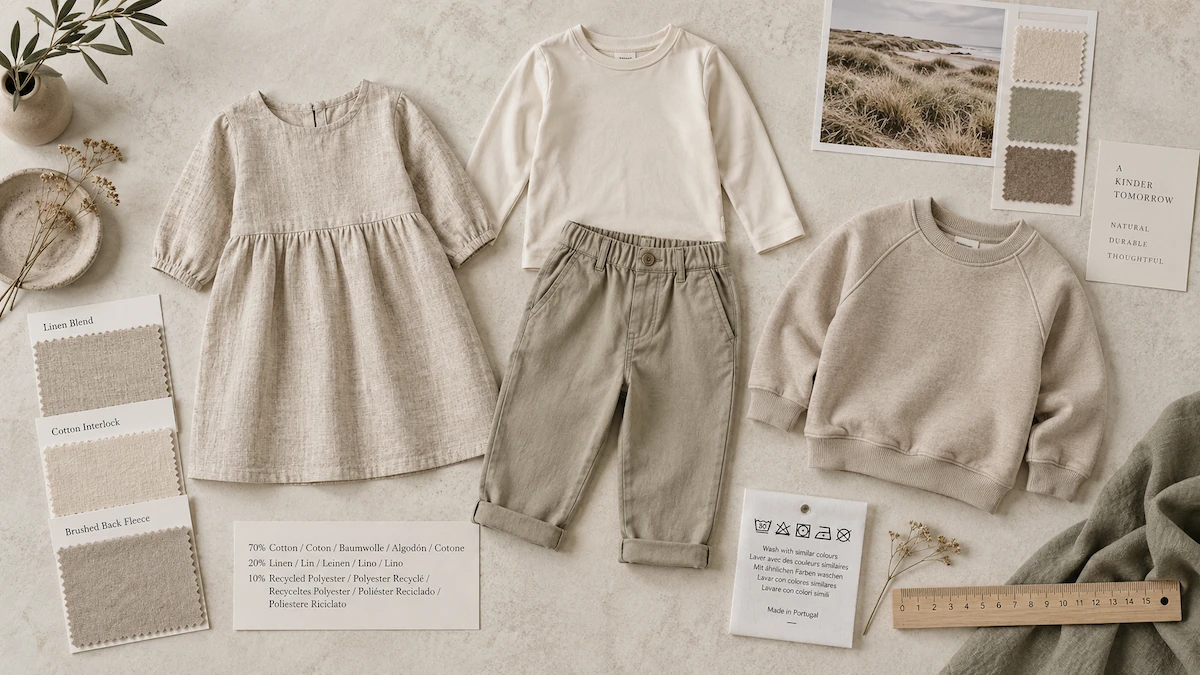
The 2027 European base is built on cotton and cotton-rich knits, brushed-back sweatshirting and loopback terry for layering, and plain-weave wovens for straightforward daywear. Linen and linen-blend interest is real but seasonal and less forgiving to produce at volume. Bamboo viscose and modal have a place in the premium tier where the care instruction supports them. The failure modes are shrinkage and distortion against the printed care condition, shade variation across tonal ranges, and trim or interlining behaviour that differs from the base.
Fabric direction. Cotton interlock and single jersey remain the safest platforms for a first EU range because their behaviour under a defined wash condition is predictable and their hand feel is what the mid-market expects. Brushed-back sweatshirting carries the soft outdoor direction, but brushing depth has to be specified — otherwise the same style produced twice will not feel the same twice. Loopback terry is more durable and slightly less soft, which suits the longevity argument. Linen blends offer the natural-palette story but bring creasing, which conflicts with a care instruction that implies a neat finish. We cover base behaviour in our fabric weight guide and the premium fibre trade-offs in our modal versus cotton comparison and bamboo fabric guide; this article only states which base fits which European direction.
Construction and failure modes
- Shrinkage against the care label. In a market that models a garment over many washes, this is the defect that most directly contradicts the durability claim. Pre-shrunk fabric plus a wash test at the printed condition is the only reliable pair of controls.
- Shade variation in a tonal range. Close tones expose dye-lot variation that a high-contrast range hides. Confirm the shade band tolerance covers the range before bulk, not at inspection.
- Brushing depth inconsistency. Brushed-back knits are specified by feel, not by number. Without a defined brushing depth and a reference swatch, the same article number arrives softer one order and flatter the next.
- Trim and interlining behaviour. Fusible interlinings and narrow trims are the components most likely to fail at the printed wash condition. Validate them with the base, in the assembled garment.
- Adjustable hardware. Waist adjusters, press studs and zip pulls on garments sold for younger children need a defined attachment strength; the attachment is the risk, not the fitting.
- Seam choice and the durability story. Flat-felled and covered seams support the longevity argument; overlocked edges on a visible surface undercut it. Our bound versus flatlock seam guide sets out how each behaves.
7. MOQ, cost and lead time
EU-facing ranges are usually built on From 150–300 pcs per color on selected styles, depending on fabric, size range and customization requirements, mixable across styles and colours. Custom dyeing is reviewed case by case; MOQ is confirmed after reviewing fabric composition, GSM, yarn count, size range, artwork, print method, construction and other customization requirements. Cost is driven by fabric platform count, number of label languages, colour and shade coverage, and trim specification. Lead time is driven by lab-dip approval, label printing and the number of countries the range has to be documented for.
| Route | MOQ |
|---|---|
| Stock fabric + existing colour | From 2 pcs on selected in-stock styles, colors and sizes (styles, colors and sizes mixable) |
| Custom dye (Pantone / lab dip) | Reviewed based on fabric and colour |
| Custom fabric development | Quoted separately, per fabric and colour |
| Sleepwear and loungewear sets | From 1,000 sets per design |
| Baby sizes 50–90 (set programmes) | From 150–300 pcs per color on selected styles |
Five cost levers, in the order they usually move an EU price:
- Fabric platform count. Two platforms instead of five cuts testing, approval steps and minimum-quantity exposure in one decision.
- Number of label languages. A multi-language label printed once costs little more than a single-language label; a label reprinted per country costs a great deal more than either.
- Colour and shade coverage. Depth across a narrow tonal range is cheaper than breadth across many unrelated colours, because it concentrates approval work into fewer dye lots.
- Trim count and specification. Every trim is a separately sourced component with its own wash behaviour and its own approval.
- Depth versus breadth in the assortment. Fewer styles with fuller size coverage reduce reorder friction for the retailer, which is a commercial advantage rather than only a cost one.
Lead-time chain: fabric sourcing → lab dip (if custom colour) → prototype → fit and construction approval → label artwork and printing → pre-production sample → bulk → QC → freight. For an EU range, the two steps that most often push a launch date are lab-dip approval on a tonal range and label artwork sign-off once several languages are involved. Both should be scheduled rather than absorbed. Our production timeline case study walks through the sequence, and our swatch, lab dip and bulk approval guide covers the colour-approval stages.
8. EU market & compliance considerations
Four instruments decide most EU kidswear questions. REACH Annex XVII restricts substances including azo colourants (entry 43, tested under the EN ISO 14362 series) and formaldehyde in certain textile articles (entry 23). Regulation (EU) No 1007/2011 governs textile fibre names, composition and labelling, including language requirements for the country of sale. GPSR (EU) 2023/988 sets general product safety duties including traceability and technical documentation. EN 14682 covers cords and drawstrings on children’s clothing, and EN 14878 together with EN 1103 addresses children’s nightwear burning behaviour.
Substance restrictions. REACH Annex XVII entry 43 restricts azo colourants that can release listed aromatic amines above defined limits, with testing carried out under the EN ISO 14362 series. It applies to dyed and printed components, not only to the main fabric — which is why trims, threads and prints belong in the same conversation. Entry 23 restricts formaldehyde in certain textile articles, with different limits depending on the article and its closeness of contact, and testing under the EN ISO 14184 series. Both are Annex XVII entries: they attach to the article, and the evidence trail has to be assembled from the supply chain rather than asserted. Our guide to azo dyes and heavy metal testing covers where this is usually checked.
Fibre labelling. Regulation (EU) No 1007/2011 sets the permitted fibre names, the composition statement and the durability and legibility requirements for the label, and it requires that the information be provided in the official language or languages of the member state where the product is sold. Two practical consequences: the fibre name on the label is a regulated term rather than a marketing choice, and the number of languages is a labelling decision made at the tech-pack stage. Our guide to EU fibre label checks covers the checks buyers run.
General product safety. GPSR (EU) 2023/988 governs the general safety obligation for consumer products placed on the EU market. For a non-EU manufacturer and a brand selling into the EU, the operative points are traceability — being able to identify the economic operator and the product through the supply chain — and having technical documentation that can be produced on request. This is a documentation discipline that runs alongside the product itself; it is not satisfied by a certificate for the fabric.
Cords and drawstrings. EN 14682 covers cords and drawstrings on children’s clothing and applies by garment category and age band, not as a blanket prohibition. Decorative ties, functional hood cords and waist drawstrings are treated differently, and the applicability depends on the specific garment. The correct sequence is: identify the garment category, then the age band, then the cord type — and confirm the outcome rather than generalising from another style.
Nightwear. If a style is intended for sleep, it moves out of the general daywear framing. EN 14878 addresses the burning behaviour of children’s nightwear, and EN 1103 addresses the burning behaviour of fabrics for apparel, with the applicable method dependent on the product. The decision is made by intended use on the tech pack, exactly as with the US sleepwear route. Our pajama and sleepwear trends guide covers the construction and fit implications.
9. Nuohua’s 20-year manufacturing view
Two decades in children’s apparel tell us that EU ranges fail on the care condition and the label, not on styling. Fix the wash condition before fabric approval, design the label component for every country you intend to sell in, and consolidate the fabric platforms — then the durability story has something to stand on.
- The care instruction is a specification, not a label. The condition printed on the garment becomes the condition the fabric, the stitch, the trim and the interlining must survive. We have seen ranges choose a gentle wash instruction for marketing reasons and then discover that a fusible interlining cannot hold it. Fix the instruction first, then approve the fabric against it.
- Close tones are harder than contrasting ones. A tonal European palette looks simpler to produce and is not. Two adjacent greys or two adjacent earth tones make dye-lot variation visible in a way a bright print never does. Narrow ranges need a tighter shade band, agreed before bulk.
- Depth beats breadth in European wholesale. The strongest EU ranges we produce carry more size coverage per style and fewer styles overall. It reduces reorder friction for the retailer and reduces minimum-quantity exposure for the brand.
- The label is a component like any other. It is printed, it has a lead time, it has an approval step, and it cannot be changed cheaply after it is ordered. Ranges that treat it as a component plan it correctly; ranges that treat it as stationery discover the cost at the worst moment.
One question we would reframe. “Which 2027 direction sells in Europe?” is the wrong first question. The right first question is “which direction can this range carry at this price, in this size run, at the wash condition we intend to print, and in the countries we intend to sell?” — because a garment that cannot be labelled for its market is not yet a product.
10. Buyer checklist
Eleven checks before briefing a 2027 EU range: countries of sale named, label languages fixed, care instruction set before fabric approval, fibre names taken from the regulated naming rules, end-use stated for the nightwear question, tonal shade band tolerance agreed, trims and interlinings wash-tested with the base, fabric platforms consolidated, documentation ready, cord and drawstring applicability confirmed by garment category, and lead time mapped backwards from launch.
- Are the countries of sale named, and is the required label language set fixed for each?
- Has the label component been designed once for all countries rather than added per order?
- Is the care instruction fixed before fabric approval, and is the wash test run at that exact condition?
- Does the fibre composition wording use the names defined in the applicable textile naming rules?
- Is the intended end-use stated on the tech pack, so the nightwear question is answered on paper?
- For a tonal range, has the shade band tolerance been agreed against the actual range?
- Have trims, threads and interlinings been wash-tested together with the base?
- Has the range been consolidated onto as few fabric platforms as the design allows?
- Can material and component documentation be produced before the buyer asks?
- For any cord, tie or functional string, has the applicable cords and drawstrings standard been confirmed for the specific garment category and age band?
- Is the lead-time chain mapped backwards from launch, including lab-dip approval and label printing?
11. Related manufacturing guides
12. Turn the trend into a production plan
Turn the 2027 European direction into a range that is label-ready per market.
Send us your reference images, the countries you intend to sell in and your target price point. We will return a feasibility read on fabric platform, wash condition and shade control, plus the labelling and documentation questions that need answering before sampling.
Or reply with your tech pack — see our tech pack guide.
Standards verified as of 2026-09; regulations change — confirm with a qualified laboratory or qualified counsel before ordering. This article is a Nuohua buyer-side assessment, not compliance advice or an industry standard. Nuohua Garment — kidswear OEM & ODM manufacturer since 2016.